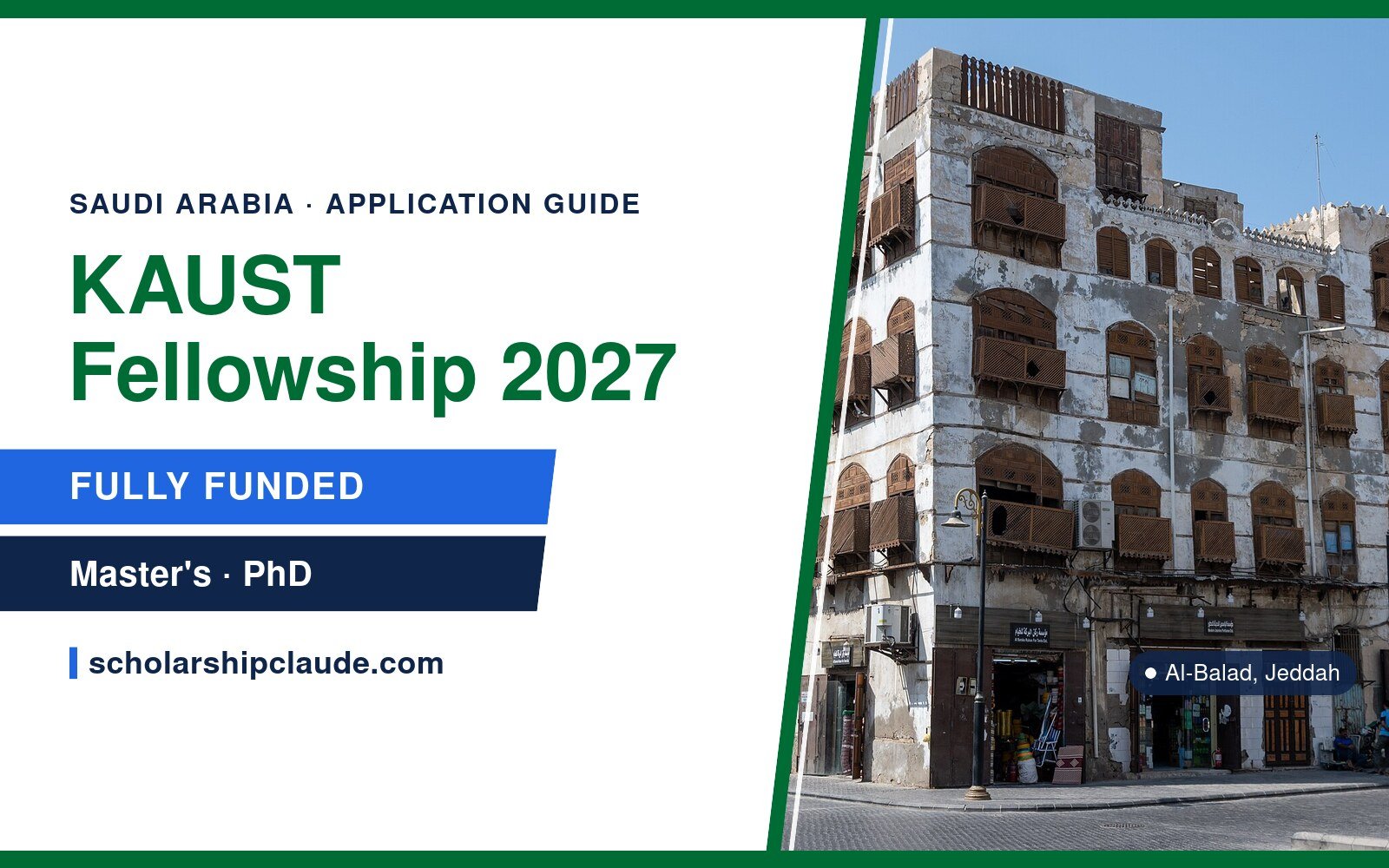
King Abdullah University of Science and Technology (KAUST) is a graduate research university on the Red Sea coast of Saudi Arabia. Every student admitted to a KAUST master’s or PhD programme automatically receives the KAUST Fellowship, which covers tuition, housing, a living stipend and medical care. There is no separate scholarship form and no application fee. Applications for Fall 2027 close on 3 January 2027.
This guide explains what the fellowship covers, who can apply, the documents, how KAUST reviews applications and how to apply step by step. KAUST describes its dates as tentative, so confirm them on its website. It was last checked on 4 October 2026.
KAUST Fellowship 2027 at a glance
| Host country | Saudi Arabia |
|---|---|
| University | King Abdullah University of Science and Technology |
| Study levels | MS, MS/PhD and PhD |
| Funding | Fully funded |
| Who can apply | All nationalities |
| Application fee | None |
| Deadline | 3 January 2027 |
| Decisions expected | Around 14 February 2027 |
| Classes start | 29 August 2027 |
What is the KAUST Fellowship?
KAUST teaches only graduate students, in science and engineering, and all of them are funded. Being admitted and being awarded the fellowship are the same decision, so your admission application is the only application you make.
What does the KAUST Fellowship cover?
The fellowship covers full tuition, a monthly living stipend, free housing on campus, medical and dental coverage, and support with relocation, visa and travel. Every admitted student receives it, so there is no competition for funding after admission. KAUST does not state the stipend figure on the page we checked. Look for the current amount on KAUST’s admissions website before you compare offers.
Who can apply?
- You hold a bachelor’s degree for the MS, or a master’s degree for the PhD, in a relevant science or engineering field.
- You have a strong academic record.
- You can show English proficiency with TOEFL or IELTS, unless you are exempt.
- You meet the entry requirements of the programme you choose.
Documents you need
- Online application form
- Academic transcripts and degree certificates
- CV
- Statement of purpose
- Recommendation letters. Referees can submit within seven days after the deadline.
- English test results
How KAUST reviews applications
KAUST says it takes a holistic view of each application. It considers academic achievements together with personal qualities such as motivation and potential impact in the scientific community. Grades matter, but they are not the only measure.
KAUST Fall 2027 timeline
| 28 September 2026 | Application round opened |
|---|---|
| 3 January 2027 | Application deadline |
| Within 7 days after the deadline | Referees submit recommendation letters |
| Around 14 February 2027 | Decisions expected |
| 29 August 2027 | Classes start |
How to apply to KAUST, step by step
- Choose your programme and degree: MS, MS/PhD or PhD.
- Create an account on the KAUST application portal.
- Write your statement of purpose. Explain your research interests and why KAUST fits them.
- Upload your transcripts, CV and English test results.
- Enter your referees and make sure they submit on time.
- Submit by 3 January 2027.
Tips to strengthen your application
- Explain why you want to do research, not only what you have studied.
- Show potential impact with projects, publications or competitions.
- Name the research areas at KAUST that match your background.
- Choose referees who supervised your research or project work.
Common mistakes to avoid
- A statement of purpose that could be sent to any university.
- Relying on grades alone.
- Choosing a programme that does not match your earlier degree.
- Referees who miss the seven-day window.
Is the KAUST Fellowship right for you?
It suits you if:
- your degree is in science, engineering, mathematics or computing;
- you want a research-based master’s or PhD taught in English;
- you want every main cost covered, including housing on campus;
- you are happy to live in a university community on the Red Sea coast.
Look elsewhere if:
- your field is in the humanities, business, law or clinical medicine;
- you want a taught degree with no research;
- you want a wider choice of Saudi universities and subjects, in which case see our guide to Saudi government scholarships.
Which degree should you apply for?
- MS: for bachelor’s graduates who want a master’s degree, with a thesis or coursework route depending on the programme.
- MS/PhD: for bachelor’s graduates who already know they want a doctorate. You enter the master’s and continue to the PhD.
- PhD: for applicants who hold a master’s degree in a relevant field.
Choose the programme closest to your previous degree. Admissions committees look for the academic preparation that the programme needs, such as mathematics for computing or laboratory experience for the biosciences.
How to write the KAUST statement of purpose
KAUST reviews each application as a whole and looks at motivation and potential impact as well as grades. The statement is where you show both. Structure it in four parts:
- Your academic path: your degree, your strongest areas and the research or project work you have done.
- Your research interests: the specific problems you want to work on. Name areas, not just a department.
- Why KAUST: research centres, facilities or faculty whose work matches your interests. Read their recent papers first.
- Your goals: what you plan to do after the degree and why it matters.
Be concrete. A sentence about a method you used and what you found says more than a paragraph about your passion for science. Our statement of purpose guide gives a structure.
Recommendation letters and test scores
- Recommendation letters: choose professors or supervisors who know your research or project work. Your referees can submit up to seven days after the application deadline, but ask them at least a month before. See how to get strong recommendation letters.
- English test: KAUST asks for TOEFL or IELTS unless you are exempt. Check the exemption rules, and book the test early if you need one.
- Transcripts: upload official transcripts for every degree, with the grading scale.
Should you contact faculty before applying?
It is not required, but it helps PhD applicants. A short email to a professor whose work matches yours, with your CV and a few lines on your interests, can tell you whether the group is taking students. Keep it brief and specific. Our guide on how to email professors has a template. Do not send the same message to many professors at once.
A preparation plan
- October: choose your programme and degree, and read faculty and research centre pages.
- Early November: ask your referees and book your English test if you need one.
- Late November: draft your statement of purpose and update your CV.
- December: create your account, upload your documents and enter your referees.
- By 3 January 2027: submit, then check that your referees send their letters within seven days.
After you apply
KAUST reviews applications after the deadline, and some applicants are invited to an online interview with faculty. Decisions for Fall 2027 are expected around 14 February 2027. If you are admitted, KAUST guides you through the visa process and your travel, and classes start on 29 August 2027.
Living at KAUST
KAUST is a self-contained campus community at Thuwal, north of Jeddah. Students live in university housing, and the campus has shops, sports facilities, schools and a health centre. English is the working language of the university. Because housing and medical cover are provided, the stipend is mainly for food, personal costs and travel.
How KAUST compares with other funded options
KAUST is unusual because funding comes with admission, the application is free and the whole process takes about six weeks from deadline to decision. Government scholarships such as the CSC Scholarship or the GKS Scholarship take months longer and include a language year. Research institutes such as GIST also fund their graduate students, but with smaller allowances and an application fee. Many applicants apply to KAUST alongside one or two of these, since the documents are similar.
If you are not admitted
KAUST has an application round each year, and you can apply again. Before you do, strengthen the part of your profile that was weakest. That may be research experience, such as a project, an internship or a paper. It may be your English score, or a statement that did not name clear research interests. Summer research internships, including the ones KAUST itself runs, are a good way to build experience and to get a recommendation letter from a research supervisor.
Final checklist before you submit
- Your programme matches your previous degree.
- You selected the right degree: MS, MS/PhD or PhD.
- Your statement of purpose names specific research interests.
- Your transcripts and CV are uploaded.
- Your English test result is attached, or you qualify for an exemption.
- Your referees are entered and know about the seven-day window.
- You submitted by 3 January 2027.
Frequently asked questions
Is IELTS required for KAUST?
KAUST asks for TOEFL or IELTS unless you are exempt. Check the exemption rules on its admissions pages.
Is there an application fee?
No.
Do I apply separately for the fellowship?
No. Every admitted student receives it automatically.
Can I apply with a bachelor’s degree?
Yes, for the MS and the MS/PhD.
When will I hear back?
Decisions are expected around 14 February 2027.
Where to apply
Apply on the official KAUST application portal. See our KAUST Fellowship page for the full details, and our guide to Saudi government scholarships for other universities in Saudi Arabia.
Related scholarships: funding, stipend and deadlines
| Scholarship | Funding | Stipend | Deadline |
|---|---|---|---|
| KAUST Fellowship 2027 in Saudi Arabia | Fully funded | Living allowance of 20,000 to 30,000 US dollars a year, depending on qualifications and progress | 3 Jan 2027 |
| King Abdulaziz University Scholarship 2027 in Saudi Arabia | Fully funded | See the scholarship page | Varies |
| Saudi Arabia Government Scholarships 2027 | Partial | See the scholarship page | Varies |
This list updates itself from our scholarships page. Stipend figures are shown where the provider publishes them. See all scholarships.


