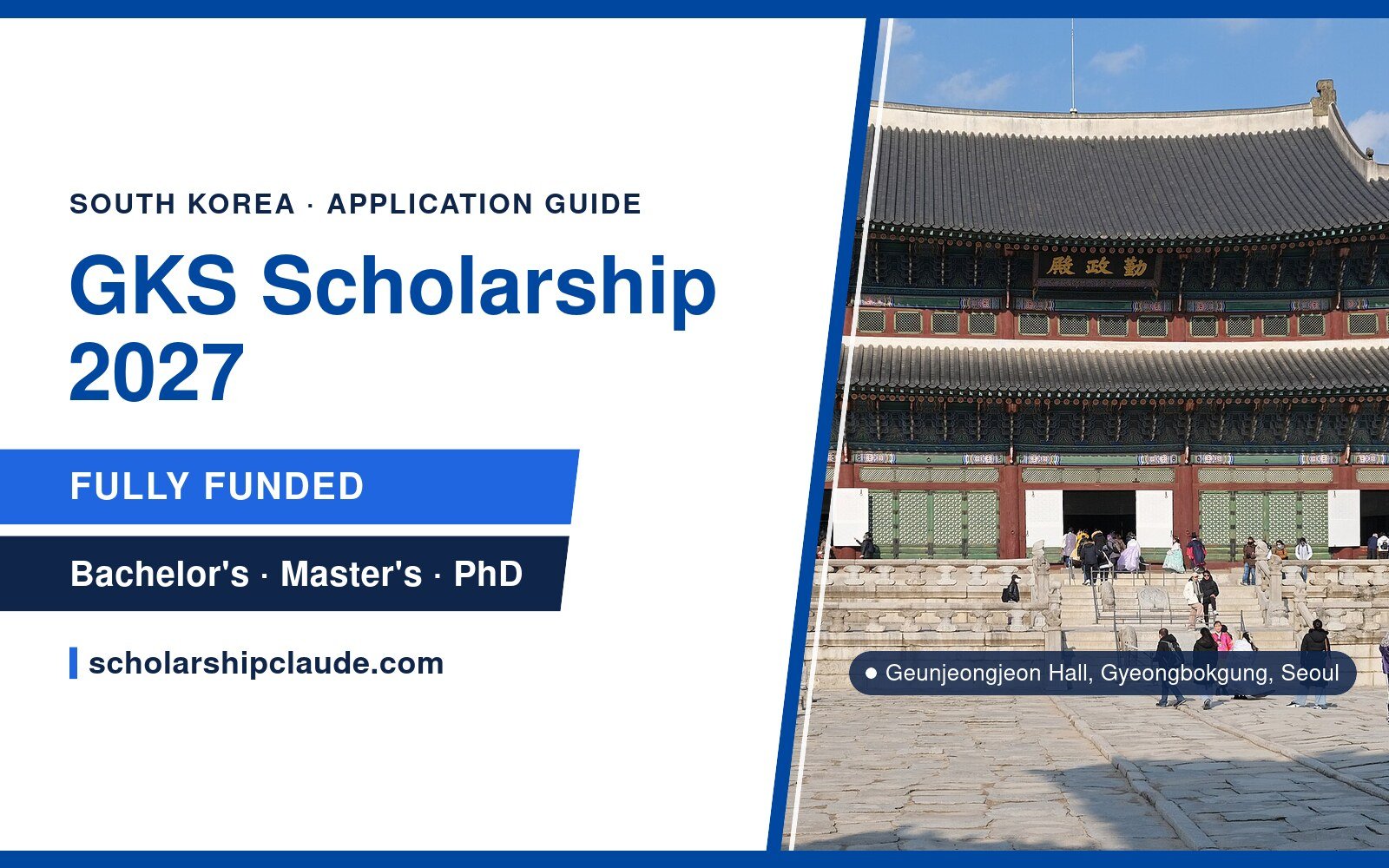
The Global Korea Scholarship (GKS) is the Korean government’s scholarship for international students. The graduate programme funds a master’s or PhD at a Korean university, usually after one year of Korean language training. It is run by the National Institute for International Education (NIIED). The 2027 guidelines are expected in February 2027.
This guide explains the two application tracks, what GKS pays for, who can apply, the documents, the selection rounds and how to apply step by step. Dates for 2027 are estimates based on the 2026 cycle. It was last checked on 4 October 2026.
GKS Scholarship 2027 at a glance
| Host country | South Korea |
|---|---|
| Run by | NIIED, Korean Ministry of Education |
| Study levels | Master’s and PhD |
| Funding | Fully funded |
| Who can apply | Citizens of GKS partner countries without Korean citizenship |
| Age limit | Under 40 |
| Guidelines expected | February 2027 |
| Duration | Master’s 2 years or PhD 3 years, plus 1 year of Korean language |
Embassy track or university track?
You apply through one of two tracks, and the choice affects everything else:
- Embassy track: you apply through the Korean embassy in your country and can choose up to three universities.
- University track: you apply directly to one Korean university.
Read the guidelines for your track carefully, because each embassy and university can set its own submission rules.
What does GKS cover?
- Round-trip airfare
- Full tuition
- A monthly living allowance
- A settlement allowance on arrival
- Korean language training
- Medical insurance and research support
Who can apply?
- You are a citizen of a GKS partner country and do not hold Korean citizenship.
- You are under 40 years old.
- You hold a bachelor’s degree for a master’s, or a master’s degree for a PhD. Final-year students can apply if they graduate before the date in the guidelines.
- Your cumulative grades are at least 80%, or the equivalent set in the guidelines.
- You are in good health.
Documents you need
- GKS application form
- Personal statement
- Study plan
- Recommendation letters
- Degree certificates and transcripts, apostilled or confirmed by the consulate
- Passport copy and health certificate
- TOPIK, IELTS or TOEFL scores, if you have them
Authenticating documents takes weeks in many countries. Start as soon as you decide to apply.
How GKS selects scholars
- First round: the embassy or the university screens documents and interviews shortlisted applicants.
- Second round: NIIED evaluates the applicants who passed the first round.
- Third round, embassy track only: the universities you chose review your application.
- Final results: NIIED announces the successful candidates.
Timeline: what happened in 2026 and what to expect
| February | Guidelines published and applications open. In 2026 the window was 12 to 25 February. |
|---|---|
| March | First-round document screening, interviews and results |
| Early May | Second-round results from NIIED |
| June | University round and final results |
| August | Scholars arrive in Korea |
In 2026 applications moved fully online through the Study in Korea website. Expect similar months in 2027, and confirm the dates in the new guidelines.
How to apply for GKS, step by step
- Read the NIIED guidelines for the graduate programme when they are published.
- Choose your track and your universities and departments.
- Write your personal statement and study plan. These are what first-round reviewers read.
- Arrange recommendation letters early.
- Authenticate your certificates by apostille or consular confirmation.
- Submit the application through the Study in Korea website before your track deadline.
- Attend the interview if you are shortlisted.
Tips to strengthen your application
- Explain clearly why Korea and why your chosen field, with a link to your earlier degree.
- Give your study plan a realistic structure: language year first, then your degree goals.
- If you have a TOPIK or English test score, include it.
- Prepare short, direct answers for the interview.
Common mistakes to avoid
- Following the submission rules of another embassy or university.
- Recommendation letters that arrive late.
- A study plan with no link to your previous studies.
- Starting document authentication too late.
How to decide between the two tracks
- Embassy track: you can choose up to three universities, and the Korean embassy in your country runs the first round. It suits applicants who want more than one university option.
- University track: you apply to one university, which runs the first round itself. It suits applicants who have a clear first choice, especially if a professor there already knows their work.
Each country has its own number of places on each track, and the guidelines publish them. Check the places for your country before you decide.
How to write the personal statement
The personal statement is about you. Reviewers use it to understand your motivation and character. Cover:
- your educational background and the achievements you are proudest of;
- experiences that shaped your interest in your field, such as a project, a job or a difficulty you overcame;
- why you want to study in Korea in particular;
- activities outside class, such as volunteering, leadership or awards.
Use specific examples and keep to the space in the official form. Our statement of purpose guide explains how to turn experiences into clear paragraphs.
How to write the study plan
The study plan looks forward. It should show that you know what you want to do in Korea and that the plan is realistic:
- Language plan: how you will learn Korean before and during the language year.
- Study goal: the degree, the field and, for research degrees, the topic you want to work on.
- Plan by stage: what you will do in each year of the degree.
- After graduation: your career plan and how you will use what you learned.
Do not repeat your personal statement here. Our study plan template gives a structure you can copy.
How to choose universities and departments
- Use the list of universities and departments in the guidelines. Only listed programmes are available.
- Check the language of teaching for your department.
- For research degrees, read the laboratory or professor pages and choose places that work on your topic.
- On the embassy track, choose three universities you would be happy to attend, not one favourite and two fillers.
How to prepare for the first-round interview
Embassies and universities interview shortlisted applicants. Be ready to explain why you chose Korea, why your field, what you plan to study and what you will do after you return home. Practise short, direct answers, and learn a few basic facts about the universities you chose. See our scholarship interview tips.
A preparation plan
- October to December: shortlist universities, and start your personal statement and study plan.
- December and January: ask for recommendation letters and begin the apostille or consular confirmation of your certificates.
- January: take a language test if you want to include a score, and get your health certificate form ready.
- February: read the new guidelines the day they are published, complete the forms and submit through the Study in Korea website.
- March: prepare for the interview.
After you are selected
Final results are announced by NIIED. Scholars then receive instructions for the visa and for travel to Korea, and most arrive in August. The first year is Korean language training, and you must reach the language level set in the guidelines to move on to your degree. The scholarship continues to pay your tuition and living allowance through both stages.
Final checklist before you submit
- You chose one track and followed that track’s rules.
- Your personal statement and study plan are on the official forms and within the limits.
- Your recommendation letters are ready in the format the guidelines require.
- Your certificates and transcripts are apostilled or confirmed by the consulate.
- Your age and grades meet the requirements.
- Your passport copy and health form are attached.
- You submitted before your embassy’s or university’s deadline.
Is the GKS Scholarship right for you?
It suits you if:
- you have strong grades and are under 40;
- you are ready to spend a year learning Korean before your degree;
- you want tuition, living costs, airfare and insurance covered;
- you can prepare authenticated documents well before the deadline.
Look elsewhere if:
- you hold Korean citizenship;
- you want to study only in English with no language year, in which case research institutes such as GIST may fit better;
- your grades are below the minimum in the guidelines.
Common questions about documents
Most rejected GKS applications fail on documents, not on merit. Three points cause the most trouble. First, certificates and transcripts must be authenticated by apostille or by the Korean consulate, and photocopies without it are not accepted. Second, recommendation letters must follow the format in the guidelines and often have to be sealed by the referee. Third, every form must be the version for the current year. Download the forms again when the new guidelines are published, even if you prepared drafts earlier.
Frequently asked questions
Is IELTS or TOPIK required for GKS?
The list of required documents asks for TOPIK, IELTS or TOEFL scores if you have them. Check the guidelines for your track.
Do I need to speak Korean?
No. Most scholars take one year of Korean language training before the degree.
How many universities can I choose?
Up to three on the embassy track and one on the university track.
What is the age limit?
Under 40.
Is there a GKS for bachelor’s degrees?
Yes. See our GKS undergraduate scholarship page.
Where to apply
Guidelines and the application system are on the official Study in Korea website. See our GKS graduate scholarship page for benefits and the expected deadline, and use our statement of purpose guide and recommendation letter guide.
Related scholarships: funding, stipend and deadlines
| Scholarship | Funding | Stipend | Deadline |
|---|---|---|---|
| Global Korea Scholarship | Fully funded | See the scholarship page | 15 Mar 2027 (expected) |
| KAIST Scholarship 2027 in South Korea for International Master’s & PhD Students | Fully funded | See the scholarship page | 31 Mar 2027 (expected) |
| GIST Scholarship 2027 in South Korea | Fully funded | Student allowance of 140,000 KRW a month (master's) or 295,000 KRW a month (PhD), plus a research assistantship that averaged 6,400,000 KRW a year (master's) and 13,740,000 KRW a year (PhD) in 2022 | 8 Apr 2027 |
| Seoul National University Global Scholarships 2027 in South Korea | Fully funded | See the scholarship page | 15 Apr 2027 (expected) |
| Global Korea Scholarship | Fully funded | All-inclusive allowance: 13,560,000 KRW a year (language year) and 14,400,000 KRW a year (degree) | 30 Sep 2027 (expected) |
This list updates itself from our scholarships page. Stipend figures are shown where the provider publishes them. See all scholarships.