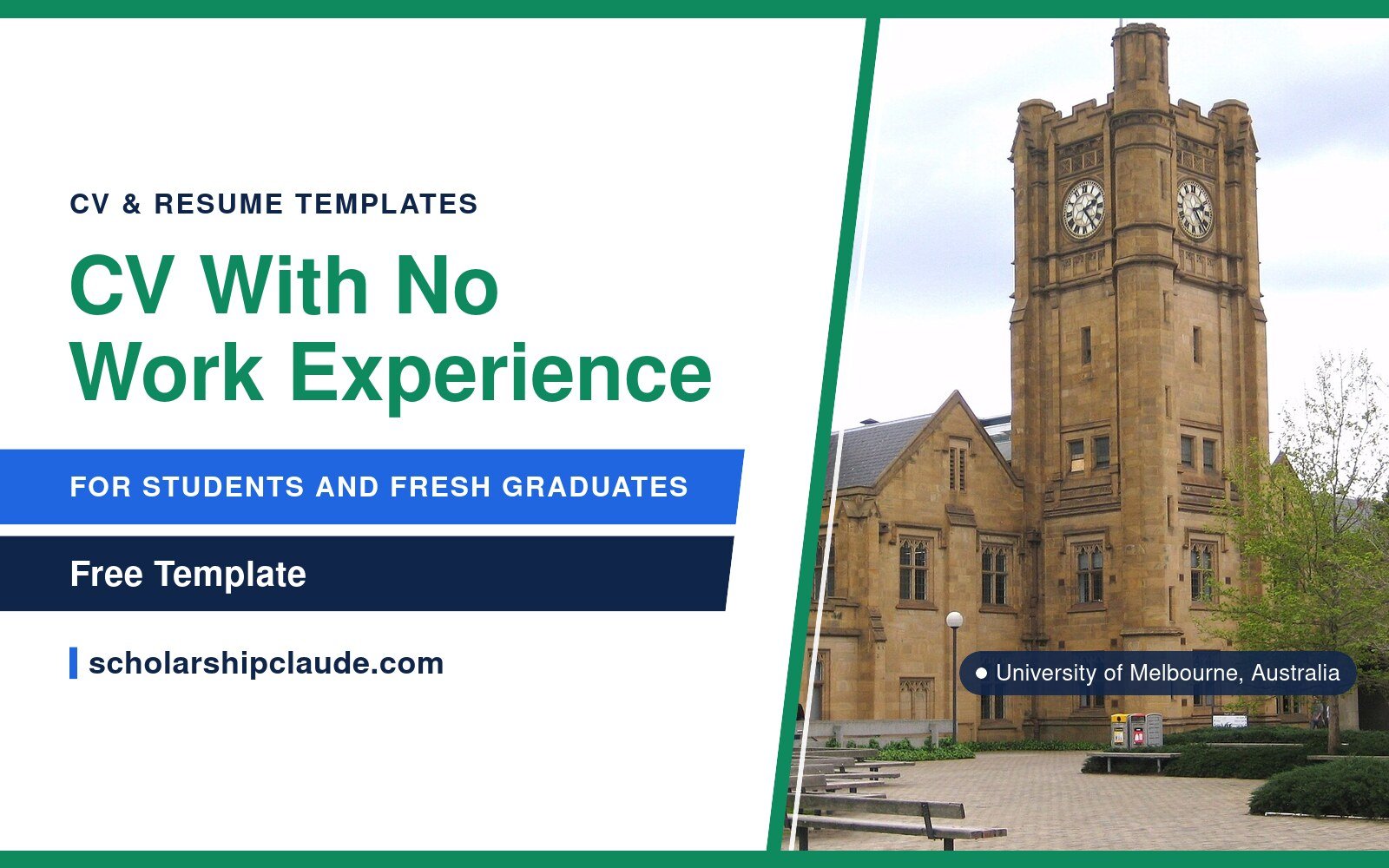
Many scholarship applicants are final-year students or fresh graduates with no full-time job to list. That is normal, and selectors know it. A CV with no work experience can still be strong if it shows what you have studied, what you have built or researched, and what you have done outside class. This guide shows what to include, the order to use, and a template you can copy.
What selectors look for in a student CV
- Academic results: your degree, grades and rank.
- Evidence of ability: a thesis, projects, competitions or coursework that produced something.
- Initiative: things you chose to do, such as volunteering, societies, tutoring or online courses.
- Fit: a clear link between your background and the programme you are applying for.
They do not expect job titles. They do expect proof that you finish what you start.
The best order for a CV with no work experience
- Contact details: name, email, phone with country code, city and country, and a LinkedIn link if it is up to date.
- Profile: two or three lines on who you are and what you are applying for.
- Education: this goes near the top, because it is your strongest section.
- Projects and research: your final-year project, thesis and course projects.
- Experience: internships, part-time work, tutoring and volunteering all count.
- Skills: software, lab techniques, programming and languages.
- Awards and activities: prizes, scholarships, societies and competitions.
- Referees: two teachers who know your work, or a line saying they are available on request.
How to write each section
Profile
Keep it specific. Name your degree, your main subject interest and the level you are applying for. Avoid general phrases such as hardworking and passionate. One good sentence beats five vague ones.
Education
Give the degree, university, years and your grade with the scale, for example 3.6 out of 4.0. Add your rank if it is good, relevant courses, and your thesis or final project title.
Projects
This section replaces work experience. For each project write the title, the dates, what you did and the result. Start each line with an action word such as designed, analysed, built, tested or presented. Give numbers where you can: sample size, accuracy, people reached or time saved.
Experience without a job
Count everything that shows responsibility: a two-month internship, tutoring school students, organising a university event, running a society page or helping in a family business. Describe what you did and what happened as a result.
Skills
List only skills you can use. Group them, for example programming, laboratory, data analysis and languages. For languages, state your level and any test score.
Copy-paste CV template for fresh graduates
[City, Country] | [Email] | [Phone with country code] | [LinkedIn]
PROFILE
[Degree] graduate from [University] with a [grade] and a strong interest in [field]. Completed a final-year project on [topic]. Applying for [programme or scholarship] to [one-line goal].
EDUCATION
[Degree, Major], [University], [City, Country] [Start year] to [End year]
Grade: [GPA or percentage with scale] Rank: [if strong]
Relevant courses: [four to six courses]
Final-year project: [title]
PROJECTS AND RESEARCH
[Project title] [Month Year] to [Month Year]
– [What you did, with a tool or method]
– [Result, with a number if possible]
[Second project title] [dates]
– [What you did]
– [Result]
EXPERIENCE
[Role, e.g. Intern, Tutor, Volunteer], [Organisation] [dates]
– [Responsibility]
– [Achievement]
SKILLS
Technical: [software, lab or programming skills]
Languages: [language and level, test score]
AWARDS AND ACTIVITIES
– [Award or scholarship], [Year]
– [Society, competition or leadership role], [Year]
REFEREES
[Name, title, university, email]
[Name, title, university, email]
Example lines you can adapt
- Designed and tested a low-cost water filter for my final-year project; removed 92% of turbidity in laboratory trials.
- Tutored 12 secondary school students in mathematics for one year; 10 improved by at least one grade.
- Led a team of five to organise a departmental science fair attended by 300 students.
- Completed three online courses in data analysis and applied the methods to my thesis dataset.
Common mistakes to avoid
- Leaving the page half empty instead of describing your projects properly.
- Listing duties with no results.
- Adding a photo, age, religion or marital status when the scholarship does not ask for them.
- Using two pages when one is enough. One page is fine for a fresh graduate.
- Sending the same CV to every scholarship without changing the profile and the order of projects.
- Spelling and formatting errors. Save the file as a PDF with your name in the file name.
Where to find experience you did not know you had
"No work experience" rarely means no experience. Go through this list with a pen. Most students find five or six items they can use.
- Final-year project or thesis: your topic, your method and your result.
- Course projects: a report, design, app, survey or lab study that you completed.
- Teaching and helping: tutoring juniors, lab demonstration or home tuition.
- Student societies: any role where you organised people, money or events.
- Volunteering: relief work, awareness campaigns, blood drives or teaching.
- Family business or farm: real tasks such as accounts, sales, stock or scheduling.
- Competitions and hackathons: what you built and how far you went.
- Online courses with a project: list the project, not only the certificate.
- Freelance or part-time work: writing, design, data entry or coding, even if it was unpaid.
Turn each item into a strong line
Use the same pattern each time: a verb, what you did, how, and the result.
| What you did | How to write it |
|---|---|
| Gave tuition at home | Tutored six Grade 9 students in mathematics for two years; all passed, four with an A grade |
| Helped in the family shop | Kept daily sales and stock records for a family grocery shop; set up a simple spreadsheet that reduced stock errors |
| Was in the debating society | Organised an inter-university debate for 14 teams as events secretary, with a budget of PKR 150,000 |
| Did a class project | Built a library management system in Python with three classmates; graded 92% |
Write only what is true and what you can explain in an interview.
What to do in the next three months
If your CV still looks thin, you can add real content before the next deadline.
- Finish one small project in your field and write a one-page summary of it.
- Take one recognised free course that fills a gap, and complete its final assessment.
- Volunteer for one defined task with a clear result, such as teaching a short course or running a survey.
- Ask a teacher for a small research task, such as data collection or a literature summary.
One completed activity with a result is worth more than five certificates of attendance.
Your profile statement: two honest sentences
If you use a short profile at the top, keep it factual. Example: "BS Economics graduate (CGPA 3.7 out of 4.0, ranked 5th of 90) with a final-year study on household energy use in Multan. Looking for a master’s in development economics to build skills in impact evaluation." Avoid words such as "dynamic" and "highly motivated". They add nothing.
Check your CV against the scholarship
- Does the top third of page one show your degree, your grade and your best project?
- Is there at least one example of leadership or service, if the scholarship values it?
- Does every line have a result or a number where one is possible?
- Is the CV one page, or two at most?
- Do the dates match your transcript?
Words to avoid, and what to write instead
- "Responsible for" tells the reader your duty, not your result. Write what you achieved.
- "Hardworking, punctual, honest" are claims without proof. Show them through a result or a rank.
- "Participated in" is weak. Say what you did there: presented, organised, built or won.
- "Various" and "many" hide the number. Give the number.
- "Fresher" or "no experience" should never appear. Your projects and activities are your experience.
Frequently asked questions
Can I include unpaid work and volunteering?
Yes. Selection panels look at what you did and what resulted, not at whether you were paid.
Should I include my school results?
One line each for your secondary and higher secondary results is enough, unless the scholarship asks for more.
Can I win a scholarship with no work experience?
Yes, for many of them. Some scholarships do require work experience, such as Chevening and DAAD EPOS, so check each one’s rules.
How long should my CV be?
One page is usually enough for a fresh graduate. Use two only if you have research or publications to show.
Which format should I use?
Use the format the scholarship asks for. For European programmes that is often the Europass CV.
Next steps
For research-focused applications, see our academic CV template. For European scholarships, see the Europass CV guide. If you are not sure which document to send, read resume vs academic CV. Then browse the active scholarships and match your CV to each one.
Scholarships with the nearest deadlines
| Scholarship | Funding | Stipend | Deadline |
|---|---|---|---|
| OIST Research Internship 2027 in Japan | Fully funded | 2,400 yen per working day, plus one round trip and shared on-campus housing | 15 Oct 2026 |
| Kochi University of Technology SSP Scholarship in Japan | Fully funded | 150,000 yen a month for 3 years, plus fee exemptions | 16 Oct 2026 |
| CERN Administrative Student Programme 2027 in Switzerland | Fully funded | 3,486 Swiss francs a month, tax free | 16 Oct 2026 |
| CERN Technical Student Programme 2027 in Switzerland | Fully funded | Monthly net allowance of 3,486 Swiss francs | 16 Oct 2026 |
| Canada Graduate Research Scholarship – Doctoral | Fully funded | CAD 40,000 per year | 17 Oct 2026 |
| Commonwealth Scholarships 2027/28 in the UK | Fully funded | 1,712 pounds a month, or 2,000 pounds a month at universities in the London area (current rates) | 20 Oct 2026 |
| EUI Jean Monnet Fellowships 2027–28 in Italy | Partial | Basic grant of 2,850 euros per month | 23 Oct 2026 |
| Honjo International Scholarship 2027 in Japan | Partial | 230,000 yen a month (degree of 1 to 2 years), 210,000 yen a month (3-year degree) or 180,000 yen a month (degree longer than 3 years) | 31 Oct 2026 |
| Swiss Government Excellence Scholarships 2027–28 in Switzerland | Partial | CHF 2,450 per month for living costs | 31 Oct 2026 |
| University of Melbourne Graduate Research Scholarships 2027 in Australia | Fully funded | 41,100 Australian dollars a year (2027 rate), plus a full fee offset | 31 Oct 2026 (expected) |
This list updates itself from our scholarships page. Stipend figures are shown where the provider publishes them. See all scholarships.