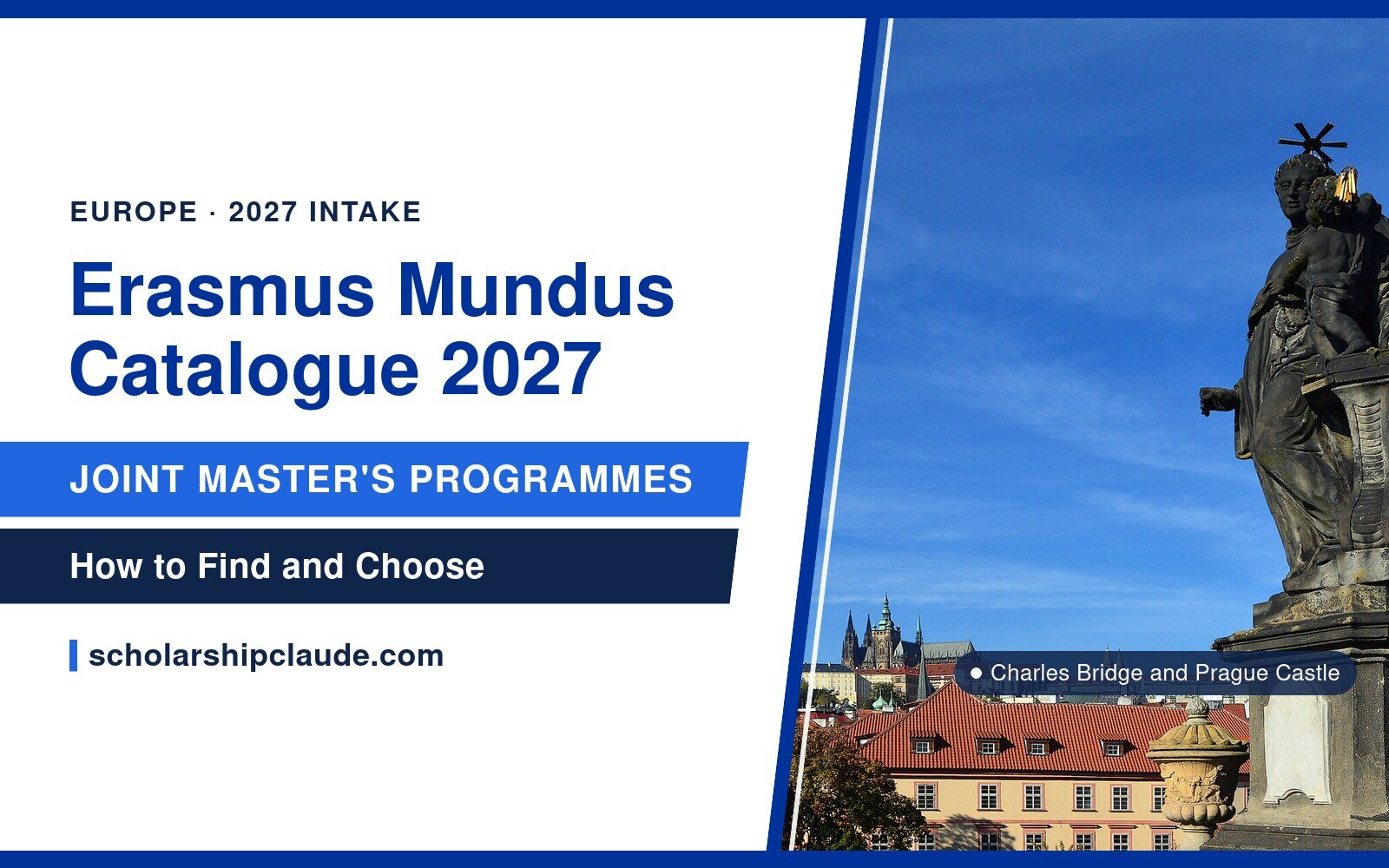
The Erasmus Mundus Catalogue is the official list of joint master’s programmes supported by the European Union. It is published by the European Education and Culture Executive Agency (EACEA) and updated every year. It listed 218 programmes when we checked it in October 2026. If you want a funded master’s degree in Europe for the 2027 intake, start your search here.
What an Erasmus Mundus scholarship covers
- Participation costs, which include tuition fees and insurance.
- A monthly allowance of 1,400 euros for the whole programme, up to 24 months. It is meant to cover living costs, accommodation, travel, visa and installation.
- Extra support for students with disabilities who meet the grant conditions.
Not every programme in the catalogue has scholarships
EACEA explains that many listed programmes offer Erasmus Mundus scholarships, but some do not. A programme may be near the end of its funding period, or it may only keep the Erasmus Mundus name. Always confirm scholarship availability for the 2027 intake on the programme’s own website.
How to use the catalogue step by step
- Open the Erasmus Mundus Catalogue.
- Filter by field of study, for example Chemistry, Environmental and Geosciences, Information Technology, Life Sciences or Social Sciences and Humanities.
- Narrow the list with keywords, country, university or duration (12, 18 or 24 months).
- Open each programme’s own website. The “project overview” link only shows project results, not admission details.
- Check four things: scholarship availability, admission requirements, the deadline and the countries where you would study.
- Shortlist the programmes that match your bachelor’s degree.
Timeline for the 2027 intake
Most programmes accept applications between October and January for courses that start in the following academic year. Each consortium sets its own date. For example, the Erasmus Mundus Flood Risk Management programme closes scholarship applications on 3 January 2027 for applicants from partner countries. Results usually arrive between March and May.
How to choose between programmes
- Academic fit: many programmes require a bachelor’s degree in specific fields. If yours does not match, your application will not pass the eligibility check.
- Selection criteria: some programmes publish their scoring. Flood Risk Management, for example, gives up to 30 points for your overall grade, 30 for relevant subjects and experience, 20 for motivation and 20 for recommendation letters.
- Language rules: check the accepted English tests, minimum scores and exemptions. See IELTS vs TOEFL.
- Study route: look at which universities and countries you will move between and which degrees you receive.
Documents to prepare now
- Degree certificate and transcripts, with certified translations if needed.
- CV, often in Europass format. Use our Europass CV guide.
- Motivation letter or answers to motivation questions. See our motivation letter template.
- Two recommendation letters. Read how to get strong recommendation letters.
- English test results and a passport copy.
Common mistakes
- Relying on last year’s deadline instead of the programme’s current page.
- Applying to programmes where your degree does not meet the entry requirements.
- Submitting AI-written motivation answers. Some programmes state that they deduct points for this.
- Waiting for the last day, when upload problems are hard to fix.
For an overview of benefits and eligibility, see our Erasmus Mundus Joint Master’s Scholarships page and the Erasmus Mundus guide.
See which programmes are open now in our Erasmus Mundus 2027 deadlines tracker.
How to read one programme page in ten minutes
Every Erasmus Mundus master’s is run by a group of universities, called a consortium, and each has its own website. The catalogue only gives you the link. On the programme’s own site, look for these things in order:
- Who can apply: the degree fields that are accepted, the minimum grade and the English level.
- The study route: which universities you attend in each semester. This is called the mobility track.
- Scholarship rules: whether you apply for the scholarship in the same form, and the scholarship deadline, which can be earlier than the deadline for self-funded students.
- Documents: the exact list, including the number of reference letters and any template for the CV or motivation letter.
- Dates: the opening date, the closing date with its time zone, and when results are sent.
Real dates show how much programmes differ
These dates for the 2027 intake come from the programmes’ own websites, checked in October 2026.
| Programme | Application window |
|---|---|
| TELME (language teaching) | 3 October 2026 to 10 January 2027, 12:00 noon Paris time |
| Erasmus Mundus Journalism | 1 November 2026 to 10 January 2027, 13:00 Central European Time |
| Flood Risk Management | Scholarship deadline 3 January 2027, 23:59 CET, for applicants from Partner Countries |
| imAGEin (biology of ageing) | 6 January to 6 March 2027 |
| TCCM (theoretical chemistry) | Opens 30 October 2026; deadline not yet published |
| BIOPHAM | Opens 1 November 2026; deadline not yet published |
One programme closes before another has opened. You cannot plan from a single "Erasmus Mundus deadline", because there is none.
Scholarship place, self-funded place or reserve list
- Scholarship place: the EU scholarship covers the participation costs and pays a monthly allowance of 1,400 euros for the length of the programme.
- Self-funded place: you are admitted but pay the fees yourself. These can be high. The Flood Risk Management master’s, for example, charges self-funded students 18,000 euros, and offers a reduced-fee scholarship with a later deadline.
- Reserve list: you are next in line if a scholarship holder withdraws. Reserve candidates do receive offers, so keep your documents ready and answer e-mails quickly.
If you are offered a self-funded place, work out the full cost before you accept. Do not assume that a scholarship will follow later.
Compare programmes with a simple sheet
| Question | Programme A | Programme B |
|---|---|---|
| Does my degree match the entry rules? | ||
| Which countries would I study in? | ||
| Which specialisation fits my goal? | ||
| Scholarship deadline and time zone | ||
| Documents I still need | ||
| English test and minimum score |
Fill in one column for each programme. Apply to the two or three where you meet every rule and where your background fits the specialisation.
The 10% rule and what it means for you
In one programme, no more than 10% of the scholarships can go to students of the same nationality. If many applicants from your country apply to the same popular programme, the competition among you is strong. Less well-known programmes in your field can give you a better chance, so search the catalogue by subject, not by fame.
What can go wrong
- You trust a date from a blog: take every date from the programme’s own website.
- You miss the time zone: most deadlines are in Central European Time, which is four hours behind Pakistan in winter.
- Your referees are late: many programmes need letters uploaded before the deadline.
- Your degree does not match: programmes are strict about the academic background they accept.
- You apply to too many: each application needs its own motivation letter. Two or three strong ones beat six rushed ones.
Example: from twenty programmes to three
Suppose Hira has a bachelor’s degree in chemistry and wants to work on clean water. Her search might go like this.
- Search by subject. She filters the catalogue for chemistry, environment and water, and finds about twenty programmes.
- Remove programmes that do not accept her degree. Several need an engineering background. Twelve are left.
- Check the specialisations. She keeps the six whose courses include water treatment or environmental chemistry.
- Check the dates. Two of the six close before her English test result will be ready. Four are left.
- Read the selection criteria. One values work experience that she does not have. She keeps three.
She now writes three careful applications. The numbers in this example are invented, but the order of the steps works for any field.
Words in the catalogue, explained
- Consortium: the group of universities that runs one programme together.
- Mobility track: your route between the universities, usually one or two semesters in each.
- ECTS: European study credits. A two-year master’s normally has 120 ECTS.
- Joint or multiple degree: you receive either one degree issued jointly, or separate degrees from the universities where you studied.
- Partner Country and Programme Country: the two groups of applicant countries. Pakistan is a Partner Country.
- Self-funded student: a student who is admitted but pays the fees without the EU scholarship.
Keep one tracking sheet
For each programme on your list, write down the website, the opening date, the scholarship deadline with its time zone, the documents, the number of referees and the result date. Check the websites again every two weeks. Some programmes publish their deadlines only when the call opens.
Frequently asked questions
How often is the catalogue updated?
New programmes are added and some end, so check it again each autumn before you finalise your list. Take every date from the programme’s own website, because the catalogue does not show deadlines for each course.
Is there one application for all Erasmus Mundus programmes?
No. You apply to each programme on its own website.
Do I apply separately for the scholarship?
In many programmes one application covers both admission and the scholarship. Erasmus Mundus Journalism, for example, needs no separate scholarship application. Check each programme.
Can students from Pakistan apply?
Yes. Students from all over the world can apply, and some programmes set separate deadlines for applicants from Partner Countries, which include Pakistan.
How much is the scholarship?
It is calculated as 1,400 euros a month for the length of the master’s, and it also covers the participation costs.
Where can I see deadlines for specific programmes?
See our overview of Erasmus Mundus scholarships for 2027.
Related scholarships: funding, stipend and deadlines
| Scholarship | Funding | Stipend | Deadline |
|---|---|---|---|
| Erasmus Mundus Theatre SPACEs Scholarship 2027 | Fully funded | Erasmus Mundus scholarships cover participation costs and pay a monthly allowance of 1,400 euros | 1 Dec 2026 |
| Erasmus Mundus Clinical Linguistics Scholarship 2027–2029 | Fully funded | Erasmus Mundus scholarships cover participation costs and pay a monthly allowance of 1,400 euros | 1 Dec 2026 |
| Erasmus Mundus NOHA Scholarship 2027 | Fully funded | Erasmus Mundus scholarships cover participation costs and pay a monthly allowance of 1,400 euros | 15 Dec 2026 |
| Erasmus Mundus Flood Risk Management Scholarship 2027–2029 in Europe | Fully funded | Monthly allowance of 1,400 euros for up to 24 months (for living costs, accommodation, travel and installation) | 3 Jan 2027 |
| Erasmus Mundus International Law Scholarship 2027–2029 | Fully funded | Erasmus Mundus scholarships cover participation costs and pay a monthly allowance of 1,400 euros | 4 Jan 2027 |
| Erasmus Mundus Innovative Medicine Scholarship 2027 | Fully funded | Erasmus Mundus scholarships cover participation costs and pay a monthly allowance of 1,400 euros | 4 Jan 2027 |
| Erasmus Mundus Security, Intelligence and Strategic Studies Scholarship 2027–2029 | Fully funded | Erasmus Mundus scholarships cover participation costs and pay a monthly allowance of 1,400 euros | 7 Jan 2027 |
| Erasmus Mundus STEPS Scholarship 2027 | Fully funded | Erasmus Mundus scholarships cover participation costs and pay a monthly allowance of 1,400 euros | 8 Jan 2027 (expected) |
| Erasmus Mundus TELME Scholarship 2027 | Fully funded | Erasmus Mundus scholarships cover participation costs and pay a monthly allowance of 1,400 euros | 10 Jan 2027 |
| Erasmus Mundus Journalism Scholarship 2027–2029 | Fully funded | 1,400 euros a month for up to 24 months, with tuition waived | 10 Jan 2027 |
This list updates itself from our scholarships page. Stipend figures are shown where the provider publishes them. See all scholarships.