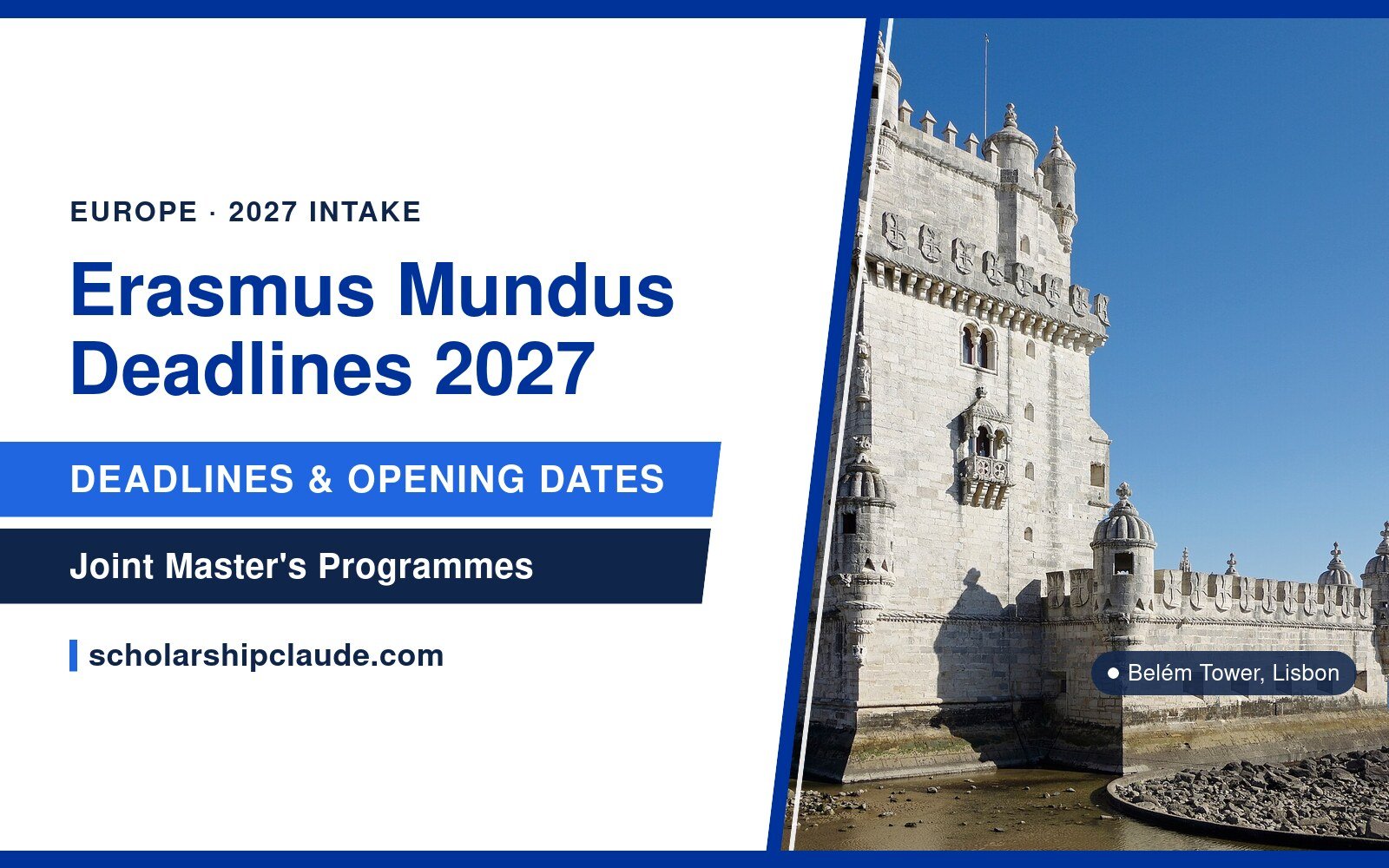
Erasmus Mundus Joint Master’s programmes are fully funded for scholarship holders and open to students of all nationalities. The official catalogue lists 218 programmes, and each one has its own application dates. This page tracks the Erasmus Mundus programmes we have checked for the 2027 intake, with the status of each call. It now covers 19 programmes and was last updated on 6 October 2026.
Erasmus Mundus scholarships 2027: deadlines and opening dates
| Programme | Field | Status for the 2027 intake |
|---|---|---|
| International Law (ILSPSD) | Law, security and peace | Open. Scholarship deadline 4 January 2027 |
| GLOCAL | Global economy and creative industries | Open. Scholarship deadline 14 January 2027 |
| STEPS | Electrical power systems and transport | Open. Deadline 8 January 2027 (to be confirmed) |
| Flood Risk Management | Water and flood risk | See the scholarship page |
| Mundus Journalism | Journalism and media | Call opens 1 November 2026 |
| BIOPHAM | Pharmaceutical materials science | Call opens 1 November 2026 |
| European Politics and Society (EPS) | Politics and European studies | Window opens 1 November 2026 |
| TELME | Language teaching | Open. Deadline 10 January 2027 |
| Theatre SPACEs | Theatre and community arts | Open. Deadline 1 December 2026 |
| Clinical Linguistics (EMCL) | Linguistics and speech | Open. Deadline 1 December 2026 |
| Animal Biodiversity and Genomics (EMABG) | Animal science and genetics | Open. Deadline 15 January 2027 |
| Education, Migration and Diversity | Education and migration | Opens 15 December 2026. Deadline 15 February 2027 |
| NOHA Humanitarian Action | Humanitarian action | Deadline 15 December 2026 (to be confirmed) |
| Security and Intelligence (IMSISS) | Security studies | Open now. See the programme website for the deadline |
| Biology of Ageing (imAGEin) | Biology and health | Opens 6 January 2027 |
| DocNomads | Documentary film | Call opens November 2026 |
| Innovative Medicine (IMIM) | Biomedical research | Opens November 2026. Deadline 4 January 2027 |
| Theoretical Chemistry (TCCM) | Chemistry and modelling | Call opens 31 October 2026 |
| MemBioMed | Biology and neuroscience | Opens 1 December 2026 |
Each link opens the scholarship page with eligibility, benefits and the official application link.
When do Erasmus Mundus applications open?
Most programmes open their call between October and December and close between December and February. Several programmes on this page open on 1 November 2026. If your programme is not open yet, use the time to prepare your documents, because the windows are short.
What does an Erasmus Mundus scholarship cover?
- Tuition and participation costs
- A monthly allowance of 1,400 euros for the whole programme
- Travel and installation costs
- Health insurance
Our Erasmus Mundus scholarship page has the general rules, and each programme confirms the details for its own intake.
How to choose a programme
- Match your degree. Each consortium asks for a bachelor’s degree in a related field.
- Check the countries. You will study in at least two countries, so look at the mobility path.
- Read the selection criteria. Every programme publishes its own.
- Note the scholarship deadline. It is often earlier than the deadline for self-funded students.
Our guide to the Erasmus Mundus Catalogue shows how to search all 218 programmes by subject.
How to apply
- Choose two to four programmes that fit your background.
- Open each programme’s website and read its requirements.
- Prepare your transcripts, CV, motivation letter, references and language certificate.
- Apply on each programme’s own website before its scholarship deadline.
For the full process, read our Erasmus Mundus application guide. Our motivation letter template and Europass CV guide cover the two documents consortia read most closely.
What the scholarship pays, with the numbers
The Erasmus Mundus scholarship has two parts. First, it covers the participation costs of the programme, so scholarship holders do not pay tuition. Second, it pays a monthly allowance of 1,400 euros for the length of the master’s. For a 24-month programme that is up to 33,600 euros. The allowance is meant to cover your travel, visa, installation and living costs together, so plan your budget across the whole period. Your first flight and your housing deposit usually come before your first payment.
Partner Country or Programme Country?
Programmes often set different rules or deadlines for two groups of applicants. Programme Countries are the EU member states and a few associated countries. All other countries, including Pakistan, are Partner Countries. The Flood Risk Management master’s, for example, has a scholarship deadline of 3 January 2027 for applicants from Partner Countries and 7 February 2027 for Programme Countries. Always read the line that applies to your own group.
Documents most programmes ask for
- Usually required: passport, bachelor’s degree and transcript, CV, motivation letter, proof of English and reference letters.
- Often required: a certified translation of documents that are not in English, and proof of your place of residence.
- Needed in some programmes only: a portfolio, a research idea, a video or a specific form.
The number of references and the minimum English score differ. The European Politics and Society master’s, for example, asks for two references and an IELTS score of 7.0. Check the list of every programme you apply to.
If you have not graduated yet
Many programmes accept final-year students who will have their degree before the course starts. Rules differ on the date by which you must send the final degree. Look for this rule on the programme’s website before you apply, and ask your university for an official letter that states your expected graduation date.
A plan for the 2027 intake
- October 2026: choose two or three programmes and write down each opening and closing date.
- By early November: ask your referees, and book an English test if you still need one. Some programmes let you upload a test result after the deadline. The Flood Risk Management master’s, for example, accepts it until 1 February 2027.
- November: write a separate motivation letter for each programme, and adapt your CV.
- December: complete the forms, and check every upload.
- Two days before each deadline: submit, and save the confirmation.
- Spring 2027: watch your e-mail for results, reserve-list offers and interview invitations. The Flood Risk Management master’s, for example, sends results at the beginning of April.
After the result
- Main list: confirm your place by the date in the offer, then start your visa application for the first country of study.
- Reserve list: stay ready. Places open when other candidates withdraw.
- Admitted without a scholarship: ask about the fees, the payment dates and any reduced-fee options before you decide.
- Not selected: ask whether feedback is available, and prepare for the next round.
What can go wrong
- You treat last year’s date as final: some programmes have changed their dates for 2027. imAGEin, for example, now opens on 6 January and closes on 6 March 2027.
- You send the same motivation letter to every programme: each consortium has its own focus.
- You plan only for the first country: you will move between countries, and each move has visa and housing steps.
- You forget the nationality limit: no more than 10% of a programme’s scholarships go to one nationality, so apply to more than one programme.
What to cover in an Erasmus Mundus motivation letter
Each consortium reads for fit with its own programme. A strong letter answers four questions:
- Why this field? One real experience that led you to it.
- Why this programme? Name the specialisation you want, and one or two courses or partner universities that match your goal.
- Why are you ready? Your degree, a project and a result.
- What will you do afterwards? A concrete plan, and who benefits from it.
Also show that you understand the joint structure. Mention that you are prepared to study in more than one country, and say what you hope to gain from each place. Follow the length and the template that the programme gives.
Living on 1,400 euros a month
The allowance is the same wherever you study, but the cost of living is not. A month in a small university town costs much less than a month in a capital city.
- Look up the student cost-of-living estimate on each host university’s website.
- Expect higher costs in your first month in each country: a housing deposit, transport and household items.
- Save a little in cheaper semesters for the expensive ones, and for moving between countries.
- Ask the programme office when and how the allowance is paid, so that you know how much money to bring at the start.
Studying in two or three countries: practical points
- Visas and residence permits: you may need a new permit for each country. Start each process early, and ask the consortium for its guidance.
- Housing: apply for university housing as soon as you are admitted, because rooms are limited.
- Insurance: check what the programme’s insurance covers in each country.
- Documents: carry certified copies of your degree, transcript and birth certificate. You may need them again in each country.
Frequently asked questions
What time are the deadlines in Pakistan?
Most programmes use Central European Time, which is four hours behind Pakistan in winter. A deadline of 13:00 CET is 5:00 pm in Pakistan, and 23:59 CET is 3:59 am the next day. Convert each deadline and submit two days early.
Is the monthly allowance the same in every programme?
The EU scholarship is calculated as 1,400 euros a month. Check your programme’s website for how and when it is paid.
Do I need work experience?
Most programmes do not require it, but some value it. Read the selection criteria of each programme.
Can I apply to more than one Erasmus Mundus programme?
Yes. Each application is separate. Check each programme’s rules.
Is IELTS required for Erasmus Mundus?
Most programmes ask for an English certificate. The accepted tests and scores are set by each programme.
How much is the Erasmus Mundus stipend?
The monthly allowance is 1,400 euros.
Where is the full list of programmes?
In the official Erasmus Mundus Catalogue on the European Commission’s website.
We add more programmes to this page as their 2027 calls are confirmed.
Live list: every scholarship we currently cover here
| Scholarship | Funding | Stipend | Deadline |
|---|---|---|---|
| Erasmus Mundus Theatre SPACEs Scholarship 2027 | Fully funded | Erasmus Mundus scholarships cover participation costs and pay a monthly allowance of 1,400 euros | 1 Dec 2026 |
| Erasmus Mundus Clinical Linguistics Scholarship 2027–2029 | Fully funded | Erasmus Mundus scholarships cover participation costs and pay a monthly allowance of 1,400 euros | 1 Dec 2026 |
| Erasmus Mundus NOHA Scholarship 2027 | Fully funded | Erasmus Mundus scholarships cover participation costs and pay a monthly allowance of 1,400 euros | 15 Dec 2026 |
| Erasmus Mundus Flood Risk Management Scholarship 2027–2029 in Europe | Fully funded | Monthly allowance of 1,400 euros for up to 24 months (for living costs, accommodation, travel and installation) | 3 Jan 2027 |
| Erasmus Mundus International Law Scholarship 2027–2029 | Fully funded | Erasmus Mundus scholarships cover participation costs and pay a monthly allowance of 1,400 euros | 4 Jan 2027 |
| Erasmus Mundus Innovative Medicine Scholarship 2027 | Fully funded | Erasmus Mundus scholarships cover participation costs and pay a monthly allowance of 1,400 euros | 4 Jan 2027 |
| Erasmus Mundus Security, Intelligence and Strategic Studies Scholarship 2027–2029 | Fully funded | Erasmus Mundus scholarships cover participation costs and pay a monthly allowance of 1,400 euros | 7 Jan 2027 |
| Erasmus Mundus STEPS Scholarship 2027 | Fully funded | Erasmus Mundus scholarships cover participation costs and pay a monthly allowance of 1,400 euros | 8 Jan 2027 (expected) |
| Erasmus Mundus TELME Scholarship 2027 | Fully funded | Erasmus Mundus scholarships cover participation costs and pay a monthly allowance of 1,400 euros | 10 Jan 2027 |
| Erasmus Mundus Journalism Scholarship 2027–2029 | Fully funded | 1,400 euros a month for up to 24 months, with tuition waived | 10 Jan 2027 |
| GLOCAL Erasmus Mundus Scholarship 2027–2029 in Europe | Fully funded | See the scholarship page | 14 Jan 2027 |
| Erasmus Mundus Animal Biodiversity and Genomics Scholarship 2027 | Fully funded | Erasmus Mundus scholarships cover participation costs and pay a monthly allowance of 1,400 euros | 15 Jan 2027 |
| Erasmus Mundus Joint Master’s Scholarships 2027 in Europe | Fully funded | Monthly allowance of 1,400 euros | 15 Jan 2027 (expected) |
| Erasmus Mundus Education, Migration and Diversity Scholarship 2027 | Fully funded | Erasmus Mundus scholarships cover participation costs and pay a monthly allowance of 1,400 euros | 15 Feb 2027 |
| Erasmus Mundus MemBioMed Scholarship 2027–2029 | Fully funded | 1,400 euros a month for 24 months, with tuition waived | 28 Feb 2027 |
| Erasmus Mundus Biology of Ageing Scholarship 2027–2029 | Fully funded | 1,400 euros a month for scholarship holders | 6 Mar 2027 |
| Erasmus Mundus BIOPHAM Scholarship 2027 | Fully funded | Erasmus Mundus scholarships cover participation costs and pay a monthly allowance of 1,400 euros | Varies |
| Erasmus Mundus DocNomads Scholarship 2027 | Fully funded | 1,400 euros a month, with no fees, for scholarship holders | Varies |
| Erasmus Mundus European Politics and Society Scholarship 2027–2029 | Fully funded | Erasmus Mundus scholarships cover participation costs and pay a monthly allowance of 1,400 euros | Varies |
| Erasmus Mundus Theoretical Chemistry and Computational Modelling Scholarship 2027 | Fully funded | Erasmus Mundus scholarships cover participation costs and pay a monthly allowance of 1,400 euros | Varies |
This table updates itself whenever a scholarship is added or changed, so it can include newer entries than the sections above. See all scholarships.