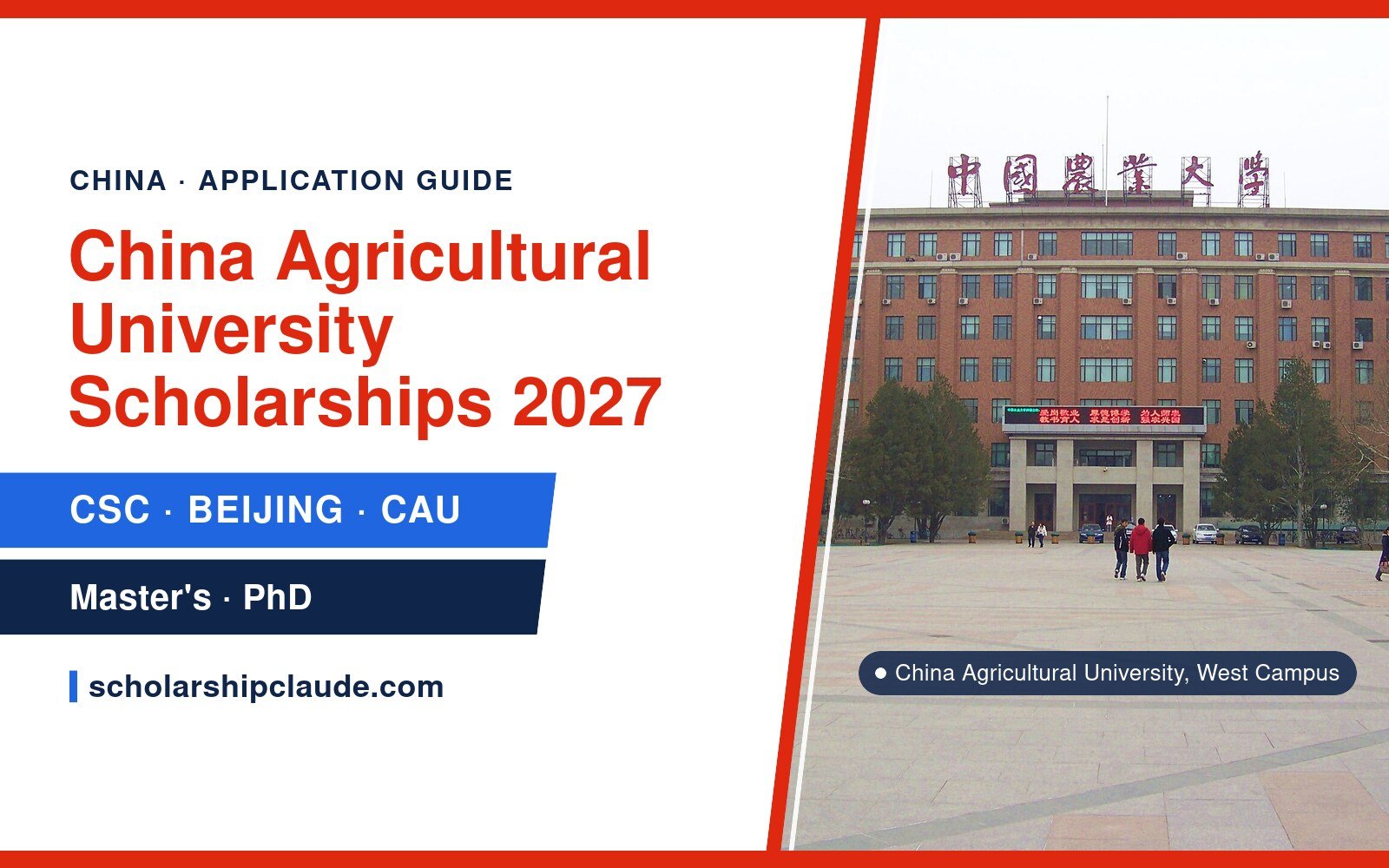
China Agricultural University (CAU) in Beijing admits international master’s and PhD students through several scholarship routes. The main one is the Chinese Government Scholarship (CSC) High Level Postgraduate Program, open from 1 November 2026 to 28 February 2027. There are also the CSC Silk Road Program, the Beijing Government Scholarship and CAU’s own awards, each with its own dates and rules. This guide explains every route, what each covered in its latest official notice, the documents, and the steps.
This guide was checked on 16 October 2026 against CAU’s official 2027 international graduate admission announcement and its 2026 notices for the CSC High Level Postgraduate Program, the CSC Silk Road Program and the Beijing Government Scholarship.
CAU 2027 admission at a glance
| University | China Agricultural University (CAU), Beijing |
|---|---|
| Levels | Master’s (2 or 3 years) and PhD (3 or 4 years) |
| Language | English-taught and Chinese-taught programmes |
| Main scholarship | CSC High Level Postgraduate Program (Type B) |
| CSC Type B applications | 1 November 2026 to 28 February 2027 |
| Other routes | CSC Silk Road, CSC Type A, Beijing Government Scholarship, CAU and other scholarships |
| Age limit | Under 35 (master’s), under 40 (PhD) |
| English | TOEFL iBT 90 or IELTS 6.0 (general admission rule) |
| Application fee | RMB 400, not refundable |
| Admission notices | July 2027 |
About CAU’s 2027 admission
CAU is a specialist university in agriculture and related sciences in Beijing. Its 2027 admission covers master’s degrees, which take two or three years, and PhDs, which take three or four years. Both English-taught and Chinese-taught programmes are open to international students. CAU publishes the full 2027 list of majors as a file attached to its admission announcement.
English-taught students do not need any Chinese to apply, but CAU expects them to reach International Chinese Language Level 3 by the time they graduate. CAU offers Chinese classes during the degree.
Scholarship routes and 2027 dates
| Route | Application period |
|---|---|
| CSC High Level Postgraduate Program (Type B) | 1 November 2026 to 28 February 2027 |
| CSC Silk Road Program (Type B) | March to May 2027 |
| CSC Type A programmes | Set by the Chinese embassy or agency in your country |
| Beijing Government Scholarship | November 2026 to May 2027 |
| CAU and other scholarships, or self-funded | November 2026 to June 2027 |
CAU says final dates follow the notices on its website. Only the CSC High Level route has exact dates so far. For the others, CAU gives a range of months and will publish a separate notice for each.
Type A and Type B: what is the difference?
With a CSC Type B scholarship, you apply through the university, and CAU nominates you. With a Type A scholarship, you apply through the Chinese embassy or another agency in your country, which runs its own selection and deadline. CAU’s 2027 notice says Type A dates depend on those overseas missions.
Route 1: CSC High Level Postgraduate Program (Type B)
This is the main route for funded master’s and PhD study at CAU, with applications from 1 November 2026 to 28 February 2027. CAU has not yet published its 2027 notice for this programme, so the details below come from its 2026 notice. Check the 2027 notice when it appears.
What it covered in 2026
- Tuition
- A shared double room on campus
- A living allowance (CAU’s notice does not state the amount)
- Medical insurance
International travel was not covered.
Who could apply in 2026
- A non-Chinese citizen with a valid ordinary passport, in good health and with no criminal or disciplinary record.
- Master’s: a bachelor’s degree, and under 35.
- PhD: a master’s degree, and under 40.
- English-taught programmes: TOEFL iBT 90 or IELTS 6.0. Chinese-taught programmes: HSK 4 in the 2026 notice. CAU’s 2027 general admission notice asks for HSK 5, so check which level the 2027 CSC notice sets.
- Transcripts with no failed courses and a GPA above 3.0.
How it worked in 2026
- Apply on the CAU system (apply.cau.edu.cn) and pay RMB 400.
- Take an online interview with the CAU college. If you pass, the college issues a pre-admission notice, which you add to your application.
- Apply on the CSC online system as Type B, using CAU’s agency number 10019.
Route 2: CSC Silk Road Program (Type B)
The Silk Road Program is a CSC scholarship for students from selected countries. CAU’s 2027 notice gives an application period of March to May 2027. The details below come from CAU’s 2026 Silk Road notice.
- Coverage in 2026: tuition, a shared double room on campus, a living allowance and insurance. International travel was not covered.
- Countries in 2026: Malawi, Kenya, Ethiopia, Zambia, Madagascar, Malaysia, Indonesia, Thailand, Laos and Nepal.
- Fields in 2026: programmes in the College of Plant Protection (agricultural entomology and pest control, plant pathology, plant quarantine and agricultural ecological health) and the College of Resources and Environmental Sciences (resource and environmental science and plant protection, and plant nutrition).
- English: a bachelor’s degree taught in English, TOEFL iBT 90 or IELTS 6.0.
- Master’s applicants: under 35, with a bachelor’s degree.
In 2026, applicants registered on the CAU system, applied on the CSC system as Type B with institution code 10019, and uploaded a signed CSC application form. The 2027 country list and fields may change.
Route 3: Beijing Government Scholarship
The Beijing Government Scholarship (BGS) is funded by the Beijing city government. CAU’s 2027 notice gives an application period of November 2026 to May 2027. The details below come from CAU’s 2026 BGS notice.
Categories in 2026
| Category | What it covered |
|---|---|
| A | Tuition, accommodation, living allowance and medical insurance |
| B | Tuition, accommodation and medical insurance |
| C | Tuition and medical insurance |
You do not choose a category. CAU assigns one after the interview. In 2026, the scholarship covered only the first academic year, and students had to apply again from the second year.
Who could apply in 2026
- Ages: under 35 for master’s and under 40 for PhD.
- Grades: an average of at least 80 out of 100, or a GPA of 3.0, normally from a key university or research institute in your country.
- English-taught programmes: TOEFL iBT 85, IELTS 6.5, or a degree taught in English. Chinese-taught programmes: HSK 4.
- A general track open to all nationalities, and a Belt and Road and BRICS track for Thailand, Malaysia, Uzbekistan, Kazakhstan, Vietnam, Laos, Brazil, Indonesia, South Africa and Egypt.
Route 4: CAU and other scholarships, or self-funded
CAU’s 2027 notice lists CAU and other scholarships, and self-funded study, with applications from November 2026 to June 2027. It does not say what CAU’s own scholarships cover. Watch CAU’s scholarship pages for a separate notice.
Comparing the routes
| Route | Who it suits | Coverage (latest notice) |
|---|---|---|
| CSC High Level (Type B) | Strong master’s and PhD applicants of any nationality | Tuition, housing, living allowance, insurance (2026) |
| CSC Silk Road (Type B) | Students from the listed countries in the listed fields | Tuition, housing, living allowance, insurance (2026) |
| CSC Type A | Students applying through their Chinese embassy | Set by the embassy route |
| Beijing Government | Students with an 80/100 average or GPA 3.0 | Category A, B or C, first year only (2026) |
| CAU and other, or self-funded | Students who miss other routes | Not stated |
What you pay without a scholarship
| Cost | Amount |
|---|---|
| Tuition, master’s | RMB 26,000 a year |
| Tuition, PhD | RMB 30,000 a year |
| On-campus shared room | RMB 1,000 to 1,600 a month |
| Insurance | RMB 800 a year |
| Application fee | RMB 400 |
For a self-funded PhD student in a shared room at the lower price, that is RMB 30,000 in tuition, RMB 12,000 in rent and RMB 800 in insurance, or RMB 42,800 a year before food and other costs. This is why a scholarship that covers housing, like CSC or BGS Category A or B, makes a large difference.
Who can apply (general rules for 2027)
- A non-Chinese citizen with a valid ordinary passport.
- Master’s: a bachelor’s degree or equivalent, and under 35.
- PhD: a master’s degree or equivalent, and under 40.
- In good health, meeting visa and programme health requirements.
- No criminal, public security or disciplinary record.
- Meets the academic requirements of your chosen programme.
- English-taught programmes: TOEFL iBT 90 or IELTS 6.0. Chinese-taught programmes: HSK 5.
Each scholarship notice can set its own language level, so read the notice for your route.
Programmes
CAU attaches its 2027 list of majors for international students to the admission announcement. In earlier years, its English-taught options included crop cultivation, crop genetics and breeding, seed science, plant protection, horticulture, food science and engineering, plant nutrition, agricultural engineering, agricultural economics and management, and rural development and development studies. Check the 2027 list for the current options before you apply.
Documents you need
Required
- Passport valid beyond December 2027
- Notarised copy of your highest degree certificate. Final-year students give proof of student status or an expected graduation certificate.
- Transcripts from undergraduate study onward, issued and sealed by your university
- Two signed recommendation letters from associate professors or higher
- Your study or work experience, updated to the application date
- A study or research plan of at least 1,000 words in Chinese or English
- Language certificate: IELTS or TOEFL for English-taught programmes, HSK 5 for Chinese-taught programmes
- Physical examination form for international students
- Criminal record report from the police
Conditional
- Visa information, if you are already in China
- Notarised translations of documents not in Chinese or English
- For CSC routes: the signed CSC application form, and in 2026 a pre-admission notice from the CAU college
Optional
- Published papers, patents or other achievements
Tips for the key documents
- Study or research plan: at least 1,000 words. Name your intended major, the problem you want to study, your methods and how your background prepares you.
- Recommendation letters: two signed letters from associate professors or higher. Ask early, because notarisation and signatures take time.
- Physical examination form: use the official form linked from CAU’s notice and have every section completed.
- Criminal record report: it must come from the public security or police authority in your country.
Our study plan template and guide to recommendation letters can help.
How to write the 1,000-word research plan
Every CAU route asks for a study or research plan of at least 1,000 words. It is often the document that shows the reviewers whether you understand your field and can work on your own. A clear structure helps:
- Title and field (one line): a working title and the CAU major you are applying to.
- Background (about 200 words): the problem you want to study and why it matters, for example for food security, crop yields or rural incomes in your region.
- Aims and questions (about 150 words): two or three clear research questions.
- Methods (about 250 words): how you will collect and analyse data, including field work, lab work or surveys.
- Your preparation (about 200 words): the courses, projects and skills that make you ready for this work.
- Why CAU (about 150 words): the college, labs or researchers that fit your topic.
- Timeline and plans after the degree (about 100 words): a year-by-year outline and what you want to do afterwards.
Keep the language simple and specific. Reviewers read many plans, so a focused question is better than a broad topic.
A suggested timeline
| When | What to do |
|---|---|
| Now to October 2026 | Choose your major and route, book an English test if needed, and contact the college or a supervisor |
| October to November 2026 | Ask for recommendation letters, request your criminal record report and start your research plan |
| November 2026 to January 2027 | Apply on the CAU system and, for CSC, on the CSC system |
| By 28 February 2027 | Finish the CSC High Level application |
| March to June 2027 | Silk Road, Beijing Government and CAU routes; interviews |
| July 2027 | Admission notices and visa forms |
This plan is our suggestion based on CAU’s published dates. Your college may set its own interview times.
How to apply, step by step
- Download CAU’s 2027 programme list and choose your major.
- Choose your scholarship route and note its application period.
- Contact the college or a potential supervisor in your field. In 2026, CSC applicants needed a pre-admission notice after an online interview with the college.
- Prepare your documents, especially the research plan and recommendation letters.
- Register on the CAU online application system, choose your major and route, and upload your documents.
- Pay the RMB 400 application fee.
- For CSC routes, also apply on the CSC online system as Type B, following CAU’s notice for that route.
- Watch your email and the CAU system. Colleges may invite you to an exam or interview, with one or two weeks’ notice.
- Admission notices and visa forms (JW201 or JW202) are issued in July 2027.
Our guide to emailing professors for China scholarships explains how to approach a supervisor.
Preparing for the college interview
CAU’s colleges may invite you to an exam or interview, with one or two weeks’ notice. In 2026, CSC applicants had an online interview before the college issued a pre-admission notice. To prepare:
- Be ready to explain your research plan in five minutes, without reading from notes.
- Review the key ideas of your past projects and thesis, because interviewers often ask about methods and results.
- Learn about the college’s research and the work of the supervisor you hope to join.
- Test your camera, microphone and internet connection before an online interview.
- Have a short answer ready for why you chose China and CAU.
Our scholarship interview tips cover common questions.
After you are admitted
- Apply for an X1 student visa with your admission notice, JW201 or JW202 form and the original physical examination record.
- Within 30 days of arriving in China, apply for a residence permit.
- Register on time. Missing registration without a reason, failing the health or criminal check, or not having the original final degree certificate cancels your admission.
Common mistakes to avoid
- Waiting for the wrong route. The CSC High Level route closes on 28 February 2027, months before the other routes.
- Applying on the CSC system without also applying on the CAU system, or the other way round.
- Using the wrong agency or institution number on the CSC system.
- Sending a research plan shorter than 1,000 words.
- Missing the language level for your route, which can differ from the general rule.
- Letting your passport expire before December 2027.
Frequently asked questions
Is the China Agricultural University scholarship fully funded?
The CSC High Level and Silk Road programmes covered tuition, housing, a living allowance and insurance in 2026. The Beijing Government Scholarship ranged from tuition and insurance only (Category C) to full support (Category A), for the first year.
What is the deadline for the CSC scholarship at CAU?
CSC Type B applications run from 1 November 2026 to 28 February 2027.
Can students from any country apply?
The CSC High Level route and the Beijing Government general track had no country limit in 2026. The Silk Road route and the Beijing Government Belt and Road and BRICS track were limited to listed countries.
What is the age limit?
Under 35 for master’s and under 40 for PhD.
Do I need IELTS?
English-taught programmes need TOEFL iBT 90 or IELTS 6.0 under the general rule. The Beijing Government Scholarship asked for TOEFL iBT 85 or IELTS 6.5 in 2026.
Do I need to speak Chinese?
Not for English-taught programmes, but you should reach Chinese Level 3 by graduation. Chinese-taught programmes need HSK 5.
How much is the application fee?
RMB 400, paid on the CAU system and not refunded.
When will I know the result?
Admission notices are issued in July. You can check your status on the CAU system before then.
Where to apply
Read CAU’s official 2027 international graduate admission announcement and apply through the CAU online application system. CAU’s Chinese Government Scholarship notices and Beijing Government Scholarship notices will carry the 2027 details. Our CAU scholarship page keeps the key facts in one place. See also our CSC scholarship guide and our guide to scholarships in China.
Related scholarships: funding, stipend and deadlines
| Scholarship | Funding | Stipend | Deadline |
|---|---|---|---|
| USTC International Winter Camp 2027 in China | Partial | See the scholarship page | 8 Nov 2026 |
| JUSTCOOL PhD Programme 2027 in China | Fully funded | JUSTCOOL: PhD fellowship plus a research or teaching assistantship (amounts not stated on the official website) | 14 Nov 2026 |
| Yenching Academy Scholarship 2027 in China | Fully funded | See the scholarship page | 30 Nov 2026 |
| Shenzhen University PhD Scholarships 2027 in China | Fully funded | Liyuan International Scholarship: CNY 4,000 to 6,000 a month | 30 Nov 2026 |
| Peking University Scholarships 2027 in China for International Students | Partial | See the scholarship page | 23 Dec 2026 (expected) |
| CAS-ANSO Scholarship 2027 in China | Fully funded | Monthly stipend of 3,000 CNY for master's students (up to 36 months) | 31 Jan 2027 (expected) |
| Tsinghua University Scholarships 2027 in China for International Students | Fully funded | See the scholarship page | 28 Feb 2027 (expected) |
| China Agricultural University Scholarships 2027 in China | Fully funded | CSC living allowance (amount not stated in CAU's announcement) | 28 Feb 2027 |
| USTC Research Internship Program 2027 in China | Partial | USTC Fellowship Level A: tuition, comprehensive medical insurance, free university dormitory and a monthly stipend of 2,500 RMB… | 22 Mar 2027 (expected) |
| Chinese Government Scholarship | Fully funded | Last published rates: 2,500 CNY a month (bachelor's), 3,000 CNY (master's), 3,500 CNY (PhD); not yet confirmed for 2027–28 | Varies |
This list updates itself from our scholarships page. Stipend figures are shown where the provider publishes them. See all scholarships.