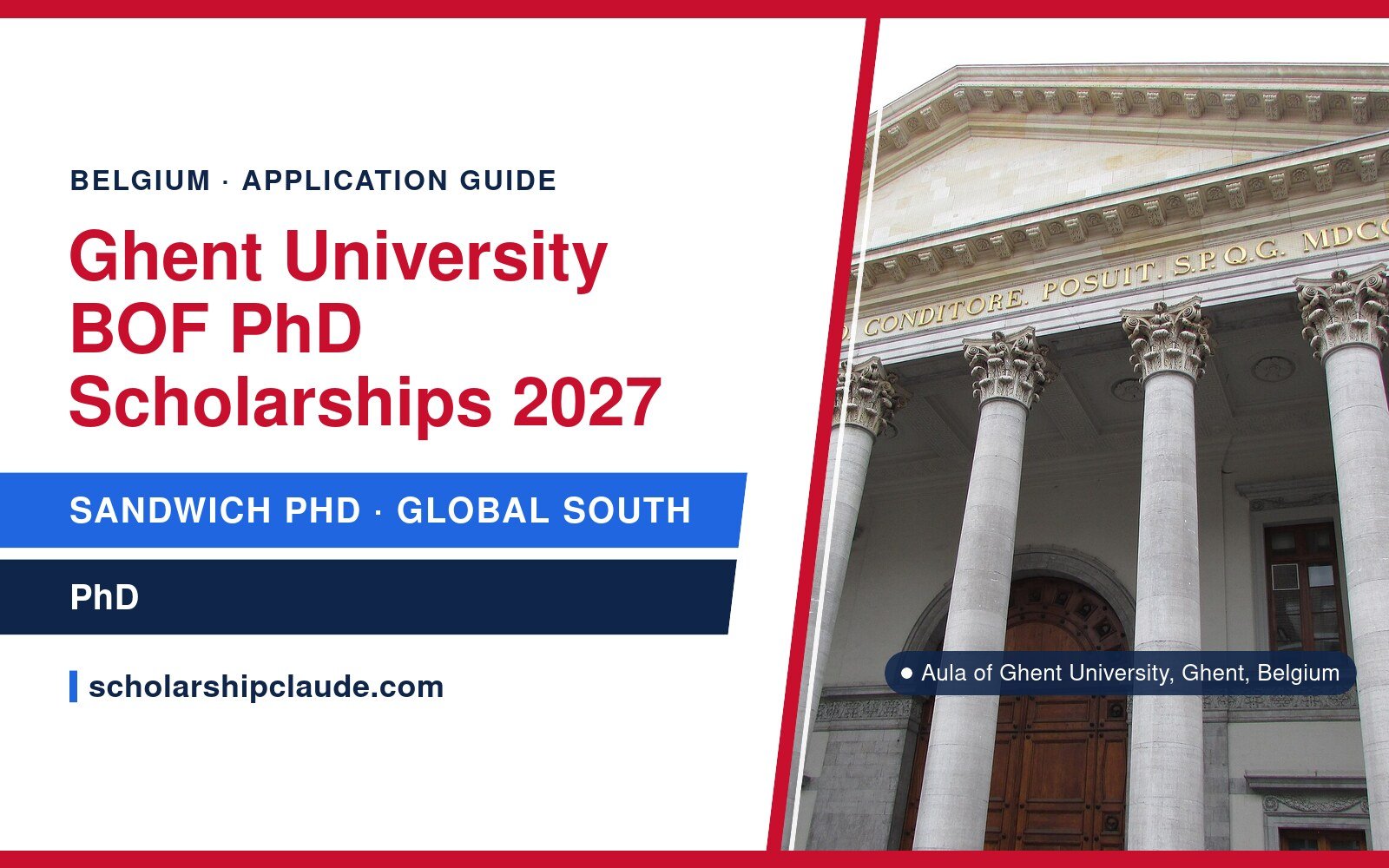
Ghent University in Belgium funds about 15 PhD scholarships a year for researchers from the Global South through its Special Research Fund (BOF). They are sandwich PhDs: you spend about half your PhD at Ghent University and half at a partner institution in your home region, and you earn a doctorate from Ghent. The closing date for the 2027 call is 9 February 2027, and the scholarship starts on 1 October 2027.
This guide was last checked on 21 October 2026 against Ghent University’s official call page for BOF Doctoral Scholarships for Candidates from the Global South.
Ghent BOF Doctoral Scholarships at a glance
| Official name | Special Research Fund (BOF) Doctoral Scholarships for Candidates from the Global South (DOS) |
|---|---|
| University | Ghent University, Belgium |
| Level | PhD or joint PhD |
| Length | 48 months, as a sandwich PhD |
| Ghent funds | 24 months of research in Ghent, a 310 euro monthly bench fee and an 8,000 euro travel budget |
| Partner funds | 24 months of research in the Global South |
| Scholarships a year | About 15 |
| Closing date | 9 February 2027 |
| Exception requests | 15 January 2027 |
| Results | From 12 May 2027 |
| Start date | 1 October 2027 |
Is this scholarship right for you?
The BOF sandwich scholarship suits a particular kind of researcher. Ask yourself these questions before you invest time in it:
- Do you want to keep a base at home? Half of your PhD happens in your home region. This suits people who already work at, or want to join, a university or research institute there.
- Is there local funding for you? The partner side must pay you a full-time scholarship or salary for 24 months. If no one can commit to that, the application cannot go ahead.
- Is your research question linked to your region? Topics relevant to the South-North context are preferred.
- Are you at the start of your PhD? At least 36 months of doctoral research must remain on 1 October 2027.
If your answers are yes, this is one of the few PhD schemes in Europe designed for researchers who want to stay connected to their home institutions.
What is a sandwich PhD?
In a sandwich PhD, your research is split between two places. Here, you start and end your PhD with a research stay at Ghent University, and in between you do at least 24 months of research at a partner institution in the Global South. The Ghent stays are the bread of the sandwich; your home research is the filling.
The call sets these rules:
- The PhD lasts 48 months in total.
- Ghent University funds 24 months, for the research done in Ghent.
- A partner institution in the Global South funds the other 24 months, through a full-time local PhD scholarship or salary.
- You start and end with a research stay at Ghent of 3 to 12 months.
- Your first stay in Ghent must begin between 1 October 2027 and 28 February 2028.
- At least 24 months of locally funded research in the Global South must fall between your two Ghent stays.
This structure lets you build a research career at home while working with a European university. It also means you need two committed supervisors and two sources of funding.
An example 48-month plan
This example only shows how the rules can fit together. Your own plan will depend on your project and your supervisors.
| Period | Where | Funded by |
|---|---|---|
| October 2027 to September 2028 (12 months) | Ghent University | Ghent BOF scholarship |
| October 2028 to September 2030 (24 months) | Partner institution, home region | Local PhD scholarship or salary |
| October 2030 to September 2031 (12 months) | Ghent University | Ghent BOF scholarship |
Each Ghent stay must last 3 to 12 months, the Ghent months add up to 24, and at least 24 locally funded months sit between the two Ghent stays.
What Ghent University pays
| Item | Details |
|---|---|
| PhD scholarship at Ghent | 24 months in total, for the research done in Ghent |
| Bench fee | 310 euros for each month of research in Ghent, paid to the Ghent supervisor |
| Travel budget | 8,000 euros for part of the operational costs and part of the travel of the student and both supervisors |
The monthly stipend amount for the Ghent months is not stated on the official call page. Ask your Ghent supervisor or the BOF office for the current amount before you plan your budget. The call says clearly that Ghent only finances the part of the research carried out in Ghent.
What the partner institution must provide
Co-funding is mandatory. During your 24 months of research in the Global South, you must receive a full-time local PhD scholarship or salary from the partner side. The conditions also mention a written statement from the partner confirming this local funding and an exemption from teaching, so that you can work on your research full-time. Without this commitment, the application does not meet the rules.
Who can apply
- Nationality: you must come from, and hold the nationality of, one of the countries on Ghent University’s Global South country list for 2027. The list is published as a PDF on the call page; check it first.
- Degree student: you must plan to earn a PhD or joint PhD at Ghent University. Exchange students cannot apply.
- Early stage: the scholarship is for the start of a PhD. On the start date, 1 October 2027, at least 36 months of doctoral research must remain.
- Supervisors: you need a Ghent University supervisor and a supervisor at the partner institution. They apply together with you.
- Supervisor limit: each Ghent supervisor can support at most two candidates in a call, and the two must be of different genders.
An age limit is not stated on the official source, and neither is an English test requirement. The application form must be completed in English.
Who applies: you and two supervisors
This is not a scholarship you can apply for alone. The proposal is submitted jointly by three people:
- You, the candidate: you send the completed application form, in English, to BOFapplication@ugent.be.
- Your Ghent University supervisor: they submit an advice on you as a candidate and an advice on the ethical and biosafety context of the project before the deadline.
- Your partner supervisor in the Global South: they help design the project and secure the 24 months of local funding.
This means your work starts months before the deadline, with finding the right supervisors.
Finding a Ghent University supervisor
Your Ghent supervisor (called a promoter at Ghent) is the most important person in your application. Here is a practical way to find one:
- Define your topic. Write one paragraph on the research question you want to work on and why it matters in your country or region.
- Search Ghent’s research groups. Look for professors who publish on your topic. Read two or three of their recent papers.
- Check existing links. Supervisors who already work with institutions in your country may find it easier to build the partnership the call requires.
- Write a short, specific email. Introduce yourself, explain your research idea in a few sentences, mention why their work fits, and attach your CV. Ask if they would consider supporting a BOF application for the 2027 call.
- Follow up politely. Professors receive many emails. If you get no reply after two weeks, send one short reminder, then move on to another supervisor.
Start now. Supervisors need time to read your proposal, discuss it with you and prepare their advice forms before 9 February 2027.
Questions to ask a potential Ghent supervisor
- Do you have experience supervising sandwich PhDs or researchers from my region?
- Which parts of this project would work best in Ghent, and which at my home institution?
- Are you supporting other candidates in this call? Each supervisor can support at most two.
- What is the current stipend for the Ghent months, and what costs should I plan for?
- Can we agree a timeline for drafts and your advice forms before 9 February 2027?
Securing the partner institution and local funding
The partner institution is usually a university or research institute in your home region where you will do your 24 months of local research. You need a supervisor there and a confirmed source of full-time funding for those 24 months, such as a PhD scholarship or a salary. If you already work at a university or research institute, talk to your head of department early about a teaching exemption and continued salary during your PhD.
If you need an exception to the funding or mobility rules, the request form is due by 15 January 2027, almost a month before the main deadline.
Choosing a topic
No field is excluded, but the call says preference goes to topics relevant within the South-North context. Ghent defines this as how far a proposal’s objectives match the needs of beneficiaries, synergy opportunities, global priorities and the policies of partners and donors. In practice, a strong topic:
- Addresses a real problem in your country or region.
- Benefits from both Ghent’s expertise and your partner institution’s local knowledge.
- Has results that people outside the university can use, such as policy makers, farmers, health services or industry.
Writing the research proposal
The application form is your research proposal. Download the 2027 form from the call page and follow its sections exactly. A clear proposal usually includes:
- Research question and objectives: what you want to find out and why it matters.
- Background: what is already known, with key references.
- Methods: how you will collect and analyse data, and which parts happen in Ghent and which at home.
- Work plan: a timeline for 48 months that shows your two Ghent stays and the local research period.
- South-North relevance: who benefits and how.
- Ethics: any ethical or biosafety issues, which your Ghent supervisor also addresses in a separate advice.
Our guide to the research proposal for PhD scholarships has a full structure and common mistakes.
How your supervisors can strengthen your application
Your two supervisors do more than sign forms. A strong application usually shows that they have worked on the project with you. Ask them to:
- Read and comment on your draft research proposal, especially the methods and work plan.
- Agree on which parts of the research happen in Ghent and which at the partner institution, so the plan matches the sandwich rules.
- Confirm the local funding and teaching exemption in writing in good time.
- For the Ghent supervisor: prepare the advice on you and the ethics and biosafety advice well before 9 February 2027.
Agree a shared timeline with both supervisors in December, so no one is surprised by the deadline.
Preparing your CV and academic record
Even though the call page does not list a CV as a separate document, your academic background will matter to your supervisors and the selection. Keep a research CV ready with your degrees, grades, thesis titles, publications, conference talks, research projects and relevant work. Have your transcripts and degree certificates ready to share with your Ghent supervisor, who will need them to judge your fit for a PhD at Ghent.
Key dates
| Date | What happens |
|---|---|
| 15 January 2027 | Deadline for exception requests on funding or mobility |
| 9 February 2027 | Closing date for applications and supervisor advice |
| From 12 May 2027 | Results published online |
| Within six weeks of results | Feedback for candidates who were not selected |
| 1 October 2027 | Scholarship start date |
| 1 October 2027 to 28 February 2028 | Window to begin your first research stay in Ghent |
A plan from now to 9 February
| When | What to do |
|---|---|
| Late October | Check the country list, define your topic and update your CV. |
| November | Contact possible Ghent supervisors and talk to your home institution about a partner supervisor and local funding. |
| December | Agree the project with both supervisors and start the application form. |
| By 15 January | Send any exception request. |
| Late January | Finish the form, get the partner’s funding confirmation and share drafts with both supervisors. |
| By 9 February | Email the application; your Ghent supervisor sends both advice forms. |
After the results
Ghent publishes results online from 12 May 2027. If you are not selected, you receive feedback within six weeks, which can help you prepare a stronger application for a later call. If you are selected:
- Your scholarship starts on 1 October 2027.
- Plan your first stay in Ghent to begin between 1 October 2027 and 28 February 2028, and agree its length (3 to 12 months) with your supervisors.
- Check the Belgian visa and residence rules for researchers and students on the official Belgian government websites, and apply early.
- Arrange housing in Ghent before you travel.
- Make sure the partner institution’s 24 months of funding is ready for when you return home.
Ghent also publishes a final report template for BOF scholarships on the call page, so you can see what will be expected at the end of the project.
Related PhD scholarships
- Hong Kong PhD Fellowship Scheme, closing 1 December 2026.
- MBZUAI PhD Scholarship in the UAE, closing 15 December 2026.
- CAS-ANSO Scholarship in China.
For more on preparing a research CV, see our research CV guide for PhD scholarships.
Common mistakes to avoid
- Applying without checking that your country is on the 2027 list.
- Contacting supervisors in January, when there is no time left to build the project.
- No confirmed local funding for the 24 months in the Global South.
- A proposal that does not explain the South-North relevance.
- Applying when you are already far into a PhD, so less than 36 months remain.
- Missing the 15 January deadline for exception requests.
Checklist before you submit
- My country is on Ghent’s Global South country list 2027.
- I have a Ghent supervisor and a partner supervisor who support the application.
- My partner institution has confirmed 24 months of local funding.
- My application form is complete and in English.
- My Ghent supervisor will send both advice forms before 9 February 2027.
- At least 36 months of my PhD will remain on 1 October 2027.
Frequently asked questions
Is the Ghent BOF scholarship fully funded?
Ghent funds the 24 months of research in Ghent, plus a bench fee and an 8,000 euro travel budget. The other 24 months must be funded locally by the partner side, so it is not fully funded by Ghent alone.
How much is the stipend?
Not stated on the official call page. Ask your Ghent supervisor or the BOF office.
Who sends the application?
You send the application form to BOFapplication@ugent.be. Your Ghent supervisor sends two advice forms.
How many scholarships are there?
Ghent funds about 15 a year.
When are results announced?
From 12 May 2027.
Can I apply without a supervisor?
No. The application is joint, with a Ghent supervisor and a partner supervisor.
Can I earn a joint PhD?
Yes. The call is open to degree students who intend to earn a PhD or a joint PhD at Ghent University. Discuss the joint degree option with both supervisors early, because it affects the agreements between the two institutions.
Is there an age limit?
An age limit is not stated on the official source.
Do I need an English test?
An English test is not stated on the official call page, but the application form must be completed in English.
Where to apply
Download the call, application form and country list from the official Ghent University call page. Our Ghent BOF scholarship page keeps the key facts in one place.
Scholarships with the nearest deadlines
| Scholarship | Funding | Stipend | Deadline |
|---|---|---|---|
| US–Pakistan Knowledge Corridor PhD Scholarships 2027 | Fully funded | Not stated on HEC's programme page (see the HEC advertisement) | 30 Oct 2026 |
| Honjo International Scholarship 2027 in Japan | Partial | 230,000 yen a month (degree of 1 to 2 years), 210,000 yen a month (3-year degree) or 180,000 yen a month (degree longer than 3 years) | 31 Oct 2026 |
| European Parliament Schuman Traineeships 2027 | Partial | Monthly grant paid; amount not stated on the official source | 31 Oct 2026 |
| University of Melbourne Graduate Research Scholarships 2027 in Australia | Fully funded | 41,100 Australian dollars a year (2027 rate), plus a full fee offset | 31 Oct 2026 (expected) |
| Australian Government RTP Scholarships 2027 in Australia | Fully funded | 2027 full-time RTP stipend: base rate 35,550 Australian dollars a year, maximum 55,537 Australian dollars a year | 31 Oct 2026 (expected) |
| DAAD EPOS Scholarship 2027/28 in Germany | Fully funded | 992 euros a month for graduates; 1,400 euros a month for doctoral candidates | 31 Oct 2026 (expected) |
| One Young World Leading Scholarship 2026 in South Africa | Partial | See the scholarship page | 31 Oct 2026 |
| UNU Junior Fellows Internship 2027 in Tokyo, Japan | Partial | Monthly stipend; amount not stated on the official source | 1 Nov 2026 |
| Open Doors Russian Scholarship Project 2026–27 in Russia | Partial | Tuition-free study; a monthly allowance is possible only with grant support for Russian-taught programmes | 1 Nov 2026 |
| Max Planck Computer Science Summer Internships 2027 in Germany | Fully funded | Monthly stipend (amount not stated on the official source) | 1 Nov 2026 |
This list updates itself from our scholarships page. Stipend figures are shown where the provider publishes them. See all scholarships.