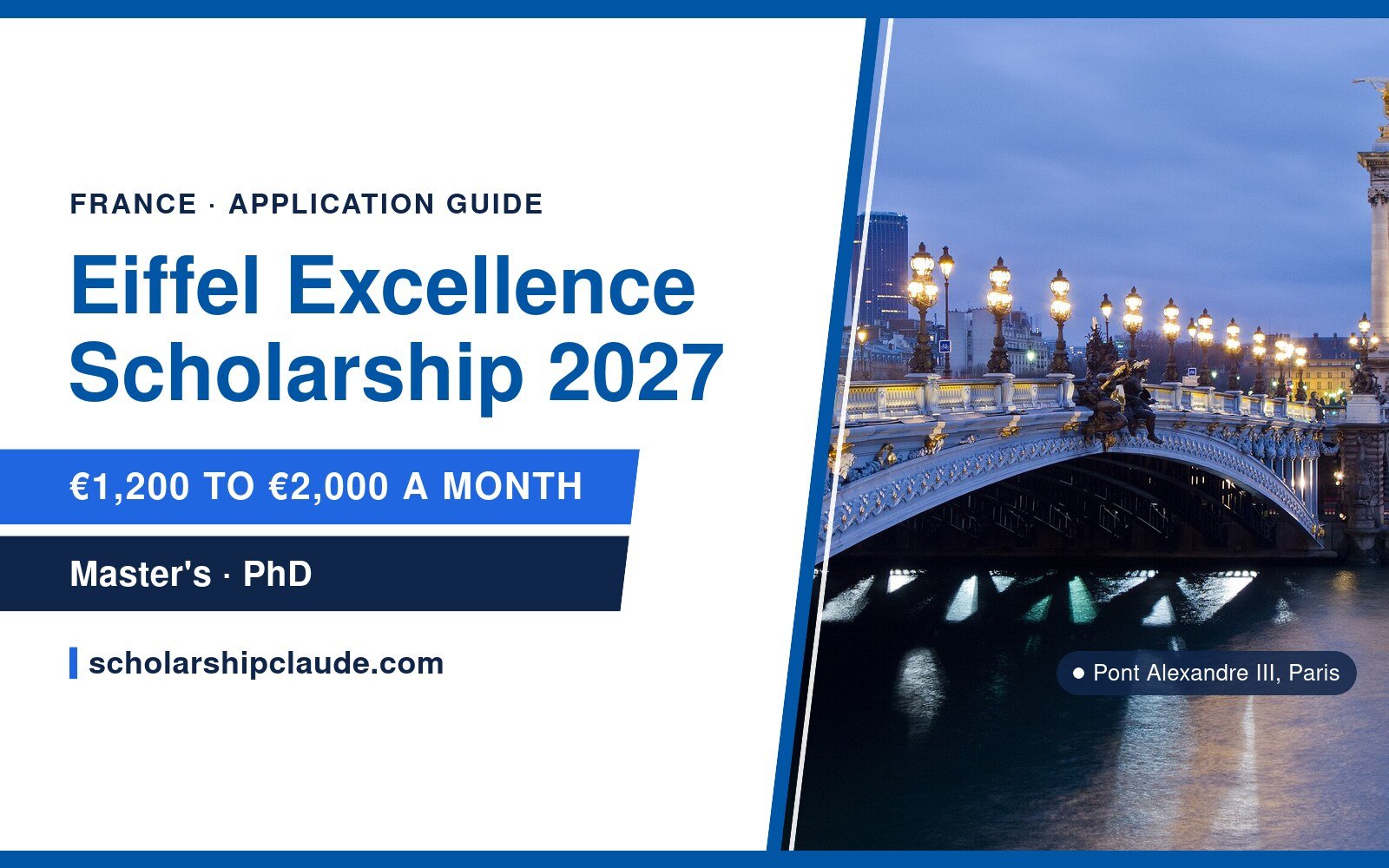
The France Excellence Eiffel Scholarship is the French government’s main scholarship for top international students on master’s, engineering and PhD programmes. It pays €1,200 a month to master’s students and €2,000 a month to PhD students, and adds travel, health insurance and help with housing. You cannot apply to Campus France yourself: a French university or school must put you forward. For 2027, institutions must submit their files by 6 January 2027, and each one sets an earlier deadline for its own students.
This guide was checked on 16 October 2026 against Campus France’s official Eiffel page, the 2027 application guide for institutions, the Eiffel programme rules and the Campus France guide for scholarship holders.
Eiffel scholarship 2027 at a glance
| Funded by | French Ministry for Europe and Foreign Affairs |
|---|---|
| Run by | Campus France |
| Levels | Master’s (M1 or M2), engineering degree, PhD |
| Monthly allowance | €1,200 (master’s and engineering) or €2,000 (PhD) |
| Other benefits | Ticket to France, travel to your city, health insurance, help with housing, cultural activities |
| Tuition | Exempt for national diplomas and accredited engineering degrees at public institutions |
| Age limit | 29 or younger (master’s), 35 or younger (PhD) |
| Nationality | Foreign nationals only; dual nationals who also hold French nationality are not eligible |
| Who submits the application | Your French institution, not you |
| Institution deadline | 6 January 2027 |
| Results | Week of 12 April 2027 |
| Start of studies | Between 1 September and 30 November 2027 |
What is the Eiffel scholarship?
The programme helps French universities, engineering schools and research institutions attract the best foreign students to their master’s and doctoral programmes. The French Ministry for Europe and Foreign Affairs pays for it, and Campus France, the national agency for international students, manages it.
There are two tracks. The master’s track funds students on a state-accredited master’s degree or an engineering degree. The PhD track funds doctoral students, including students on a joint PhD (cotutelle) or a co-supervised PhD with a partner university abroad.
The most important rule is how you apply. Campus France only accepts files from French institutions. You apply for a place on a programme, the institution decides whether to put you forward, and then it sends your file to Campus France. There is no way to apply around the institution.
Key dates for the 2027 campaign
| Step | Date |
|---|---|
| Call opens for institutions | 2 October 2026 |
| Your institution’s internal Eiffel deadline | Set by each institution, before January 2027 |
| Institutions submit files to Campus France | 6 January 2027 |
| Results sent to institutions and winners | Week of 12 April 2027 |
| Studies start in France | Between 1 September and 30 November 2027 |
6 January 2027 is the deadline for institutions, not for students. Each university or school sets its own internal date so it has time to choose its candidates and prepare their files. Ask your programme or international office for that date as soon as possible. Once you are selected, the start date in France cannot be postponed.
What the scholarship pays
Monthly allowance
| Track | Monthly allowance |
|---|---|
| Master’s and engineering | €1,200 |
| PhD | €2,000 |
These rates apply from January 2026. The first payment is usually sent through Western Union. After that, the allowance is paid by bank transfer to a French bank account in your name.
Other benefits
- Flight to France: an international ticket in the cheapest class, between the international airports nearest to your home and your place of study. If you buy your own ticket, Campus France can refund up to 50% of the ministry’s maximum rate, on receipts. A return ticket is paid only if you ask for it within 12 months of the end of the scholarship, and it depends on your final academic results.
- Travel inside France: a second-class train or bus ticket to your place of study.
- Health insurance: temporary cover when you arrive, then the French national health insurance plus supplementary cover (mutuelle) at no cost to you. You must send proof of your national cover within two months of arriving, or your payments can be suspended.
- Housing: Campus France can offer a room in a CROUS student residence or in private housing, or you can find your own. The rules describe this as help with housing; they do not say that housing is free.
- Cultural activities: subsidised weekend trips, sports, shows and other outings.
- Alumni network: access to the Eiffel alumni community through France Alumni.
Tuition fees
Eiffel scholars are exempt from tuition fees for a national diploma (master’s or doctorate) or an accredited engineering degree at a public institution, under article R719-49 of the French Education Code. Other programme costs are not covered. If you study at a private institution, or on a programme outside these rules, you may still have fees to pay, so ask your institution what an Eiffel scholar would pay.
How long the scholarship lasts
| Level | Maximum length |
|---|---|
| Master’s, second year (M2) | 12 months |
| Master’s, first year (M1) | 24 months |
| Engineering degree | 36 months |
| PhD, first year, newcomer to France, no cotutelle | 36 months |
| PhD, first or second year | 18 months |
| PhD, second or third year | 12 months |
Master’s students can ask for up to one extra month for French language training before their course starts, if they say so in the application. The scholarship does not pay the language course fees. PhD stays can be split into several periods of at least six months each, up to three years in total, except for 36-month awards.
Who can apply
- Nationality: you must be a foreign national. Dual nationals who also hold French nationality are not eligible.
- Age, master’s track: 29 or younger.
- Age, PhD track: 35 or younger.
- Programme: a state-accredited master’s or engineering degree, or a PhD, including a cotutelle or co-supervised PhD with a foreign partner.
- Field: one of the seven Eiffel fields listed below.
- One institution only: if two institutions put you forward, your application is rejected.
Age is counted at the time of selection. The 2027 guide for institutions gives birth-date cut-offs that look carried over from the previous year, so ask your institution to confirm the exact date that applies to you.
If you are already in France
- Master’s candidates who are already studying in France are not eligible.
- PhD candidates who are already studying in France can apply, but candidates studying abroad are given priority.
- The 36-month PhD award is only for newcomers who are not studying or enrolled in France.
- If you already had an Eiffel scholarship for a master’s, you cannot get a second one at master’s level.
Scholarships you cannot combine with Eiffel
Eiffel cannot be combined with another French government scholarship, or with an Erasmus+ or AUF scholarship.
Fields of study
Seven fields are eligible:
- Biology and health
- Ecological transition
- Mathematics and digital sciences
- Engineering sciences
- French history, language and civilisation
- Law and political science
- Economics and management
Your programme must fit one of these fields. Each field has its own expert panel, so ask your institution which field your file will be placed in.
Language requirements
The Eiffel programme does not set its own English or French test. A language certificate is needed only if your programme asks for one. When an institution puts forward a student who does not speak French, it must make sure the student’s language level matches what the programme requires. Some programmes are taught in English and others in French, so check the teaching language of your programme and the tests it accepts.
How candidates are selected
Campus France passes the files to a committee of seven expert panels, one for each field. Experts cannot assess files from institutions they belong to. For PhD files, the experts are senior researchers qualified to supervise doctorates (HDR) with international experience.
The main criteria are:
- Your academic excellence, based on your previous studies
- For PhD candidates, how innovative the research topic is
- The international reach of the institution and how it welcomes foreign students
The cooperation office of the French embassy in your country is also consulted, and the programme gives priority to certain countries. The 2027 guide does not list those countries. Each institution can put forward no more than 40 candidates per field and per track, so institutions choose carefully before they submit.
Documents you need
Your institution builds the file and uploads it to Campus France’s online platform. You give your documents to the institution by its internal deadline. Your institution may also have its own form or extra steps, so follow its instructions.
Master’s and engineering candidates
Required
- Copy of your passport or ID card showing your name and date of birth
- CV in French or English, two pages at most
- Copies of your latest diplomas with dates, subjects and grades, plus any proof of excellence such as your class ranking
- Transcripts for the last three years of study
- Professional project of one or two pages, in French or, if not, in English
- Signed candidate declaration and commitment form
Conditional
- Language certificate, if your programme requires one
- Double-degree agreement, if your programme is a double degree
Added by the institution
- The programme outline with its full calendar, and its accreditation details where relevant
PhD candidates
Required
- Copy of your passport or ID card
- CV in French or English, one or two pages
- Copies of your latest diplomas with grades, plus any proof of excellence
- Transcripts for the last three years of study
- Professional project of one or two pages, in French or English
- Thesis project of up to five pages, in French or English
- Signed candidate declaration and commitment form
- An external expert’s opinion on the scientific value of your thesis topic, with the expert’s CV (two pages at most). The expert must be a professor, research director or HDR holder from outside the submitting institution, working in the same field.
- The overall financing plan for the thesis
Conditional
- Language certificate, if your programme requires one
- Cotutelle agreement or co-supervision certificate, if relevant (a blank page for 36-month awards without one)
How to apply, step by step
- Choose a state-accredited master’s, engineering or PhD programme in one of the seven Eiffel fields.
- Check that you meet the nationality and age rules.
- Apply for admission to the programme. PhD candidates should agree a thesis topic and supervisor first.
- Ask the programme or international office if it takes part in Eiffel and what its internal deadline is.
- Prepare your documents, especially the professional project and, for PhD candidates, the thesis project and expert opinion.
- Sign the candidate commitment form and give the institution everything it asks for by its deadline.
- Make sure only one institution puts you forward.
- Your institution submits the file to Campus France by 6 January 2027.
- Results arrive in the week of 12 April 2027. If you are selected, plan to start your studies between 1 September and 30 November 2027.
Tips for a stronger application
- Start with the right programme. Your admission and your Eiffel nomination come from the same institution, so choose a programme that matches your record and your plans.
- Write a clear professional project. You have one or two pages to explain what you want to study, why in France, and how it fits your career. Be specific about your goals.
- Show your results. Selection rests on your academic record, so include rankings, honours or awards if you have them.
- PhD candidates: arrange the expert opinion early. The expert must be a senior researcher from outside your institution, and finding one takes time.
- Respect the page limits. The CV is limited to two pages and the PhD thesis project to five. Extra pages in the expert’s CV are not taken into account.
Our motivation letter template can help you shape the professional project, and our research proposal template helps with the thesis project.
Questions to ask your French institution
Because the institution, not Campus France, handles your Eiffel file, most of your practical questions go to the programme or international office. Ask early:
- Does the institution take part in the 2027 Eiffel campaign, and for which programmes?
- What is its internal Eiffel deadline, and how does it select its candidates?
- Does it need extra documents or an internal form beyond the Campus France list?
- Which Eiffel field will my programme be filed under?
- What tuition or other fees would I pay as an Eiffel scholar at this institution?
- Does it help Eiffel scholars find housing?
Institutions can put forward at most 40 candidates per field and per track, so they usually run their own internal selection. Knowing their process helps you prepare the right documents in time.
Choosing a programme with Eiffel in mind
Not every programme suits an Eiffel application. Look for a state-accredited master’s or engineering degree, or a PhD, in one of the seven Eiffel fields, at an institution that regularly puts forward international candidates. Ask the programme whether it has nominated Eiffel candidates before. A department with experience of the process can guide you on the professional project, the documents and the internal timeline.
Common mistakes to avoid
- Writing to Campus France to apply. It does not accept applications from students.
- Missing your institution’s internal deadline, which comes before 6 January 2027.
- Being put forward by two institutions. Your application is then rejected.
- Applying when you also hold French nationality.
- Applying to the master’s track while already studying in France.
- Accepting another French government, Erasmus+ or AUF scholarship for the same studies.
Frequently asked questions
Can I apply for the Eiffel scholarship directly?
No. Only French higher education institutions can submit applications to Campus France. You apply to a programme and the institution puts you forward.
Is the Eiffel scholarship fully funded?
At a public institution, on a national diploma or accredited engineering degree, you are exempt from tuition and receive a monthly allowance, travel and health insurance. At a private institution you may still pay some fees. Whether the allowance covers all your living costs depends on your city.
How much is the Eiffel allowance?
€1,200 a month for master’s and engineering students and €2,000 a month for PhD students, at the rates in force since January 2026.
What is the age limit?
29 or younger for the master’s track and 35 or younger for the PhD track.
Do I need IELTS for the Eiffel scholarship?
Eiffel does not set its own test. You need a language certificate only if your programme asks for one.
What is the Eiffel deadline for 2027?
Institutions must submit files by 6 January 2027. Your own deadline is earlier and is set by your institution.
Can I apply if I already study in France?
Not for the master’s track. PhD candidates in France can apply, but candidates studying abroad have priority.
When are the results announced?
Results are sent by email in the week of 12 April 2027.
Can I postpone my Eiffel scholarship?
No. Studies must start between 1 September and 30 November 2027, and the start date cannot be postponed.
Who pays the allowance?
The French Ministry for Europe and Foreign Affairs funds the programme, and Campus France manages the payments.
Official links
Read the official Campus France Eiffel page (in French), which has the 2027 calendar, rules and application guide, and the English Campus France guide for Eiffel scholarship holders. Our Eiffel scholarship page keeps the key facts in one place, and our guide to scholarships in France lists other options.
Related scholarships: funding, stipend and deadlines
| Scholarship | Funding | Stipend | Deadline |
|---|---|---|---|
| Sciences Po Émile Boutmy Scholarship 2027 in France | Partial | Tuition exemption of 18,500 euros a year at master's level | 29 Nov 2026 |
| ENS International Selection 2027 in France | Partial | €1,000 a month for 36 months | 15 Dec 2026 |
| MOPGA Visiting Fellowship 2027 in France for Early-Career Researchers | Partial | 2,500 euros a month for 12 months, plus a 500 euro settling-in allowance | 15 Dec 2026 |
| Sorbonne University Scholarships 2027 in France | Partial | See the scholarship page | 6 Jan 2027 |
| Eiffel Excellence Scholarship 2027 in France | Partial | €1,200 a month (master's), €2,000 a month (PhD) | 6 Jan 2027 |
This list updates itself from our scholarships page. Stipend figures are shown where the provider publishes them. See all scholarships.