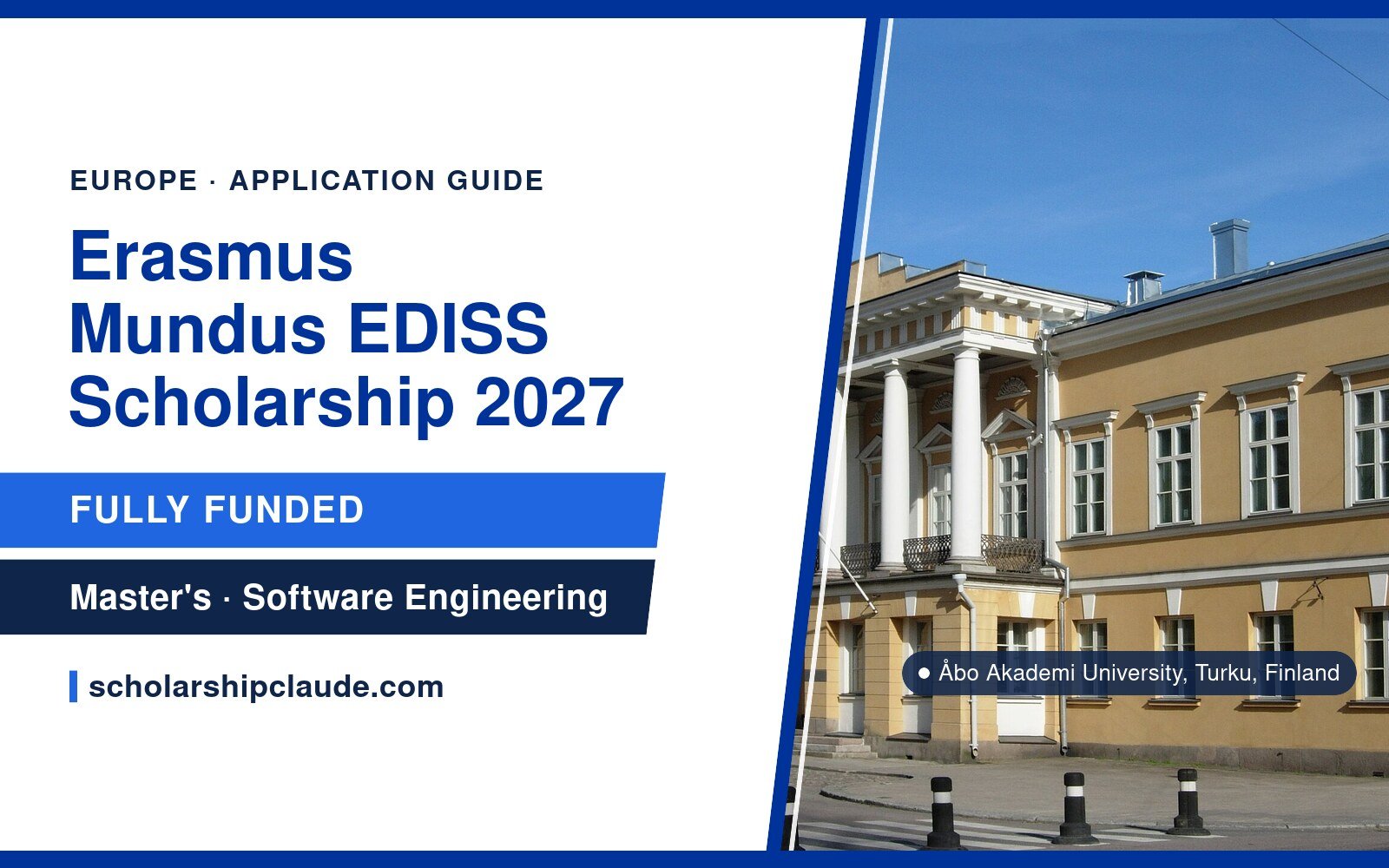
EDISS is a two-year Erasmus Mundus Joint Master in Engineering of Data-intensive Intelligent Software Systems. You spend the first year at Åbo Akademi University in Finland and the second year at a partner university in Sweden, Spain or Italy, and you graduate with two master’s degrees. Students of any nationality can apply. The scholarship round for the 2027 intake opens on 16 November 2026 and closes on 12 January 2027.
This guide was checked on 20 October 2026 against the official EDISS website: the application rounds, admission requirements, scholarship, application process, evaluation criteria, curriculum and degree pages.
EDISS at a glance
| Programme | EDISS, Engineering of Data-intensive Intelligent Software Systems (Erasmus Mundus Joint Master) |
|---|---|
| Year 1 | Åbo Akademi University, Finland |
| Year 2 | Mälardalen University (Sweden), University of the Balearic Islands (Spain) or University of L’Aquila (Italy) |
| Degrees | Double degree: one from Åbo Akademi and one from your second-year university |
| Studies start | August 2027 (Intake 7) |
| Scholarships | Erasmus Mundus scholarship, EDISS scholarship and tuition fee waiver scholarship |
| Where to apply | Studyinfo.fi |
| Scholarship round | 16 November 2026 to 12 January 2027 |
| Fee waiver round | 25 February to 11 March 2027 |
| Self-funded round | 6 to 15 April 2027 |
| Application fee | Not stated on the official source |
What is EDISS?
EDISS is about building software systems that collect, process and act on large amounts of data. The programme’s website says it brings together software engineering educators who work on data collection, data-driven assessment and decision-making, with practitioners in data pipelines, data architectures, DataOps and experimentation systems. It describes intelligent systems as coming from application development combined with artificial intelligence, the Internet of Things and big data analytics.
As an Erasmus Mundus Joint Master, it is run by a group of European universities together, and the European Union funds scholarships for top-ranked applicants. You study in at least two countries and receive degrees from two universities.
The first year at Åbo Akademi University
The whole first year, 60 ECTS, is at Åbo Akademi University in Finland. The curriculum page lists two modules.
| Module | Credits | Content |
|---|---|---|
| Core, compulsory | 20 ECTS | Data Science, Artificial Intelligence, Machine Learning, Edge Computing for ML (5 ECTS each) |
| Core, electives | 20 ECTS | Four 5-ECTS courses from a list that includes Software Quality, Cloud Computing, Parallel Computing, System Safety, Autonomic Software and Systems, Analytics for Industrial Internet, System Architecture of IoT, High Performance Computing for AI and Data-driven Computing Architectures |
| Project and practice | 20 ECTS | Internship, Winter School, Data Intensive Engineering I and Data Intensive Engineering II (5 ECTS each) |
The curriculum page was last updated some time ago, so course names can change. Check the current list when you are admitted.
Second-year specialisations
In the second year you move to one partner university, based on the mobility path you choose. In every specialisation the first semester trains you for research and your thesis, and the second semester is for the thesis itself.
| University | Specialisation | Examples of courses |
|---|---|---|
| Mälardalen University, Sweden | Industrial Software Engineering | Research Methods in Computer Science, Distributed Software Development, Safety-critical Systems Engineering, Software Verification and Validation, Web Security; 30 ECTS thesis |
| University of the Balearic Islands, Spain | Computer Vision and Intelligent Systems | Computer Vision and 3-D Reconstruction, Image and Video Analysis, Medical Image Processing; 18 ECTS master’s thesis |
| University of L’Aquila, Italy | Model Driven Machine Learning – Software Engineering | Machine Learning for Model Driven Engineering, Model-Driven Engineering, Software Architectures; 6 ECTS internship and thesis defence |
Degrees you receive
EDISS graduates receive a double degree. Åbo Akademi always awards one diploma, and your second-year university awards the other.
- Åbo Akademi University: Master of Science (Technology) in Computer Engineering.
- Mälardalen University: Master of Science in Computer Science, or Master of Science in Computer Science with specialisation in Software Engineering, depending on your courses.
- University of L’Aquila: Master’s degree in Computer Science.
- University of the Balearic Islands: Master’s degree in Intelligent Systems.
You also receive a Joint Diploma Supplement that describes your studies.
The three scholarships
EDISS charges a participation cost of 9,000 euros a year. It includes tuition, insurance, travel and accommodation for the compulsory winter school, orientation, student services and tutor help. The scholarship page gives these amounts for the most recent intake (studies starting August 2026). Figures for the 2027 intake were not yet published when we checked.
| Scholarship | What it covers | Total value |
|---|---|---|
| Erasmus Mundus scholarship | Participation cost of 9,000 euros a year, health insurance, and 1,400 euros a month for 24 months | 51,600 euros |
| EDISS scholarship | Participation cost, health insurance, 800 euros a month in year 1 and 310 euros a month in year 2 | 31,320 euros |
| Tuition fee waiver scholarship | Participation cost and health insurance, with no monthly allowance | 18,000 euros |
All three are open to every nationality. The number of awards is not stated on the official source. EDISS and fee waiver holders may also be eligible for an Erasmus+ mobility grant in the second year; the scholarship page quotes 490 to 540 euros a month based on the 2024–25 rate. The Erasmus Mundus scholarship is not available to anyone who has already held an Erasmus Mundus master’s or joint doctorate scholarship, and it cannot be combined with another EU-funded scholarship for the same course.
What the participation cost does not include
- Travel to and from your home country.
- Travel between universities, and for your internship or thesis.
- Visa and residence permit costs.
- Accommodation and living costs.
- Textbooks and equipment.
- Local fees such as student union and health care fees.
If you receive an EDISS or fee waiver scholarship, these costs come from your own money, so plan a budget before you accept.
Three application rounds
| Round | Dates | Who it is for |
|---|---|---|
| 1 | 16 November 2026 to 12 January 2027 | Erasmus Mundus and EDISS scholarships |
| 2 | 25 February to 11 March 2027 | Tuition fee waiver scholarship |
| 3 | 6 to 15 April 2027 | Self-funded students |
In round 1, eligible applications are considered for both the Erasmus Mundus and EDISS scholarships automatically. Rounds 2 and 3 need a new application, even if you applied in an earlier round. No scholarships are awarded in round 3.
Who can apply
- A bachelor’s or equivalent degree of at least 180 ECTS from an accredited university, in computer science, software engineering or an equivalent subject.
- Basic knowledge of computer science, software engineering and applied mathematics.
- Passed courses in several of these areas: programming, algorithms and data structures, basic computer architecture, computer networks, software engineering and mathematics.
- Good English, shown by a test or an exemption.
The programme also says it expects you to be able to solve basic computer science problems, build a given software artefact such as a requirements or design model, and improve or fix a given design.
If you are in your final year
You can apply before you graduate. Upload an official statement from your university giving your expected graduation date and the courses you still need to complete, with your transcript. You may then be admitted on condition that you send your final documents. The application process page says they must arrive by the last Friday of July. Confirm the exact date with the programme office.
English requirements
| Test | Minimum |
|---|---|
| IELTS Academic | 6.5 overall, no band below 6 (the online version is not accepted) |
| TOEFL iBT (taken before 21 January 2026) | 93 |
| TOEFL iBT (taken on or after 21 January 2026) | 4.5, no band below 4 |
TOEFL Home Edition is not accepted, and the EDISS institution code is 9880. No other tests are accepted. Your result must still be valid and verifiable at least 14 days after the application round ends.
You do not need a test if your secondary education, or a bachelor’s or master’s degree taught in English (and stated on the diploma), was completed in Australia, Canada, New Zealand, the United Kingdom, the USA, Switzerland or an EU/EEA country. Distance-learning and offshore-campus degrees do not count. Current students of the four EDISS universities can instead submit a certificate showing English at B2 level. If you need a test, our comparison of IELTS and TOEFL can help you choose.
Documents you need
All files are PDFs except the video. Scans must be in colour and include every page with text, stamps or serial numbers. EDISS asks you to name files in the form lastname-firstname-document.
- Bachelor’s degree certificate: an officially certified or legalised scan in the original language, plus an authorised English translation.
- Transcript of records: certified or legalised, with an English translation, showing all courses, credits and grades. You must also state your cumulative GPA, the maximum GPA in your system, your grading scale and, if available, the conversion scheme.
- Diploma supplement, if your university issues one.
- English proof: your IELTS or TOEFL report number, or the exemption document.
- Passport: a colour copy of a valid passport.
- CV on the EDISS template: a fillable PDF with five sections. Your answers must fit the space given.
- Two academic recommendation letters: signed, preferably on university letterhead with a stamp.
- Motivation video: about 2 minutes, give or take 30 seconds.
- Certificates for every experience you list: work, international experience, publications, summer schools, awards or certifications.
How applications are scored
EDISS publishes its scoring scheme, which helps you see where to spend your time.
| Criterion | Points | Based on |
|---|---|---|
| Academic merit | 0–70 | Grades, with extra attention to computer science, computer architecture, networks, software engineering, mathematics and thesis work |
| Previous relevant experience | 0–15 | Professional, academic, volunteer, entrepreneurial, international and other experience, backed by documents |
| Personal motivation | 0–10 | The motivation video |
| Recommendations | 0–5 | The two academic letters |
Incomplete applications are ruled ineligible before scoring. Eligible applicants are ranked by total score, and if two totals are equal, the one with the higher academic merit score ranks first. No minimum score is published.
Using the scores to plan your effort
- Academic merit is 70 of 100 points. Your grades matter most. Make sure your transcript, GPA, maximum GPA and grading scale are clear, so nothing is misread.
- Experience counts only with proof. Only experiences supported by uploaded documents are considered. Collect internship letters, certificates and links to publications now.
- The video is your motivation letter. There is no written motivation letter in the document list, so the video carries your story.
- Letters are worth 5 points, but missing letters can make your application incomplete. Ask early.
Filling in the EDISS CV template
EDISS does not accept your own CV design. You must use its fillable template, which has five sections:
- Personal information.
- Education, with room for two entries.
- Relevant work or entrepreneurial experience, up to four.
- Relevant international experience, up to three.
- Other relevant experience, skills and accomplishments, up to three.
Do not list the same experience in two sections, and keep each answer inside its box. Pick your strongest items rather than listing everything. For each item, upload a supporting document, because the programme ignores experiences without proof. Our academic CV guide explains how to describe experience in short, clear lines, which also works inside a fixed template.
Recording the motivation video
The video should last about 2 minutes, give or take 30 seconds, and must answer three questions:
- What is your main motivation, and why should you be chosen?
- What is your main scientific interest in the EDISS fields?
- How does your background make you suitable?
Give each question about 40 seconds. Accepted formats include mp4, MPEG, OGG and MOV. Some practical tips:
- Write a script of about 250 to 300 words and practise until you can speak it naturally, without reading.
- Name a concrete interest, such as data pipelines, edge machine learning or computer vision, and link it to one second-year specialisation.
- Mention one project you did and what you learned from it.
- Record in a quiet room with good light, and check the file plays before you upload it.
Recommendation letters
Only academic letters are accepted. They should be signed and, if possible, on university letterhead with a stamp. You can upload them yourself, or your referee can email them to ediss@abo.fi before the deadline with the subject line RL_lastname_firstname_application ID. Letters that arrive late are not reviewed. Ask teachers who taught you programming, software engineering or data courses. Our guide on strong recommendation letters explains how to brief them.
How to apply on Studyinfo.fi
- Check the academic and English requirements, and book a test early if you need one.
- Prepare all documents as colour PDF scans, and record your video.
- Open the EDISS form on Studyinfo.fi during the round. You cannot save a draft, so complete all fields and upload everything in one session.
- Submit and keep the confirmation email. It contains a personal link that lets you edit your application until the deadline. Do not share that link.
- If admitted, bring your original degree certificate and transcripts with official translations to Finland, where they are verified.
Late applications and documents are not processed, and documents sent by email are not reviewed. The only email exception is recommendation letters sent by referees before the deadline.
A plan from now to 12 January
| When | What to do |
|---|---|
| Late October | Check eligibility, book an English test if needed, and ask two academic referees. |
| Early November | Order certified copies and translations, collect certificates for every experience, and download the CV template. |
| 16 November onwards | Fill in the CV template, record the video and prepare all PDFs. |
| By late December | Submit on Studyinfo.fi in one session. |
| Before 12 January | Check your application through your personal link and confirm your letters have arrived. |
Results and appeals
The official source does not give a date for results. The application process page says appeals about admission must be filed within 14 days of publication and are handled by Åbo Akademi University. Scholarship decisions cannot be appealed.
Similar Erasmus Mundus master’s programmes
- DEAI, Data Engineering and Artificial Intelligence, at ULB, UPC, TU Wien, Lyon 1 and Padua.
- CYBERSURE, Cybersecurity and Assurance, starting at NTNU in Norway.
Under the Erasmus Mundus rules explained in our Erasmus Mundus scholarship guide, you can apply to up to three programmes in the same year. Our Erasmus Mundus catalogue 2027 guide shows how to find more.
Common mistakes to avoid
- Using your own CV layout instead of the EDISS template.
- Listing experiences without uploading proof.
- Taking the IELTS online or TOEFL Home Edition, which are not accepted.
- Forgetting to state your GPA, maximum GPA and grading scale.
- Starting the form late and finding you cannot save a draft.
- Assuming a round 1 application also counts for rounds 2 or 3.
Checklist before you submit
- My bachelor’s is in computer science, software engineering or an equivalent subject, worth at least 180 ECTS.
- My English test or exemption meets the rules.
- My degree and transcripts are certified, translated and scanned in colour.
- My CV is on the EDISS template and every experience has a document.
- My video lasts about 2 minutes and answers all three questions.
- My two academic letters are uploaded or on their way before the deadline.
Frequently asked questions
Is EDISS fully funded?
The Erasmus Mundus scholarship covers the participation cost, health insurance and 1,400 euros a month for 24 months. The EDISS scholarship covers the participation cost with a smaller monthly allowance, and the fee waiver covers the participation cost only.
When is the deadline?
The scholarship round closes on 12 January 2027. The fee waiver round closes on 11 March 2027 and the self-funded round on 15 April 2027.
Is there a written motivation letter?
The document list does not include one. Your motivation is assessed through the video.
Can I apply in my final year?
Yes. Upload an official statement with your expected graduation date and remaining courses, and you may be admitted conditionally.
How many scholarships are there?
Not stated on the official source.
Is there an interview?
No interview is mentioned for most applicants. Current students of the partner universities who use the B2 certificate exemption may be asked to an interview to check their English.
Where to apply
Read the full rules on the official EDISS admission requirements page and the application process page. Our EDISS scholarship page keeps the key facts in one place.
Related scholarships: funding, stipend and deadlines
| Scholarship | Funding | Stipend | Deadline |
|---|---|---|---|
| KTH Scholarship 2027 in Sweden | Partial | See the scholarship page | 15 Jan 2027 |
| Uppsala University Global Scholarships 2027 in Sweden | Partial | See the scholarship page | 2 Feb 2027 (expected) |
| Swedish Institute Scholarship | Fully funded | 12,000 Swedish kronor a month, plus a travel grant of 15,000 kronor | 25 Feb 2027 (expected) |
This list updates itself from our scholarships page. Stipend figures are shown where the provider publishes them. See all scholarships.