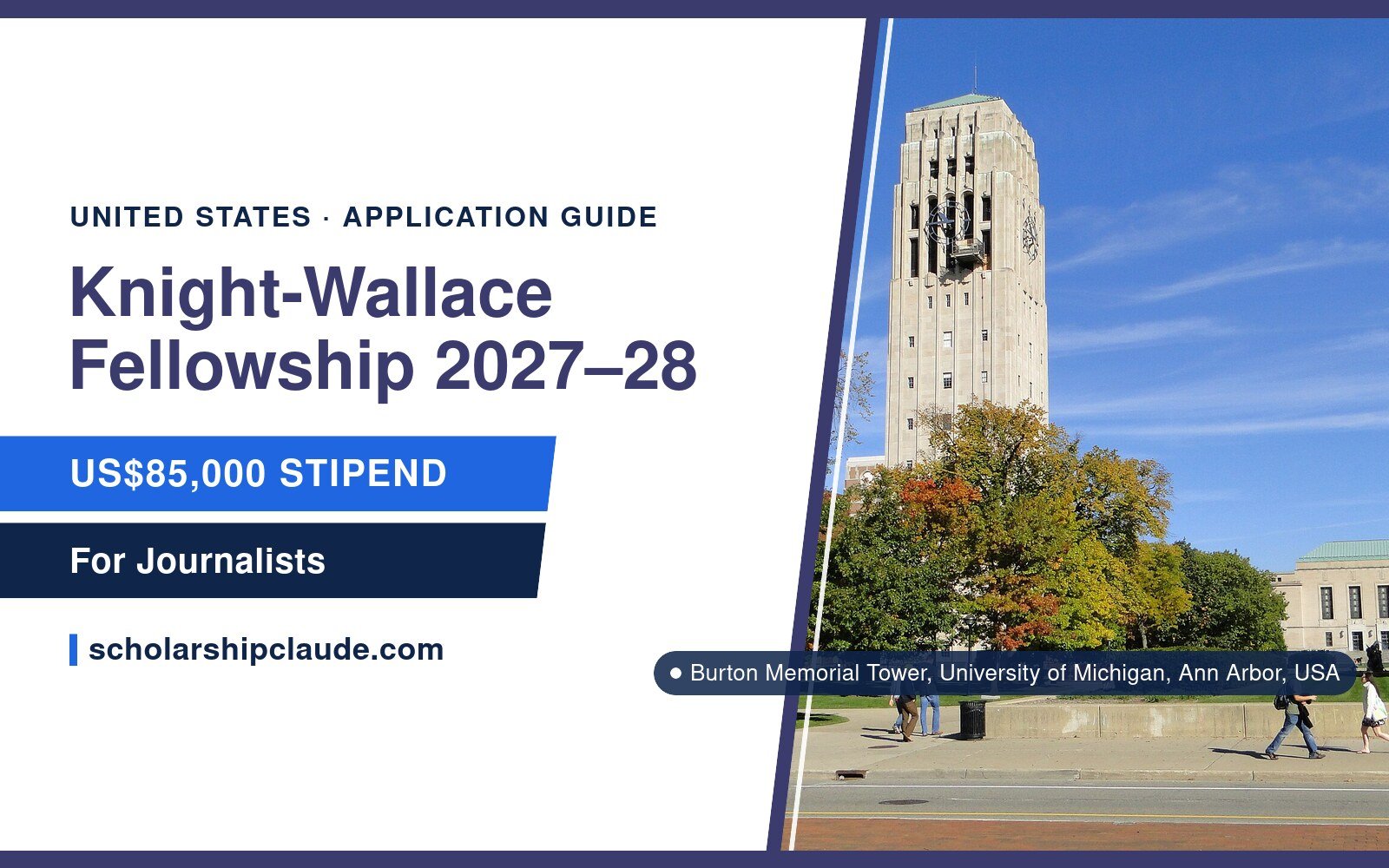
The Knight-Wallace Fellowship gives experienced journalists eight months at the University of Michigan to study, learn and work on a project of their own. Fellows receive a stipend of 85,000 US dollars, 5,000 dollars for relocation and paid health insurance. Journalists from every country can apply. The closing date for international applicants for 2027–2028 is 1 December 2026.
This guide was last checked on 21 October 2026 against the official Wallace House website: the fellowship, about, how to apply, international applicants and application FAQ pages.
Knight-Wallace Fellowship at a glance
| Host | Wallace House Center for Journalists, University of Michigan, Ann Arbor, USA |
|---|---|
| Who it is for | Journalists with at least five years of experience |
| Length | Eight months, late August 2027 to April 2028 |
| Stipend | 85,000 US dollars, paid monthly from August to April |
| Other support | 5,000 dollars for relocation, housing help, health insurance, course auditing, J-1 visa sponsorship |
| Fellows a year | Up to 19, usually including up to six international fellows |
| International closing date | 1 December 2026 |
| US closing date | 1 February 2027 |
| Application fee | Not stated on the official source |
What is the Knight-Wallace Fellowship?
Wallace House at the University of Michigan runs the fellowship for accomplished journalists who are ready for their next career step. Fellows step away from daily deadlines for an academic year. They study at the university, attend private off-the-record seminars with newsroom leaders and experts, take part in workshops and an international trip, and work on an individual journalism project.
The project can focus on building skills, a challenge in your newsroom, a long-term reporting project or a new journalism venture. The FAQ gives data reporting and developing a venture as examples.
Is the Knight-Wallace Fellowship right for you?
This fellowship is not a scholarship for a degree. It is a paid year away from deadlines for working journalists. Ask yourself these questions before you apply.
- Do you have five years of journalism behind you? The minimum is five years. Count only journalism work, not public relations, advocacy or communications jobs.
- Is journalism your main work today? You must currently work in journalism. If you have moved into another field, you do not meet the rule.
- Can you leave your job for eight months? Fellows take a leave of absence, live in Ann Arbor and cannot take new assignments. Plan this with your employer or clients.
- Do you have a clear question to work on? The project proposal is central. If you cannot yet say what you want to learn or build, spend time on that first.
If your answers are yes, the fellowship offers time, money and access to a large research university that few journalists ever get.
Choosing a strong project
Wallace House gives four broad types of project: sharpening your skills, solving a challenge in your newsroom, a long-term reporting project, or a new journalism venture. Whatever you choose, a strong project has three things:
- A clear focus. One question or goal, not a list of interests.
- A link to the university. Subjects and resources at the University of Michigan that will help, such as data science, public health, law or business, described by area rather than by course name.
- A use after the year. What changes for you, your newsroom or your audience when you return.
For example, a reporter covering health might propose learning data methods to investigate hospital records. An editor might propose designing a training plan for a small newsroom. Use your own idea; these only show the level of focus that works.
What fellows receive
- Stipend: 85,000 US dollars, paid monthly from August through April.
- Relocation: 5,000 dollars, plus individual help finding and securing housing.
- Health insurance: costs paid by Wallace House.
- Courses: Wallace House pays for fellows to audit University of Michigan courses.
- Visas: Wallace House sponsors J-1 visas for fellows and J-2 visas for legal spouses and dependent children. It cannot help with other visa types, such as for unmarried partners or non-dependent children.
- Family: spouses and partners can join fellowship activities and audit courses.
- Programme: seminars, workshops and an international trip.
Tuition is not mentioned, because fellows audit courses rather than study for a degree. Whether all costs of the international trip are covered is not stated on the official source.
Who can apply
- At least five years of journalism experience.
- You must currently work in journalism, for a news organisation or as an independent journalist.
- Full-time journalists qualify. Others must do mostly journalism work.
- Not eligible: public relations writers, internal trade writers, lobbyists, public advocates and people seeking a degree.
The fellowship is open to reporters, editors, photographers, and audio and video journalists; the work sample rules cover all of these. Reporting Fellowship alumni can also apply for this fellowship.
International or US application?
You apply according to citizenship. US citizens use the US application, even if they live abroad or work for non-US outlets. Everyone else uses the international application, even if they work in the USA. A Green Card does not count as citizenship. International applications uploaded to the US portal are not considered.
What the fellowship asks of you
- Live in Ann Arbor for the whole fellowship and arrive by mid-August 2027.
- Attend all seminars and events, and make the fellowship your main professional focus.
- Take a leave of absence and do not accept new assignments during the fellowship. Limited work such as commentary, blogging or speaking is allowed.
Employer approval is not required to apply, but Wallace House encourages newsroom applicants to talk to their employers about a leave of absence early.
What the year looks like
The fellowship runs for eight months, from late August to April. Each fellow follows their own plan, but the year has a shared structure:
- Your project: the core of the year, using the university’s faculty and specialised resources.
- University courses: you audit courses that support your project, paid for by Wallace House.
- Seminars: private, off-the-record sessions with newsroom leaders and experts.
- Workshops: practical sessions with the rest of the class.
- An international trip: part of the programme, with safety reviewed continuously.
Classes are small, with up to 19 fellows, so you also learn from journalists from other countries and newsrooms.
A note on the Great Lakes Local News Fellowship
Wallace House also offers a specialised Great Lakes Local News Fellowship for two US journalists building local news in Illinois, Indiana, Michigan, Minnesota, Ohio or Wisconsin. It is for US applicants only. International journalists apply for the general Knight-Wallace Fellowship.
Key dates for 2027–2028
| Step | International applicants | US applicants |
|---|---|---|
| Applications open | October 2026 (open now) | Open now |
| Closing date | 1 December 2026 | 1 February 2027 |
| Interviews | Early 2027 | April 2027 |
| Offers | February to March 2027 | Early May 2027 |
| Fellowship starts | Late August 2027 | Late August 2027 |
The two official pages give slightly different interview dates for international applicants. The how to apply page says interviews in January and February with offers by mid-February. The FAQ says phase two invitations in January, interviews in February and March, and offers in March. Either way, international interviews come early so there is time for visas.
The application in two phases
The international application has two phases. You only complete phase one now. You can save your work and return to it before you submit.
Phase one (everyone)
- Basic information: contact details, demographic information and questions about your journalism background.
- Resume: all relevant positions since your formal education, your education, and professional awards.
- Journalism project proposal: no more than 500 words on what you hope to gain for yourself, your news organisation or journalism more broadly. Name academic areas, subjects or university resources you want to use, not specific courses.
- Fellowship project summary: 60 words or fewer.
- Personal statement: up to 1,500 words on what inspires you as a journalist, including life experiences, professional interests and core ethical values, and why you are applying now.
- Three work samples from the past three years (see below).
- Reference names: name, title and affiliation of each reference.
Phase two (semi-finalists only)
If you are selected as a semi-finalist, Wallace House will ask you to complete phase two, which requires references and may include more work samples.
Work sample rules
- Print, digital and graphics: include publication dates.
- Photography: captions with when and where each was published; photos must be from the past two years.
- Video and audio: 30 minutes in total at most, from the past two years, with dates aired or posted and a statement of your role.
- Editors and managers: a statement of up to 500 words on your responsibilities and approach, plus optional stories with a description of your role.
- Other languages: work not in English needs English translations.
- Links: URLs must stay active through the review period.
Choose samples that show range and your best judgement, and that connect to the project you propose.
How to choose your three work samples
You can send only three pieces, so each one must do a job:
- Your strongest piece: the work you are most proud of, where your role was central.
- A piece that shows range: a different format, topic or skill, such as a data story, an investigation or a long feature.
- A piece linked to your project: work that shows why your proposed project makes sense for you.
Check the date rules before you choose. Written work must be from the past three years, and photos, video and audio from the past two years. Give each sample a short note on your role, especially for team projects.
Preparing your resume
Your resume should list every relevant journalism position since you finished your formal education, with dates, outlet names and your role. Add your education and professional awards. Put the most recent job first. If you are an independent journalist, list the main outlets you have worked for and the type of work. Our CV template shows a clean layout you can adapt for a journalism resume.
If English is not your first language
Many international fellows work mainly in another language. That is not a barrier, but your written materials must be your own. Write in short, clear sentences. Read your proposal and statement aloud to check they make sense. Translate your work samples carefully, because reviewers will rely on the English versions. An English language test is not stated as a requirement on the official source.
Planning the year in Ann Arbor
If you are selected, start planning straight away. International interviews happen early in 2027 so there is time for the J-1 visa. Wallace House helps fellows find housing based on their needs, and the 5,000 dollar relocation payment helps with moving costs. If your spouse or dependent children will join you, they can come on J-2 visas. Unmarried partners and non-dependent children need to find another visa route, because Wallace House cannot sponsor other visa types. Arrive by mid-August 2027, ready for the start in late August.
Writing the project proposal
The proposal is only 500 words, so keep it focused:
- The problem: what question, skill gap or newsroom challenge you want to work on.
- Why it matters: who benefits, such as your audience, your newsroom or journalism in your country.
- What you will use: the academic areas and university resources that will help, described by subject rather than course names.
- The result: what you will bring back, such as a new skill, a reporting plan or a working model for a venture.
Then write the 60-word summary last. It should say the same thing in two or three sentences.
The 60-word project summary
The summary is short, but reviewers may read it first. Use one sentence for the problem, one for what you will do at Michigan, and one for the result. Avoid general phrases such as “improve journalism”. Name the topic, the method and who benefits. Count the words carefully, because 60 is the limit, and make sure the summary matches your full proposal.
Writing the personal statement
You have up to 1,500 words, which is room for a real story. Explain what inspires your work, the experiences that shaped you, and the ethical values you hold as a journalist. Show one or two moments from your career in detail rather than listing every job. End with why now is the right time and what professional goals the fellowship will help you reach.
Wallace House says applicants must write their own submissions without AI support, and this applies equally to applicants for whom English is a second language. Write in your own voice; clear, simple English is fine.
Interviews
International finalists are interviewed in early 2027. Prepare to talk about your project, your best work and how you will use the year. Our scholarship interview tips cover how to prepare and what to say.
A plan from now to 1 December
| When | What to do |
|---|---|
| Late October | Create your account, read the FAQ, and talk to your employer about a possible leave. |
| Early November | Choose three work samples and prepare translations if needed. |
| Mid-November | Draft the 500-word proposal and the 1,500-word personal statement. |
| Late November | Revise, write the 60-word summary, update your resume, and check every link. |
| By 1 December | Submit the international application. |
Other fellowships for professionals
- Yale World Fellows Program, for mid-career leaders, closing 2 December 2026.
- Harvard LEAD Fellowship, for global health professionals.
- Erasmus Mundus Journalism, a funded master’s for journalists who want a degree.
For more US options, see our guide to fully funded scholarships in the USA.
Common mistakes to avoid
- Applying on the US portal as a non-US citizen, or the reverse.
- Applying with less than five years of journalism experience.
- Naming specific courses instead of subjects and resources in the proposal.
- Old work samples: photos, video and audio must be from the past two years.
- Broken links or missing translations.
- Writing that does not sound like you.
Checklist before you submit
- I have at least five years of journalism experience and currently work in journalism.
- I am using the international application because I am not a US citizen.
- My proposal is under 500 words and my summary is under 60 words.
- My personal statement is under 1,500 words and written by me.
- My three work samples are recent, dated and translated if needed.
- I will submit before 1 December 2026.
Frequently asked questions
How much is the Knight-Wallace stipend?
85,000 US dollars, paid monthly from August to April, plus 5,000 dollars for relocation.
Can international journalists apply?
Yes. Anyone who is not a US citizen uses the international application, which closes on 1 December 2026.
Do I need my employer’s permission?
Not to apply. Fellows must take a leave of absence, so Wallace House encourages you to talk to your employer.
Can freelancers apply?
Yes, independent journalists can apply if they currently work in journalism and meet the experience rule.
Can my family come?
Wallace House sponsors J-2 visas for legal spouses and dependent children, and spouses and partners can join activities.
Do I earn a degree?
No. People seeking a degree are not eligible; fellows audit courses.
Where to apply
Read the rules and apply from the official Knight-Wallace how to apply page. Our Knight-Wallace Fellowship page keeps the key facts in one place.
Related scholarships: funding, stipend and deadlines
| Scholarship | Funding | Stipend | Deadline |
|---|---|---|---|
| US–Pakistan Knowledge Corridor PhD Scholarships 2027 | Fully funded | Not stated on HEC's programme page (see the HEC advertisement) | 30 Oct 2026 |
| PPIA Junior Summer Institute 2027 in the USA | Fully funded | See the scholarship page | 6 Nov 2026 |
| Harvard LEAD Fellowship 2027–28 in the USA | Fully funded | Living stipend for the in-residence period (amount not stated on the official source) | 15 Nov 2026 |
| Harvard Kennedy School Fellowships and Financial Aid 2027 in the USA | Partial | See the scholarship page | 1 Dec 2026 |
| Stanford Graduate Fellowship | Fully funded | Stipend of 58,500 US dollars for 2026–27, paid as 14,625 dollars per quarter | 1 Dec 2026 (expected) |
| Knight-Wallace Fellowship 2027–2028 in the USA | Fully funded | 85,000 US dollars for the fellowship year, paid monthly from August to April | 1 Dec 2026 |
| Yale World Fellows Program 2027 in the USA | Fully funded | Taxable stipend to cover the cost of living in New Haven (amount not published) | 2 Dec 2026 |
| LPI Summer Intern Program in Planetary Science 2027 in Houston, USA | Partial | Stipend paid; amount not stated on the official source | 14 Dec 2026 |
| MIT Presidential Fellowship 2027 in the USA | Fully funded | See the scholarship page | 15 Dec 2026 (expected) |
| Fully Funded STEM PhD Programs in the USA 2027 | Fully funded | See the scholarship page | 15 Dec 2026 (expected) |
This list updates itself from our scholarships page. Stipend figures are shown where the provider publishes them. See all scholarships.