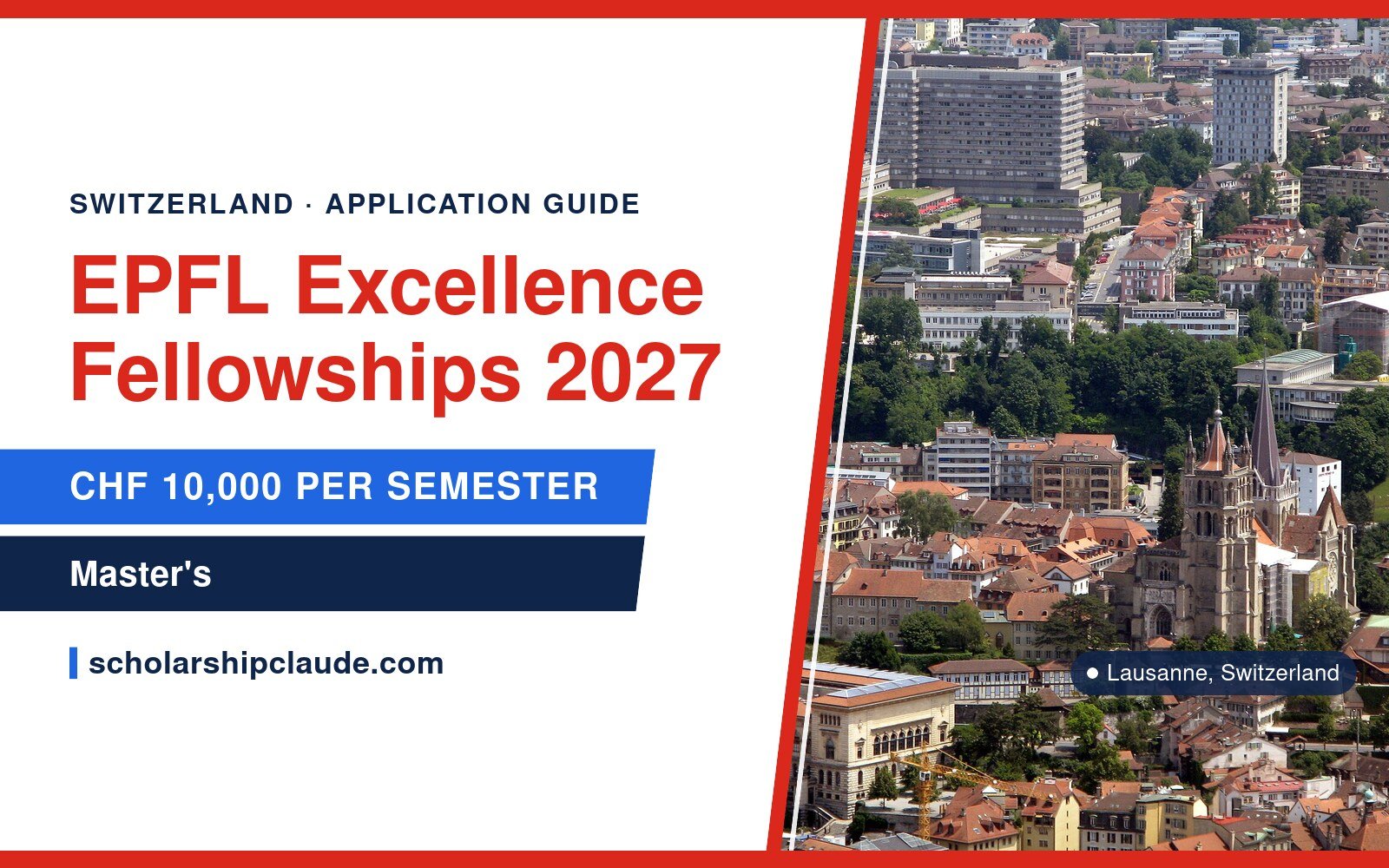
The EPFL Excellence Fellowships give outstanding new master’s students at EPFL in Switzerland CHF 10,000 per semester, for up to four semesters. There is no separate scholarship application: you tick a box in EPFL’s online master’s application. For students coming from a foreign university, the application must be paid for and validated by 15 December 2026 to be considered.
This guide was checked on 17 October 2026 against EPFL’s master’s admission pages, the Excellence Fellowships pages and EPFL’s tuition fee page.
EPFL Excellence Fellowships at a glance
| University | EPFL (École polytechnique fédérale de Lausanne) |
|---|---|
| Level | Master’s |
| Amount | CHF 10,000 per semester |
| Length | Up to four semesters (two to three semesters of courses plus one semester for the master’s project) |
| Tuition | Not waived; fellows pay tuition and rent themselves |
| Who can apply | Anyone applying to an EPFL master’s programme who does not already hold a master’s degree |
| How to apply | Tick the fellowship box in the online master’s application |
| Applications open | Mid-November 2026 |
| Closing date | 15 December 2026 (application paid for and validated) |
| Results | Late March 2027 |
What are the EPFL Excellence Fellowships?
EPFL is one of Switzerland’s two federal institutes of technology, and it teaches master’s programmes in engineering, the sciences, architecture and related fields. Each year it gives a limited number of Excellence Fellowships to the most deserving new master’s students.
The fellowship is a fixed payment of CHF 10,000 per semester. It covers two to three semesters of the master’s, depending on how long your programme is, plus one semester for the master’s project. Fellows also receive a certificate of excellence when they finish, and external fellows can reserve a student room.
Because tuition is not waived and fellows pay their own rent and living costs from the fellowship, we list it as partial funding. Even so, it is a large award, and for many students it covers a big part of the cost of studying in Lausanne.
How much the fellowship is worth
| Item | Amount or detail |
|---|---|
| Fellowship payment | CHF 10,000 per semester |
| Maximum length | Four semesters |
| Maximum total | CHF 40,000 over four semesters (our calculation: 4 × CHF 10,000) |
| Housing help | Student room reservation (external candidates only) |
| Recognition | Certificate of excellence on completion |
| Payment | Paid into a Swiss bank or postal account that you open after you arrive |
The number of semesters you receive depends on the length of your programme and on renewal after the first year, explained below.
What you still need to pay
EPFL says fellows are responsible for all living expenses, including tuition fees and rent. Plan for these costs before you accept a place.
| Cost | What EPFL states |
|---|---|
| Tuition fee for foreign students who came to Switzerland to study | CHF 2,190 per semester |
| Total semester invoice for these students | CHF 2,240 per semester (tuition plus compulsory fees) |
| Rent and daily living costs | Paid by you; not covered separately |
By our calculation, after paying a semester invoice of CHF 2,240, a fellow has CHF 7,760 per semester left for rent, food, transport and other costs. Lausanne is an expensive city, so make a realistic budget. EPFL’s fee page says the tuition fee will next be adjusted in 2029.
Who can apply
- Anyone who applies to an EPFL master’s programme can be considered.
- To be admitted to a master’s, you need a bachelor’s degree, or equivalent, from a university in a related field.
- Admission is competitive. EPFL looks for excellent academic results and strong references.
- There is no nationality restriction.
Who cannot apply
- People who already hold a master’s degree.
- Students who are already enrolled in an EPFL master’s programme.
- Applicants who want to apply to more than one master’s programme in the same year. EPFL allows only one master’s application per year.
- Students who validate their application after 15 December. They can still be considered for admission in the next round, but not for the fellowship.
Key dates for autumn 2027 entry
| Date | What happens |
|---|---|
| Mid-November 2026 | EPFL’s online master’s application opens. |
| 15 December 2026 | Closing date: your application must be paid for and validated to be considered for a fellowship. |
| About one week after 15 December | Reference letters must be uploaded. The exact date is in your validation email. |
| End of March 2027 | Admission decisions for the December round; fellowship winners are told in late March. |
| 16 December 2026 to 31 March 2027 | Second admission round, not eligible for the fellowship. |
| Early September 2027 | Master’s programmes start. |
How to apply, step by step
- Choose one programme. You can apply to only one EPFL master’s programme per year, so choose carefully. Read the programme’s structure, specialisations and admission requirements.
- Check your degree. Make sure your bachelor’s is in a related field and that you do not already hold a master’s degree.
- Prepare your admission documents. The fellowship needs no extra documents beyond those EPFL asks for master’s admission. Gather them in good time.
- Brief your referees. Strong references matter for admission. Tell your referees that letters are uploaded about a week after the 15 December deadline.
- Fill in the online application when it opens in mid-November 2026.
- Tick the box to be considered for an Excellence Fellowship.
- Pay for and validate your application by 15 December 2026.
- Watch your email for the validation message with the reference letter date, and later for the results in late March.
If you already study at EPFL
EPFL bachelor’s students follow different steps. If you continue in the same field, you apply directly to your section, with a copy to the address on EPFL’s page, and send a CV, motivation letter, a transcript of all your EPFL grades and two professor recommendation letters by 31 January. If you change field, you use the online master’s form, tick the fellowship box by 15 December and arrange two professor letters by 31 January.
How the winners are chosen
EPFL’s sections first screen the applications. The Excellence Fellowships Committee then makes the awards to the most deserving candidates. EPFL does not publish a points system or a minimum grade for the fellowship, so the best way to improve your chances is to make your master’s application as strong as possible. If a winner declines or does not reply, the fellowship goes to the next person on the waiting list.
How to make your master’s application stronger
Because there is no separate fellowship essay, everything depends on your master’s application. Focus on these points.
- Grades. EPFL wants excellent academic results. Upload complete, clear transcripts and include your university’s grading scale if it is not obvious.
- Fit with the programme. Show that your bachelor’s prepared you for the specific master’s. Courses, projects and a thesis in the same area help.
- References. Ask teachers who know your work well and can compare you with other strong students. Our guide on strong recommendation letters explains how to brief them.
- Motivation. If your programme asks for a motivation or statement, explain clearly why this master’s, why EPFL and what you plan to do afterwards. Our motivation letter template shows a clear structure.
- CV. Highlight projects, research, internships and awards. Our academic CV template shows the layout.
Keeping the fellowship in the second year
The fellowship is renewed for a second year only if your results are excellent. EPFL sets two conditions:
- A weighted average of at least 5.0. EPFL grades go up to 6, and 4 is a pass.
- At least 50 credits, not counting the internship. Language courses, admission courses and courses outside your study plan do not count.
EPFL says there are no exceptions for students who fall short. Plan your first-year courses so that you earn enough credits and can keep a high average.
Combining the fellowship with other funding
The Excellence Fellowship cannot be combined with other substantial scholarships. Fellows must declare every scholarship they receive during their master’s. If you are also applying for funding from your government, a foundation or an employer, check how large that award is and ask EPFL whether it would conflict before you accept both.
Practical points before you arrive
- Bank account. The fellowship is paid into a Swiss bank or postal account that you open after you arrive. Bring enough money of your own for your first weeks, including rent deposits and the first semester invoice if it falls due early.
- Housing. External fellows can reserve a student room. Use this option early, because finding housing in Lausanne can take time.
- Visa. If you need a student visa or residence permit for Switzerland, start as soon as you receive your admission. Our visa process guide explains the general steps.
- French. EPFL offers admitted students a four-week intensive French course before the start date. Even if your programme is taught in English, basic French helps in daily life in Lausanne.
Choosing your one programme
EPFL allows only one master’s application per year, so this choice decides both your admission and your fellowship chances. Use these questions to decide:
- Does my bachelor’s match? EPFL admits holders of a bachelor’s in a related field. If your degree is in a different area, check whether you would need extra courses, and whether the programme would accept you at all.
- Do my strongest grades fit this programme? Reviewers look closely at the courses most related to the master’s. Choose the programme where your best results are most relevant.
- Can I explain my plans clearly? You should be able to say in two or three sentences why this master’s leads to the work you want to do next.
- Does the programme length suit me? Programmes differ in length, and the fellowship covers two to three semesters of courses plus one semester for the master’s project.
Do not choose a programme only because it seems less competitive. A programme that matches your background usually gives you a stronger application.
A short message to your referees
The example below is invented. Change every detail to match your own case.
Dear Dr [Name],
I am applying for the master’s in [programme] at EPFL for autumn 2027 and for EPFL’s Excellence Fellowship. You taught me in [course] and supervised my project on [topic], so I would be grateful if you could write a reference letter. I will validate my application before 15 December 2026, and EPFL will then send you an upload link. Letters are due about one week after that date. I have attached my CV, my transcript and a short note on why I chose this programme.
With thanks,
[Your name]
Send this in November, before the application opens, so your referee has time to plan.
If you are admitted but do not receive a fellowship
EPFL awards only a limited number of fellowships, so many admitted students do not receive one. If that happens, you can still accept your place if you can fund your studies in another way. Before you decide, check:
- Whether you can pay the semester invoice, rent and living costs for the full programme.
- Whether your home government, a foundation or an employer offers funding for study abroad.
- Whether you could apply again in a later year with a stronger profile, remembering that holders of a master’s degree are not eligible.
Our guide on finding fully funded scholarships explains where to look for other funding.
Is the EPFL Excellence Fellowship right for you?
It is a good fit if you have excellent grades in a bachelor’s closely related to an EPFL master’s, you want to study engineering, science, architecture or technology in Switzerland, and you can plan your finances around tuition and rent with the help of CHF 10,000 per semester. If you need a fully funded award that also waives tuition and pays a separate living allowance, compare it carefully with the other options listed below.
What to do between December and March
After you validate your application, there is a long wait until the results in late March. Use the time well:
- Check that your referees uploaded their letters by the date in your validation email. A missing letter can weaken your file.
- Keep your final-year grades high. If you are still finishing your bachelor’s, admission may depend on your final results.
- Prepare your finances. Work out how you would pay the semester invoice and rent if you are admitted, with or without a fellowship.
- Find out what your country requires for a Swiss student visa or residence permit, so you can start quickly in spring.
- Apply for other scholarships with later closing dates, in case the fellowship does not come through.
How it compares with other Swiss awards
- EPFL Excellence Fellowships: master’s at EPFL, CHF 10,000 per semester, tick a box in your application by 15 December 2026.
- ETH Zurich Excellence Scholarship (ESOP): master’s at ETH Zurich. See our ETH ESOP page and ESOP guide.
- Swiss Government Excellence Scholarships: mainly for research and PhD study, with closing dates that differ by country. See our Swiss Government Excellence Scholarships page.
- EPFL Summer Research Program: an eight-week paid summer programme in life sciences for bachelor’s and first-year master’s students. See our EPFL Summer Research Program page.
Our guide to scholarships in Switzerland lists more options.
Common mistakes to avoid
- Forgetting to tick the fellowship box in the online application.
- Validating the application after 15 December, which removes you from fellowship consideration.
- Not paying the application fee in time. EPFL says the application must be paid for and validated by 15 December.
- Applying to EPFL when you already hold a master’s degree in the same or a related field.
- Choosing referees who barely know you.
- Planning a budget as if tuition were waived. It is not.
- Holding another large scholarship at the same time without checking the rules.
Checklist before you submit
- I have chosen one EPFL master’s programme that fits my bachelor’s degree.
- I do not already hold a master’s degree.
- My admission documents are complete.
- My referees know they must upload letters about a week after the deadline.
- I have ticked the Excellence Fellowship box.
- I will pay for and validate my application by 15 December 2026.
- I have a budget that includes tuition, rent and living costs.
Frequently asked questions
How much is the EPFL Excellence Fellowship?
CHF 10,000 per semester, for up to four semesters.
Is the EPFL Excellence Fellowship fully funded?
No. Tuition is not waived, and fellows pay their tuition, rent and living costs themselves. The fellowship payment helps cover these costs.
What is the closing date?
For external candidates, the master’s application must be paid for and validated by 15 December 2026 to be considered for a fellowship.
Do I need to write a separate essay?
No. You tick a box in the online master’s application. No extra documents are needed beyond those required for admission.
Can international students apply?
Yes. Anyone applying to an EPFL master’s programme can be considered.
Can I apply if I already have a master’s degree?
No. Candidates who already hold a master’s degree are not eligible.
When will I know if I won?
Selected candidates are notified in late March.
How do I keep the fellowship in the second year?
You need a weighted average of at least 5.0 out of 6 and at least 50 credits, not counting the internship.
Can I hold another scholarship as well?
Not another substantial scholarship. You must declare every scholarship you receive during your master’s.
Does EPFL help with housing?
External fellows can reserve a student room.
What language do I need?
Not stated on the fellowship page. Check the teaching language and language requirements of your chosen master’s programme on EPFL’s website.
Can I apply to two EPFL master’s programmes to improve my chances?
No. EPFL allows only one master’s application per year.
Is there an application fee?
EPFL says the application must be paid for and validated by 15 December. The fee amount is not stated on the pages we checked, so check it in the online application.
Where to apply
Read the full rules on the official EPFL Excellence Fellowships page and EPFL’s master’s application pages. Our EPFL Excellence Fellowships page keeps the key facts in one place.
Scholarships with the nearest deadlines
| Scholarship | Funding | Stipend | Deadline |
|---|---|---|---|
| US–Pakistan Knowledge Corridor PhD Scholarships 2027 | Fully funded | Not stated on HEC's programme page (see the HEC advertisement) | 30 Oct 2026 |
| Honjo International Scholarship 2027 in Japan | Partial | 230,000 yen a month (degree of 1 to 2 years), 210,000 yen a month (3-year degree) or 180,000 yen a month (degree longer than 3 years) | 31 Oct 2026 |
| European Parliament Schuman Traineeships 2027 | Partial | Monthly grant paid; amount not stated on the official source | 31 Oct 2026 |
| University of Melbourne Graduate Research Scholarships 2027 in Australia | Fully funded | 41,100 Australian dollars a year (2027 rate), plus a full fee offset | 31 Oct 2026 (expected) |
| Australian Government RTP Scholarships 2027 in Australia | Fully funded | 2027 full-time RTP stipend: base rate 35,550 Australian dollars a year, maximum 55,537 Australian dollars a year | 31 Oct 2026 (expected) |
| DAAD EPOS Scholarship 2027/28 in Germany | Fully funded | 992 euros a month for graduates; 1,400 euros a month for doctoral candidates | 31 Oct 2026 (expected) |
| One Young World Leading Scholarship 2026 in South Africa | Partial | See the scholarship page | 31 Oct 2026 |
| UNU Junior Fellows Internship 2027 in Tokyo, Japan | Partial | Monthly stipend; amount not stated on the official source | 1 Nov 2026 |
| Open Doors Russian Scholarship Project 2026–27 in Russia | Partial | Tuition-free study; a monthly allowance is possible only with grant support for Russian-taught programmes | 1 Nov 2026 |
| Max Planck Computer Science Summer Internships 2027 in Germany | Fully funded | Monthly stipend (amount not stated on the official source) | 1 Nov 2026 |
This list updates itself from our scholarships page. Stipend figures are shown where the provider publishes them. See all scholarships.