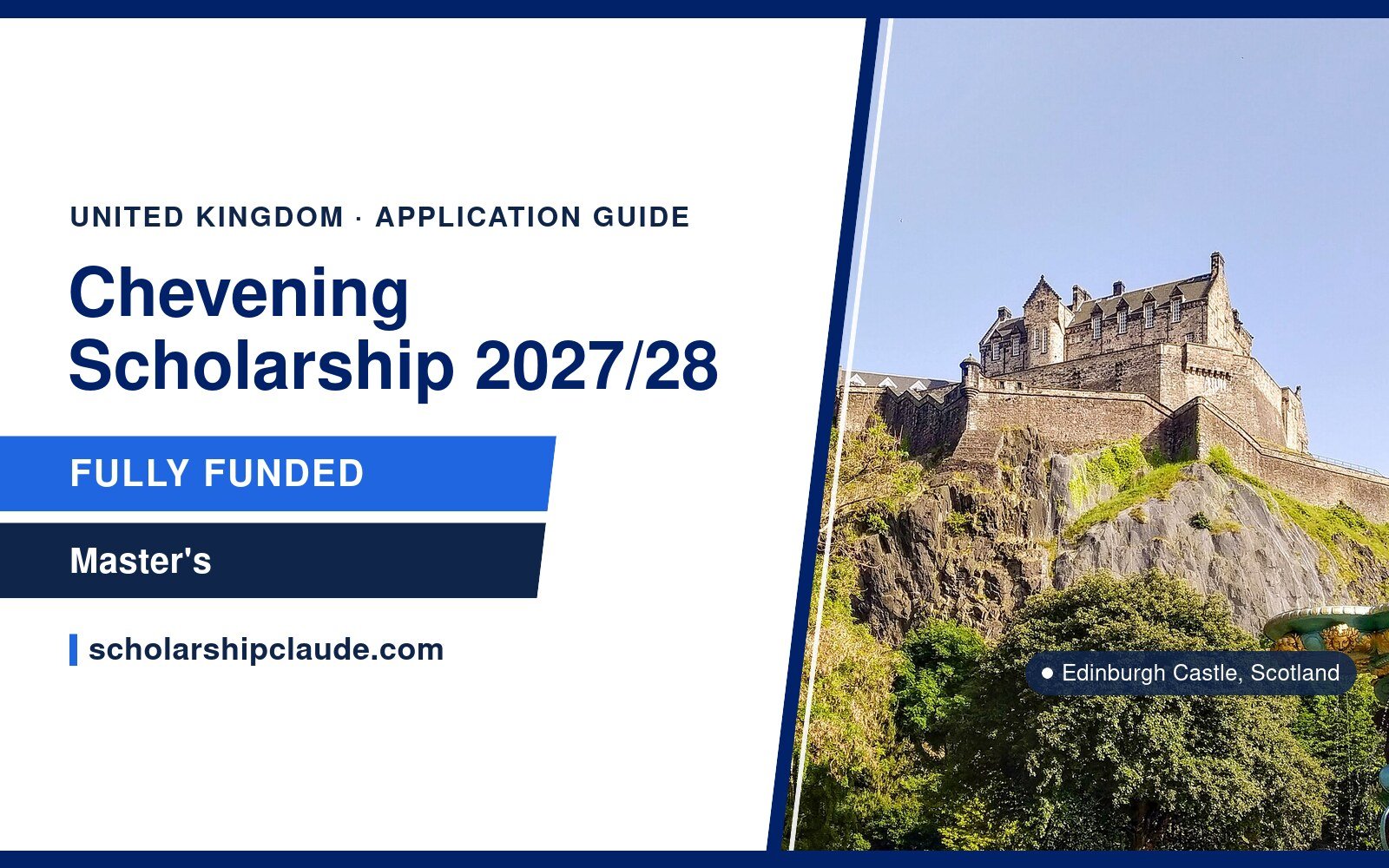
The Chevening Scholarship is the UK government’s flagship award for international students. It pays for a one-year master’s degree at a UK university, including tuition, living costs and flights. Applications for the 2027/28 academic year close on 6 October 2026 at 11:00 UTC. If you are reading this after that date, use this guide to prepare for the next round, which normally opens in early August.
This guide explains who can apply, what the scholarship pays for, the four essays, the documents you need, every date in the timeline and how to apply step by step. It was last checked against the Chevening website on 4 October 2026.
Chevening Scholarship 2027/28 at a glance
| Host country | United Kingdom |
|---|---|
| Funded by | UK Foreign, Commonwealth and Development Office and partner organisations |
| Study level | One-year taught master’s degree |
| Funding | Fully funded |
| Who can apply | Citizens of Chevening-eligible countries and territories |
| Work experience | At least two years (2,800 hours) |
| Applications opened | 4 August 2026 |
| Deadline | 6 October 2026, 11:00 UTC |
| Results | From mid-June 2027 |
| Studies begin | September or October 2027 |
What is the Chevening Scholarship?
Chevening is funded by the UK government and its partner organisations. It is designed for people who have already started their careers, can show leadership, and plan to return home and use what they learn. It is not awarded on grades alone. Selectors look for leadership, the ability to build professional relationships, a clear career plan and good reasons for studying in the UK.
What does the Chevening Scholarship cover?
- Full tuition fees for your master’s course
- A monthly living allowance
- An economy return flight to the UK
- Arrival and departure allowances
- The cost of one visa application
Because the award covers tuition, living costs and travel, you do not need your own funds to study, as long as you choose an eligible course.
Who can apply for Chevening?
You must meet all of these requirements:
- You are a citizen of a Chevening-eligible country or territory.
- You have at least two years of work experience, which Chevening counts as 2,800 hours.
- You completed your undergraduate degree at least two years before the deadline.
- You apply to three different eligible UK master’s courses.
- You agree to return to your home country for at least two years after the award ends.
The eligible countries, and the full list of people who cannot apply, are on the official Chevening website. Check your own country page before you start, because some countries have extra conditions.
The four Chevening essays
The essays are the heart of the application. You write one essay on each of four areas, and independent reading committees score them:
- Leadership and influence: describe real situations where you led people or changed an outcome, and say what the result was.
- Networking: show how you build and use professional relationships, and how you would use the Chevening network.
- Studying in the UK: explain why you chose your three courses and how they fit your background.
- Career plan: set out a realistic short-term step after your degree and a longer-term goal in your home country.
Use a different example in each essay, and give facts and results instead of general statements. Our guide to the Chevening essays, with structure and templates goes through each question.
Documents you need
- The online Chevening application with the four essays
- Two references
- Your undergraduate degree certificate and transcripts
- A valid passport or national ID
- At least one unconditional offer from one of your three courses, by 8 July 2027 if you are selected
You do not need a university offer to apply. You need it later, so apply to your three universities in parallel with the scholarship.
Chevening 2027/28 timeline
| 4 August 2026 | Applications opened |
|---|---|
| 6 October 2026, 11:00 UTC | Applications close |
| Mid-October 2026 to January 2027 | Independent reading committees assess eligible applications |
| Mid-February 2027 | Shortlisted applicants are invited to interview |
| March to April 2027 | Interviews at British embassies and high commissions |
| From mid-June 2027 | Results announced |
| 8 July 2027, 17:00 UK time | Deadline to submit at least one unconditional university offer |
| September or October 2027 | Studies begin in the UK |
How to apply for the Chevening Scholarship, step by step
- Check your eligibility. Confirm your country is eligible and that you have 2,800 hours of work experience.
- Choose three courses. Pick three different eligible UK master’s courses that fit your career plan. They can be at the same university or at different ones.
- Write the four essays. Draft them offline first, then edit until each one answers its question directly.
- Arrange two referees. Ask people who know your work or studies well and can write in English.
- Complete the online form. Fill in your education, work history and course choices, and upload your documents.
- Submit before 6 October 2026, 11:00 UTC. Convert the time to your own time zone. The system closes at that minute.
- Apply to your universities. Do this separately and early, so you can meet the 8 July 2027 offer deadline.
- Prepare for the interview. If you are shortlisted in February, practise explaining your essays and career plan out loud.
How Chevening selects scholars
Chevening publishes four things it assesses: leadership and influencing skills, the ability to build and maintain professional relationships, a realistic career plan for creating positive change, and a researched case for how studying in the UK will help you achieve it. Reading committees score the essays first. British embassies and high commissions then shortlist candidates for interview.
Tips to strengthen your application
- Plan all four essays before you write any of them, so each one covers different ground.
- Use numbers and outcomes: how many people, how much money, what changed.
- Make sure your three courses clearly lead to your career plan.
- Ask your referees early and tell them what Chevening looks for.
Common mistakes to avoid
- Reusing the same story in more than one essay.
- Writing a career plan that is vague or has no link to your course.
- Counting work experience that does not add up to 2,800 hours.
- Waiting for the scholarship result before applying to universities.
- Submitting in the last hour, when the system is busiest.
How to choose your three courses
Your course choices are part of the assessment, because one of the four essays asks why you want to study them. Choose with care:
- Check eligibility first. The course must be a full-time taught master’s that Chevening accepts. Chevening’s website has a course finder.
- Keep the three choices consistent. They should lead to the same career plan. Three unrelated subjects look undecided.
- Read the entry requirements of each university, including the English requirement, so you can actually get an unconditional offer.
- Rank them honestly. Put the course you most want first.
Apply to the universities at the same time as you apply to Chevening. An offer can take weeks, and you need one that is unconditional by 8 July 2027.
How to choose your referees
You name two referees. Pick people who know your work or studies well and can describe specific things you did, such as a manager, a project leader or a university teacher. A detailed reference from someone who worked with you closely is more useful than a short one from a senior person who barely knows you. Tell your referees what Chevening looks for, and give them your CV and a summary of your essays so the references support the same story.
How to prepare for the Chevening interview
Interviews take place at British embassies and high commissions between March and April 2027. The panel asks about the same four areas as the essays, so your preparation starts there:
- Reread your essays and be ready to expand each example with more detail.
- Prepare a second example for leadership and for networking, in case you are asked for another.
- Practise explaining your career plan in two minutes: where you are now, what the master’s adds and what you will do in the first years back home.
- Know your three courses well enough to say what you will study in each.
- Follow current affairs in your field and in your country, because panels often ask how you would deal with a real problem.
Our scholarship interview tips cover how to structure answers.
After you are selected
If you are conditionally selected in June 2027, you still need to meet the remaining conditions: an unconditional offer from one of your three courses by 8 July 2027, and the documents Chevening asks for. After that, Chevening helps with the visa application and travel arrangements, and your studies begin in September or October 2027.
Frequently asked questions
Is IELTS required for the Chevening Scholarship?
You do not need an English test result to submit the Chevening application. Your chosen universities set their own English requirements, and you must meet them to receive an unconditional offer.
Do I need an offer letter before applying?
No. You name three courses in your application and need at least one unconditional offer by 8 July 2027.
How much work experience do I need?
At least two years, counted as 2,800 hours, completed after your undergraduate degree.
When are Chevening results announced?
Results for 2027/28 are announced from mid-June 2027.
Do I have to return home after the scholarship?
Yes. Chevening requires you to return to your home country for at least two years.
Where to apply
Apply only through the official Chevening website. For benefits, eligibility and the deadline in one place, see our Chevening Scholarship page. You can also use our statement of purpose guide, recommendation letter guide and interview tips.
Related scholarships: funding, stipend and deadlines
| Scholarship | Funding | Stipend | Deadline |
|---|---|---|---|
| Commonwealth Scholarships 2027/28 in the UK | Fully funded | 1,712 pounds a month, or 2,000 pounds a month at universities in the London area (current rates) | 20 Oct 2026 |
| Imperial College London President’s PhD Scholarships 2027–28 in the UK | Fully funded | Stipend of 27,036 pounds a year (2027–28 rate) for living costs | 2 Nov 2026 |
| Cambridge Trust Scholarships 2027–28 in the UK | Partial | See the scholarship page | 8 Dec 2026 |
| Gates Cambridge Scholarship 2027–28 in the UK | Fully funded | Maintenance allowance of 23,152 pounds for 12 months (2026–27 rate); PhD scholars are funded for up to 4 years | 8 Dec 2026 |
| Commonwealth Shared Scholarships 2027/28 in the UK | Fully funded | 1,712 pounds a month, or 2,000 pounds a month at universities in the London area (rate for 2027/28 awards) | 15 Dec 2026 (expected) |
| Oxford University Scholarships 2027–28 in the UK: Clarendon and University Funding | Fully funded | See the scholarship page | 8 Jan 2027 (expected) |
| LSE Graduate Support Scheme 2027/28 in the UK | Partial | See the scholarship page | 27 Apr 2027 (expected) |
| Fully Funded Scholarships in the UK 2027–28: Chevening, Commonwealth, Gates and Cambridge Trust | Fully funded | See the scholarship page | Varies |
| Rhodes Scholarship 2027 in the UK | Fully funded | 20,400 pounds a year (1,700 pounds a month), 2025–26 rate | Varies |
This list updates itself from our scholarships page. Stipend figures are shown where the provider publishes them. See all scholarships.