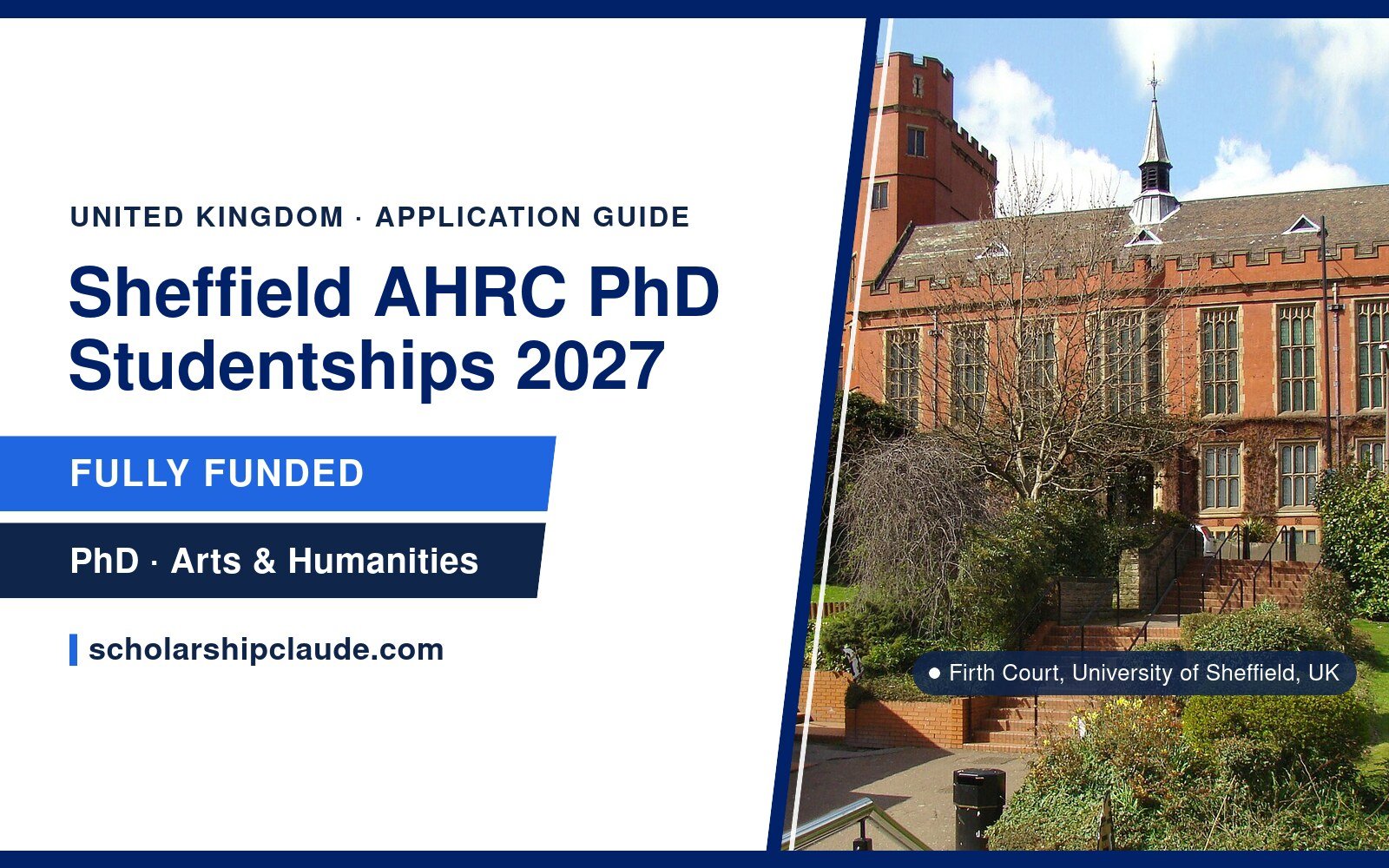
The University of Sheffield offers four fully funded PhD studentships a year in the arts and humanities through the AHRC Doctoral Landscape Award. Each one pays tuition fees and a stipend of 21,805 pounds a year (2026/27 rate) for 3.5 years. International candidates can apply, but only up to one of the four places may go to an international student. To be considered for 2027 entry, submit your PhD study application by 14 December 2026, then the funding application by 19 February 2027.
This guide was last checked on 21 October 2026 against the University of Sheffield’s official AHRC Doctoral Landscape Award page.
Sheffield AHRC studentships at a glance
| Scheme | AHRC Doctoral Landscape Award (DLA), linked to the AHRC North/Northwest Hub |
|---|---|
| University | University of Sheffield, UK |
| Level | PhD, starting in 2027/28 |
| Studentships | Four a year; up to one for an international candidate |
| Funding | Tuition fees (home or international rate) and a UKRI stipend |
| Stipend | 21,805 pounds a year at the 2026/27 rate |
| Length | 3.5 years full-time (pro rata for part-time) |
| Study application | By 14 December 2026 |
| Funding application | By 19 February 2027 |
| Results | Aimed for the end of March 2027 |
What is the AHRC Doctoral Landscape Award?
The Arts and Humanities Research Council (AHRC) is the UK’s public funder for arts and humanities research. Its Doctoral Landscape Awards fund PhD studentships at UK universities. Sheffield’s studentships are part of the AHRC North/Northwest Hub, a collaboration with nine other universities in the region. Students take part in cohort training as part of the award.
At Sheffield, the studentships sit in the Faculty of Arts and Humanities and cover four schools:
- School of English.
- School of History, Philosophy and Digital Humanities.
- School of Languages, Arts and Societies.
- School of Law.
Is this studentship right for you?
Before you spend weeks on the application, think honestly about these points:
- Does your project fit one of the four schools? The studentships are only in English; history, philosophy and digital humanities; languages, arts and societies; and law.
- Are you new to the PhD? If you are already enrolled on a PhD anywhere, you cannot apply.
- How strong is your academic record? With only four studentships, the panel chooses from a very competitive group.
- Are you an international applicant? There is at most one place for you. Apply if your project is excellent, but build a list of other funding options at the same time.
If your answers are positive, this is a chance at a fully funded humanities PhD at a large UK research university.
What the studentship covers
| Item | Details |
|---|---|
| Tuition fees | Paid at the home or international rate, as applicable |
| Stipend | UKRI rate, 21,805 pounds for 2026/27 |
| Length | 3.5 years, pro rata for part-time study |
Because the studentship pays international fees for an international candidate as well as the stipend, it is a fully funded PhD. Research training support beyond the required cohort training is not stated on the official source. The stipend rate is set by UKRI and is usually updated each year, so check the rate for 2027/28 when it is published.
Who can apply
- You want to start a new PhD in one of the four schools above.
- You are not already enrolled on a PhD. Sheffield says the scheme is not open to candidates who are already PhD students.
- You meet the entry requirements for your PhD programme, including any English requirement.
- Home and international candidates can apply, but up to one studentship may go to an international candidate.
A note for international applicants
Sheffield says competition for the international place will be particularly intense. With up to one place, only a very strong application has a realistic chance. Apply if your project and record are excellent, and apply to other funding at the same time. The English language requirement is not stated on the scholarship page; check the entry requirements for your PhD programme on Sheffield’s website.
Choosing the right school
Your PhD application goes to one school, and that school does the first assessment. Choose the one where your project and your supervisor belong:
- School of English: for projects in literature, language and related fields.
- School of History, Philosophy and Digital Humanities: for historical research, philosophy, and projects that use digital methods in the humanities.
- School of Languages, Arts and Societies: for projects on languages, cultures and the arts.
- School of Law: for legal research within the arts and humanities scope of the award.
If your project crosses two areas, ask your possible supervisors which school should lead. Some PhDs are supervised across two schools, but your application still goes to one home school.
Questions to ask a possible supervisor
- Does my project fit your research and the school’s strengths?
- Would you be willing to read a draft of my proposal before 14 December?
- Which sources, archives or collections at Sheffield would help this project?
- Have your students held AHRC funding before, and what made their applications strong?
The two-step application
You must complete two separate applications, in this order.
Step 1: the PhD study application (by 14 December 2026)
Apply for a PhD place through the University of Sheffield’s online postgraduate application. Your school will ask for documents such as a research proposal, CV, transcripts, references and, if needed, English test results. Follow your programme’s instructions. When you submit, you receive an application number. Keep it safe, because you need it for step 2.
Step 2: the funding application (by 19 February 2027)
After you have your application number, complete the AHRC DLA funding application through the link on Sheffield’s page. The form must be completed in one sitting, so prepare your answers in advance. Sheffield provides a template so you can draft the answers before you open the form. The funding application closes at 5 pm GMT on Friday 19 February 2027.
How applications are assessed
- Your application goes to your academic school for a first-phase assessment.
- The school nominates selected applicants to a Faculty panel.
- The Faculty panel meets in March 2027 to confirm the final selection.
- Sheffield aims to tell candidates the outcome by the end of March 2027.
Interviews are not mentioned on the official page.
Key dates
| Date | What happens |
|---|---|
| 14 December 2026 | Closing date for the PhD study application |
| 19 February 2027 | Closing date for the funding application |
| March 2027 | Faculty panel meets |
| End of March 2027 | Outcome expected |
| 2027/28 | PhD starts |
Finding a supervisor
A UK PhD in the arts and humanities is usually built around your own research project and a supervisor who knows the field. Before you apply, find one or two academics in your school whose research matches your topic.
- Read the staff pages of the relevant school and note people who publish on your topic.
- Read some of their recent work.
- Email a short message with your research idea, why their work fits, and your CV.
- Ask whether they would support your application and comment on your proposal.
A supervisor who has read and shaped your proposal can make your application much stronger at the school assessment stage.
Writing the research proposal
Your research proposal is the heart of a humanities PhD application. A clear proposal usually covers:
- Title and research question: what you want to find out.
- Context: the main scholarship on your topic and the gap your project fills.
- Sources and methods: the texts, archives, cases or data you will use and how you will analyse them.
- Why Sheffield: the supervisors, collections or research centres that make Sheffield the right place.
- Timeline: a realistic plan for 3.5 years.
- Contribution: what your research adds and who will care about it.
Check your school’s instructions for length and format. Our guide to the research proposal for PhD scholarships has a full template.
Getting your documents ready
The study application is due before the holiday period, so prepare documents early:
- Transcripts and degree certificates: for your bachelor’s and master’s, with official English translations if needed.
- English test results: if your programme asks for them, book a test date that gives results before 14 December.
- Research proposal: in the length and format your school asks for.
- CV: a research CV with your education, dissertation titles, any publications or conference papers, teaching or research assistant work, and language skills.
- References: contact details for your referees, who should already know your plans.
Name your files clearly and keep copies of everything you upload. You will reuse much of this material for the funding application and for other PhD funding you apply to.
A note on your writing sample
Some humanities programmes also ask for a writing sample, such as a chapter of your master’s dissertation or a long essay. If your programme asks for one, choose a piece close to your proposed project and in polished English.
Preparing the funding application
Use Sheffield’s template to prepare your answers before you open the funding form, since it must be completed in one sitting. Write your answers in a document, check the word limits in the template, and ask your proposed supervisor to read them. Make sure your funding answers match your research proposal, so the panel sees one clear project.
What makes a strong humanities PhD application
Sheffield does not publish a scoring scheme for the studentships, but humanities PhD panels usually look for the same core strengths. Use these as a guide while you prepare:
- A clear, original question. Your project should ask something that has not been fully answered, in a way that can be finished in 3.5 years.
- Knowledge of the field. Show that you know the main debates and where your project fits.
- A realistic method. Explain which sources you will use and how you will reach them, for example archives you need to visit.
- A strong fit with Sheffield. Name supervisors, collections or research centres that make Sheffield the right place.
- Evidence of ability. Good grades, a strong master’s dissertation, conference papers or publications help.
Choosing referees
Your PhD study application will usually ask for references. Choose academics who know your recent work well, ideally your master’s dissertation supervisor and another teacher in your field. Send each referee your research proposal and CV, explain the 14 December deadline, and thank them. Our guide on strong recommendation letters explains how to brief them.
Studying part-time
The studentship can be held part-time, with the funding paid pro rata. This means the length is extended and the annual payment is reduced in proportion. Part-time study can suit home students who work, but international students should check whether UK visa rules allow part-time study on their visa before choosing it.
Tips for the funding answers
- Draft every answer in a separate document first, using Sheffield’s template, and keep within each word limit.
- Use the same title and research question as your study application, so the two applications tell one story.
- Explain clearly why your project needs doctoral funding now and what it will produce.
- Ask your proposed supervisor to read your answers in January, well before 19 February.
- Set aside a quiet hour to paste in your answers and submit, since the form must be finished in one sitting.
A plan from now to 19 February
| When | What to do |
|---|---|
| Late October | Choose your school, find possible supervisors and email them. |
| November | Write your research proposal, update your CV and ask two referees. |
| Early December | Complete the PhD study application and book an English test if needed. |
| By 14 December | Submit the study application and note your application number. |
| January | Draft your funding answers using the template. |
| By 19 February | Submit the funding application in one sitting. |
Planning your budget and visa
The stipend of 21,805 pounds a year at the 2026/27 rate is meant to cover living costs during your PhD. If you are an international student, also plan for costs that come before the first stipend payment, such as your UK student visa fee, the Immigration Health Surcharge, flights and a housing deposit. Check the current rules and fees on the official GOV.UK website, and start your visa application as soon as you have your offer and funding confirmation.
If you are not selected
Many strong candidates are not selected, simply because there are only four studentships. If that happens:
- Ask your school whether other funding is available for your PhD place.
- Look at other UK funding, such as the Gates Cambridge Scholarship, the Cambridge Trust and university PhD scholarships.
- Keep your research proposal. A well-developed project can be used for other applications or for a later round.
Our guide to a research CV for PhD scholarships can help you strengthen your next application.
Related scholarships in the UK
- Gates Cambridge Scholarship, funding deadlines 8 December 2026 or 6 January 2027.
- Cambridge Trust Scholarships.
- Imperial President’s PhD Scholarships.
See our guide to fully funded scholarships in the UK for more options.
Common mistakes to avoid
- Missing the 14 December study application deadline and applying only for funding.
- Opening the funding form without preparing answers, then running out of time in one sitting.
- Applying when you are already enrolled on a PhD.
- A general research proposal that does not explain why Sheffield.
- Relying only on this studentship as an international candidate, when there is at most one place.
Checklist before you submit
- My project fits one of the four schools in the Faculty of Arts and Humanities.
- I am not already enrolled on a PhD.
- My study application is in by 14 December 2026, and I have my application number.
- My research proposal is clear and my supervisor has seen it.
- I prepared my funding answers with the template.
- My funding application is in by 19 February 2027.
Frequently asked questions
Is the Sheffield AHRC studentship fully funded?
Yes. It pays tuition fees at the home or international rate and a UKRI stipend of 21,805 pounds a year (2026/27 rate) for 3.5 years.
Can international students apply?
Yes, but up to one of the four studentships may go to an international candidate, and competition for it is intense.
What is the deadline?
Submit the PhD study application by 14 December 2026 and the funding application by 19 February 2027.
Which subjects are covered?
English; history, philosophy and digital humanities; languages, arts and societies; and law.
When are results announced?
Sheffield aims to tell candidates by the end of March 2027.
Is there an interview?
Interviews are not mentioned on the official page. Your school may contact you about your PhD application, so check your email.
Do I need a master’s degree?
The scholarship page does not set this rule. Check the entry requirements for your PhD programme, since many humanities PhD programmes ask for a relevant master’s degree or equivalent.
Can I apply if I am in the final year of my master’s?
The scholarship page does not say. Check your PhD programme’s entry requirements, which explain whether you can apply before you finish your current degree and by when you must complete it.
How many studentships are there?
Four a year at Sheffield, with up to one for an international candidate.
Where to apply
Read the rules and find the funding form on the official Sheffield AHRC Doctoral Landscape Award page. Questions go to pgr-scholarships@sheffield.ac.uk. Our Sheffield AHRC studentship page keeps the key facts in one place.
Related scholarships: funding, stipend and deadlines
| Scholarship | Funding | Stipend | Deadline |
|---|---|---|---|
| Imperial College London President’s PhD Scholarships 2027–28 in the UK | Fully funded | Stipend of 27,036 pounds a year (2027–28 rate) for living costs | 2 Nov 2026 |
| Harding Scholarship 2027–28 in the UK | Fully funded | Maintenance allowance for 3.5 years (£21,360 a year in 2025-26; 2027-28 rate not stated on the official website) | 8 Dec 2026 |
| Mastercard Foundation Scholarship 2027 at Cambridge in the UK | Fully funded | Monthly living allowance (amount not stated on the official website) | 8 Dec 2026 |
| Cambridge Trust Scholarships 2027–28 in the UK | Partial | See the scholarship page | 8 Dec 2026 |
| Gates Cambridge Scholarship 2027–28 in the UK | Fully funded | Maintenance allowance of 23,152 pounds for 12 months (2026–27 rate); PhD scholars are funded for up to 4 years | 8 Dec 2026 |
| Warwick Chancellor’s Scholarship 2027 in the UK | Fully funded | Tax-free stipend at the UKRI rate for 3.5 years (UKRI minimum for 2026/27: 21,805 pounds a year; the 2027/28 rate is not yet stated) | 10 Dec 2026 |
| University of Sheffield AHRC PhD Studentships 2027 in the UK | Fully funded | 21,805 pounds a year at the 2026/27 UKRI rate | 14 Dec 2026 |
| Commonwealth Shared Scholarships 2027/28 in the UK | Fully funded | 1,712 pounds a month, or 2,000 pounds a month at universities in the London area (rate for 2027/28 awards) | 15 Dec 2026 (expected) |
| University of Stirling Vice-Chancellor’s Postgraduate International Scholarship 2027 in the UK | Partial | No stipend (tuition fee waiver only) | 15 Dec 2026 |
| Ertegun Scholarship 2027–28 in the UK | Fully funded | Annual grant for living costs: £21,805 for 2026-27 (2027-28 rate not stated on the official website) | 5 Jan 2027 |
This list updates itself from our scholarships page. Stipend figures are shown where the provider publishes them. See all scholarships.