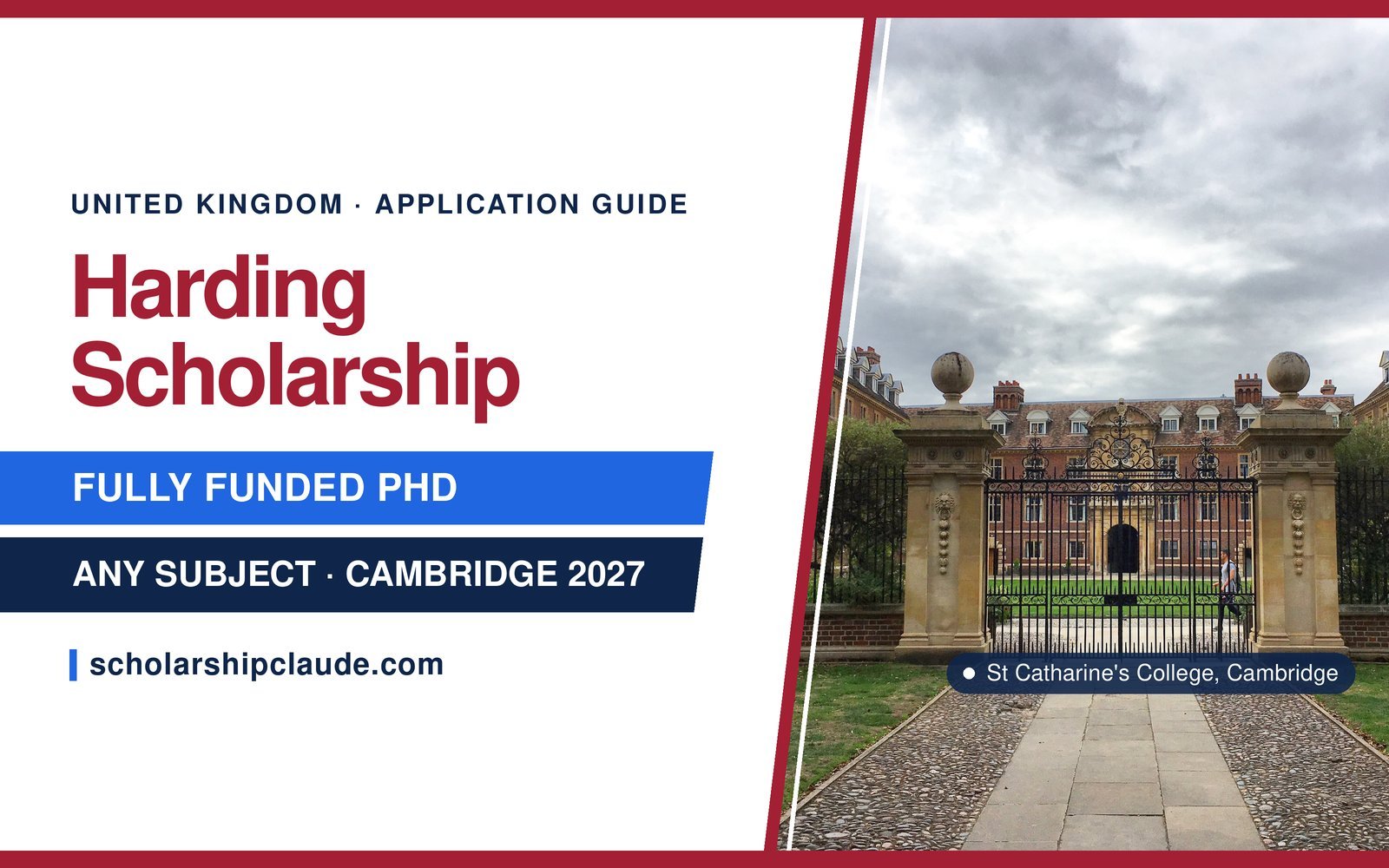
A Harding Scholarship application is your route to one of the most generous fully funded PhD awards at the University of Cambridge. The Harding Distinguished Postgraduate Scholars Programme funds about 45 outstanding PhD students a year, from any country and in any subject, and there is no separate form to fill in. This guide explains who is eligible, what the scholarship pays, how selection works and the December 2026 and January 2027 deadlines. The key facts are also on our Harding Scholarship 2027 listing.
We checked every detail on 29 October 2026 against the official Harding Distinguished Postgraduate Scholars Programme website and the University of Cambridge postgraduate funding page. Where Cambridge does not give a detail, we say so.
Harding Scholarship at a glance
| University | University of Cambridge, United Kingdom |
| Level | PhD (full-time or part-time), including MRes+PhD (1+3) routes |
| Who can apply | Any nationality, any discipline |
| Awards | About 45 a year |
| Funding | Fees, maintenance for 3.5 years, £6,000 research allowance, visa/IHS and travel for international scholars |
| Applications open | September 2026 |
| Deadline | 8 December 2026 or 6 January 2027, 23:59 GMT, depending on the course |
| Offers | Late February to early March 2027 |
What the scholarship pays
- Fees. The University Composition Fee at the appropriate rate (home or overseas) for the length of the course.
- Maintenance. A living allowance for 3.5 years from the start. For 2025-26 it was 21,360 pounds; the 2027-28 rate is not yet published.
- Writing-up support. You can request maintenance for the final six months of the 12-month writing-up period if you need it.
- Research allowance. 6,000 pounds over the PhD for books, conferences and other research costs.
- Visa and health surcharge. International scholars get the cost of the student visa and the Immigration Health Surcharge for the length of the visa.
- Travel. Economy travel to Cambridge at the start and home at the end of the course.
On top of this, the programme offers discretionary support that must be approved: sickness pay of up to 28 weeks of maintenance in a rolling 12-month period, help with unexpected costs such as illness or bereavement, parental leave, and an allowance for accompanying children (including their visa, health surcharge and travel). Scholars also have a calendar of activities and academic events.
Who can apply
- applicants for a full-time or part-time PhD at Cambridge, including fully integrated MRes+PhD (1+3) routes;
- applicants of any nationality and in any discipline;
- applicants assessed as academically excellent by the Department or Faculty they apply to; and
- current Cambridge undergraduate or Master’s students (for example MPhil students) who are applying for a Cambridge PhD.
You cannot use the scholarship for the rest of a Cambridge PhD you have already started. People who already have a PhD, or who held a Harding scholarship before, are not normally eligible, unless the Advisory Committee approves an award for exceptionally groundbreaking interdisciplinary research. Scholars are expected to live in the UK for most of their studies, with time abroad only for fieldwork, internships or similar long-term academic activity.
College rules
The scholarship can be held at every College except Trinity and St John’s. Applying to one of those two does not stop you being considered, but you will be asked to move to an eligible College if you are offered the scholarship. A proportion of scholars are placed at St Catharine’s College, reflecting David Harding’s link with it.
Harding Scholarship application deadlines for 2027
Cambridge’s main funding deadlines for 2027-28 entry are Tuesday 8 December 2026 and Wednesday 6 January 2027. Your PhD course page in the Postgraduate Course Directory tells you which applies. Your complete application, including references, must be submitted by 23:59 GMT on that date.
| When | What happens |
|---|---|
| September 2026 | Applications opened |
| 8 December 2026 or 6 January 2027 | Course funding deadline, 23:59 GMT |
| December 2026 to February 2027 | Departmental academic assessment |
| Late February 2027 | Scholarship selection |
| Late February to early March 2027 | Scholarships offered (possibly later) |
| Within about 7 days of the offer | Scholarship accepted |
Documents you need
The Harding website does not list a separate set of documents. Everything comes from your normal Cambridge PhD application:
- the supporting documents your PhD course asks for, which you will find on the course page (departments look at your transcripts and experience);
- references, which must be submitted by the funding deadline; and
- the funding box ticked in the ‘Funding your Study’ section of the Applicant Portal.
Many Cambridge PhD courses ask for a research proposal and an academic CV. Our research proposal template and research CV guide can help.
How to apply step by step
- Choose your PhD course in the Postgraduate Course Directory and note its funding deadline and requirements.
- Contact potential supervisors if your department expects it (check the course page).
- Apply in the Applicant Portal for the PhD, a College place and funding at the same time.
- Tick ‘Yes – I wish to apply for funding’ in the funding section.
- Submit the complete application, including references, by your funding deadline.
- Wait for the decision. If you are offered a scholarship, accept within the time given, usually about seven days.
How selection works
Harding scholarships go to the most academically excellent applicants of the year. Departments and Faculties assess each applicant through their transcripts, references, experience and potential to succeed on the course, and the strongest are put forward for a Harding scholarship. The programme cannot advise individual applicants on improving their chances, including on choice of College, and does not give feedback on unsuccessful applications.
Tips for a strong application
- Aim for the earlier deadline. If your course uses 8 December, treat that as your final date and ask referees for their letters in early November.
- Make your academic record easy to read. Explain your grading scale and rank if your transcript does not.
- Write a focused research proposal. Show the question, why it matters and why Cambridge is the right place.
- Pick referees who know your research. Strong, specific references weigh heavily in the departmental assessment.
Common mistakes to avoid
- Forgetting the funding box. If you do not tick it, you are not considered.
- Missing references. An application is only complete when your referees have submitted.
- Applying after starting a Cambridge PhD. The award is only for incoming PhD students.
Comparing options? See the Gates Cambridge Scholarship, the Cambridge Trust Scholarships and the Imperial College London President’s PhD Scholarships.
Frequently asked questions
Is the Harding Scholarship fully funded?
Yes. It pays the University Composition Fee, maintenance for 3.5 years and a £6,000 research allowance, plus visa, health surcharge and travel for international scholars.
How much is the maintenance allowance?
It was £21,360 for 2025-26. The 2027-28 rate is not yet published.
What is the deadline?
Your course funding deadline: 8 December 2026 or 6 January 2027, at 23:59 GMT.
Can international students apply?
Yes. Applicants of any nationality are welcome.
Do I need a separate application?
No. Tick the funding box in your Cambridge PhD application and apply by the funding deadline.
Can I apply for a Master’s?
No. The scholarship is for PhD students, including MRes+PhD (1+3) routes.
Can I study part-time?
Yes. Full-time and part-time PhD applicants are eligible.
How many scholarships are there?
About 45 a year.
Where to apply
Read the official Harding application and eligibility page, the list of what the scholarship offers and the Cambridge funding deadlines before you apply. Our Harding Scholarship listing keeps the key facts in one place.
Scholarships with the nearest deadlines
| Scholarship | Funding | Stipend | Deadline |
|---|---|---|---|
| US–Pakistan Knowledge Corridor PhD Scholarships 2027 | Fully funded | Not stated on HEC's programme page (see the HEC advertisement) | 30 Oct 2026 |
| Honjo International Scholarship 2027 in Japan | Partial | 230,000 yen a month (degree of 1 to 2 years), 210,000 yen a month (3-year degree) or 180,000 yen a month (degree longer than 3 years) | 31 Oct 2026 |
| European Parliament Schuman Traineeships 2027 | Partial | Monthly grant paid; amount not stated on the official source | 31 Oct 2026 |
| University of Melbourne Graduate Research Scholarships 2027 in Australia | Fully funded | 41,100 Australian dollars a year (2027 rate), plus a full fee offset | 31 Oct 2026 (expected) |
| Australian Government RTP Scholarships 2027 in Australia | Fully funded | 2027 full-time RTP stipend: base rate 35,550 Australian dollars a year, maximum 55,537 Australian dollars a year | 31 Oct 2026 (expected) |
| DAAD EPOS Scholarship 2027/28 in Germany | Fully funded | 992 euros a month for graduates; 1,400 euros a month for doctoral candidates | 31 Oct 2026 (expected) |
| One Young World Leading Scholarship 2026 in South Africa | Partial | See the scholarship page | 31 Oct 2026 |
| UNU Junior Fellows Internship 2027 in Tokyo, Japan | Partial | Monthly stipend; amount not stated on the official source | 1 Nov 2026 |
| Open Doors Russian Scholarship Project 2026–27 in Russia | Partial | Tuition-free study; a monthly allowance is possible only with grant support for Russian-taught programmes | 1 Nov 2026 |
| Max Planck Computer Science Summer Internships 2027 in Germany | Fully funded | Monthly stipend (amount not stated on the official source) | 1 Nov 2026 |
This list updates itself from our scholarships page. Stipend figures are shown where the provider publishes them. See all scholarships.