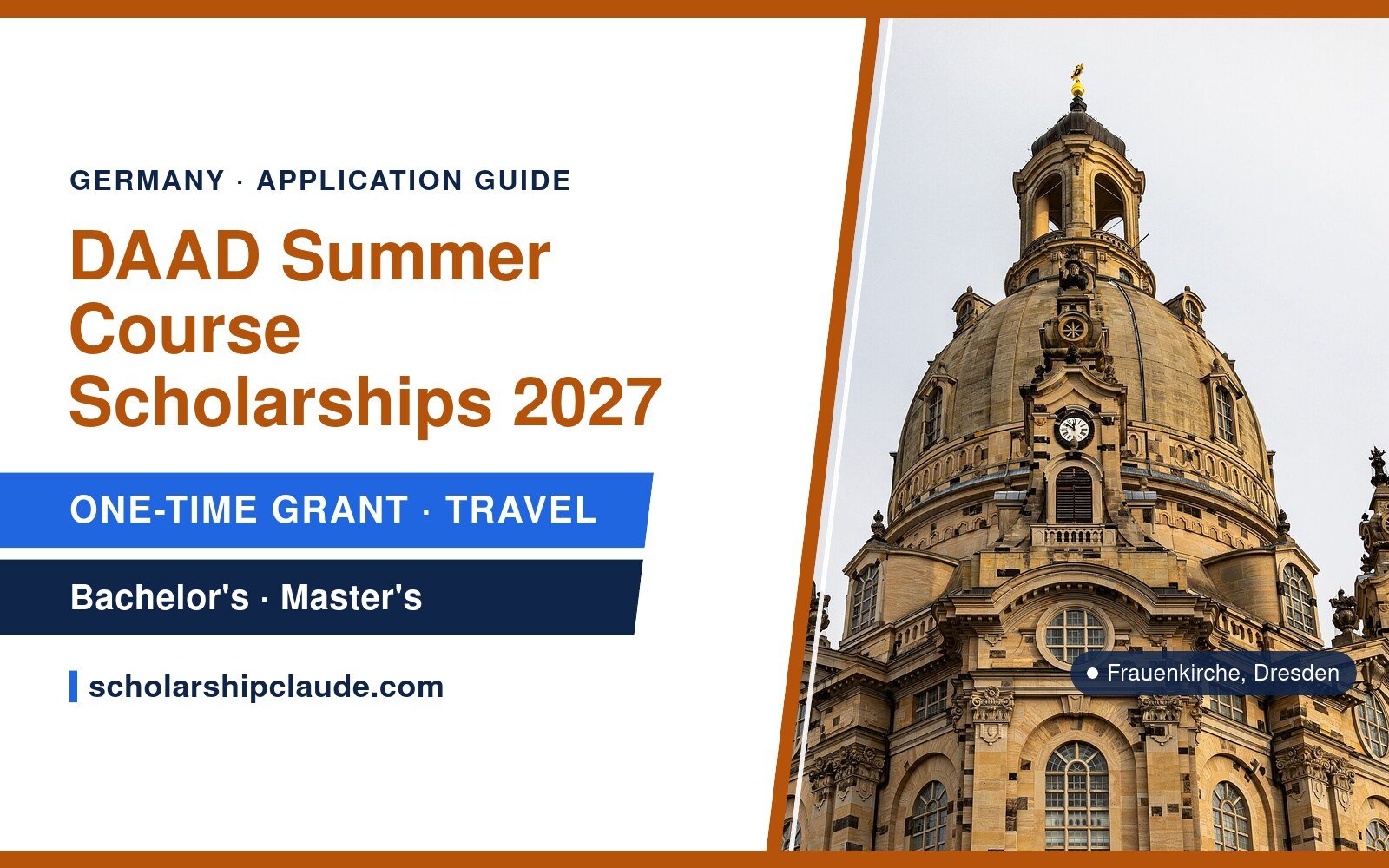
The DAAD gives scholarships for summer courses in German language and culture at universities in Germany. The grant is €1,134 (€1,309 for students from Least Developed Countries), plus insurance and, for most students, a travel allowance. Courses are taught in German, so you need to prove your German level. The closing date for summer 2027 courses is 1 December 2026.
This guide was checked on 15 October 2026 against the official DAAD scholarship database entry for University Summer Courses.
DAAD summer course scholarship at a glance
| Funder | DAAD (German Academic Exchange Service) |
|---|---|
| What you study | German language, regional studies or technical German, at a German university |
| Who can apply | Bachelor’s students (after two years of study) and master’s students, any subject |
| Grant | €1,134 one-time (€1,309 for Least Developed Countries) |
| Travel | Allowance based on your country (not for Western Europe) |
| Insurance | Health, accident and personal liability |
| Course length | At least 18 teaching days, usually June to September |
| Language | German only; a certificate is required |
| Applications opened | 15 September 2026 |
| Closing date | 1 December 2026 |
What the scholarship pays
- A one-time grant of €1,134, or €1,309 if you come from a Least Developed Country.
- A travel allowance based on your country. Students from Western Europe do not receive it.
- Health, accident and personal liability insurance.
The course provider usually takes the course fee and accommodation directly from your grant, so you may receive only what is left. The grant is not paid to you abroad, and it cannot be extended.
What the courses are like
The courses run at state or state-recognised German universities and their language schools. They cover German language, regional studies or technical German. Each course has at least 18 teaching days, up to 5 days a week, with at least 25 teaching hours a week. Most run between June and September.
Who can apply
- Bachelor’s students who have finished at least two years of study by the start of the course.
- Master’s students, in any subject.
- Enrolled at a university outside Germany, in a country covered by the programme, when you apply and during the course.
- At least 18 years old when the course starts.
- At least two years since any earlier DAAD summer or winter course grant.
The DAAD scholarship database shows each programme by country. Search for your country there to confirm that you are covered.
German language requirement
You must prove your German level when you apply. Accepted certificates include TestDaF, the Goethe-Institut Zertifikat, DSH and telc Deutsch. A certificate should generally be no more than one year old, but B2 or TDN 4 certificates in all parts may be older.
Documents you need
Required
- Online application form in the DAAD Portal
- CV in table format, in German
- Motivation letter in German
- Bachelor’s students: school-leaving certificate with grades
- Master’s students: your last university degree certificate
- Transcripts for the last two years, in German or English
- German language certificate, with a translation if needed
Optional
- Other supporting documents, such as internship or work certificates
Upload documents as PDF files. If a document needs a translation, upload it next to the original.
How to apply, step by step
- Check that your country is covered in the DAAD scholarship database.
- Get a recent German certificate if you do not have one.
- Look through the list of summer courses and choose three different locations.
- Write your CV and motivation letter in German.
- Register in the DAAD Portal and fill in the online form.
- Upload all documents as PDFs.
- Submit by 1 December 2026. You cannot change your course choices after you submit.
Selection is based mainly on your academic results and your motivation letter, so give the letter time. Our motivation letter template shows a clear structure you can follow in German.
Who this scholarship suits
The DAAD University Summer Course scholarship is a short award for students who already speak some German and want to improve it in Germany. It suits:
- Bachelor’s students in their third year or later, and master’s students, in any subject.
- Students of German studies, translation or European studies who want time in a German-speaking setting.
- Students in other fields who plan a master’s, PhD or career in Germany and need stronger German.
It does not suit complete beginners, because you must prove your German when you apply, and it does not fund a degree. Think of it as a three- to four-week language and culture course with most costs covered.
How to choose your three course locations
You must list three different course locations, and you cannot change them after you submit. Places are limited, so your first choice is not guaranteed. To choose well:
- Use the DAAD’s list of summer courses. It shows the universities and language schools that take part, with dates and course types.
- Match the level. Pick courses that suit your current German level, not the level you hope to reach.
- Check the dates. Courses must have at least 18 teaching days, and most run between June and September. Make sure they fit your university calendar and exams.
- Look at the focus. Some courses focus on language, some on regional studies and culture, and some on technical German. Choose what helps your studies or career.
- Spread your choices. Choosing three popular cities in the same weeks raises the risk of getting none of them. Mix large and smaller university towns.
Explain in your motivation letter why these courses suit you. A clear reason for each choice reads better than a list of famous cities.
Understanding the money
The grant is a single payment of €1,134, or €1,309 for students from Least Developed Countries. The course provider usually takes the course fee and accommodation straight from this amount, so you may receive only what is left as pocket money. On top of the grant, most students receive a travel allowance based on their country, and all receive health, accident and personal liability insurance.
Two points are easy to miss. First, students from Western Europe do not receive the travel allowance. Second, the DAAD does not transfer the grant abroad, so you receive any remaining money in Germany. Bring enough of your own money for the first days and for meals, local travel and personal costs.
Proving your German level
You must send a German language certificate with your application. Accepted certificates include TestDaF, the Goethe-Institut Zertifikat, DSH and telc Deutsch. In general, the certificate should not be more than one year old. B2 certificates, or TestDaF with level TDN 4 in all parts, may be older.
If you are not sure what level you have, the Common European Framework of Reference (CEFR) uses six levels from A1 (beginner) to C2 (near-native). Most university summer courses offer classes from intermediate levels upward, so check each course’s level before you list it.
Writing your motivation letter in German
The DAAD selects mainly on your academic results and your motivation letter, and the letter must be in German. Keep it to about one page and use this structure:
- Einleitung (introduction): who you are, what you study, and that you are applying for a DAAD summer course scholarship.
- Warum Deutsch? (why German): how German connects to your studies, research or career plans.
- Warum diese Kurse? (why these courses): why your three chosen courses suit your level and goals.
- Bisherige Erfahrung (experience so far): how long you have studied German and any time spent using it.
- Ziele (goals): what you will do with the improved German after the course.
Write in simple, correct German rather than complex sentences with mistakes. Ask a teacher or a fluent speaker to read it before you submit. Our motivation letter template shows the same structure in English.
A sample opening in German
Here is a short example of how a motivation letter could begin. Adapt it to your own studies and courses; do not copy it word for word.
Sehr geehrte Damen und Herren,
ich studiere im dritten Jahr Maschinenbau an der Universität [Name] und bewerbe mich um ein DAAD-Stipendium für einen Hochschulsommerkurs. Ich lerne seit zwei Jahren Deutsch und habe im Mai das Goethe-Zertifikat B1 bestanden. Nach meinem Bachelor möchte ich einen Master in Deutschland machen. Deshalb möchte ich mein Deutsch, besonders die Fachsprache der Technik, gezielt verbessern.
The example states the degree, the year of study, the German level with a certificate, and a clear goal in a few simple sentences. Follow it with a paragraph on why you chose each of your three courses, and a short closing paragraph.
Writing your CV in German
The DAAD asks for a complete CV in table form, in German, known as a tabellarischer Lebenslauf. Common headings are:
- Persönliche Daten: name, date of birth, nationality and contact details
- Studium: your university, programme and years
- Schulbildung: your secondary school
- Sprachkenntnisse: languages and levels
- Praktika und Berufserfahrung: internships and work
- Engagement: volunteering and activities
List each stage with month and year, newest first, and keep it to one or two pages. Our Europass CV guide explains another format that many European institutions know.
If you are selected: getting ready to travel
Once you receive the award, plan your trip early, because summer is a busy season for travel and visas.
- Visa: if your country needs a visa for Germany, book a visa appointment as soon as you have the award letter. Bring the DAAD award and the course confirmation.
- Travel allowance: read the DAAD’s instructions on how the travel allowance is paid before you book a ticket.
- Arrival date: arrange to arrive in time for the first day of the course, as stated by the provider.
- Money for the first days: the grant is not sent abroad, so carry enough of your own money for food and local travel until you receive any remaining amount.
- Your home university: make sure the course dates do not clash with exams, and ask whether your university recognises the course in any way.
Making the most of three or four weeks
A summer course is short, so a plan helps you return with real progress:
- Set two or three goals, such as holding a 10-minute conversation without English, or reading a newspaper article without a dictionary.
- Speak German outside class. Use German in shops, at the station and with other course participants, even those who share your native language.
- Join the cultural programme. Excursions and evening events are part of the course and give you more listening practice.
- Keep a vocabulary notebook or app, and review it each evening.
- Find a language partner among local students if the course offers tandem meetings.
- Take notes for your CV. Record the course name, level, dates and certificate, since you will want to list them later.
After the course: next steps in Germany
Many students use a summer course as a first step towards studying in Germany. If that is your plan, start looking at funded options while you are there:
- The DAAD funds full degrees and research stays. See our DAAD scholarship guide and the DAAD EPOS scholarship page.
- Universities award the Deutschlandstipendium to strong students. See our Deutschlandstipendium at TUM page.
- Students in computer science can look at the Max Planck computer science internships.
Our guide to scholarships in Germany lists more options, with their closing dates.
Questions to ask before you list a course
Course pages differ in how much they explain. Before you choose your three locations, look for answers to these questions, and email the course provider if they are missing:
- What German levels does the course accept, and is there a placement test on the first day?
- How many teaching hours are there each week, and is there an afternoon or evening programme?
- What does accommodation look like: student residence, shared flat or host family?
- How much of the DAAD grant will the provider deduct for the course fee and accommodation?
- What certificate will you receive at the end, and does it state your level?
- When must you arrive, and is there help at arrival?
These answers help you write a precise motivation letter and avoid surprises once you arrive.
A suggested timeline
| When | What to do |
|---|---|
| October 2026 | Check your country in the DAAD database; book a German test if needed |
| Early November 2026 | Choose three courses; collect transcripts and certificates |
| Mid-November 2026 | Write your CV and motivation letter in German; get them checked |
| By late November 2026 | Register in the DAAD Portal and upload all documents |
| 1 December 2026 | Closing date |
| June to September 2027 | Course period, if selected |
Checklist before you submit
- Your country is covered for this programme in the DAAD database.
- You will have finished two years of study by the start of the course (bachelor’s students).
- You are at least 18 when the course starts.
- Your German certificate is recent enough.
- Your CV and motivation letter are in German.
- Your transcripts for the last two years are in German or English.
- You have listed three different course locations.
- At least two years have passed since any earlier DAAD summer or winter course grant.
Common mistakes to avoid
- Writing the motivation letter or CV in English.
- Choosing courses below or far above your level.
- Listing three courses in the same city or the same popular weeks.
- Applying again too soon after an earlier DAAD course grant.
- Expecting the full grant as cash when the provider deducts fees and housing.
Frequently asked questions
Is the DAAD summer course scholarship fully funded?
No. It is a one-time grant of €1,134 (€1,309 for Least Developed Countries), plus insurance and usually a travel allowance. The course fee and accommodation are usually taken from the grant.
Do I need to speak German?
Yes. The courses are taught in German, and you must send a German language certificate.
Can bachelor’s students apply?
Yes, if you have finished at least two years of study by the start of the course.
Can I choose my university?
You list three different course locations. Places are limited, so you may not get your first choice.
What is the closing date?
1 December 2026, for courses in summer 2027.
Is there an age limit?
You must be at least 18 when the language course starts. The official entry does not set an upper age limit.
Can I extend the course?
No. The grant cannot be extended.
How is the winner chosen?
Selection is based mainly on your previous academic achievements and your motivation letter.
Do I need to be enrolled during the course?
Yes. You must be enrolled at a university in a country covered by the programme when you apply and throughout the scholarship period.
What if my documents are not in German or English?
Upload a translation next to the original. Your transcripts for the last two years must be in German or English.
Can master’s students apply?
Yes. The programme is open to bachelor’s students who have finished at least two years and to master’s students in all subjects.
Where to apply
Read the full rules on the official DAAD scholarship database entry. Our DAAD summer course page keeps the key facts in one place. For degree funding, see our DAAD scholarship guide and our guide to scholarships in Germany.
Related scholarships: funding, stipend and deadlines
| Scholarship | Funding | Stipend | Deadline |
|---|---|---|---|
| DAAD EPOS Scholarship 2027/28 in Germany | Fully funded | 992 euros a month for graduates; 1,400 euros a month for doctoral candidates | 31 Oct 2026 (expected) |
| Max Planck Computer Science Summer Internships 2027 in Germany | Fully funded | Monthly stipend (amount not stated on the official source) | 1 Nov 2026 |
| University of Erfurt Doctoral Scholarships 2027 in Germany | Partial | €1,400 a month | 24 Nov 2026 |
| Max Planck Schools PhD Program 2027 in Germany | Fully funded | 1,565 euros net a month in the first phase plus up to 100 euros for health insurance; then a TVöD/TV-L E 13 salary | 1 Dec 2026 |
| DAAD University Summer Course Scholarships 2027 in Germany | Partial | One-time grant of €1,134 (€1,309 for Least Developed Countries) | 1 Dec 2026 |
| ifa CrossCulture Programme | Fully funded | 650 euros a month for fellows from abroad; 1,200 euros a month for fellows from Germany | 8 Dec 2026 |
| Deutschlandstipendium 2027/28 in Germany at TUM | Partial | 300 euros a month | 31 Jul 2027 (expected) |
| Heidelberg University Scholarships 2027 in Germany | Partial | 300 euros a month | 31 Aug 2027 (expected) |
| DAAD Research Grants 2027/28 in Germany: Doctoral Programmes | Fully funded | See the scholarship page | Varies |
This list updates itself from our scholarships page. Stipend figures are shown where the provider publishes them. See all scholarships.