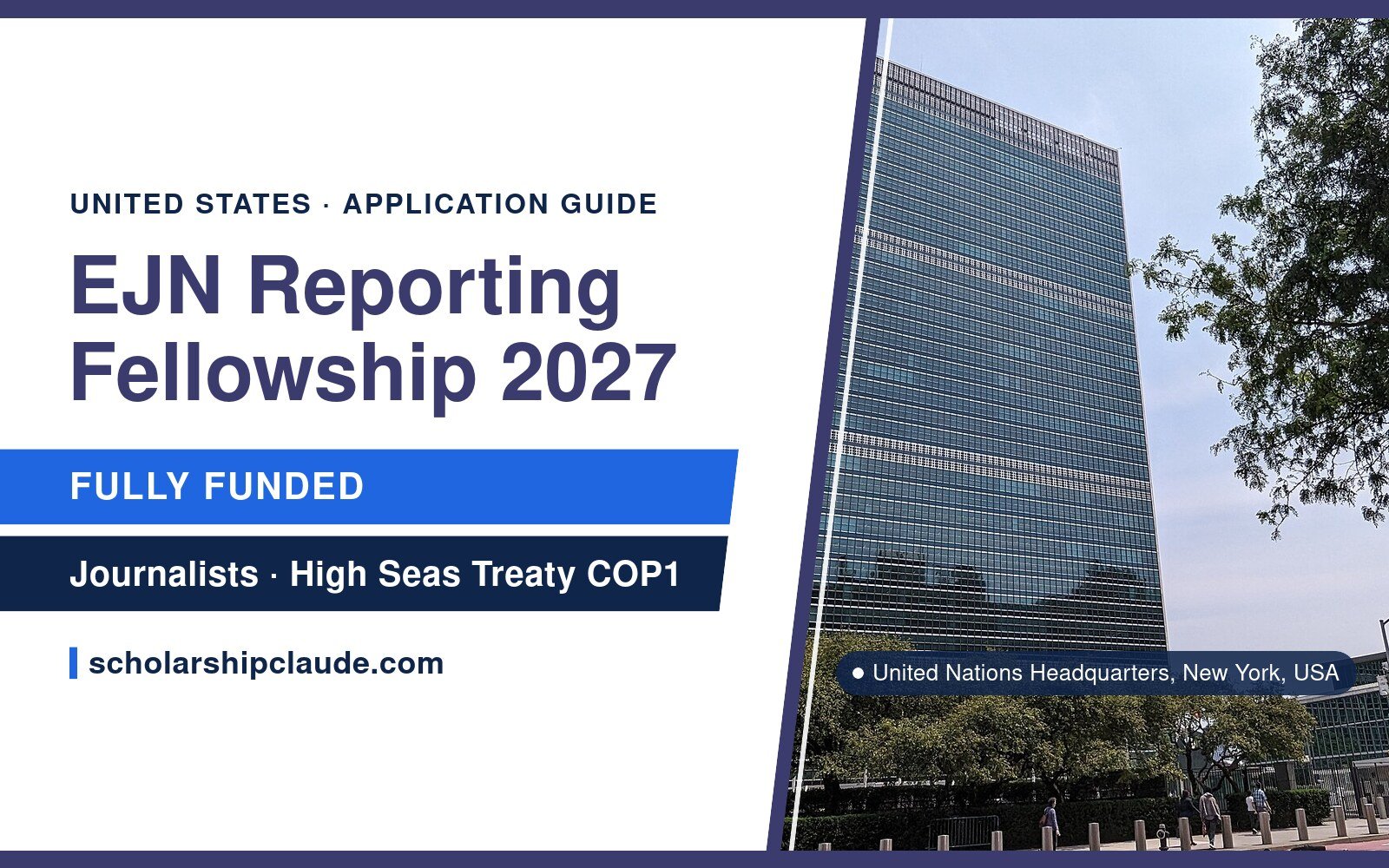
Internews’ Earth Journalism Network (EJN) will take 10 journalists to New York City to report on the first conference of the High Seas Treaty in January 2027. The fellowship pays for flights, hotel, meals, insurance, local transport and a daily allowance, and EJN reimburses visa costs. It is for journalists who already cover ocean issues and work with an established media outlet. The closing date is 27 October 2026, so there is very little time left.
This guide was last checked on 21 October 2026 against the official EJN opportunity page.
EJN BBNJ COP1 Reporting Fellowship at a glance
| Organiser | Internews’ Earth Journalism Network (EJN) |
|---|---|
| Event | First Conference of the Parties (COP1) of the BBNJ agreement, the High Seas Treaty |
| Where | New York City, USA |
| Conference dates | 11 to 22 January 2027 |
| Fellowship dates | Arrive 9 January, depart 23 January 2027 |
| Fellows | 10, with equal numbers from the Global North and Global South |
| Funding | Flights, hotel, meals, insurance, ground transport, visa reimbursement and a daily allowance |
| Closing date | 27 October 2026 |
| Decisions | November 2026 |
| Application fee | Not stated on the official source |
Is this fellowship right for you?
This is a short, intense fellowship for working journalists, not a training course for beginners. Ask yourself:
- Do you already report on the ocean? The panel looks for demonstrated ocean reporting and a long-term commitment to the topic. One environment story is not enough; a track record helps.
- Does an established outlet stand behind you? You need a signed letter from an editor, producer or supervisor confirming your stories will run.
- Can you produce under pressure? You must publish at least two in-depth stories during the fellowship or within two weeks after it.
- Is your country coastal? The eligibility rule asks for journalists reporting from a coastal country.
- Can you be away for two weeks in January? You must attend the full trip.
If you can say yes to each point, it is worth applying even with the short time left.
What is the High Seas Treaty?
The Agreement on Biodiversity Beyond National Jurisdiction, known as BBNJ or the High Seas Treaty, deals with the ocean areas that lie outside any one country’s control. COP1 is the first meeting of the countries that are parties to it. First meetings like this set many of the rules and processes that later meetings follow, which makes it an important event for journalists who cover the ocean.
EJN’s fellowship is part of a new three-year initiative. The official page says the programme depends on final funding approval from the Bloomberg Ocean Fund.
Why ocean journalists should consider applying
Few newsrooms can pay to send a reporter to New York for two weeks. This fellowship removes that barrier and puts you in the room for the first meeting of a new global agreement. You also join a small group of journalists from different regions, with trainers and experts to help you understand the issues. For a journalist building a career on the ocean beat, that mix of access, support and published work is valuable.
What the fellowship covers
- Non-refundable economy-class airfare to New York.
- Accommodation and meals.
- Travel medical insurance.
- Ground transport related to the fellowship.
- Press accreditation support and general trip logistics.
- Visa cost reimbursement. You arrange and apply for your visa yourself.
- A daily allowance (per diem) for expenses in New York.
- A pre-conference virtual workshop, an orientation with ocean experts, daily briefings by media trainers, side events and special briefings with high-profile speakers.
The amount of the daily allowance is not stated on the official source.
Fellowship timeline
| Date | What happens |
|---|---|
| 27 October 2026 | Applications close |
| November 2026 | Decisions sent to applicants |
| Before January | Pre-conference virtual workshop; selected fellows apply for US visas |
| 9 January 2027 | Fellows arrive in New York |
| 10 January 2027 | Orientation day run by EJN |
| 11 to 22 January 2027 | BBNJ COP1 |
| 23 January 2027 | Fellows depart |
| Within two weeks after the fellowship | Last date for your required stories to be published |
Who can apply
- A professional journalist from, or representing, an established media house, reporting from a coastal country.
- Previous experience reporting on ocean issues, such as illegal fishing, marine protected areas, the blue economy, sustainable fisheries or marine pollution.
- A clear plan for the stories you will pursue at the conference.
- Available for the whole trip, from 9 to 23 January 2027.
- Good command of English. Applications are accepted in English only.
All media types are welcome: online, print, TV and radio. Staff journalists, freelancers, and international, national, local and community journalists can all apply. Freelancers need a letter from the outlet they plan to report for.
Countries EJN especially encourages
EJN especially encourages journalists from Namibia, Ecuador, Peru, Seychelles, Japan, Spain, Canada and South Korea, but it will also select journalists from other countries. The cohort will have equal numbers from the Global North and Global South.
Documents you need
- CV or resume: up to date, showing your journalism experience.
- Letter of support: from an editor, producer or supervisor, confirming that your work from the fellowship will be published or broadcast by an established outlet. It should be signed.
- Work samples: recent stories on ocean issues, published in the last 12 months, with clear bylines. You can upload documents or add web links. Work in other languages is accepted with a short English synopsis.
- Online application form: including your story plan for the conference.
Preparing your CV for a journalism fellowship
Your CV should make your ocean reporting easy to find. Put your current role and outlet at the top, then list your recent work with dates. Add a short section called “Ocean and environment reporting” with three to five key stories, their outlets and publication dates. Include any awards, training courses or past fellowships. Keep it to one or two pages, and make sure the names and dates match your work samples. Our CV template shows a clear layout you can adapt for a journalism CV.
Making the most of the trainers and briefings
The fellowship includes a pre-conference virtual workshop, an orientation day with ocean experts and daily briefings by media trainers. Use them well. Arrive at the workshop with your story list and questions about the topics you find hardest. During the conference, ask the trainers to look at a draft or help you find a source. These sessions can save you hours of research in a fast-moving negotiation.
How applications are judged
A panel of international judges, made up of Internews staff and environmental journalism experts, makes the final decisions. The official page lists these criteria:
- Demonstrated experience reporting on the ocean and the environment.
- Long-term commitment to ocean journalism.
- A relationship with an established media house, backed by a signed letter of support.
The panel also aims for a diverse group across media types and regions. EJN says AI tools may help with administrative tasks and preliminary review, but human evaluators review all applications. It may disqualify applicants who plagiarise or submit AI-generated content as their own work.
What fellows must deliver
- At least two in-depth stories or analyses for your media house, published during the fellowship or within two weeks after it.
- Follow EJN’s editorial standards, shared at the start of the fellowship.
- Provide English summaries of any non-English stories, and fully translate at least one story into English. Automated tools can help, but you must check the translation for accuracy.
- Include EJN’s acknowledgement line in your stories.
- Allow EJN, its partners and funders to edit, republish, broadcast and distribute your stories. Your outlet can publish first.
You are also responsible for meeting US travel requirements and for your own safety. EJN will share travel and health risk updates before the conference.
Story ideas that connect to your audience
A treaty negotiation can feel distant to readers at home. Strong fellowship stories link the talks to people and places your audience knows. Some ways to do that:
- Local fishing: how decisions on the high seas could affect fish stocks that coastal communities in your country rely on.
- Your country’s position: what your government’s delegation is asking for, and why.
- Science on the record: what researchers know about the ocean areas the treaty covers, explained in plain language.
- Money and fairness: how countries plan to share benefits and costs, and what that means for developing nations.
- People behind the talks: profiles of delegates, scientists or community advocates from your region.
Use these only as starting points. Your own ideas, based on your beat and your audience, will be stronger.
Practical tips for covering a UN negotiation
- Study the agenda early. Know which topics are on which days so you can plan interviews.
- Use the side events. Panels and briefings around the main talks are often where you meet experts and find stories.
- Find your delegation. Contact your country’s delegation before you travel and ask for an interview during the conference.
- Write explainers. Many readers will not know what the High Seas Treaty is. A clear explainer is often your most read piece.
- File as you go. Do not save everything for the end. Short updates during the talks keep your editor and audience engaged.
- Use the briefings. EJN’s media trainers and expert briefings are there to help you understand complex issues quickly.
Talking to your editor now
Your editor’s support is part of the eligibility, and it also shapes your story plan. When you ask for the letter, agree on what the outlet wants: how many pieces, which formats, and roughly when they will run. This helps you write a realistic story plan in your application, and it shows the panel that your work will be published.
How to apply
- Open the official EJN opportunity page and click Apply now.
- Log in, or create an account if you do not have one. If you cannot log in, reset your password.
- Complete the form and upload your CV, letter of support and work samples. You can save a draft and come back by clicking Apply now again.
- Submit before the deadline on 27 October 2026. Late applications are not considered.
Questions go to info.ejn@internews.org. EJN asks applicants not to contact other Internews email addresses about this opportunity.
Writing a strong story plan
Your story plan shows the panel what you will produce. With only days left, keep it simple and specific:
- Two or three story ideas linked to the High Seas Treaty and to your country or region, such as how the treaty could affect fishing communities or marine protected areas near you.
- The angle for your audience: why readers, viewers or listeners at home should care.
- Your sources: delegates, scientists or civil society groups you plan to approach at the conference.
- The format: article, radio feature, TV package or data story, and where it will run.
Getting the letter of support quickly
The letter of support is often the slowest part. Ask your editor today. Make it easy for them by sending a short draft with the key points: your name and role, the outlet’s name, a confirmation that the outlet will publish or broadcast your fellowship stories, and a signature. Freelancers should ask the editor of the outlet they plan to report for.
Choosing your work samples
- Pick stories on ocean topics from the last 12 months.
- Make sure your byline is clear on each one.
- Check that web links open without a paywall or login, or upload a PDF.
- Add a short English synopsis for work in other languages.
A plan for the days before 27 October
| When | What to do |
|---|---|
| Today | Ask your editor for the signed letter of support, and send them a short draft to sign. |
| Next day | Choose your work samples from the last 12 months and check every link. |
| Next two days | Write your story plan with two or three specific ideas, and update your CV. |
| By 26 October | Fill in the online form, upload everything and submit a day early. |
| 27 October | Closing date. Late applications are not considered. |
Submitting a day early protects you from last-minute website problems or internet cuts.
Planning your US visa
If you are selected in November, you will have about seven weeks before arrival on 9 January. You apply for your US visa yourself, and EJN reimburses the cost. Check visa appointment wait times at the US embassy or consulate in your country now, because they can be long. Keep your passport valid well beyond January 2027.
After the fellowship
Your work is not finished when you fly home. Within two weeks of the fellowship, your required stories must be published. If you wrote in another language, prepare English summaries and translate at least one story fully into English, checking any machine translation carefully. Add EJN’s acknowledgement line to each story. Keep copies and links of everything you publish, because EJN and its partners may republish or share your work.
Safety, health and travel rules
EJN provides travel medical insurance, but you are responsible for meeting US travel requirements and for your own safety. EJN says participation is voluntary and that it will share travel and health risk updates before the conference. January in New York is cold, so pack warm clothes. Keep copies of your passport, visa, invitation letter and insurance details on your phone and on paper.
Related fellowships for journalists
- Yale World Fellows Program, four months at Yale for mid-career leaders from outside the USA, including journalists.
- Erasmus Mundus Journalism, a funded master’s degree in Europe.
- Erasmus Mundus NOHA, for those interested in humanitarian work.
Common mistakes to avoid
- Waiting for the letter of support until the last day.
- Work samples older than 12 months or without bylines.
- A vague story plan with no link to the treaty.
- Applying when you cannot attend the full dates.
- Submitting writing that is not your own.
Checklist before you submit
- I am a professional journalist reporting from a coastal country.
- I have published ocean stories in the last 12 months.
- My editor’s signed letter of support is uploaded.
- My story plan names specific ideas.
- I can travel from 9 to 23 January 2027.
- I will submit before 27 October 2026.
Frequently asked questions
Is the EJN fellowship fully funded?
Yes. EJN covers airfare, accommodation, meals, travel insurance, ground transport, visa cost reimbursement and a daily allowance.
Can freelancers apply?
Yes, with a letter of support from the outlet they intend to report for.
How many fellows are selected?
10, with equal representation from the Global North and Global South.
Do I need an English test?
No test is mentioned, but you need good English, and applications are accepted in English only.
When will I hear back?
EJN plans to send decisions in November 2026.
Can I bring a camera crew or a colleague?
The fellowship is for individual journalists. Support for anyone else is not stated on the official source.
Who do I contact with questions?
Email info.ejn@internews.org. EJN asks applicants not to use other Internews addresses for this opportunity.
Is there an age limit?
An age limit is not stated on the official source.
Do I need press accreditation before I apply?
No. EJN supports fellows with press accreditation after selection.
Where to apply
Apply on the official EJN opportunity page. Our EJN fellowship page keeps the key facts in one place.
Related scholarships: funding, stipend and deadlines
| Scholarship | Funding | Stipend | Deadline |
|---|---|---|---|
| US–Pakistan Knowledge Corridor PhD Scholarships 2027 | Fully funded | Not stated on HEC's programme page (see the HEC advertisement) | 30 Oct 2026 |
| PPIA Junior Summer Institute 2027 in the USA | Fully funded | See the scholarship page | 6 Nov 2026 |
| Harvard LEAD Fellowship 2027–28 in the USA | Fully funded | Living stipend for the in-residence period (amount not stated on the official source) | 15 Nov 2026 |
| Harvard Kennedy School Fellowships and Financial Aid 2027 in the USA | Partial | See the scholarship page | 1 Dec 2026 |
| Stanford Graduate Fellowship | Fully funded | Stipend of 58,500 US dollars for 2026–27, paid as 14,625 dollars per quarter | 1 Dec 2026 (expected) |
| Knight-Wallace Fellowship 2027–2028 in the USA | Fully funded | 85,000 US dollars for the fellowship year, paid monthly from August to April | 1 Dec 2026 |
| Yale World Fellows Program 2027 in the USA | Fully funded | Taxable stipend to cover the cost of living in New Haven (amount not published) | 2 Dec 2026 |
| LPI Summer Intern Program in Planetary Science 2027 in Houston, USA | Partial | Stipend paid; amount not stated on the official source | 14 Dec 2026 |
| MIT Presidential Fellowship 2027 in the USA | Fully funded | See the scholarship page | 15 Dec 2026 (expected) |
| Fully Funded STEM PhD Programs in the USA 2027 | Fully funded | See the scholarship page | 15 Dec 2026 (expected) |
This list updates itself from our scholarships page. Stipend figures are shown where the provider publishes them. See all scholarships.