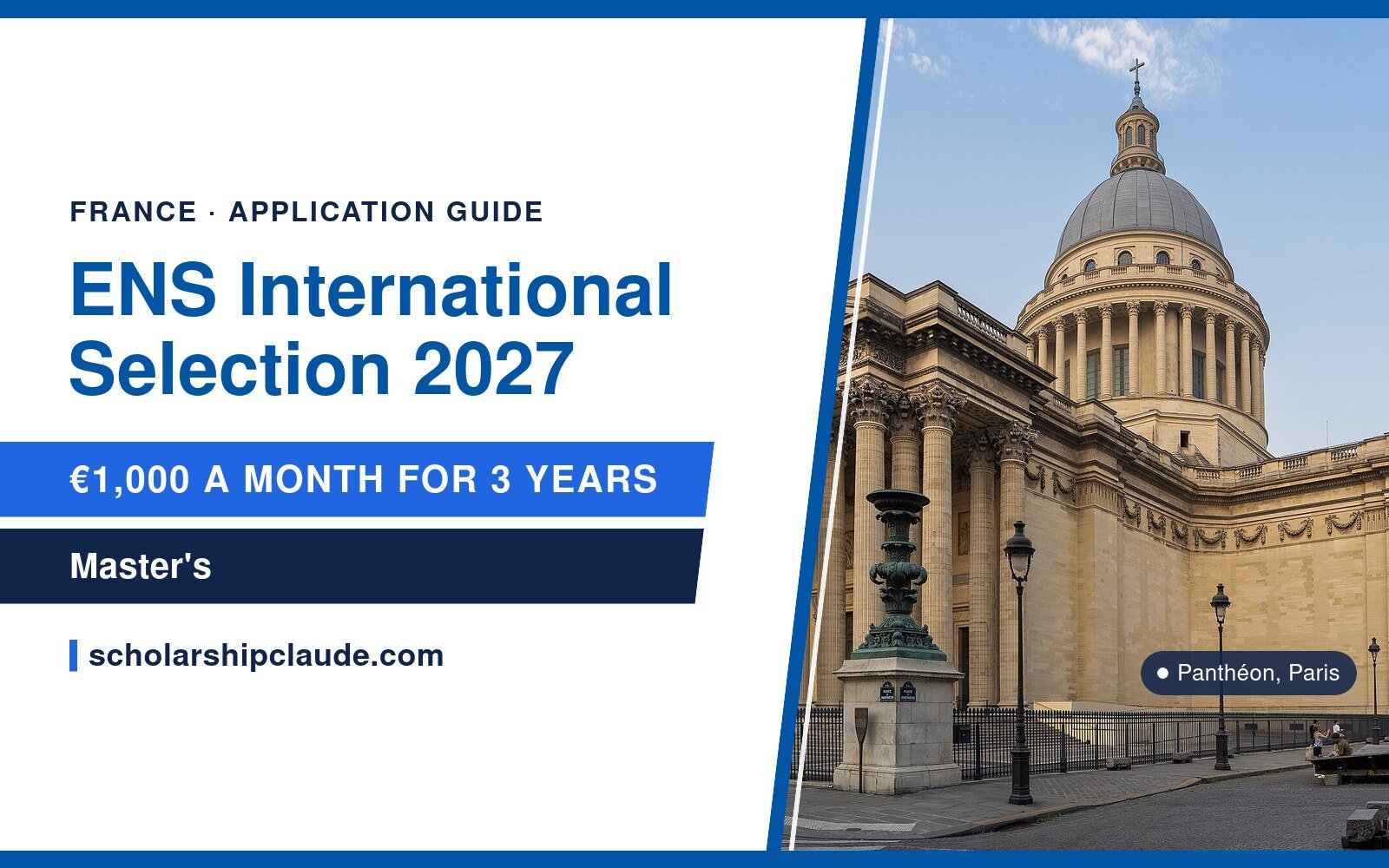
The International Selection of the École normale supérieure (ENS-PSL) in Paris is a competition for students at universities outside France. If you are selected, you spend three years at ENS, complete a master’s degree and earn the ENS graduate diploma (DENS). You receive €1,000 a month for 36 months and a furnished room. Applications for the 2027 session are open from 16 October to 15 December 2026.
This guide was checked on 15 October 2026 against the official ENS-PSL International Selection page and its FAQ.
ENS International Selection at a glance
| Institution | École normale supérieure – PSL, Paris, France |
|---|---|
| What you study | A master’s degree plus the ENS diploma (DENS), over three years |
| Tracks | Arts & Humanities (18 disciplines) and Sciences (7 disciplines) |
| Grant | €1,000 a month for 36 months |
| Housing | A furnished room on an ENS-PSL campus (not guaranteed in the third year) |
| Age | Under 26 on the day applications open |
| Applications | 16 October to 15 December 2026 |
| Closing date | 15 December 2026 |
| Start | September 2027 |
| Application platform | OnePSL30 |
What is the International Selection?
ENS is one of France’s most selective higher-education institutions. Each year it runs a separate competition for students from foreign universities. Selected students join in the third year of a bachelor’s degree (licence 3) or the first year of a master’s (master 1), and study at ENS for three years. They complete a master’s in their discipline and the extra courses of the ENS diploma.
ENS says the selection rate is usually between 5% and 10%, so the competition is strong.
What you receive
- A grant of €1,000 a month for 36 months. The first payment, in October, covers September and October. Later payments arrive monthly.
- A furnished room on an ENS-PSL campus. First-year students usually live at rue d’Ulm. The FAQ says a room is not guaranteed in the third year.
- French classes, which ENS-PSL offers to its students.
You still pay the university registration fees. The FAQ also says students receive no grant during an approved gap year.
Who can apply
Arts & Humanities
- No older than 25 on the opening day of applications (you must not have turned 26).
- Currently in your third year of study, with proof of at least three years of study toward a degree at a foreign university.
- Not resident in France for more than 10 months.
- Never applied to the International Selection before.
Sciences
- Under 26 on the opening day of applications.
- At least one year of undergraduate study at a foreign university, and at least two years by the time you enrol.
- Not registered at a school or university in France for more than six months in total across the competition year and the year before.
- Never applied to the International Selection before.
The official page does not set any nationality restriction.
Disciplines you can choose
You apply in one discipline only.
- Arts & Humanities: anthropology, archaeology, classical studies, cinema, theatre studies, history of art, musicology, cognitive sciences, economics, political studies, geography, history, history and philosophy of law, history and philosophy of sciences, linguistics, literature, philosophy, sociology.
- Sciences: biology, chemistry, earth science, computer science, mathematics, physics, cognitive sciences.
Language
Arts & Humanities is taught in French, and the written exam, oral exam and interview are in French, although you may use English during the oral tests. ENS recommends that you are fluent in French. The FAQ mentions about B1 level, with no certificate required.
In Sciences, courses are in French or English depending on the department. You may answer the oral tests in French or English, and no language level is officially required.
Documents you need
Arts & Humanities
- CV
- Motivation letter in French (in French and English for economics, linguistics and cognitive sciences)
- Research project of up to three pages, with a bibliography
- University transcript
- High school diploma
- Two to four recommendation letters
Sciences
- High school diploma
- University transcript
- CV
- A cover letter in French or English that explains your interest in ENS and your chosen department
- Two to four recommendation letters
Recommendation letters are requested through the OnePSL30 platform, so register your referees early. Incomplete applications are not considered, and applications by email or post are not accepted. ENS also asks applicants and referees not to use @icloud.com email addresses.
Selection and key dates
| Step | Arts & Humanities | Sciences |
|---|---|---|
| Applications | 16 October to 15 December 2026 | 16 October to 15 December 2026 |
| Shortlist published | From 21 January 2027 | From 27 January 2027 |
| Tests by videoconference | 15 to 26 February 2027 | 3 to 19 March 2027 |
| Results | From 9 March 2027 | From 26 March 2027 |
The tests
- Arts & Humanities: a written exam in French in your discipline, an oral exam before a panel, and a 20 to 30 minute interview about your background and project.
- Sciences: a scientific oral test in your discipline, which may include a written preparation part, and an interview about your scientific culture and motivation. The scientific test carries twice the weight of the interview.
How to apply, step by step
- Choose your track and one discipline, and read that department’s page on the ENS website.
- Check the eligibility rules for your track, especially the age limit and the rules on time spent in France.
- Create your application on the OnePSL30 platform.
- Prepare your documents. For Arts & Humanities, start the research project and French motivation letter early.
- Request your recommendation letters through the platform.
- Submit before the closing date, 15 December 2026.
- If shortlisted, prepare for the online tests in February or March 2027.
Our motivation letter template and guide to recommendation letters can help with the written parts.
Is the International Selection right for you?
The International Selection is not a normal master’s admission. It is a competitive entry to a three-year programme at one of France’s most selective institutions, with a monthly grant and a room. It suits you if:
- You are in the third year of a bachelor’s degree or the first year of a master’s at a university outside France.
- You are under 26 on the day applications open and have never applied before.
- You want an intensive, research-oriented education in one discipline.
- For Arts & Humanities, you can study and take exams in French.
Because you can apply only once in your life, it is worth applying in the year when your record and preparation are strongest, while you still meet the age and study-year rules.
Choosing your track and discipline
You apply in one discipline only, so choose with care. Read the ENS department page for each discipline you are considering, and ask yourself:
- Does my previous study give me a solid base in this discipline?
- Can I write a research project in this field, for Arts & Humanities, or explain my scientific interests, for Sciences?
- Does the department teach in a language I can work in?
- Do the department’s research areas match what I want to study over three years?
If you are between two disciplines, choose the one where you can show the strongest evidence: grades, projects, and teachers who can write detailed letters.
Arts & Humanities: the motivation letter in French
Arts & Humanities applicants write a motivation letter in French, or in French and English for economics, linguistics and cognitive sciences. A clear structure:
- Présentation: your university, year of study and discipline.
- Parcours: the courses, readings and projects that led you to this discipline.
- Projet: the research questions you want to pursue at ENS.
- Pourquoi l’ENS: what the department and the ENS diploma offer you.
- Après l’ENS: your academic or professional goals.
Write correct, simple French. The FAQ mentions about B1 level for Arts & Humanities, but the written exam and oral tests are in French, so the letter is also a first sign of your language level. Ask a French teacher to check it.
A sample opening in French
Use this only as a model for tone and structure, and write your own letter:
Madame, Monsieur,
Étudiante en troisième année de licence d’histoire à l’Université de [ville], je souhaite présenter ma candidature à la Sélection internationale de l’École normale supérieure, dans la discipline Histoire. Mon mémoire de licence, consacré aux réseaux marchands de [région] au XIXe siècle, m’a convaincue de poursuivre une formation par la recherche. Je souhaiterais approfondir ce travail à partir des archives conservées en France.
The opening states the year and discipline, the thesis topic and a link to sources in France, all in a few sentences. Continue with your project, why ENS, and your goals.
Arts & Humanities: the research project
The research project is limited to three pages plus a bibliography. It does not need to be a finished plan, but it must show that you can think like a researcher. Include:
- A question: a focused problem, not a broad theme.
- Context: the main works or debates your question responds to.
- Sources and method: the texts, archives, data or approach you would use.
- Why it matters: what your project could add.
- A short bibliography: real, relevant works you have read or plan to read.
Reviewers value precision. A project about one author, period or dataset, with a clear question, reads better than an ambitious plan to cover a whole field. Our research proposal template shows how to structure a short proposal.
Sciences: the cover letter
Sciences applicants write a cover letter in French or English explaining their interest in ENS and their chosen department. Focus on evidence: the advanced courses you took, any research project or olympiad experience, and the scientific questions that interest you. Name specific areas the department works in, and explain why the ENS diploma, with its research training, suits your plans.
Recommendation letters on OnePSL30
You need two to four recommendation letters, requested through the OnePSL30 platform. Your referees upload their letters there, so:
- Ask your referees early and give them your CV, transcript and a short note on your plans.
- Register them on the platform well before 15 December 2026, so they have time to upload.
- Use referees who taught or supervised you and can give concrete examples.
- Do not use @icloud.com email addresses for you or your referees, as ENS asks.
Applications by email or post are not accepted, and incomplete applications are not considered. Our guide to recommendation letters explains how to brief referees.
Preparing for the tests
If you are shortlisted, the tests take place by videoconference. Prepare differently for each track.
Arts & Humanities (15 to 26 February 2027)
- Written exam in French: practise timed essays in your discipline, in French.
- Oral exam: practise explaining a text or question aloud to a panel. You may use English during the oral tests, but French is expected.
- Interview of 20 to 30 minutes: be ready to discuss your background, your research project and why ENS.
Sciences (3 to 19 March 2027)
- Scientific oral test: this counts twice as much as the interview. Revise the core of your discipline and practise solving problems aloud, as the test may include a written preparation part.
- Interview: expect questions on your scientific culture and motivation. Read widely in your field.
For both tracks, test your camera, microphone and internet connection in advance, and choose a quiet room.
Living in Paris on the grant
The grant is €1,000 a month, and you receive a furnished room on an ENS-PSL campus, at least for the first two years. The first payment arrives in October and covers September and October, so bring money for your first weeks. You also pay the university registration fees. Plan for a possible change in housing in the third year, since a room is not guaranteed then.
After you are admitted
- Confirm your place as ENS instructs after the results in March 2027.
- Apply for a French student visa if you need one, using your ENS admission documents. Start early, as appointments fill up in spring and summer.
- Register at your university for the master’s and pay the registration fees, which the grant does not cover.
- Arrange your arrival for September, and bring money for the weeks before the first grant payment in October.
- Take French classes offered by ENS-PSL if you want to strengthen your French during the programme.
Other options in France
If you miss the age or study-year rules, or want a master’s with a different structure, look at the Eiffel Excellence Scholarship, which a French institution submits for you, the Sorbonne University scholarships and the Sciences Po Émile Boutmy Scholarship. Our Eiffel scholarship guide and our guide to scholarships in France compare them.
A suggested timeline
| When | What to do |
|---|---|
| October 2026 | Choose track and discipline; ask referees; read department pages |
| November 2026 | Write the research project or cover letter; write the motivation letter |
| Early December 2026 | Register referees; upload documents on OnePSL30 |
| 15 December 2026 | Closing date |
| January 2027 | Shortlists published; start test preparation |
| February to March 2027 | Tests by videoconference |
| March 2027 | Results |
| September 2027 | Start at ENS |
Checklist before you submit
- You meet the age rule and the study-year rule for your track.
- You have never applied to the International Selection before.
- You have chosen one discipline.
- Your motivation letter or cover letter is in the required language.
- Your research project (Arts & Humanities) is no more than three pages plus bibliography.
- Two to four referees are registered on OnePSL30.
- Your transcripts and high school diploma are uploaded.
Common mistakes to avoid
- Applying to Arts & Humanities without enough French for a written exam.
- Writing a research project that is too broad.
- Registering referees in the last days before the closing date.
- Applying in a year when you are too young in your studies to show a strong record, since you can apply only once.
- Forgetting the rules on time spent in France for your track.
Frequently asked questions
Is the ENS International Selection fully funded?
You receive €1,000 a month for three years and a furnished room. You pay the university registration fees, and a room is not guaranteed in the third year.
Do I need to speak French?
For Arts & Humanities, yes: the tests and courses are in French. For Sciences, you can take the tests in English and no language level is officially required.
Can I apply if I already have a master’s degree?
The selection is for students in the third year of a bachelor’s or the first year of a master’s. Check the entry level on the official page before you apply.
What is the closing date?
15 December 2026 for both tracks.
Can I apply more than once?
No. You must never have applied to the International Selection before.
When is the first grant payment?
In October. It covers September and October, and later payments arrive monthly.
Do I get the grant during a gap year?
No. The ENS FAQ says students receive no grant during an approved gap year.
How selective is the International Selection?
ENS says that between 5% and 10% of applicants are usually selected, so prepare every document carefully and apply in your strongest year.
Do selected students get housing?
Selected students receive a furnished room on an ENS-PSL campus. The FAQ says a room is not guaranteed in the third year.
Where to apply
Read the full rules on the official ENS-PSL International Selection page. Our ENS International Selection page keeps the key facts in one place, and our guide to scholarships in France lists other options.
Related scholarships: funding, stipend and deadlines
| Scholarship | Funding | Stipend | Deadline |
|---|---|---|---|
| Sciences Po Émile Boutmy Scholarship 2027 in France | Partial | Tuition exemption of 18,500 euros a year at master's level | 29 Nov 2026 |
| ENS International Selection 2027 in France | Partial | €1,000 a month for 36 months | 15 Dec 2026 |
| MOPGA Visiting Fellowship 2027 in France for Early-Career Researchers | Partial | 2,500 euros a month for 12 months, plus a 500 euro settling-in allowance | 15 Dec 2026 |
| Sorbonne University Scholarships 2027 in France | Partial | See the scholarship page | 6 Jan 2027 |
| Eiffel Excellence Scholarship 2027 in France | Partial | €1,200 a month (master's), €2,000 a month (PhD) | 6 Jan 2027 |
This list updates itself from our scholarships page. Stipend figures are shown where the provider publishes them. See all scholarships.