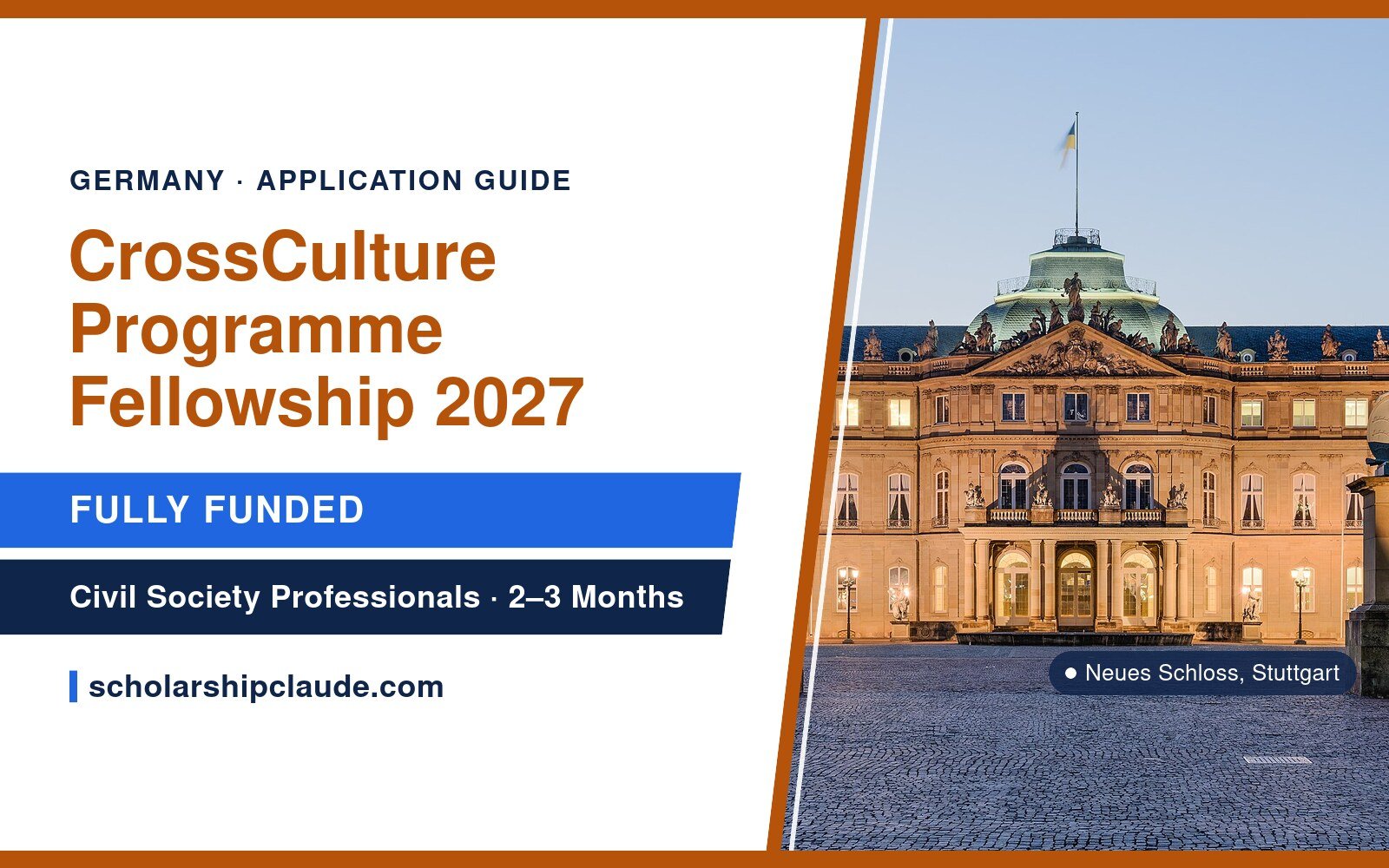
The CrossCulture Programme (CCP) Fellowships give people who work in civil society organisations two to three months with a host organisation in Germany or in a CCP partner country. The programme is run by ifa (Institut für Auslandsbeziehungen) in Germany. Fellows from abroad receive 650 euros a month, and their flights, accommodation, local transport, health insurance and visa fees are also covered. The 2027 call is open to people from about 40 countries, and the closing date is 8 December 2026.
This guide was last checked on 23 October 2026 against ifa’s official CCP application website.
CCP Fellowship 2027 at a glance
| Organiser | ifa (Institut für Auslandsbeziehungen), Germany |
|---|---|
| Who it is for | Professionals and volunteers who work in civil society organisations |
| Where | A host organisation in Germany or in a CCP partner country |
| Length | Two to three months |
| Programme period | May to November 2027 |
| Fellows each year | 50 to 60, from more than 40 countries |
| Monthly stipend | 650 euros for fellows from abroad; 1,200 euros for fellows from Germany |
| Also covered | Round-trip airfare, accommodation, monthly public transport ticket, health insurance and visa fees |
| Minimum age | 23 when you apply |
| Experience | At least two years in a civil society organisation in your home country |
| Language | Solid written and spoken English |
| Application period | 20 October to 8 December 2026 |
| Closing date | 8 December 2026 |
| Results | By email in March or April 2027 |
| Application fee | Not stated on the official source |
What is the CrossCulture Programme?
The CCP is a fellowship for people who already do social, political, cultural or environmental work in their own country. It is not a study programme. You do not attend classes or earn a degree. Instead, you join a host organisation and work with its team for two to three months.
ifa says the fellowship helps fellows broaden their expertise, build networks and develop transcultural skills. Each year it brings together 50 to 60 professionals and volunteers from more than 40 countries. Host organisations are in Germany or in CCP partner countries, and people from Germany can also apply, with their own funding terms.
The fellowship does not end when you fly home. ifa describes a “reverse phase”, in which you bring what you learned back into the work of your home organisation. This is one reason your home organisation plays a big part in your application.
The stipend is subject to funding by the German Federal Foreign Office, as ifa notes on its programme page.
Is this fellowship right for you?
Ask yourself these questions before you start:
- Do you work in civil society? You need at least two years of proven professional or volunteer work in a civil society organisation in your home country. If you are not sure whether your organisation counts, write to ifa before you apply.
- Are you 23 or older? You must be at least 23 when you apply. No upper age limit is stated on the official source.
- Is your English solid? English is the main language of the programme, and you need good written and spoken English.
- Can you be away for two to three months? You must be able to stay abroad for a long period, and your family cannot come with you at ifa’s cost.
- Are you a student? Students cannot apply.
- Do you already have a fellowship for 2027? People who receive another form of funding, such as a fellowship, in the same year cannot apply.
- Will your organisation back you? You need a recommendation from your home organisation or employer, and you are expected to share what you learn when you return.
If you can answer yes to the first, third, fourth and last questions and no to the student and fellowship questions, the CCP is worth your time.
The working areas for 2027
Every CCP fellow works in one of these areas:
- Policy and Society
- Media and Culture
- Human Rights and Peace
- Sustainable Development and Climate Justice
The key topic for 2027 is Democratic Resilience. ifa’s call page lists it next to the four areas, and fellows who work on this key topic take part in one additional event during the fellowship.
Choose the area that matches the work you already do, not the one that sounds most impressive. The selection board will read your CV and your recommendation letter, and both should show real work in the area you pick. If your work touches two areas, choose the one where you have the strongest results to show.
What the fellowship covers
Fellows from abroad
- A stipend of 650 euros a month
- Round-trip airfare
- Accommodation
- A monthly public transport ticket in the city where you live during the fellowship
- Health insurance
- Reimbursement of visa fees
Fellows from Germany
- A stipend of 1,200 euros a month
- Reimbursement of round-trip travel costs, visa fees and health insurance
Learning and support
- Mentoring for the whole fellowship
- A Transcultural Workshop lasting three to four days
- Professional development, online or on-site
- Networking with other fellows
- Membership of the CCP alumni network
What is not covered
Spouses, partners and children cannot accompany fellows, and ifa does not pay any extra costs for family members. Plan for this early if you have children or other people who depend on you.
Planning your money
Because flights, accommodation, local transport, health insurance and visa fees are covered separately, the 650 euro stipend is left for your other daily costs, such as food, phone and personal items. Some practical points to think about now:
- First payment. When the first stipend payment arrives is not stated on the official source. Keep some savings for your first days, and ask ifa about payment dates if you are selected.
- Bills at home. Rent, loans or family costs at home do not stop while you are away. Make a plan for them before you leave.
- Your job. Talk to your employer about two to three months away. You may need unpaid leave, or an agreement that the fellowship counts as part of your work, since your home organisation also benefits during the reverse phase.
- Bank card. Check that your card works abroad and what fees your bank charges.
Who can apply
According to ifa, you must:
- Be at least 23 years old when you apply
- Have at least two years of proven professional or volunteer work in a civil society organisation in your home country
- Have a solid command of written and spoken English
- Be able to undertake a long stay abroad
- Not be a student
- Not receive another form of funding, such as a fellowship, in the same year
On health, ifa asks anyone who is unsure whether they can manage a long stay abroad to contact the CCP team at crossculture@ifa.de before applying.
Things that count in your favour
- A long-term commitment to social or community work
- An existing or planned collaboration with an organisation in the host country
- Other languages, especially German
German is an advantage, not a requirement. Do not hold back from applying because you do not speak German.
Countries in the 2027 call
ifa accepts applications from these countries of origin:
Algeria, Armenia, Azerbaijan, Bangladesh, Bolivia, Brazil, Cambodia, Colombia, Cuba, Egypt, Georgia, Germany, Guatemala, India, Indonesia, Iraq, Jordan, Kazakhstan, Kyrgyzstan, Lebanon, Libya, Malaysia, Mauritania, Mexico, Mongolia, Morocco, Nepal, Pakistan, the Palestinian Territories, the Philippines, the Republic of Moldova, Serbia, Sri Lanka, Syria, Tajikistan, Thailand, Tunisia, Ukraine, Uzbekistan and Vietnam.
Russians can apply only through the call for Russians living in exile abroad. The call page for the Palestinian Territories refers to the West Bank. Each country has its own CCP Fellowship 2027 page with an “Apply now” link, so always apply through the page for your own country. If your country is not on this list, the 2027 call does not include it.
2027 timeline
| When | What happens |
|---|---|
| 20 October 2026 | Application period opens |
| 8 December 2026 | Closing date |
| After the closing date | Shortlisted applicants are invited to an interview with the Selection Board |
| March or April 2027 | Selected fellows are told by email; other applicants also get an email |
| May to November 2027 | Fellowships take place, each lasting two to three months |
| After you return | Reverse phase with your home organisation |
The exact start and end dates of each placement are not stated on the official source. The 2027 fellowships are planned on-site. ifa says digital participation may be possible depending on the circumstances and travel rules.
Documents you need
- CV in English. It should be up to date and cover your education, work experience, volunteer work and other relevant skills.
- Letter of recommendation. It must come from your home organisation or employer in your home country, preferably your supervisor, and it must use ifa’s official template.
- Photo (optional). If you add one, it should be recent.
- The online form. You complete it on ifa’s application system.
Have everything ready before you open the form. ifa says the system does not allow you to save drafts, so you need to finish in one sitting.
Getting the recommendation letter
The recommendation letter is the one document you cannot write yourself, so start with it.
- Ask early. Speak to your supervisor this week. Busy directors often need two or three weeks.
- Use the template. Send your supervisor ifa’s official template so the letter is in the right format.
- Give them notes. Share a short list of your main projects, how long you have worked or volunteered with the organisation, and which CCP working area you are applying for.
- Talk about the return. A good letter explains how your organisation will use what you learn during the reverse phase.
- Check the details. Make sure your name, the organisation’s name and the signature are correct before you upload it.
The letter must come from an organisation or employer in your home country. A reference from a partner abroad does not replace it.
Writing your CV for the CCP
Your CV is your main chance to prove the two years of civil society experience. Make that experience easy to see.
- Put your civil society work first, with dates in month and year, so the selection board can count your experience quickly.
- Include volunteer work. ifa counts both professional and volunteer work.
- For each role, add one or two results with numbers, such as “ran 12 community meetings on local water rights” or “trained 40 young volunteers in fact-checking”.
- Show your languages honestly, including your level of English and any German.
- Keep it to two pages if you can, and write it in clear, simple English.
Write the application yourself
ifa asks applicants to fill out the application in person and without the use of AI. Take this seriously. The selection board wants to hear your real voice and your real experience. Simple English with honest, specific examples is better than polished sentences that do not sound like you.
How to apply, step by step
- Open the CCP call for applications on ifa’s application website.
- Choose the CCP Fellowship 2027 page for your country of origin and read it to the end.
- Prepare your English CV, the signed recommendation letter on ifa’s template and, if you want, a recent photo.
- Write your answers in a separate document first, because you cannot save a draft in the system.
- Click “Apply now” on your country page and complete the form in one sitting.
- Upload your documents and submit before the deadline at 23:59 Central European Time on 8 December 2026.
- Watch your email, including the spam folder, for an interview invitation.
ifa will not consider incomplete applications, applications sent by email or applications submitted after the deadline.
Preparing your answers before you open the form
The official pages we checked do not list the questions in the online form. Before you start, prepare short notes in your own words on these points so you can work quickly:
- Your organisation: what it does, who it serves and your role in it.
- Two or three projects you led or supported, with clear results.
- Which working area fits your work, and why.
- What you want to learn from a host organisation, and one or two skills you hope to bring home.
- Any existing or planned contact with an organisation in Germany or a CCP partner country.
- How your home organisation will use your experience after you return.
Show your civil society work clearly
Selection boards read many applications that say “I am passionate about human rights” or “I want to make a difference”. These sentences do not tell them anything. Show the work instead.
A weak example: “I work on climate issues in my community.”
A stronger example: “Since 2022 I have coordinated a volunteer group of 25 people that plants trees along a river in my district and runs monthly clean-ups. In 2025 we convinced the local council to ban dumping on the riverbank.”
The second version proves the length of your experience, your role and a real result. Use this style throughout your application.
If you already know a host organisation
An existing or planned collaboration with an organisation in the host country counts in your favour. If you already work with a partner in Germany or in another CCP country, name it and explain what you do together. If you do not, you can still apply. How host organisations are matched with fellows is not stated on the official pages we checked, so do not promise a placement that has not been agreed.
Getting ready for the interview
If you are shortlisted, you will be invited to an interview with the Selection Board. The format and length are not stated on the official source. Prepare by:
- Re-reading your application so your answers match what you wrote.
- Practising a two-minute summary of your work and your plans for the fellowship.
- Preparing one example of a problem you solved in your organisation.
- Thinking about how you would work in a new team and a new culture.
- Explaining clearly how your home organisation will benefit when you return.
Travel, visa and health
Visa fees are reimbursed for fellows, but you still need to apply for your visa on time once you are selected. Keep your passport valid for well beyond the end of your fellowship. If you have a health condition and are unsure whether you can manage a long stay abroad, ifa asks you to contact crossculture@ifa.de. Health insurance is part of the package.
After the fellowship
When you return home, the reverse phase begins: you bring your new skills and contacts into the work of your home organisation. You also join the CCP alumni network, which links you with former fellows from many countries. Think now about one concrete change you would like to make at home after the fellowship, because it gives your application a clear purpose.
Common mistakes to avoid
- Applying as a student. Students are not eligible.
- Applying while holding another fellowship for the same year.
- Uploading a recommendation letter that is not on ifa’s template, or that comes from outside your home country.
- Writing a CV that hides your civil society experience under unrelated jobs.
- Opening the form without your documents ready, then losing your work because drafts cannot be saved.
- Applying through another country’s call page instead of your own.
- Waiting until 8 December, when a slow internet connection could make you miss the deadline.
Related opportunities
If you are a mid-career professional looking at other fellowships, see the Yale World Fellows Program, the Harvard LEAD Fellowship and, for journalists, the Knight-Wallace Fellowship. For more funding in Germany, read our guide to scholarships in Germany.
Checklist before you submit
- I am at least 23 years old.
- I have at least two years of professional or volunteer work in a civil society organisation in my home country.
- I am not a student and have no other fellowship for 2027.
- My CV is in English and shows my civil society work clearly.
- My recommendation letter is on ifa’s template and signed by my home organisation or employer.
- I am applying through the call page for my own country.
- I wrote my answers myself.
- I will submit before 8 December 2026.
Frequently asked questions
Is the CCP Fellowship fully funded?
For fellows from abroad it covers a 650 euro monthly stipend, round-trip airfare, accommodation, a monthly public transport ticket, health insurance and visa fees. Costs for family members are not covered.
Do I need IELTS or TOEFL?
No test score is stated on the official source. You need solid written and spoken English.
Is there an upper age limit?
The minimum age is 23. An upper age limit is not stated on the official source.
Can students apply?
No. ifa says students are not eligible.
Can I bring my family?
No. Spouses, partners and children cannot accompany fellows, and ifa does not pay any costs for them.
Can I choose my host organisation?
How host organisations are assigned is not stated on the official source. An existing or planned collaboration with an organisation in the host country counts in your favour.
When will I hear back?
Shortlisted applicants are interviewed after the closing date, and selected fellows are told by email in March or April 2027. ifa does not give reasons when an application is rejected.
Is there an application fee?
An application fee is not stated on the official source.
Who do I contact with questions?
The CCP team can be reached at crossculture@ifa.de.
Where to apply
Apply through the official CCP call for applications, choosing the page for your country of origin. Our CCP Fellowship page keeps the key facts in one place.
Related scholarships: funding, stipend and deadlines
| Scholarship | Funding | Stipend | Deadline |
|---|---|---|---|
| DAAD EPOS Scholarship 2027/28 in Germany | Fully funded | 992 euros a month for graduates; 1,400 euros a month for doctoral candidates | 31 Oct 2026 (expected) |
| Max Planck Computer Science Summer Internships 2027 in Germany | Fully funded | Monthly stipend (amount not stated on the official source) | 1 Nov 2026 |
| University of Erfurt Doctoral Scholarships 2027 in Germany | Partial | €1,400 a month | 24 Nov 2026 |
| Max Planck Schools PhD Program 2027 in Germany | Fully funded | 1,565 euros net a month in the first phase plus up to 100 euros for health insurance; then a TVöD/TV-L E 13 salary | 1 Dec 2026 |
| DAAD University Summer Course Scholarships 2027 in Germany | Partial | One-time grant of €1,134 (€1,309 for Least Developed Countries) | 1 Dec 2026 |
| ifa CrossCulture Programme | Fully funded | 650 euros a month for fellows from abroad; 1,200 euros a month for fellows from Germany | 8 Dec 2026 |
| Deutschlandstipendium 2027/28 in Germany at TUM | Partial | 300 euros a month | 31 Jul 2027 (expected) |
| Heidelberg University Scholarships 2027 in Germany | Partial | 300 euros a month | 31 Aug 2027 (expected) |
| DAAD Research Grants 2027/28 in Germany: Doctoral Programmes | Fully funded | See the scholarship page | Varies |
This list updates itself from our scholarships page. Stipend figures are shown where the provider publishes them. See all scholarships.