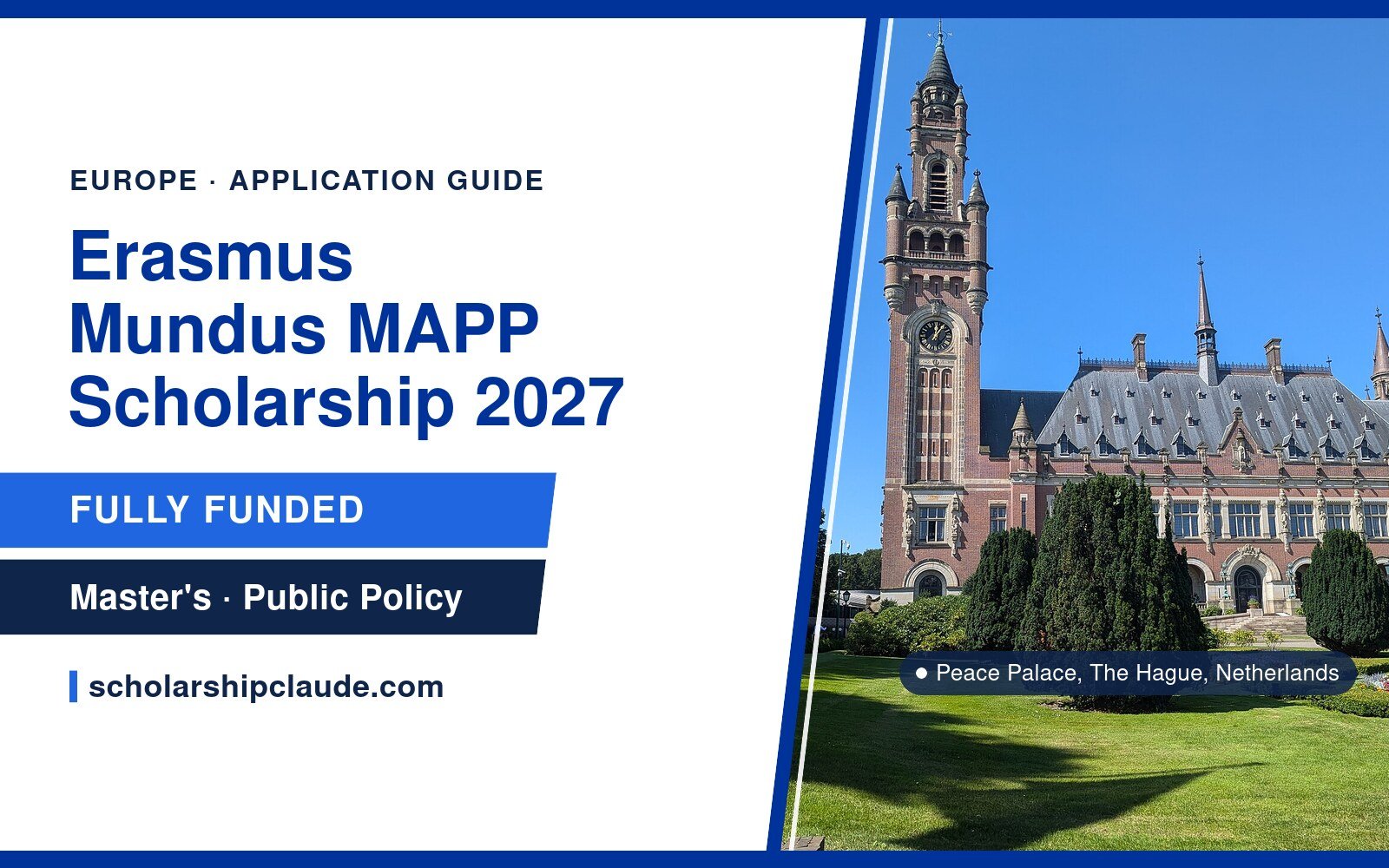
Mundus MAPP is a two-year Erasmus Mundus Joint Master’s in Public Policy taught by four universities in Austria, Spain, the Netherlands and the UK. The Erasmus Mundus scholarship waives the full tuition fee and pays 1,400 euros a month for 24 months. Applications for the 2027–2029 cohort are open now, and the closing date for scholarship applicants is 1 December 2026. There is no application fee.
This guide was last checked on 21 October 2026 against the official Mundus MAPP website: the admissions calendar, financial aid, admission requirements, how to apply, admissions checklist and tuition fee pages.
Mundus MAPP at a glance
| Programme | Mundus MAPP, Erasmus Mundus Joint Master’s in Public Policy |
|---|---|
| Universities | Central European University (CEU, Vienna, Austria), Institut Barcelona d’Estudis Internacionals (IBEI, Spain), International Institute of Social Studies (ISS) of Erasmus University Rotterdam (The Hague, Netherlands), University of York (UK) |
| Length | Two years, in two different countries |
| Scholarship | Full tuition fee waiver and up to 33,600 euros (1,400 euros a month for 24 months) |
| Tuition without a scholarship | 13,000 euros a year (26,000 euros in total) |
| Application fee | None, unless you also apply to other CEU programmes |
| Closing date for scholarships | 1 December 2026 |
| Scholarship decisions | 14 April 2027 |
| English | For example IELTS Academic 7 or TOEFL iBT 95 |
What is Mundus MAPP?
Mundus MAPP trains students in European and international public policy. It is an Erasmus Mundus Joint Master, which means a group of universities in different countries runs it together and the European Union funds scholarships for the best-ranked applicants. The programme says it is accredited in Austria, the Netherlands, Spain and the UK, and in the United States on its CEU tracks.
You study in two countries, each for at least 30 ECTS. Both countries must be different from the country where you live when you apply or enrol. Online study cannot replace these periods.
Is Mundus MAPP right for you?
Ask yourself four questions before you start.
- Is your degree in the social sciences? Politics, economics, sociology, international relations, development studies, law or public administration fit well. Natural sciences and engineering degrees are not eligible, whatever your later experience.
- Are your grades high enough? The minimum is an upper second class or a GPA of 3.17 out of 4.0. If you are below it, your application will not meet the requirement.
- Do you have a policy question you care about? The statement of purpose asks for your research interests and career plans. A clear focus, such as migration policy or public finance, makes it stronger.
- Can you move country after one year? Every track has two countries, and each move means new housing, a new residence permit where needed and new costs.
Converting your grades to a 4.0 GPA
The programme asks for your GPA on a 4.0 scale. If your university uses percentages, a 10-point scale or a class system, check whether your transcript already shows a 4.0 equivalent. If it does not, the programme mentions conversion tools such as Scholaro or WES iGPA. Use the same tool throughout, keep a copy of the result, and do not round your GPA up. If your university publishes an official conversion, use that instead.
The four tracks
You apply to one track only, and you must name it in your statement of purpose.
| Track | Year 1 | Year 2 | Specialisation |
|---|---|---|---|
| CEU-IBEI | CEU, Vienna | IBEI, Barcelona | Global Public Policy |
| CEU-York | CEU, Vienna | University of York | European Public Policy |
| ISS-IBEI | ISS, The Hague | IBEI, Barcelona | Political Economy and Development |
| ISS-York | ISS, The Hague | University of York | Governance and Development |
Spanish is not required for any track. Students on the IBEI tracks can take some Spanish-taught electives in year two if they wish.
How to choose a track
- Interested in global governance and international organisations? Global Public Policy (CEU-IBEI) fits.
- Want to work on European Union policy? European Public Policy (CEU-York) is the European focus.
- Interested in development, poverty and economic policy? Political Economy and Development (ISS-IBEI) or Governance and Development (ISS-York).
- Check the country rule. If you live in Austria, Spain, the Netherlands or the UK, you cannot study in that country as one of your two mobility periods. Choose a track that avoids it.
Read the course lists for each track on the programme website before you decide. Your statement of purpose should explain why your chosen track fits your plans.
What the scholarship covers
The financial aid page describes two awards.
| Award | What you get |
|---|---|
| Erasmus Mundus scholarship | Full tuition fee waiver, plus up to 33,600 euros in total (1,400 euros a month for 24 months) for travel, visa, installation and living costs |
| Institutional scholarship (one per track) | 50% tuition fee waiver in both years, with no monthly allowance |
The consortium also pays health insurance for enrolled students, covering the study period plus two weeks before and two months after. Extra funding is available for students with a disability or other support needs.
The number of Erasmus Mundus scholarships is not stated on the official source; the programme says a limited number go to the highest-ranked applicants. The scholarship is open to applicants from inside and outside the EU. You cannot receive it if you have already held an Erasmus Mundus master’s scholarship, and you cannot combine it with another EU-funded scholarship.
Costs the scholarship does not cover
- A study visit in the spring of year one: 600 to 1,000 euros, depending on the destination.
- A winter school in year two: 600 to 1,000 euros.
- Travel and visa costs between your home country and the consortium countries, and the move to your year-two university.
- On CEU tracks, the Austrian student union fee of 52.40 euros a year.
Plan for these from the monthly allowance.
Tuition fees if you are self-funded
Tuition is 13,000 euros a year, or 26,000 euros for the full programme. It is paid in instalments that differ by track. Students on ISS tracks who need a Dutch student visa must pay 26,623 euros by 1 July 2027: 13,000 euros tuition, 243 euros immigration fees and 13,380 euros for 12 months of living costs. The living cost part is paid back into your bank account after you arrive in the Netherlands.
Key dates for the 2027–2029 cohort
| Who | Closing date | Decision |
|---|---|---|
| Scholarship applicants and early self-funded applicants | 1 December 2026 | 14 April 2027 |
| Self-funded, from outside the EU/EEA | 15 April 2027 | 30 June 2027 |
| Self-funded, from the EU/EEA | 1 July 2027 | 15 July 2027 |
Appeals in the first round are due by 20 April 2027. In every round, official academic records must arrive by 31 July 2027. If you want a scholarship, only the 1 December 2026 round counts.
Who can apply
- A bachelor’s degree of at least three years from a recognised university.
- Degrees in natural sciences or engineering are not eligible. Social sciences degrees are preferred.
- At least an upper second class (2.1) where that system is used, or a GPA of at least 3.17 out of 4.0. If your transcript does not show a 4.0 GPA, the programme suggests conversion tools such as Scholaro or WES iGPA.
- If you already hold a master’s degree, it must meet the same grade thresholds.
- For the IBEI tracks, your degree must give access to master’s study in the country that issued it.
- Work experience is not required, but relevant experience is given preference.
If you are in your final year, you can apply with an official English document from your university confirming you will finish by 15 August 2027.
English requirements
| Test | Minimum | Taken within |
|---|---|---|
| IELTS Academic | 7 | 2 years of the deadline |
| TOEFL iBT | 95 (or 5 on the 1–6 scale) | 2 years |
| PTE Academic | 76 | 2 years |
| Duolingo English Test | 130 | 2 years |
| Cambridge C1 Advanced or C2 Proficiency | C1 or C2 | 5 years |
Scores must be submitted with the application; late scores are not accepted. You may be exempt if you are a citizen of a listed English-speaking country with a degree taught only in English, or if you completed an English-taught degree in countries such as Australia, Canada, New Zealand, the USA, the UK, Switzerland or an EU country, with proof of the language of instruction. ISS-track students who need a Dutch visa may need extra English proof. Our comparison of IELTS and TOEFL can help you choose a test.
Documents you need
- Online application form, with your chosen track.
- Two recommendation letters, preferably with at least one from an academic. Your referees upload them in the portal within 7 days of your submission. Letters by email, fax or post are not accepted.
- Bachelor’s transcript and diploma, with official English translations, as scanned copies. Add your master’s records if you have them.
- CV or resume, in any format, with publications if you have any.
- Statement of purpose of no more than 500 words. Longer statements will not be considered.
- Proof of English, unless you are exempt.
If you are admitted, you must later send hard copies of your records with an ink stamp and signature from a notary or authorised university official.
Writing the 500-word statement of purpose
The programme says the statement should cover your reasons for applying, research interests, relevant academic and work experience, and career plans, and it must name your track. It also says it values authentic, personal writing over AI-generated text. A simple structure:
- Your question (about 80 words): the policy problem you care about, linked to something you have seen or worked on.
- Your preparation (about 150 words): the courses, research or work that prepared you, with one or two concrete results.
- Why this track (about 150 words): what the two universities on your track offer for your question.
- Your plan (about 100 words): the role you want after graduating and how the degree helps.
Keep it under 500 words, and check every fact. Our guide on writing a statement of purpose has a full template.
Recommendation letters
Ask referees early, because they must upload within 7 days of your submission. If you submit on 25 November, their letters are due by 2 December. Give each referee your CV, your statement and the track you chose. A letter from a professor who taught you economics, politics or policy usually helps most. Our guide on strong recommendation letters explains how to brief them.
How to apply
- Check the admissions calendar and the requirements.
- Choose one track.
- Collect your documents using the admissions checklist.
- Apply online through Central European University’s portal. Applications made through the other universities are not considered.
- In the form, say that you want to be considered for an Erasmus Mundus scholarship. There is no separate scholarship form.
- Submit by 1 December 2026 and remind your referees to upload within 7 days.
How applicants are selected
The four consortium universities assess applications together. The programme describes the assessment as qualitative and does not publish a scoring scheme. Scholarships go on academic merit to the highest-ranked applicants. From the requirements, the strongest applications usually show a relevant social sciences degree, strong grades, a clear and personal statement, and good letters. Relevant work experience is a plus.
A plan from now to 1 December
| When | What to do |
|---|---|
| Late October | Choose your track, check your GPA, and ask two referees. |
| Early November | Book an English test if needed, and order translations of your transcript and diploma. |
| Mid-November | Write and revise your 500-word statement, and update your CV. |
| By 24 November | Submit, so referees have a week before 1 December. |
| By 1 December | Confirm both letters are uploaded. |
Living on 1,400 euros a month
The monthly allowance has to cover rent, food, local transport, the study visit, the winter school and travel between countries. Costs differ between Vienna, Barcelona, The Hague and York, so plan each year separately.
- Look for housing as soon as you accept your place, especially for the first year.
- Keep money aside from the first months for the study visit and the move in year two.
- Check the student visa or residence rules for both countries on each government’s official website, and budget for the fees.
- Keep a simple monthly budget so the move between years does not leave you short.
If you do not get the Erasmus Mundus scholarship
You still have options. One institutional scholarship per track waives half the tuition. Admitted students can also apply for scholarships run by ISS, IBEI and CEU, and the programme strongly encourages applicants to look for outside funding. If you applied in the first round without funding, you can still join as a self-funded student. If you decide later to apply as self-funded, the closing dates are 15 April 2027 for applicants from outside the EU/EEA and 1 July 2027 for EU/EEA applicants.
After you are admitted
An offer is not the last step. Keep these dates in your calendar:
- 20 April 2027: the last day to appeal a first-round decision.
- 1 July 2027: students on ISS tracks who need a Dutch visa pay 26,623 euros, which includes the living cost amount returned after arrival. Ask the programme how this applies if you hold an Erasmus Mundus scholarship.
- 31 July 2027: official academic records are due. These are hard copies with an ink stamp and signature from a notary or authorised university official, plus your diploma and transcript in the original language.
- Before enrolment: proof of residence, which the programme uses to check the two-country mobility rule.
Questions go to mundusmapp@ceu.edu. The programme warns that replies can be slow when many people write, so send questions early.
Other Erasmus Mundus master’s in the social sciences
- GLOCAL, Global Markets, Local Creativities.
- European Politics and Society (EPS).
- NOHA, International Humanitarian Action, closing 15 December 2026.
- IMSISS, Security, Intelligence and Strategic Studies.
You can apply to up to three Erasmus Mundus programmes in the same year, as our Erasmus Mundus scholarship guide explains. Our Erasmus Mundus deadlines list shows more programmes by closing date.
Common mistakes to avoid
- Applying with a natural sciences or engineering degree, which is not eligible.
- A statement of purpose over 500 words, or one that does not name your track.
- Sending English scores after the deadline.
- Submitting on the last day, so referees miss the 7-day upload window.
- Choosing a track in your country of residence.
- Applying through IBEI, ISS or York instead of the CEU portal.
Checklist before you submit
- My bachelor’s is at least three years and not in natural sciences or engineering.
- My grades are 2.1 or GPA 3.17 out of 4.0 or higher.
- My English result is valid and meets the minimum.
- My statement is under 500 words and names my track.
- My two referees know the 7-day upload rule.
- I ticked the Erasmus Mundus scholarship option.
Frequently asked questions
Is Mundus MAPP fully funded?
With an Erasmus Mundus scholarship, yes: you get a full tuition waiver and 1,400 euros a month for 24 months, and the consortium pays health insurance. The institutional scholarship covers half the tuition only.
When is the deadline?
1 December 2026 for scholarship applicants. Self-funded applicants can apply until 15 April 2027 (non-EU/EEA) or 1 July 2027 (EU/EEA).
Is there an application fee?
No, unless you also apply to other CEU programmes.
Can I apply with an engineering degree?
No. Degrees in natural sciences or engineering are not eligible.
Do I need to speak Spanish or Dutch?
No. Spanish is not required for any track, and teaching is in English.
When are results announced?
First-round decisions, including scholarships, are due on 14 April 2027.
Where to apply
Read the full rules and apply from the official Mundus MAPP how to apply page. Our Mundus MAPP scholarship page keeps the key facts in one place.
Related scholarships: funding, stipend and deadlines
| Scholarship | Funding | Stipend | Deadline |
|---|---|---|---|
| European Parliament Schuman Traineeships 2027 | Partial | Monthly grant paid; amount not stated on the official source | 31 Oct 2026 |
| Erasmus Mundus Theatre SPACEs Scholarship 2027 | Fully funded | Erasmus Mundus scholarships cover participation costs and pay a monthly allowance of 1,400 euros | 1 Dec 2026 |
| Erasmus Mundus Clinical Linguistics Scholarship 2027–2029 | Fully funded | Erasmus Mundus scholarships cover participation costs and pay a monthly allowance of 1,400 euros | 1 Dec 2026 |
| Erasmus Mundus MAPP Scholarship 2027–2029 in Europe | Fully funded | 1,400 euros a month for 24 months with an Erasmus Mundus scholarship | 1 Dec 2026 |
| Erasmus Mundus NOHA Scholarship 2027 | Fully funded | Erasmus Mundus scholarships cover participation costs and pay a monthly allowance of 1,400 euros | 15 Dec 2026 |
| Erasmus Mundus Flood Risk Management Scholarship 2027–2029 in Europe | Fully funded | Monthly allowance of 1,400 euros for up to 24 months (for living costs, accommodation, travel and installation) | 3 Jan 2027 |
| FASPE Fellowship 2027 in Germany and Poland | Fully funded | No stipend; pocket money for meals that are not group meals | 3 Jan 2027 |
| Erasmus Mundus International Law Scholarship 2027–2029 | Fully funded | Erasmus Mundus scholarships cover participation costs and pay a monthly allowance of 1,400 euros | 4 Jan 2027 |
| Erasmus Mundus Innovative Medicine Scholarship 2027 | Fully funded | Erasmus Mundus scholarships cover participation costs and pay a monthly allowance of 1,400 euros | 4 Jan 2027 |
| Erasmus Mundus CYBERSURE Scholarship 2027 | Fully funded | 16,800 euros a year (2026 intake figure) | 4 Jan 2027 |
This list updates itself from our scholarships page. Stipend figures are shown where the provider publishes them. See all scholarships.