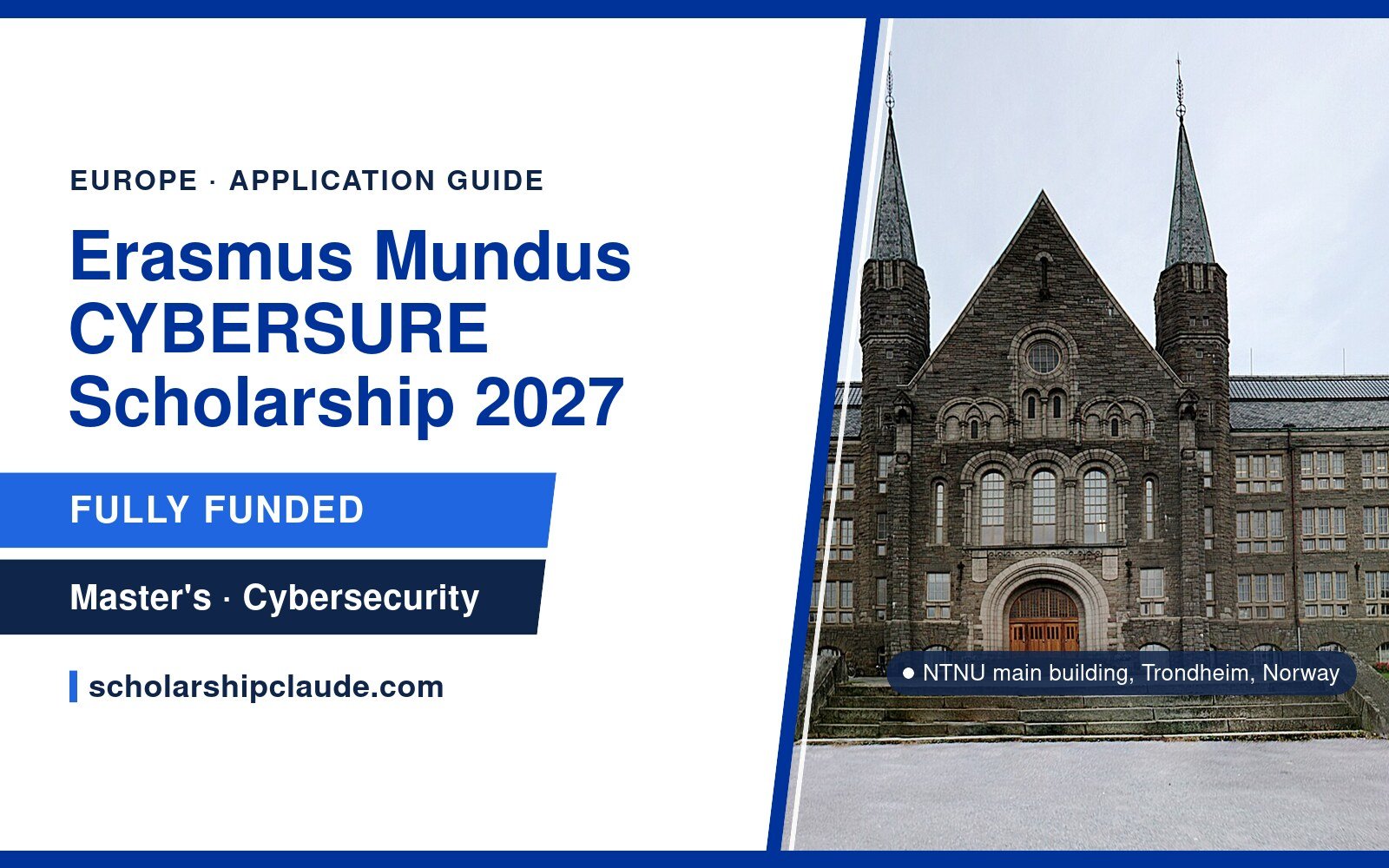
CYBERSURE is a two-year Erasmus Mundus Joint Master’s in Cybersecurity and Assurance, taught in English by seven universities in Norway, Finland, Sweden, Denmark, Estonia, France and Austria. Every student starts at NTNU in Norway and finishes at one partner with a specialisation such as cryptography or security engineering. Erasmus Mundus scholarships cover tuition, travel and a monthly allowance. Applications for the 2027 intake open on 16 November 2026 and close on 4 January 2027.
This guide was checked on 20 October 2026 against the CYBERSURE website: the admission, programme, and scholarships and fees pages.
CYBERSURE at a glance
| Programme | CYBERSURE, Master’s Programme in Cybersecurity and Assurance (Erasmus Mundus Joint Master) |
|---|---|
| Universities | NTNU (Norway), Aalto University (Finland), KTH (Sweden), DTU (Denmark), University of Tartu (Estonia), EURECOM (France), TU Graz (Austria) |
| Length | Two years, 120 ECTS, taught in English |
| Degrees | Degrees from your first-year and second-year universities |
| Students a year | 25 to 35 |
| Scholarship | Erasmus Mundus: tuition, travel and a monthly allowance (2026 intake: up to 18 scholarships, 16,800 euros a year) |
| Applications open | 16 November 2026 |
| Closing date | 4 January 2027 |
| English results due | 18 January 2027 |
| Results | By mid-March 2027 |
What is CYBERSURE?
CYBERSURE trains cybersecurity specialists with a strong grounding in cryptology, formal methods, provable security and network security. The programme also covers digital forensics, incident response, governance and regulation, compliance and audit, ethical hacking and penetration testing, threat modelling and risk management, cloud computing, and the security of operational technology and the Internet of Things.
It is an Erasmus Mundus Joint Master, which means a group of universities in different European countries runs it together and the European Union funds scholarships for the best applicants. Students study in at least two countries and graduate with degrees from both the universities where they studied.
How the two years are organised
| Period | Where | Credits |
|---|---|---|
| Semester 1 | NTNU, Trondheim (Norway) | 30 ECTS |
| Semester 2 | NTNU, Gjøvik (Norway) | 27.5 ECTS |
| End of year 1 | One-week summer school at the Norwegian Cyber Range | 2.5 ECTS |
| Summer | Internship with an industry partner or an applied research project | — |
| Semester 3 | Your exit university (specialisation) | 30 ECTS |
| Semester 4 | Master’s thesis, supervised jointly by your exit university and NTNU | 30 ECTS |
Second-year specialisations
| Exit university | Track |
|---|---|
| Aalto University (Finland) | Distributed Systems Security |
| DTU (Denmark) | Advanced Cyber and Software Assurance |
| University of Tartu (Estonia) | Cryptography |
| EURECOM (France) | Big Data Security |
| KTH (Sweden) | Networks and Systems Security |
| TU Graz (Austria) | Security Engineering |
Each exit university awards its own master’s degree, for example a Master of Science in Engineering at DTU or a Diplom-Ingenieur at TU Graz, alongside NTNU’s Master of Science in Cybersecurity and Assurance.
What the scholarship covers
CYBERSURE’s admission page says Erasmus Mundus scholarships cover tuition fees and travel costs and provide a monthly allowance for living expenses. Its scholarships page gives figures for the 2026 intake:
- Grant amount: 16,800 euros a year, which works out at 1,400 euros a month. It is meant to help with travel, visa, installation and living costs.
- Number of scholarships: up to 18, of which 12 were open to students from all countries and 5 were additional scholarships for targeted regions (the Western Balkans and certain partner country groups).
- Disability support: extra support can be requested based on individual needs.
- Reserve list: applicants on the reserve list may receive a scholarship if a selected student declines.
The 2027 figures are not yet published on the programme website, so treat the 2026 numbers as a guide only. Selected applicants who do not get a scholarship can still join with their own funding.
Who can apply
- A bachelor’s degree in computer science, information technology or a related field, worth 180 ECTS or at least three years of full-time study.
- The degree must come from an officially recognised institution and give access to master’s study in the country that awarded it.
- A very high weighted average grade. CYBERSURE does not publish a numeric minimum.
- English at the required level (next section).
- Students of any nationality can apply. People who have already held an Erasmus Mundus master’s scholarship cannot receive another.
If you are in your final year, read the admission page carefully about documents. Admitted students must send certified hard copies of their degree and transcripts by 15 August 2027.
English requirements
| Test | Minimum |
|---|---|
| IELTS Academic | 6.5 overall, 6.0 in writing |
| TOEFL iBT (taken before 21 January 2026) | 92 overall, 22 in writing |
| TOEFL iBT (taken on or after 21 January 2026) | 4.5 overall and 4.5 in each section |
| Cambridge C1 Advanced | Grade A, B or C |
| Cambridge C2 Proficiency | Grade A, B, C or C1 |
Test results must be from 16 November 2024 or later, and they must reach the programme by 18 January 2027, with no exceptions. Some applicants with English-taught degrees and students of the consortium universities can be exempt; check the admission page for the exact rules. If you still need a test, book one now. Our comparison of IELTS and TOEFL can help you choose.
Key dates for the 2027 intake
| Date | What happens |
|---|---|
| 16 November 2026 | Applications open |
| 4 January 2027 | Applications close; late applications are not accepted |
| 18 January 2027 | English test results must be received |
| January to February 2027 | Academic evaluation |
| By mid-March 2027 | Selection results |
| 15 August 2027 | Certified hard copies of degree and transcripts due for admitted students |
Documents you need
- Bachelor’s degree certificate (a scanned colour copy), with an English translation if needed.
- Official transcripts of records, with an English translation if needed.
- A motivation letter of up to 500 words.
- A motivation video of up to 1 minute, submitted as a link in a PDF.
- A CV.
- A valid passport or ID.
- Proof of residence.
- Proof of English.
- Country-specific documents, if your country has extra rules.
- Two academic recommendation letters. The admission page lists them as recommended in one place and required in another, so prepare them.
- Self-funded applicants only: documentation of financing that meets Norwegian visa rules.
Optional extras include course descriptions, further higher education, work certificates, publications and GMAT or GRE results.
How applications are judged
CYBERSURE assesses six criteria:
- Relevance of your previous studies.
- Academic performance.
- Recognition and quality of your institution.
- Motivation and commitment.
- Other relevant achievements.
- English proficiency.
Your application must meet the first two before the rest are evaluated. That means a strong motivation letter cannot make up for a degree in an unrelated field or weak grades. Check the relevance of your courses honestly before you spend time on the rest.
Choosing your second-year track
Your track decides your specialisation and your second degree. Think about where you want to work after graduating:
- Research or mathematics-heavy security: cryptography at Tartu.
- Industry security engineering: security engineering at TU Graz, or advanced cyber and software assurance at DTU.
- Networks and infrastructure: networks and systems security at KTH.
- Cloud and distributed systems: distributed systems security at Aalto.
- Data and privacy: big data security at EURECOM.
Read the course list for each track on the programme website and mention your preferred track, with a reason, in your motivation letter if the application asks for it.
Is CYBERSURE right for you?
Before you start the application, ask yourself four honest questions.
- Is your bachelor’s close to computing? The programme asks for computer science, information technology or a related field. If your degree is in another subject but you took many computing courses, list them clearly in your transcript and letter.
- Do you like mathematics as well as practical work? The programme describes a strong grounding in cryptology, formal methods and provable security. These subjects need comfort with mathematical reasoning, not only tools and scripts.
- Are you ready to move twice? You will live in Trondheim and Gjøvik in year one and then move to a new country for year two. Each move means new housing, a new residence permit process where needed, and new costs.
- Can you meet the dates? The closing date is 4 January 2027 and English results are due on 18 January 2027. Both fall during the holiday period in many countries, when offices and test centres may be closed.
If you answer yes to all four, CYBERSURE is worth your time. If not, look at the other programmes listed later in this guide.
How to show the relevance of your studies
Relevance of previous studies is the first criterion, and your application must pass it before anything else is read. You cannot change your degree, but you can make its relevance easy to see.
- Name the right courses. In your motivation letter or CV, mention courses in programming, networks, operating systems, databases, algorithms, discrete mathematics or security, with the grade you earned.
- Send course descriptions. The admission page lists course descriptions as an optional document. If your degree title does not say computer science, short official course descriptions help reviewers see what you studied.
- Show your final project. If your final-year project or thesis touched security, networks or software, give its title and one sentence on what you built or found.
- Be accurate. Do not stretch a course title to sound like security if it was not. Reviewers compare your letter with your transcript.
Presenting your grades from any country
CYBERSURE asks for a very high weighted average but does not publish a number, and applicants come from many grading systems. A few habits make your grades easier to judge:
- Upload the full transcript, including the grading scale if your university prints it on the back or on a separate sheet.
- If your university gives a class rank or a division, such as first class, include the document that shows it.
- Do not convert your grades yourself unless the application form asks you to. A wrong conversion can confuse the reviewer.
- If the original is not in English, add a translation as the admission page requires, and keep the original with it.
The first year in Norway
Every student spends the first year at NTNU, the Norwegian University of Science and Technology. The first semester is in Trondheim and the second in Gjøvik, so you will move once even inside Norway. At the end of the year there is a one-week summer school at the Norwegian Cyber Range worth 2.5 ECTS. During the summer you do an internship with an industry partner or an applied research project. Plan your housing for both cities early, and keep the dates of each move in your calendar.
If you plan to apply as self-funded
Selected applicants who do not receive a scholarship can still join with their own money. CYBERSURE says self-funded applicants must provide documentation of financing that meets Norwegian visa rules, because the first year is in Norway. The programme website does not list the exact amount. Check the current requirement on the website of the Norwegian Directorate of Immigration (UDI) before you apply, and remember you will also need money for your second-year country. Tuition fees for self-funded students are on the programme’s scholarships and fees page.
Writing the 500-word motivation letter
500 words is short. Use four parts:
- Your background in one paragraph: your degree and the security-related courses or projects you did, with results.
- Your security experience: a project, internship, capture-the-flag competition, research paper or open-source work. Describe what you did, not just the topic.
- Why CYBERSURE: the parts of the programme that fit your goals, such as the Norwegian Cyber Range summer school or a specific track.
- Your plan: the kind of role you want after graduating and how the programme prepares you for it.
Our motivation letter template shows a clear structure you can adapt.
Making the 1-minute video
- Write a short script first, of about 120 to 140 words.
- Say who you are, why cybersecurity, and why this programme, in that order.
- Record in a quiet place with your face clearly lit, and check the sound before you upload.
- Keep it under one minute; the limit is strict.
- Upload it where the link will keep working, and test the link from another device before you put it in your PDF.
Your CV and references
Put relevant work first: security projects, internships, research, competitions and certifications. Give each item a date and one line on what you achieved. Our academic CV template shows the layout. For references, ask teachers who taught you security, networks or programming and can comment on your ability. Our guide on strong recommendation letters explains how to brief them.
A plan from now to 4 January
| When | What to do |
|---|---|
| Late October | Check eligibility, book an English test if needed, and ask two referees. |
| Early November | Order certified translations, draft your motivation letter and video script, update your CV. |
| 16 November onwards | Open the application, upload documents and record the video. |
| By mid-December | Submit. Leave time before the 4 January closing date for problems. |
| By 18 January | Make sure your English results have reached the programme. |
After you submit
The academic evaluation runs in January and February 2027, and results are expected by mid-March 2027. Selected applicants who do not receive a scholarship can still join as self-funded. The programme also keeps a reserve list. If a scholarship holder declines, the next person on the reserve list may receive the scholarship, so a reserve place is worth keeping open.
If you are admitted, the work continues. Admitted students must send certified hard copies of their degree certificate and transcripts by 15 August 2027. Start your Norwegian residence permit application as soon as your admission letter arrives, because permit processing can take time.
Other Erasmus Mundus master’s in computing
- DEAI, Data Engineering and Artificial Intelligence, at ULB, UPC, TU Wien, Lyon 1 and Padua.
- EDISS, Engineering of Data-intensive Intelligent Software Systems.
- STEPS, Sustainable Transportation and Electrical Power Systems, for engineers.
You can apply to up to three Erasmus Mundus programmes in the same year under the general Erasmus Mundus rules explained in our Erasmus Mundus scholarship guide. Our guide to the Erasmus Mundus catalogue 2027 shows how to find more programmes.
Common mistakes to avoid
- Applying with a degree in an unrelated field. Relevance of previous studies is checked first.
- Missing the 18 January deadline for English results.
- A video longer than one minute, or a link that does not open.
- A motivation letter over 500 words.
- Leaving translations of your degree and transcripts until the last week.
- Assuming the 2026 scholarship figures are final for 2027.
Checklist before you submit
- My bachelor’s is in computer science, IT or a related field, worth 180 ECTS.
- My English test meets the minimum and was taken on or after 16 November 2024.
- My degree, transcripts and translations are uploaded.
- My motivation letter is under 500 words and my video is under 1 minute.
- My CV, passport, proof of residence and recommendation letters are ready.
- I will submit before 4 January 2027.
Frequently asked questions
Is CYBERSURE fully funded?
An Erasmus Mundus scholarship covers tuition fees and travel costs and pays a monthly allowance. In the 2026 intake the grant was 16,800 euros a year, and up to 18 scholarships were available. Other students can join as self-funded.
When is the deadline?
Applications open on 16 November 2026 and close on 4 January 2027. English results are due by 18 January 2027.
Do I need a computer science degree?
You need a bachelor’s in computer science, information technology or a related field. The relevance of your studies is the first thing assessed.
Is there an application fee?
The admission page does not mention one.
Where will I study?
The first year at NTNU in Trondheim and Gjøvik, Norway, then the second year at Aalto, DTU, Tartu, EURECOM, KTH or TU Graz, depending on your track.
How many students are admitted?
25 to 35 a year.
When will I hear back?
Selection results are expected by mid-March 2027.
Is the programme taught in English?
Yes. The programme says the language of instruction at all universities is English.
Where to apply
Read the full rules and apply from the official CYBERSURE admission page. Our CYBERSURE scholarship page keeps the key facts in one place.
Related scholarships: funding, stipend and deadlines
| Scholarship | Funding | Stipend | Deadline |
|---|---|---|---|
| European Parliament Schuman Traineeships 2027 | Partial | Monthly grant paid; amount not stated on the official source | 31 Oct 2026 |
| Erasmus Mundus Theatre SPACEs Scholarship 2027 | Fully funded | Erasmus Mundus scholarships cover participation costs and pay a monthly allowance of 1,400 euros | 1 Dec 2026 |
| Erasmus Mundus Clinical Linguistics Scholarship 2027–2029 | Fully funded | Erasmus Mundus scholarships cover participation costs and pay a monthly allowance of 1,400 euros | 1 Dec 2026 |
| Erasmus Mundus MAPP Scholarship 2027–2029 in Europe | Fully funded | 1,400 euros a month for 24 months with an Erasmus Mundus scholarship | 1 Dec 2026 |
| Erasmus Mundus NOHA Scholarship 2027 | Fully funded | Erasmus Mundus scholarships cover participation costs and pay a monthly allowance of 1,400 euros | 15 Dec 2026 |
| Erasmus Mundus Flood Risk Management Scholarship 2027–2029 in Europe | Fully funded | Monthly allowance of 1,400 euros for up to 24 months (for living costs, accommodation, travel and installation) | 3 Jan 2027 |
| FASPE Fellowship 2027 in Germany and Poland | Fully funded | No stipend; pocket money for meals that are not group meals | 3 Jan 2027 |
| Erasmus Mundus International Law Scholarship 2027–2029 | Fully funded | Erasmus Mundus scholarships cover participation costs and pay a monthly allowance of 1,400 euros | 4 Jan 2027 |
| Erasmus Mundus Innovative Medicine Scholarship 2027 | Fully funded | Erasmus Mundus scholarships cover participation costs and pay a monthly allowance of 1,400 euros | 4 Jan 2027 |
| Erasmus Mundus CYBERSURE Scholarship 2027 | Fully funded | 16,800 euros a year (2026 intake figure) | 4 Jan 2027 |
This list updates itself from our scholarships page. Stipend figures are shown where the provider publishes them. See all scholarships.