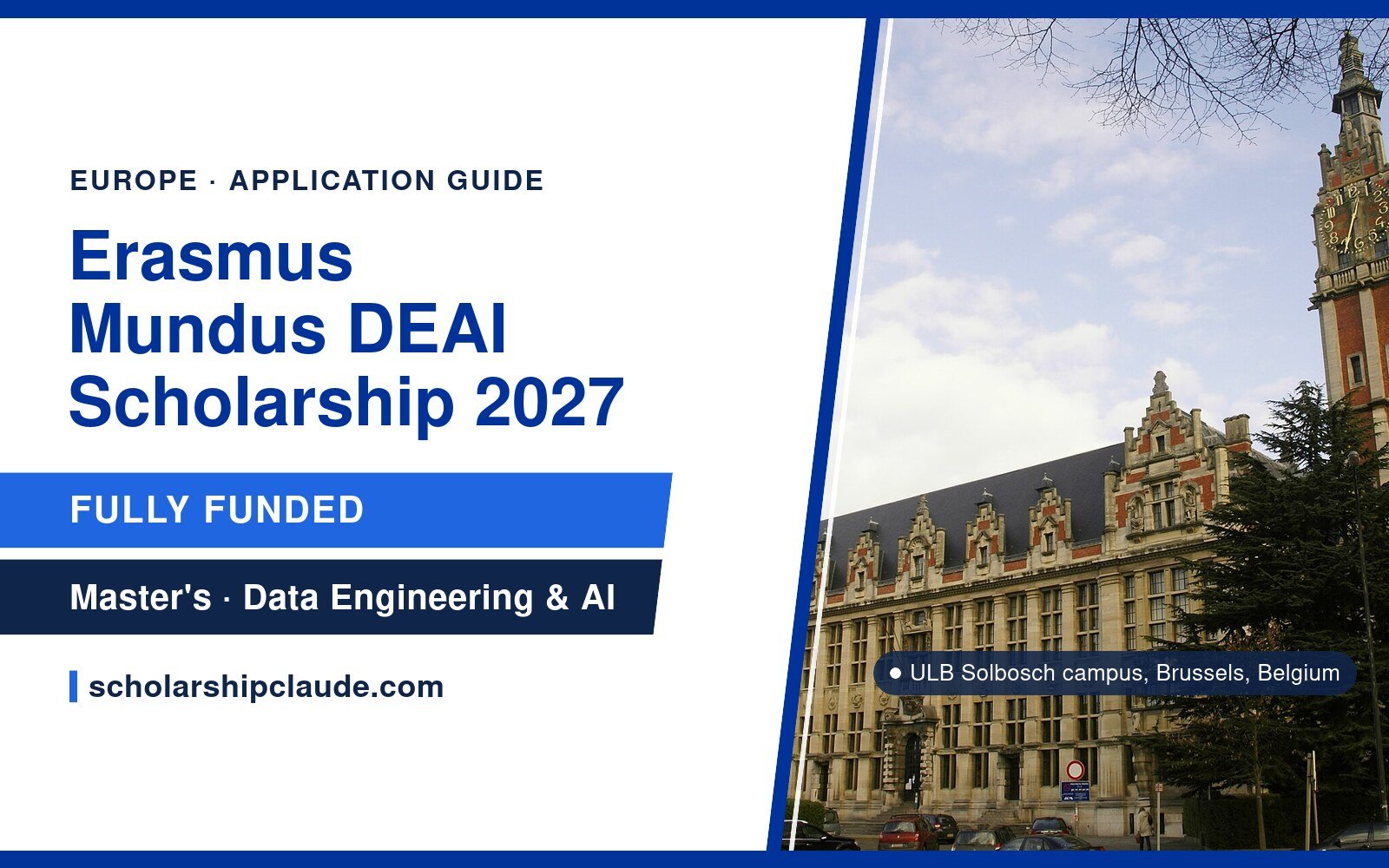
DEAI is a two-year Erasmus Mundus Joint Master in Data Engineering and Artificial Intelligence. You study in Belgium, then Spain, then specialise in Austria, Italy or France, and finish with a thesis at a partner university or company. The full scholarship covers participation costs, including tuition and insurance, and pays 1,400 euros a month for up to 24 months. The scholarship (grant) period is open now and closes on 11 January 2027.
This guide was checked on 20 October 2026 against the official DEAI website: the admission, tuition fees and scholarships, course content, and degree pages.
DEAI at a glance
| Programme | DEAI, Erasmus Mundus Joint Master in Data Engineering and Artificial Intelligence |
|---|---|
| Universities | Université libre de Bruxelles (ULB, Belgium), Universitat Politècnica de Catalunya (UPC, Spain), TU Wien (Austria), University of Padua (UniPD, Italy), Université Claude Bernard Lyon 1 (UCBL, France) |
| Length | Four semesters of 30 ECTS, 120 ECTS in total |
| Language | English |
| Full scholarship | Participation costs (tuition and full insurance) plus 1,400 euros a month for up to 24 months |
| Partial scholarship | Participation costs only |
| Grant period | Opened 20 October 2026; closing date 11 January 2027 |
| Reference letters due | 18 January 2027 |
| English level | CEFR B2 (for example IELTS Academic 5.5 or TOEFL iBT 72) |
| Application fee | Not stated on the official source |
What is DEAI?
DEAI describes itself as an excellence programme in data engineering and artificial intelligence with a focus on research and innovation. Its stated aim is to reduce the shortage of skilled data engineers who can run complex, large-scale, data-driven AI projects. It is an Erasmus Mundus Joint Master, so it is run by a group of European universities, and the European Union funds scholarships for the best-ranked applicants.
How the two years work
| Period | Where | Focus |
|---|---|---|
| Semester 1 | ULB, Belgium | Foundations of data management, data analytics and AI, bringing students from different backgrounds to the same level |
| Semester 2 | UPC, Spain | Deeper core concepts building on semester 1 |
| Summer | One partner each year | Summer School, plus an optional but encouraged summer internship |
| Semester 3 | TU Wien, UniPD or Lyon 1 | Your specialisation |
| Semester 4 | Any main or associated partner | Master’s thesis, 30 ECTS |
First-year courses
At ULB the course content page lists Advanced Databases, Database Systems Architecture, Data Warehouses, Management of Data Science and Business Workflows, and Data Mining, each worth 5 ECTS, plus a foreign language. At UPC it lists Big Data Management, Semantic Data Management, Machine Learning and High-Performance Data Analytics, each worth 6 ECTS, plus seminars, Debates on Data Ethics and a foreign language.
The language courses are part of the programme: French at ULB (or Spanish, Italian or German for native French speakers), and Spanish or Catalan at UPC. Teaching is in English, so you do not need these languages before you start.
Third-semester specialisations
| University | Specialisation | Examples of courses |
|---|---|---|
| TU Wien, Austria | Knowledge-Driven Data Management and Intelligence | Management of Graph Data, Graph AI, Declarative Knowledge and Symbolic AI |
| University of Padua, Italy | Business, Economics and Financial Data Science | Statistical Learning, Deep Learning and Human Data Analytics, Time-Series Analysis, Business Process Intelligence |
| Lyon 1, France | Data and Intelligence for Heterogeneous Systems | Real-Time Data Processing and Analytics, Machine Learning Techniques and Applications, NLP and LLMs, Big Graph Processing Systems |
The thesis
The fourth semester is a 30 ECTS master’s thesis at an industrial or university partner. The programme encourages students to consider a start-up idea as a thesis topic, and thesis work may be submitted to scientific conferences. Theses are evaluated jointly by the partners and defended at a Final Event in the summer after the fourth semester, followed by graduation.
Degrees you receive
DEAI has two mobility paths, and your path decides your degrees.
- Joint diploma path: one joint diploma with degrees from ULB, UPC and either TU Wien or Lyon 1.
- Multiple diploma path: separate diplomas from ULB, UPC and the University of Padua.
| University | Degree title |
|---|---|
| ULB | Master of Science in Computer Science and Engineering |
| UPC | Master Erasmus Mundus in Data Engineering and Artificial Intelligence |
| TU Wien | Diplom-Ingenieur/Ingenieurin |
| University of Padua | Laurea Magistrale in Data Science (LM-91) |
| Lyon 1 | Master Data and Intelligence for Smart Systems |
The degree page also shows a DEAI accreditation certificate issued in September 2026.
Is DEAI right for you?
Ask yourself these questions before you start.
- Do you enjoy data management as much as AI? The first year is heavy on databases, data warehouses, big data and semantic data management. If you only want to study machine learning models, compare the course list carefully with other programmes.
- Is your degree close to computer science? Your bachelor’s domain is scored by its share of computer science credits, so a degree with few computing courses will lose points.
- Can you move often? You will live in Belgium, then Spain, then Austria, Italy or France, and possibly a fourth place for your thesis. Each move means new housing and paperwork.
- Do you have a clear goal? The cover letter is scored on content and critical thinking. A clear plan, such as industry research, a start-up or a PhD, makes it easier to write.
Planning for three or four moves
DEAI changes country every semester in the first three semesters. That affects your budget and your time. Keep copies of your passport, admission letter and scholarship letter in one folder, because you will need them for each residence registration. Look for housing early for each move. If you have the full scholarship, the 1,400 euros a month must cover rent and travel between countries, so plan each semester’s costs before you arrive.
Scholarships and fees
| Option | What you get or pay |
|---|---|
| Full DEAI scholarship | 100% of participation costs, including tuition and full insurance, plus 1,400 euros a month for up to 24 months |
| Partial DEAI scholarship | 100% of participation costs; no monthly allowance, so you pay travel and living costs |
| Self-funded, programme country students | 4,500 euros a year |
| Self-funded, partner country students | 9,000 euros a year |
Self-funded fees cover academic costs, registration and student insurance. The number of scholarships is not stated on the official source; the programme says availability is limited and awards follow eligibility and final ranking. Anyone who has already received an Erasmus Mundus Joint Master scholarship cannot get the full scholarship.
Self-funded students follow the same curriculum, have the same academic rights and receive the same degree as scholarship holders. The programme also mentions the EU’s Skills and Education Guarantee scheme, under which some banks may offer student loans. That is a loan agreed with a bank, not a scholarship, and DEAI is not involved in it.
Two application periods
| Period | Who it is for | Key dates |
|---|---|---|
| Grant period | Applicants who want an Erasmus Mundus grant | Opened 20 October 2026; closes 11 January 2027 (strict); references by 18 January 2027 |
| Self-funded and partial grant, non-EU residents | Self-funded and partial-grant applicants | Opens 1 March 2027; closes 15 May 2027; references by 20 May; proof of bachelor’s by 15 June; preliminary decision end of May |
| Self-funded and partial grant, EU residents | Self-funded and partial-grant applicants | Opens 1 March 2027; closes 30 May 2027; references by 2 June; proof of bachelor’s by 30 May; preliminary decision mid-June |
If you want the full scholarship, the grant period is the one that matters. The selected list from that period is sent to the European Commission for scholarship approval. A date for grant results is not stated on the official source.
Who can apply
- A bachelor’s degree of 180 ECTS from an accredited university listed in the World Higher Education Database (WHED) or in the Times Higher Education, ARWU or QS rankings.
- Final-year bachelor’s students can apply before receiving their diploma.
- English at CEFR B2 level.
On the field of study, the two official pages read differently. The homepage asks for a bachelor’s with a major in computer science. The admission page does not set a required field, but it scores your bachelor’s domain by the share of computer science credits in it. In practice, the closer your degree is to computer science, the more points you earn.
English requirements
DEAI asks for English at B2 level on the Common European Framework of Reference. The admission page gives these examples:
| Test | Minimum |
|---|---|
| IELTS Academic | 5.5 |
| TOEFL internet-based | 72 |
| TOEFL paper-based | 570 |
| TOEFL computer-based | 230 |
| Cambridge | First Certificate in English (FCE) |
The list is not complete, and DEAI relies on each test body’s own B2 equivalence. Exemptions are not stated on the official source, so plan to send a test result unless the programme confirms otherwise. Our comparison of IELTS and TOEFL can help you pick a test.
Documents you need
- The online application form on DEAI’s eMundus platform.
- A cover letter, which is scored.
- Reference letters, uploaded by the deadline for your period.
- Proof of your bachelor’s degree, by the dates in the table above for the self-funded periods.
- Proof of English at B2 level.
The admission page does not mention a CV or a video, and the number of reference letters is not stated on the official source. Follow what the online form asks for.
How applications are scored
DEAI ranks applicants by total points across six categories. It does not publish the weight of each one.
- Bachelor’s domain: points in proportion to the share of computer science credits.
- Academic results: your weighted average mark.
- Other studies: a second bachelor’s or a master’s, scored by computer science credits, and extracurricular courses, scored by lecture hours.
- Professional experience: points for each year in an IT or business intelligence role.
- Cover letter: judged on organisation, sequencing, content, vocabulary, critical thinking, originality and factual accuracy.
- Reference letters: judged on the referee’s approval and comments, the referee’s reputation and the referee’s h-index.
The ranking produces a selected list and a reserve list. Under Erasmus+ rules, no more than 10% of selected applicants may share the same nationality, so strong applicants from countries with many applicants compete hard for those places.
Using the scoring to plan your application
- Show your computer science credits. If your transcript does not group courses clearly, make sure the computer science courses and their credits are easy to find.
- Count your extra study. Online or extracurricular courses are scored by lecture hours, so keep certificates that show the hours.
- Document your work years. Professional experience is counted per year in IT or business intelligence. A letter from your employer with dates helps.
- Choose referees carefully. The referee’s reputation and research record are part of the score, so an active researcher who knows your work well is a strong choice.
Writing the cover letter
The cover letter is scored on seven qualities, so treat it like a short, well-organised essay:
- Opening: one or two sentences on who you are and what you want to do in data engineering or AI.
- Your preparation: the courses, projects or work that prepared you, with facts such as tools, data sizes or results.
- Why DEAI: the parts of the programme you need, such as the ULB and UPC data management courses or one of the three specialisations.
- Your specialisation choice: TU Wien, Padua or Lyon 1, and why it fits your goals.
- Your plan: what you want to do after graduating, such as industry R&D, a start-up or a PhD.
Check every fact, because factual accuracy is one of the scored qualities. Use your own words; originality and critical thinking are scored too. Our motivation letter template gives a clear structure you can adapt.
Reference letters
For the grant period, letters must be uploaded by 18 January 2027, one week after the application closes. Ask your referees in October or November, send them your transcript and cover letter, and remind them in early January. Our guide on strong recommendation letters explains how to brief them.
If you plan to come as self-funded
Self-funded students who need a Belgian student visa must have a financial guarantor. The admission page says the guarantor must show enough income to pay you 666 euros a month while keeping 1,254.82 euros a month for themselves and 150 euros a month for each dependant. Without this, the Belgian consulate will not issue the visa. The page also warns that visas for spouses or partners accompanying non-European students are very difficult and sometimes impossible to get.
A plan from now to 11 January
| When | What to do |
|---|---|
| Late October | Check that your university is in WHED or the rankings, book an English test if needed, and ask your referees. |
| November | Collect transcripts, course certificates with hours, and work letters. Draft your cover letter. |
| Early December | Finalise the cover letter, open the online form and upload documents. |
| By late December | Submit. The 11 January closing date is strict. |
| By 18 January | Make sure all reference letters are uploaded. |
After you apply
Applications are ranked by total points, which produces a selected list and a reserve list. For the grant period, the selected list is sent to the European Commission for scholarship approval. If you are placed on the reserve list, keep your plans open until final results are confirmed. The scholarships page says academically selected applicants who do not receive a scholarship can join as self-funded students, with the same curriculum and degree.
Similar Erasmus Mundus master’s programmes
- EDISS, Engineering of Data-intensive Intelligent Software Systems, starting at Åbo Akademi University in Finland.
- CYBERSURE, Cybersecurity and Assurance, starting at NTNU in Norway.
Under the Erasmus Mundus rules explained in our Erasmus Mundus scholarship guide, you can apply to up to three programmes in the same year. Our Erasmus Mundus catalogue 2027 guide shows how to find more.
Common mistakes to avoid
- Waiting until spring for the full scholarship. Only the grant period, closing 11 January 2027, leads to the full scholarship.
- Applying from a university that is not in WHED or the THE, ARWU or QS rankings.
- Hiding your computer science credits in a long transcript.
- A cover letter with unchecked facts or copied text.
- Referees who upload letters after 18 January.
- Planning to self-fund without a guarantor who meets the Belgian visa rule.
Checklist before you submit
- My bachelor’s is 180 ECTS from a university in WHED or the THE, ARWU or QS rankings.
- My English is B2 or higher, with a test result ready.
- My transcript shows my computer science credits and weighted average.
- My cover letter is organised, accurate and in my own words.
- My referees know the 18 January deadline.
- I will submit before 11 January 2027.
Frequently asked questions
Is DEAI fully funded?
The full DEAI scholarship covers participation costs, including tuition and full insurance, and pays 1,400 euros a month for up to 24 months. The partial scholarship covers participation costs only.
When is the deadline?
For the full scholarship, the grant period closes on 11 January 2027. Self-funded and partial-grant applications close on 15 May 2027 for non-EU residents and 30 May 2027 for EU residents.
Do I need to speak French or Spanish?
No. Teaching is in English. Language courses in French and Spanish or Catalan are part of the first year.
Can I apply in my final year?
Yes. Final-year bachelor’s students can apply before receiving their diploma.
How many scholarships are there?
Not stated on the official source. The programme says availability is limited.
What is the self-funded fee?
4,500 euros a year for programme country students and 9,000 euros a year for partner country students.
Where to apply
Read the full rules on the official DEAI admission page and the tuition fees and scholarships page. Our DEAI scholarship page keeps the key facts in one place.
Related scholarships: funding, stipend and deadlines
| Scholarship | Funding | Stipend | Deadline |
|---|---|---|---|
| European Parliament Schuman Traineeships 2027 | Partial | Monthly grant paid; amount not stated on the official source | 31 Oct 2026 |
| Erasmus Mundus Theatre SPACEs Scholarship 2027 | Fully funded | Erasmus Mundus scholarships cover participation costs and pay a monthly allowance of 1,400 euros | 1 Dec 2026 |
| Erasmus Mundus Clinical Linguistics Scholarship 2027–2029 | Fully funded | Erasmus Mundus scholarships cover participation costs and pay a monthly allowance of 1,400 euros | 1 Dec 2026 |
| Erasmus Mundus MAPP Scholarship 2027–2029 in Europe | Fully funded | 1,400 euros a month for 24 months with an Erasmus Mundus scholarship | 1 Dec 2026 |
| Erasmus Mundus NOHA Scholarship 2027 | Fully funded | Erasmus Mundus scholarships cover participation costs and pay a monthly allowance of 1,400 euros | 15 Dec 2026 |
| Erasmus Mundus Flood Risk Management Scholarship 2027–2029 in Europe | Fully funded | Monthly allowance of 1,400 euros for up to 24 months (for living costs, accommodation, travel and installation) | 3 Jan 2027 |
| FASPE Fellowship 2027 in Germany and Poland | Fully funded | No stipend; pocket money for meals that are not group meals | 3 Jan 2027 |
| Erasmus Mundus International Law Scholarship 2027–2029 | Fully funded | Erasmus Mundus scholarships cover participation costs and pay a monthly allowance of 1,400 euros | 4 Jan 2027 |
| Erasmus Mundus Innovative Medicine Scholarship 2027 | Fully funded | Erasmus Mundus scholarships cover participation costs and pay a monthly allowance of 1,400 euros | 4 Jan 2027 |
| Erasmus Mundus CYBERSURE Scholarship 2027 | Fully funded | 16,800 euros a year (2026 intake figure) | 4 Jan 2027 |
This list updates itself from our scholarships page. Stipend figures are shown where the provider publishes them. See all scholarships.