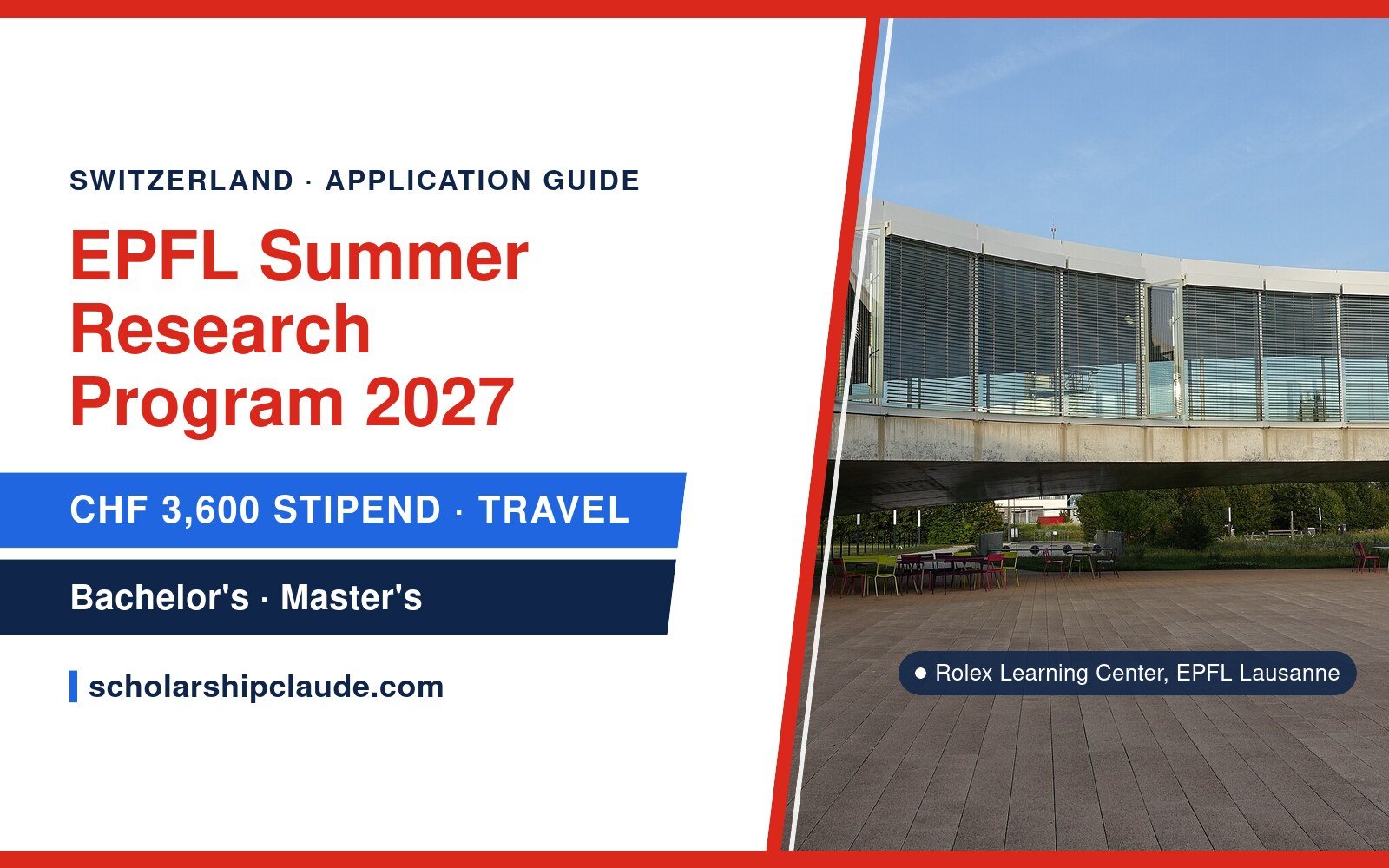
The EPFL School of Life Sciences Summer Research Program gives bachelor’s and first-year master’s students from around the world eight weeks of real lab research in Switzerland. Each student receives CHF 3,600 for housing and living costs, plus flight reimbursement of up to CHF 1,000. The 2027 programme runs from 5 July to 27 August 2027, and applications close on 15 November 2026.
This guide was checked on 17 October 2026 against the official EPFL Summer Research Program pages, including the programme description, the How to Apply page and the FAQs.
EPFL Summer Research Program at a glance
| Host | EPFL School of Life Sciences, Lausanne (three labs at Campus Biotech, Geneva) |
|---|---|
| Who can apply | Students worldwide who have completed at least two years of a bachelor’s, up to the first year of a master’s |
| Fields | Biology, biophysics, chemistry, bioengineering, bioinformatics, quantitative biology, genetics, medicine and other life sciences |
| Grades | Equivalent of at least 3.75 out of 4.0, or top 5% of your class |
| Dates | 5 July to 27 August 2027 (eight weeks, full attendance required) |
| Stipend | CHF 3,600 for the two months, covering housing and living costs |
| Travel | Flights reimbursed up to CHF 1,000 (overseas) or CHF 500 (shorter distances) |
| Places | 20 to 25 students each summer |
| Closing date | 15 November 2026 |
| Results | By email to all applicants before 20 December |
What is the Summer Research Program?
EPFL is one of Switzerland’s two federal institutes of technology. Its School of Life Sciences runs this summer programme so that strong students can find out what a research career is like. You join ongoing research in one lab, with mentoring from faculty and scientific staff. You also attend scientific seminars and Friday afternoon workshops on science and personal development.
EPFL lists these goals for students: learning new techniques, improving critical thinking and experimental design, and gaining insight into research careers. The programme ends with a closing symposium, where each student presents a poster. There are also social activities, including a day hike in the Swiss Alps and possible excursions, such as a visit to CERN.
The work is in English, and so are the seminars. You do not need to speak French to take part.
What you receive
| Item | What EPFL states |
|---|---|
| Stipend | CHF 3,600 for the two-month period, covering housing and living costs |
| Housing | Arranged in Lausanne near the campus and paid from the stipend before you arrive; usually a single room with a shared kitchen and bathroom |
| Money left after housing | About CHF 1,700, which EPFL says is enough if you budget carefully |
| Flights | Reimbursed after the programme: up to CHF 1,000 for overseas travel and up to CHF 500 for shorter distances |
| Geneva labs | A larger stipend to cover most of the extra daily travel to Campus Biotech |
| Not covered | Weekend travel and tourism |
Two practical points follow from this. First, flights are paid back after the programme, so you must buy your ticket first and wait for the refund. Second, health insurance is not mentioned on the official pages. Ask EPFL about insurance if you are selected, and check what your own insurance covers abroad.
Who can apply
The programme selects students from the whole world. There is no nationality restriction. To apply, you must meet all of these conditions:
- You are currently enrolled in a degree programme in biology, biophysics, chemistry, bioengineering, bioinformatics, quantitative biology, genetics, medicine or another life sciences field.
- You remain enrolled during the whole programme.
- By the start of the programme, you have completed at least two years of undergraduate study, up to the first year of a master’s.
- Your grades are equivalent to at least 3.75 out of 4.0, or you are in the top 5% of your class.
- You have a strong interest in a career in life sciences.
- You can be in Switzerland for the whole period, 5 July to 27 August 2027. Arriving late or leaving early is not possible.
Who cannot apply
- PhD students.
- Students with veterinary or plant science backgrounds. EPFL says they are not selected, because the programme focuses on human-based life sciences.
- Bachelor’s graduates who are not enrolled anywhere, unless they have a confirmed place in a life sciences master’s and will be enrolled by the start date.
Research experience is not required, but EPFL says most participants have some lab experience and that previous lab experience is a plus.
Understanding the grade rule
EPFL asks for a minimum grade equivalent to 3.75 out of 4.0, or a place in the top 5% of your class. Many universities do not use a 4.0 scale, so you need to show your level clearly.
- Upload complete transcripts, so reviewers can see every grade.
- If your university publishes a grading scale or class rank, include it.
- Ask your referee to state where you rank in your peer group. EPFL’s FAQ says the reference letter should cover your ranking within your peer group.
Do not convert your grades yourself with an online calculator and present the result as official. Give the real grades and let the documents speak.
How competitive is it?
Very. EPFL says that in 2026 it received more than 1,300 applications for 25 places. That is less than 2% of applicants. Your lab choices also matter, because popular labs attract more applicants. This does not mean you should not apply. It means every part of your application must be complete and specific. Our article on why you should still apply when competition is high explains how to think about long odds.
The application, part by part
EPFL warns that the online form must be finished in one sitting. You cannot save it and come back later. Prepare everything below in a document first, then copy it into the form.
1. Transcripts
Upload your bachelor’s transcript. If you have started a master’s, upload both your bachelor’s and master’s transcripts. If your first master’s semester grades are not ready, upload a list of your current courses. Official transcripts are preferred, but unofficial copies or student portal screenshots are accepted. If your transcript is not in English, Spanish, French, German, Portuguese or Italian, you must include a translation together with the original.
2. Personal essays
You answer short questions of 800 to 1,000 characters each about your accomplishments, internships, experience, strengths, motivation and interests. That is roughly 130 to 170 words per answer. A CV and motivation letter are not required, because these essays replace them.
3. Scientific essays for your three labs
You choose your top three labs. For each one, you answer questions about your research interests, the skills you want to learn and a possible project, with cited papers. This is the most demanding part of the application.
4. A question about AI
EPFL asks how you used AI tools when preparing your application. Answer honestly and briefly. If you used a tool only to check grammar, say so. If you did not use one, say that.
5. One reference letter
Your referee receives an upload link automatically after you submit the form. The letter should be about 500 words. EPFL asks it to cover your ranking in your peer group, how the referee knows you, and your academic excellence, creativity, research aptitude and fit with a group. The referee must upload it by 15 November 2026, but EPFL encourages them to upload earlier.
How to choose your three labs
The 2027 list on the official page names 34 participating labs, each with a research topic. Three are based at Campus Biotech in Geneva, about an hour and fifteen minutes from Lausanne each way, while housing is in Lausanne. Geneva students receive a larger stipend to cover the extra travel.
- Read every lab description on the official list, not only the famous names.
- Open each lab’s website and read one or two recent papers from the group.
- Match your skills. If you have done cell culture, coding or microscopy, look for labs that use these methods.
- Balance your choices. EPFL notes that popular labs draw more applicants. Choosing three of the most famous labs can lower your chances.
- Be ready to travel if you pick a Geneva lab.
Writing the scientific essays
Reviewers want to see that you understand what the lab does and that you can think like a researcher. For each lab, aim to show three things: what interests you in their research, what you want to learn, and a small project idea that fits eight weeks.
An invented example
The example below is invented to show the level of detail. Do not copy it, and do not use it for a real lab.
“Your recent work on how neurons in fruit flies coordinate walking interests me because I have used tracking software for animal movement in my bachelor’s project. I would like to learn how to combine behaviour recordings with imaging. A possible eight-week project could compare walking patterns in two fly lines already used in your group, using the pose-tracking method described in your 2025 paper.”
Notice the structure: a specific link to the lab’s work, a skill you already have, a skill you want, and a small, realistic project. Cite real papers from the lab’s own website, and make sure you have read them.
Writing the personal essays
You have only 800 to 1,000 characters for each answer. Use one example per answer and give a result. For instance, instead of writing that you are hard-working, describe a lab task you completed, what went wrong and how you fixed it. For your motivation, explain what kind of research career you are considering and what you hope to learn from eight weeks in a lab. Our guide on how to stand out in your application has more tips on using specific examples.
Briefing your referee
Choose a teacher or research supervisor who knows your lab or project work. Send them a short note with:
- The programme name, dates and the closing date of 15 November 2026.
- The points EPFL asks the letter to cover: your ranking in your peer group, how they know you, academic excellence, creativity, research aptitude and group fit.
- Your three lab choices and why you chose them.
- A reminder that the upload link will arrive by email only after you submit your application.
Because the link is sent only after you submit, do not leave your own application until the last day. Submit at least a week early so your referee has time. Our guide on getting strong recommendation letters explains more.
Timeline from now to the summer
| When | What to do |
|---|---|
| Now to early November 2026 | Read the lab list, choose three labs, read their papers, draft all essays offline and brief your referee. |
| At least one week before 15 November 2026 | Complete the form in one sitting and submit. Your referee then receives the upload link. |
| 15 November 2026 | Closing date for applications and reference letters. |
| Before 20 December 2026 | All applicants receive the result by email. |
| From the offer onwards | Start your Swiss visa process when EPFL sends instructions, if you need a visa. EPFL says it can take more than three months. |
| 5 July to 27 August 2027 | The programme in Lausanne (or Geneva for the three Campus Biotech labs). |
Visa and travel
If you need a visa for Switzerland, EPFL sends selected students an invitation letter and instructions. EPFL says the visa process can take more than three months, and it asks students not to begin until they receive the programme’s instructions. Book flights only when you are sure of your visa, and keep all receipts, because flights are reimbursed after the programme up to the stated limits. Our visa process guide covers the general steps.
What a week looks like
- Lab work: about 40 hours a week. Some tasks, such as cell culture, can need weekend time.
- Workshops: mostly on Friday afternoons, and attendance is required.
- Seminars: scientific seminars you can attend at EPFL.
- Final week: you prepare a poster and present it at the closing symposium on the last day.
- Lab rules: the dress code is informal, but closed shoes and leg coverage are required in the lab.
Managing your budget
The stipend is CHF 3,600 for the whole period. Housing is paid from it before you arrive, and EPFL says about CHF 1,700 is left for eight weeks of food, local transport and other daily costs. Switzerland is an expensive country, so plan carefully:
- Cook in the shared kitchen rather than eating out every day.
- Bring enough money of your own for your first days and for the flight, which is refunded only after the programme.
- Treat weekend trips as optional extras you pay for yourself.
How this compares with other research internships
If you are interested in summer research abroad, compare a few programmes. Each has different rules:
- EPFL Summer Research Program: life sciences only, eight weeks, CHF 3,600 plus travel, closes 15 November 2026.
- Max Planck computer science internships: for computer science students, with a stipend, housing and travel. See our Max Planck internship page.
- OIST Research Internship: research placements in Okinawa, Japan. See our OIST internship page.
- NIMS Internship Program: materials science research in Japan. See our NIMS internship page.
Our guide to scholarships in Switzerland lists other Swiss options, including master’s funding.
Common mistakes to avoid
- Starting the online form without preparing the essays first. The form cannot be saved.
- Submitting on the last day, which leaves your referee no time to upload the letter.
- Writing the same scientific essay for all three labs with only the name changed.
- Choosing labs only because they are well known.
- Uploading a transcript in another language without a translation.
- Applying while unable to attend the full eight weeks.
- Applying from a veterinary or plant science background, which EPFL says is not selected.
Checklist before you submit
- I am enrolled in a life sciences degree and will remain enrolled during the programme.
- I will have completed at least two years of undergraduate study by July 2027.
- My grades are equivalent to at least 3.75 out of 4.0, or I am in the top 5% of my class.
- I can attend from 5 July to 27 August 2027.
- I have chosen three labs and read their recent work.
- My personal and scientific essays are written and within the limits.
- My transcripts are ready, with translations if needed.
- My referee knows what to write and will watch for the upload link.
Frequently asked questions
Is the EPFL Summer Research Program paid?
Yes. Each student receives CHF 3,600 for the two months, which covers housing and living costs. Flights are reimbursed up to CHF 1,000 for overseas travel or CHF 500 for shorter distances.
What is the closing date?
15 November 2026. Reference letters must also be uploaded by that date.
Can international students apply?
Yes. EPFL selects students from around the world. There is no nationality restriction on the official pages.
Do I need IELTS or TOEFL?
No English certificate is required when you apply. EPFL may invite you to a short Zoom check. All lab work and seminars are in English.
Do I need a CV or motivation letter?
No. They are replaced by short personal essays and scientific essays.
Can first-year bachelor’s students apply?
No. You must have completed at least two years of undergraduate study by the start of the programme.
Can PhD students apply?
No. PhD students are not eligible.
Can I apply if I study veterinary or plant science?
EPFL says applicants with veterinary or plant science backgrounds are not selected, because the programme focuses on human-based life sciences.
Do I need lab experience?
It is not required, but EPFL says most participants have some lab experience and that it is a plus.
When will I know the result?
All applicants receive an email with the result before 20 December.
Can I arrive late or leave early?
No. You must be on site for the whole period, from 5 July to 27 August 2027.
How many students are selected?
Between 20 and 25 each summer. In 2026 there were more than 1,300 applications for 25 places.
Where to apply
Read the full details, the lab list and the FAQs on the official EPFL Summer Research Program page, which links to the application form. Our EPFL Summer Research Program page keeps the key facts in one place.
Scholarships with the nearest deadlines
| Scholarship | Funding | Stipend | Deadline |
|---|---|---|---|
| US–Pakistan Knowledge Corridor PhD Scholarships 2027 | Fully funded | Not stated on HEC's programme page (see the HEC advertisement) | 30 Oct 2026 |
| Honjo International Scholarship 2027 in Japan | Partial | 230,000 yen a month (degree of 1 to 2 years), 210,000 yen a month (3-year degree) or 180,000 yen a month (degree longer than 3 years) | 31 Oct 2026 |
| European Parliament Schuman Traineeships 2027 | Partial | Monthly grant paid; amount not stated on the official source | 31 Oct 2026 |
| University of Melbourne Graduate Research Scholarships 2027 in Australia | Fully funded | 41,100 Australian dollars a year (2027 rate), plus a full fee offset | 31 Oct 2026 (expected) |
| Australian Government RTP Scholarships 2027 in Australia | Fully funded | 2027 full-time RTP stipend: base rate 35,550 Australian dollars a year, maximum 55,537 Australian dollars a year | 31 Oct 2026 (expected) |
| DAAD EPOS Scholarship 2027/28 in Germany | Fully funded | 992 euros a month for graduates; 1,400 euros a month for doctoral candidates | 31 Oct 2026 (expected) |
| One Young World Leading Scholarship 2026 in South Africa | Partial | See the scholarship page | 31 Oct 2026 |
| UNU Junior Fellows Internship 2027 in Tokyo, Japan | Partial | Monthly stipend; amount not stated on the official source | 1 Nov 2026 |
| Open Doors Russian Scholarship Project 2026–27 in Russia | Partial | Tuition-free study; a monthly allowance is possible only with grant support for Russian-taught programmes | 1 Nov 2026 |
| Max Planck Computer Science Summer Internships 2027 in Germany | Fully funded | Monthly stipend (amount not stated on the official source) | 1 Nov 2026 |
This list updates itself from our scholarships page. Stipend figures are shown where the provider publishes them. See all scholarships.