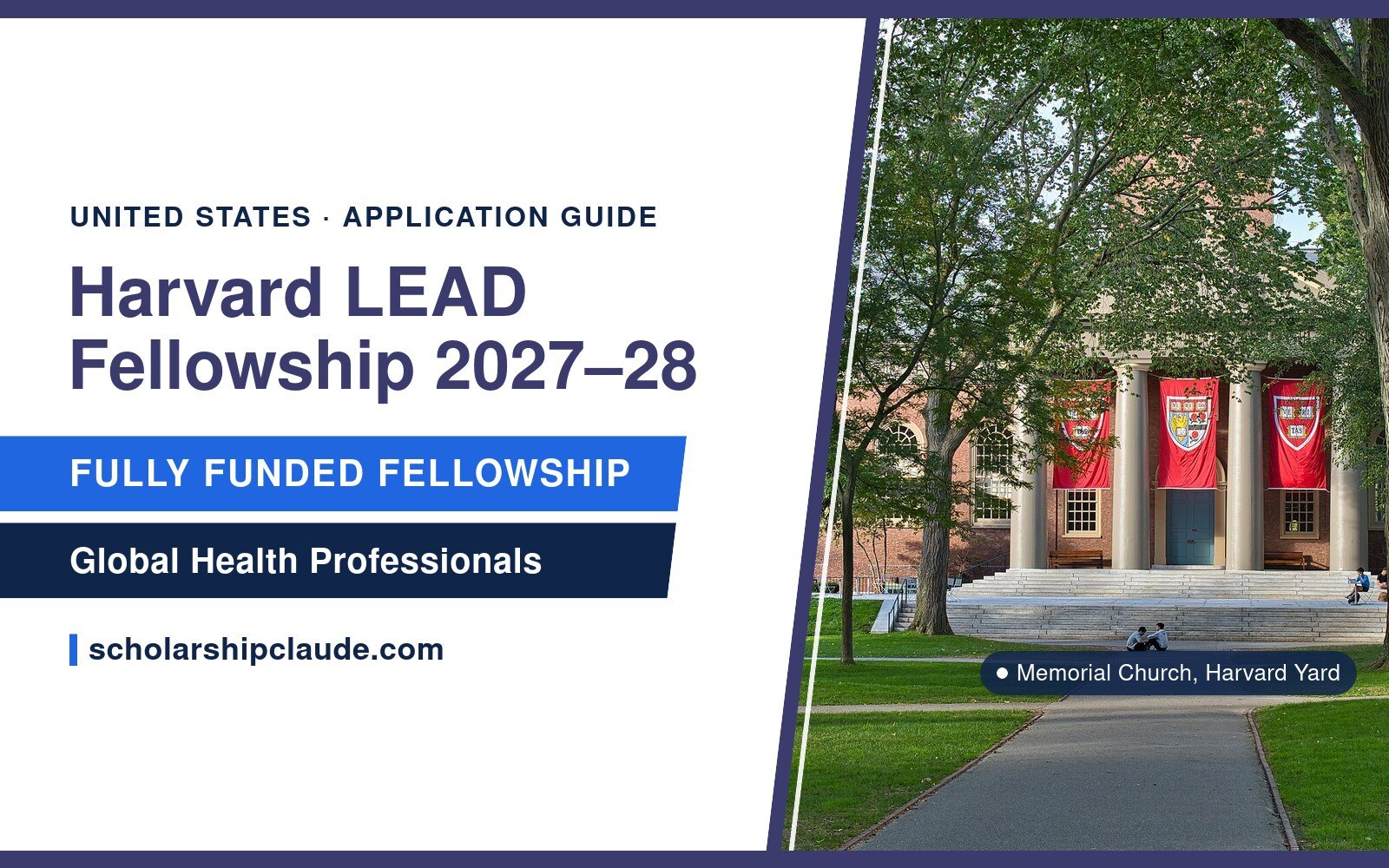
The Harvard LEAD Fellowship is a one-year leadership programme for experienced global health professionals who live or work in a low- or middle-income country. It combines online coaching and mentoring from your home country with a six-week residency at Harvard in April 2028. Harvard describes it as fully funded: visa fees, housing and flights are covered, and fellows receive a living stipend while in residence. Applications for the 2027–2028 cohort close on 15 November 2026.
This guide was checked on 17 October 2026 against the Harvard Global Health Institute LEAD Fellowship page and the Harvard Gazette announcement of the 2027–2028 call.
Harvard LEAD Fellowship at a glance
| Run by | Harvard Global Health Institute (HGHI), with the Department of Global Health and Population at the Harvard T.H. Chan School of Public Health |
|---|---|
| Type | One-year leadership fellowship (not a degree) |
| Who it is for | Global health professionals based or working in a low- or middle-income country |
| Experience | At least 10 years of full-time professional experience |
| Degree | At least a master’s degree in a relevant field |
| Fellowship year | 1 September 2027 to 31 August 2028 |
| Residency | Six weeks in Cambridge, Massachusetts, in April 2028 |
| Covered | Visa fees, housing, flights and a living stipend for the residency |
| Closing date | 15 November 2026 |
What is the Harvard LEAD Fellowship?
LEAD is a leadership development programme run by the Harvard Global Health Institute. It is built around mentorship and coaching, and the curriculum is shaped around the goals of each fellow. Harvard calls it “a personalized, fully funded alternative” for people who want to grow as leaders in global health without leaving their jobs for a long time.
The fellowship is not a master’s or PhD programme, and you do not earn a degree. Instead, you work on your own leadership goals and on a project linked to your organisation, with support from coaches, Harvard faculty mentors and the other fellows in your cohort.
The Harvard Gazette announcement lists these parts of the programme: one-on-one leadership coaching, mentorship, an executive education course, speaking events, private leadership masterclasses led by Harvard faculty, networking, cohort-based training and independent project work.
The 2027–2028 call is titled the Harvard LEAD Fellowship for Promoting Women in Global Health. Even so, the official page says it welcomes applicants from all continents, regions, disciplines, sectors, genders and gender identities. Past fellows have worked in research, advocacy, administration, policy and clinical care.
How the fellowship year is organised
| Period | Where you are | What happens |
|---|---|---|
| Autumn 2027 | Your home country (online) | Virtual engagement, including one-on-one executive coaching. Harvard says fellows are not expected to stop their work duties in this phase. |
| April 2028 (six weeks) | Cambridge, Massachusetts | In-person residency with an executive education course, leadership workshops, mentoring and public speaking opportunities. |
| The whole year | Online and in person | Monthly mentoring with Harvard faculty. |
This design matters for planning. You keep your job for most of the year. The only long absence is the six-week residency, and your employer must agree to it before you apply.
What the fellowship covers
- Visa fees. The official page says visa fees are covered.
- Housing during the residency.
- Flights to and from Cambridge, Massachusetts.
- A living stipend for the time you spend in residence. The official page does not state the amount.
- The programme itself: coaching, monthly faculty mentoring, the executive education course and the other activities.
The official page does not say whether your salary continues during the six weeks. That depends on your employer. Discuss it when you ask for leave, so there are no surprises later.
Who can apply
Read every rule carefully. The official page is strict about several of them.
- Where you are based. You must be currently based or working in a low- or middle-income country, and you should plan to return there after the fellowship. No specific nationality is required.
- Degree. You need at least a master’s degree in a relevant field.
- Work. You must work full-time in global health.
- Experience. You need at least 10 years of professional experience. Work done as a university student does not count.
- Employer support. You must have the full support of your employer and a champion in your organisation who acts as a reference.
- Leave. You must be able to take leave from your home institution for six weeks in April 2028.
- Visa and residence. You must be able to obtain a J-1 visa and live in Boston during the residency.
- Recent fellowships. You should not have completed a full-time fellowship of four months or longer in the two years before you arrive.
Who should not apply this year
- People with fewer than 10 years of professional experience after their studies.
- People who do not yet hold a master’s degree.
- People based in a high-income country with no plan to return to a low- or middle-income country.
- People whose employer cannot release them for six weeks in April 2028.
- People who recently finished a full-time fellowship of four months or more.
If one of these applies to you, keep the fellowship on your list for a future year and work towards the missing requirement.
How to count your 10 years of experience
The experience rule is one of the easiest places to make a mistake. Use these steps before you start writing.
- List every professional role you have held since you finished your studies, with start and end dates by month and year.
- Remove anything you did as a university student, such as internships, student research assistant posts or volunteer roles during your degree. The official page says these do not count.
- Add up the full-time months. If you held a part-time role, do not present it as full-time.
- Check that your CV shows the same dates. Reviewers will compare your CV with the rule.
If you reach exactly 10 years only by stretching a role or counting student work, you are not ready yet. It is better to apply when your experience clearly meets the rule.
What “low- or middle-income country” means here
The LEAD page asks that candidates be based or working in a low- or middle-income country. The page does not publish its own list of countries. If you are unsure whether the country where you work counts, write to the Harvard Global Health Institute before you apply rather than guessing. Note that the rule is about where you are based and where you work, not your passport. A person working in a low- or middle-income country can apply even if their nationality is different, as long as the other rules are met.
Documents you need
| Document | What it must contain |
|---|---|
| CV or resume | Your full professional history with dates, education and key achievements |
| Letter of intent | No more than 1.5 pages |
| Four essays | Up to 2,000 characters each: career development plan, project plan, mentoring plan, and impact on your organisation, field and home country |
| Letter of institutional commitment | From your home institution, including approval for your leave in April |
| Letter of mentor commitment | From a professional champion in your organisation |
| Two more reference letters | One must come from your current or most recent professional role, and both must be different from the mentor letter |
That is six separate pieces, and three of them depend on other people. Start with the letters, because they take the longest.
Writing the letter of intent
You have only 1.5 pages, so every paragraph needs a clear job. A simple structure works well:
- Who you are now. Your current role, your organisation and the health problem you work on, in two or three sentences.
- What you have done. Two or three achievements from your 10 or more years of work, with results you can show, such as a programme you led, a policy you shaped or a team you built.
- The leadership gap. One honest sentence or two about the leadership skills you still need, and why they matter for your next step.
- Why LEAD. How the mix of coaching, mentoring and the residency fits that gap. Refer to the programme’s actual parts, not general praise of Harvard.
- What changes afterwards. What you will do differently in your organisation and country after the fellowship.
Keep the tone factual. Reviewers read many letters, and specific results are more convincing than strong adjectives.
The four essays
Each essay is limited to 2,000 characters. In English that is roughly 300 words, so you must be brief. Check whether the online form counts spaces, and write in a document first so you can see the character count.
1. Career development plan
Explain where you are in your career and where you want to be in the next five to ten years. Name the role or responsibility you are working towards. Then explain which skills you need to get there, such as leading large teams, managing change, negotiating with government partners or speaking in public. End with how the fellowship year would help you build those skills.
2. Project plan
The fellowship includes independent project work. Describe one project you would work on during the year. A strong project plan answers five questions:
- What problem does the project address?
- Who benefits, and how many people or facilities are involved?
- What will you actually do during the fellowship year?
- What result will show that it worked?
- Why are you, in your current role, the right person to lead it?
Choose a project your employer supports. It should be realistic for one year alongside your normal work.
3. Mentoring plan
Mentoring is at the centre of LEAD. Explain what you want from a mentor: advice on a specific leadership challenge, help with strategy, feedback on your project, or guidance on moving into a new type of role. You can also explain how you will use the monthly sessions, for example by preparing questions in advance and reporting progress on your project.
4. Impact on your organisation, field and home country
Show how the benefit will spread beyond you. Think in three circles: your team and organisation, your professional field, and health in your country. Give one concrete example for each circle. For instance, you might train colleagues in what you learn, share a new approach at a national meeting, or use your project results to influence a policy discussion.
An invented example of a project plan opening
The example below is invented to show the level of detail. Do not copy it.
“In our district, 40 primary health centres report maternal health data on paper, and reports reach the regional office about six weeks late. During the fellowship I will lead a pilot with eight centres to move monthly reporting to a simple digital form, train one data focal person per centre, and agree a reporting calendar with the regional office. Success means reports from all eight centres arrive within two weeks for four months in a row.”
Notice that it states the problem, the scale, the action, the people involved and a measurable result in a few sentences.
The three letters from other people
Letter of institutional commitment
This letter comes from your home institution. It must include approval for your leave in April. Ask the person who can actually approve leave, such as your director or head of department. Give them a short note with the fellowship dates, the six-week residency in April 2028 and what the fellowship will bring to the organisation. If your employer has a formal process for approving leave, start it early.
Letter of mentor commitment
This letter comes from a professional champion in your organisation. The official page says applicants need a champion who serves as a reference. Choose someone senior who knows your work well and who is willing to support you during the year. Share your project plan with them, so their letter can refer to it.
Two additional reference letters
You need two more letters. One must come from your current or most recent professional role. Both must be different from the mentor letter. Good referees can describe specific things you led and the results. Our guide on getting strong recommendation letters explains how to brief referees.
Planning your leave and the J-1 visa
The residency is in April 2028. The fellowship covers visa fees, but you must be able to obtain a J-1 visa, which is a United States exchange visitor visa. Check now that your passport will be valid well beyond your travel dates, and think about any past visa issues that could cause delays. If you are selected, follow the visa instructions that Harvard sends you, and start as soon as they arrive. Our visa process guide explains the general steps of applying for a student or exchange visa.
For your leave, agree on a plan with your employer before you apply: who will cover your duties for six weeks, how urgent work will be handled, and whether your salary continues. A clear plan also makes the institutional commitment letter stronger.
A four-week plan before 15 November 2026
| Week | Main tasks |
|---|---|
| Week 1 | Check eligibility. Count your years of experience. Talk to your employer about leave in April 2028. Choose your champion and two referees and ask them. |
| Week 2 | Update your CV. Draft the project plan and the career development plan. Send your referees a short summary of your goals and project. |
| Week 3 | Draft the mentoring plan, the impact essay and the letter of intent. Ask a colleague to read them for clarity. |
| Week 4 | Cut every essay to the character limit. Collect the letters. Fill in the online form and submit before 15 November 2026. |
If you are reading this close to the closing date, focus on the letters first. An application with missing letters is weaker than one with shorter but complete essays.
How LEAD compares with other leadership fellowships
LEAD is one of several programmes for experienced professionals. Each has different rules, so compare them before you decide where to put your effort.
- Harvard LEAD Fellowship: one year, mostly from your home country, with a six-week residency. For global health professionals based in low- and middle-income countries with at least 10 years of experience.
- Yale World Fellows: a four-month residency at Yale for mid-career leaders from any field who are citizens of a country other than the United States. See our Yale World Fellows page.
- Humphrey Fellowship: a United States programme for experienced professionals. See our Humphrey Fellowship page for its rules.
You can apply to more than one programme if you meet their rules, but read each one’s conditions about holding other fellowships at the same time. Our guide on how many scholarships to apply for explains how to plan several applications.
Is the Harvard LEAD Fellowship right for you?
LEAD suits you if most of these are true:
- You have spent 10 or more years building a career in global health.
- You lead people or programmes now, or you are about to.
- You want to grow as a leader without leaving your job for a long period.
- You have a project your organisation wants to move forward.
- You value coaching and mentoring more than formal classes.
If you want a degree, a research post or a long period abroad, a different kind of programme may fit better. Our guide to scholarships in the USA lists degree options.
Common mistakes to avoid
- Counting work done as a student towards the 10 years.
- Applying without first agreeing the April 2028 leave with your employer.
- Asking the same person for the mentor letter and a reference letter. The two extra references must be different from the mentor letter.
- Writing essays that repeat the CV instead of explaining plans.
- Choosing a project that is too large for one year alongside a full-time job.
- Going over the 2,000-character limit and losing your last sentences.
- Leaving the letters until the final week.
Checklist before you submit
- I am based or working in a low- or middle-income country and plan to return there.
- I hold at least a master’s degree in a relevant field.
- I work full-time in global health and have at least 10 years of professional experience, not counting student work.
- My employer has approved six weeks of leave in April 2028.
- I can obtain a J-1 visa and stay in Boston during the residency.
- I have not completed a full-time fellowship of four months or longer in the past two years.
- My CV, letter of intent and four essays are ready and within the limits.
- My institutional commitment letter, mentor commitment letter and two reference letters are arranged.
Frequently asked questions
Is the Harvard LEAD Fellowship fully funded?
Harvard describes it as fully funded. Visa fees, housing and flights are covered, and fellows receive a living stipend for the in-residence period. The stipend amount is not stated on the official source.
What is the closing date?
Applications for the 2027–2028 cohort close on 15 November 2026.
Do I have to leave my job?
No. Most of the fellowship happens online from your home country, and Harvard says fellows are not expected to stop their work duties in autumn 2027. You must take six weeks of leave for the residency in April 2028.
Is the fellowship only for women?
The 2027–2028 call is titled the fellowship for Promoting Women in Global Health, but the official page says it welcomes applicants of all genders and gender identities.
Can I apply if I am a citizen of a high-income country?
The rule is about where you are based. Candidates must be currently based or working in a low- or middle-income country and plan to return there. No specific nationality is required.
How much experience do I need?
At least 10 years of professional experience, while working full-time in global health. Work done as a university student does not count.
Do I need a PhD?
No. The minimum is a master’s degree in a relevant field.
Is there an English test requirement?
Not stated on the official source. The programme, coaching and residency are in English, so you need to be comfortable working in English.
Do I receive a degree?
No. LEAD is a leadership fellowship, not a degree programme.
How many fellows are selected?
The size of the 2027–2028 cohort is not stated. Harvard’s announcement says the programme has welcomed 26 fellows from 21 countries so far.
Is there an application fee?
Not stated on the official source.
How are fellows selected?
Candidates nominate themselves by submitting an application. The official page does not describe the selection process or criteria, so make every part of your application complete and specific.
Where to apply
Read the full rules and find the application link on the official Harvard LEAD Fellowship page. Our Harvard LEAD Fellowship page keeps the key facts in one place, and our guide to scholarships in the USA lists other options.
Scholarships with the nearest deadlines
| Scholarship | Funding | Stipend | Deadline |
|---|---|---|---|
| US–Pakistan Knowledge Corridor PhD Scholarships 2027 | Fully funded | Not stated on HEC's programme page (see the HEC advertisement) | 30 Oct 2026 |
| Honjo International Scholarship 2027 in Japan | Partial | 230,000 yen a month (degree of 1 to 2 years), 210,000 yen a month (3-year degree) or 180,000 yen a month (degree longer than 3 years) | 31 Oct 2026 |
| European Parliament Schuman Traineeships 2027 | Partial | Monthly grant paid; amount not stated on the official source | 31 Oct 2026 |
| University of Melbourne Graduate Research Scholarships 2027 in Australia | Fully funded | 41,100 Australian dollars a year (2027 rate), plus a full fee offset | 31 Oct 2026 (expected) |
| Australian Government RTP Scholarships 2027 in Australia | Fully funded | 2027 full-time RTP stipend: base rate 35,550 Australian dollars a year, maximum 55,537 Australian dollars a year | 31 Oct 2026 (expected) |
| DAAD EPOS Scholarship 2027/28 in Germany | Fully funded | 992 euros a month for graduates; 1,400 euros a month for doctoral candidates | 31 Oct 2026 (expected) |
| One Young World Leading Scholarship 2026 in South Africa | Partial | See the scholarship page | 31 Oct 2026 |
| UNU Junior Fellows Internship 2027 in Tokyo, Japan | Partial | Monthly stipend; amount not stated on the official source | 1 Nov 2026 |
| Open Doors Russian Scholarship Project 2026–27 in Russia | Partial | Tuition-free study; a monthly allowance is possible only with grant support for Russian-taught programmes | 1 Nov 2026 |
| Max Planck Computer Science Summer Internships 2027 in Germany | Fully funded | Monthly stipend (amount not stated on the official source) | 1 Nov 2026 |
This list updates itself from our scholarships page. Stipend figures are shown where the provider publishes them. See all scholarships.