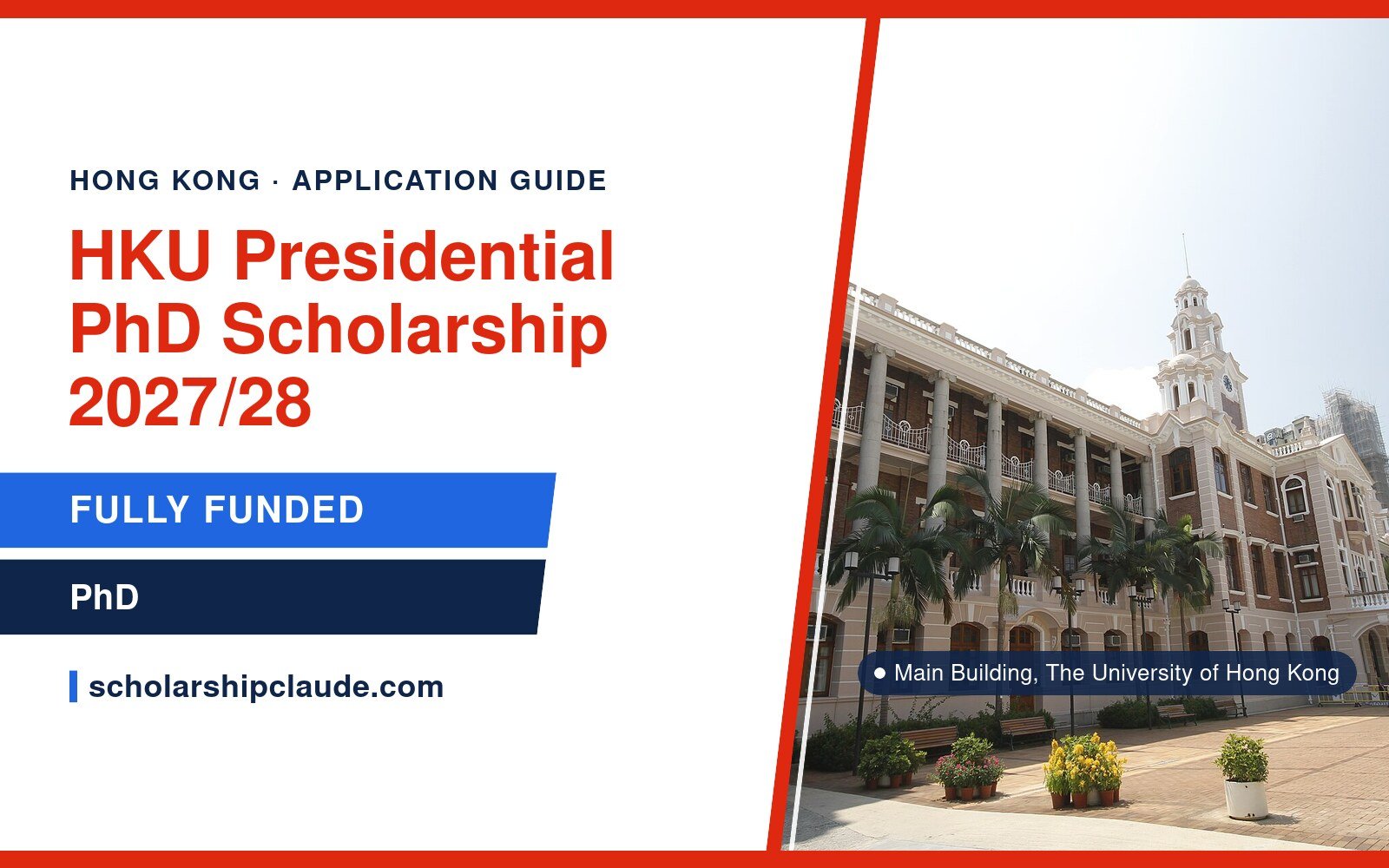
The HKU Presidential PhD Scholar Programme (HKU-PS) is the University of Hong Kong’s top award for new full-time PhD students. For 2027/28 admission it is worth up to around HK$445,800 in the first year, with a monthly scholarship, a fee waiver, a cash award, a travel allowance and a guaranteed hall place. There is no separate scholarship form: every applicant to HKU’s full-time PhD programme is considered. The Main Round closes on 1 December 2026.
This guide was checked on 17 October 2026 against the HKU Graduate School pages on the HKU Presidential PhD Scholar Programme, the PhD programme and application periods.
HKU Presidential PhD Scholarship at a glance
| University | The University of Hong Kong (HKU) |
|---|---|
| Level | Full-time PhD |
| Value | Up to around HK$445,800 (about US$57,150) in Year 1; up to around HK$428,300 (about US$54,920) in each later year |
| Monthly scholarship | HK$28,700 |
| Fees | Composition fee waived for the normative study period (HK$49,500 a year) |
| Who is considered | All applicants to HKU’s full-time PhD programme |
| Separate form | No |
| Main Round | 1 September to 1 December 2026 |
| Closing date (Main Round) | 1 December 2026 |
What is the HKU Presidential PhD Scholar Programme?
HKU-PS is a scholarship programme run by HKU for its strongest new PhD students. HKU describes its scholars as the brightest candidates who are passionate about research. Besides money, the programme offers individual advisory services, teaching training, access to leading scholars and mentorship from senior faculty.
It is separate from the Hong Kong PhD Fellowship Scheme (HKPFS), which is run by the Research Grants Council for eight universities in Hong Kong. HKU strongly encourages Main Round applicants to apply for both. We explain how the two fit together below.
What the scholarship pays
| Part of the award | Amount |
|---|---|
| Postgraduate scholarship | HK$28,700 a month |
| Composition fee waiver | HK$49,500 a year, for the whole normative study period |
| Cash award for research and living expenses | HK$40,000 in Year 1, then HK$20,000 a year |
| Conference and research travel allowance | HK$14,400 a year |
| Housing | Guaranteed hall place in Year 1, which may be renewed |
| Extra year | Selected outstanding students may receive funding for one more year, based on research output and progress |
HKU states the total as up to around HK$445,800 (about US$57,150) in the first year and up to around HK$428,300 (about US$54,920) in each later year of the normative study period. Because tuition is waived and a monthly scholarship is paid, this is a fully funded PhD award.
Who can apply
You are considered for HKU-PS if you apply for full-time PhD study at HKU. The official pages do not set a nationality restriction. Your academic background decides which PhD route you follow:
| Your highest degree | PhD route | Normative study period (full-time) |
|---|---|---|
| A good bachelor’s degree with honours and/or a taught master’s degree | Four-year PhD | 48 months |
| A research master’s degree, such as an MPhil | Three-year PhD | 36 months |
The HKU-PS page does not publish a minimum grade or an English test score. Check the HKU Graduate School’s English language requirements for research postgraduate applicants, and the requirements of your chosen programme, before you apply.
How selection works
- You apply for a full-time PhD at HKU through the online application system.
- All full-time PhD applicants are considered for HKU-PS. There is no extra form.
- Shortlisted candidates may be invited to an interview.
- HKU says admission quotas are limited. It strongly encourages applying in the Main Round, because clearing rounds are considered only if places remain.
- Some faculties, schools and departments start reviewing applications before each round’s deadline.
The last point matters. Applying early in the Main Round can only help you, because your file may be read before the closing date.
Application rounds for 2027/28
| Round | Dates |
|---|---|
| Main Round | 1 September 2026 to 1 December 2026 |
| 1st Clearing Round | 2 December 2026 to 30 April 2027 |
| 2nd Clearing Round | 1 May 2027 to 31 August 2027 |
For HKU-PS and HKPFS together, aim for the Main Round.
HKU-PS and the Hong Kong PhD Fellowship Scheme
HKU strongly encourages Main Round applicants to also apply for the Hong Kong PhD Fellowship Scheme, because competition is high. The two are different awards, but you can prepare for both at the same time.
- HKPFS initial application. Submit the initial application in the Research Grants Council’s HKPFS system between 1 September and 1 December 2026. This gives you an HKPFS reference number. You can submit only one initial application.
- HKU PhD application. Apply for full-time PhD study at HKU by 1 December 2026, and quote your HKPFS reference number if you have one.
- HKU-PS consideration. Your HKU PhD application is considered for HKU-PS automatically.
Read our Hong Kong PhD Fellowship Scheme page and the full HKPFS application guide for the details of that scheme.
How to apply, step by step
- Choose your research area. Look through HKU’s faculties and departments and find a field where your past work fits.
- Find potential supervisors. Read the profiles and recent papers of academics whose research matches your interests.
- Write to one or two potential supervisors. A short, specific email can tell you whether they are taking new PhD students. Our guide on emailing professors was written for China, but the same method works for Hong Kong.
- Prepare your documents. Check the requirements of your programme in HKU’s online application system. The HKU-PS page does not list documents, so rely on your programme’s own list.
- Apply for HKPFS if you wish, to get your reference number.
- Submit your HKU PhD application in the Main Round, by 1 December 2026. Submit earlier if you can, because some departments start reviewing before the deadline.
- Prepare for an interview. Shortlisted candidates may be invited to one.
Preparing a strong PhD application
HKU-PS has no separate essay, so your PhD application does all the work. Programmes differ, but most PhD applications are judged on your academic record, your research potential and how well your plans fit the department. Focus on these areas.
Your research proposal or research statement
If your programme asks for a research proposal, it is often the most important document. It should set out a clear research question, explain why it matters, show what is already known and describe how you would study it. Keep it realistic for a PhD timeline. Our research proposal guide has a structure and a template.
Your CV
Use a research CV: education with grades, research projects, publications or posters if you have them, technical skills, and awards. Put research experience near the top. Our research CV template shows the layout.
Your referees
Choose academics who have supervised your research or taught you in advanced courses. Ask them early, and give them your proposal and CV. Our guide on strong recommendation letters explains how to brief them.
Your English
The HKU-PS page does not state an English score. Find the Graduate School’s language requirement for research postgraduate applicants, and book a test early if you need one. Our comparison of IELTS and TOEFL can help you choose.
Preparing for the interview
If you are shortlisted, you may be interviewed. Expect questions about your past research, your proposed project and why you chose HKU and your potential supervisor. Practise explaining your research in plain English in two minutes, then in ten minutes. Be ready to discuss a weakness in your project and how you would deal with it. Our scholarship interview tips cover common questions.
A suggested timeline
| When | What to do |
|---|---|
| Now to early November 2026 | Choose your field and potential supervisors, contact them, draft your proposal and CV, ask referees, book an English test if needed. |
| November 2026 | Submit the HKPFS initial application if you are applying for it, then complete and submit your HKU PhD application. |
| 1 December 2026 | Main Round closing date at HKU and closing date for the HKPFS initial application. |
| After the closing date | Shortlisted candidates may be invited to an interview. |
HKU does not publish the HKU-PS result date on the page we checked. Keep your email and the application system under watch after you apply.
Life as an HKU Presidential PhD Scholar
The package is designed so that you can focus on research. The monthly scholarship and cash award help with living costs. The travel allowance can support conference trips, which are important for building your academic network. The guaranteed hall place in the first year means you do not need to search for housing as soon as you arrive. You also receive teaching training and mentorship, which help if you plan an academic career.
Funding runs for the normative study period of your PhD. HKU says selected outstanding students may receive funding for one additional year, based on their research output and progress. Plan your research so that you make steady progress from the first year.
Three-year or four-year PhD?
Your route is decided mainly by your highest degree, but it is worth understanding what each one means for you.
- Four-year PhD. This is for applicants with a good bachelor’s degree with honours and/or a taught master’s degree. A taught master’s is mostly coursework, so HKU treats it like a bachelor’s for this purpose. The extra year gives you time for training before your main research.
- Three-year PhD. This is for applicants who already hold a research master’s, such as an MPhil. You are expected to start research quickly, because you already have research training.
HKU-PS funding follows the normative study period of your route. On a four-year PhD that is 48 months of full-time study, and on a three-year PhD it is 36 months.
Writing to a potential supervisor
A first email should be short. It should show that you have read the academic’s work and that you have a relevant background. The example below is invented. Change every detail to match your own case.
Subject: Prospective PhD applicant for 2027/28: soil microbes and drought
Dear Professor [Name],
I am a final-year master’s student in environmental science at [University]. My thesis tests how soil bacteria change after long dry periods in farmland. I read your 2025 paper on microbial recovery after drought and would like to build on its sampling method in a PhD.
I plan to apply for full-time PhD study at HKU in the Main Round, and I would be grateful to know whether you expect to take a new PhD student in 2027/28. I have attached my CV and a one-page research idea.
Kind regards,
[Your name]
Send it to one or two academics at a time, and wait about two weeks before a polite follow-up. Do not send the same message to many staff in one department.
Questions to ask before you accept
If a potential supervisor replies with interest, a short call can help you decide whether the fit is right. Useful questions include:
- What projects are current PhD students in the group working on?
- How often does the group meet, and how are students supervised?
- Which conferences do students usually attend?
- What do you expect a first-year PhD student to achieve?
The answers help you write a proposal that fits the group, and they show that you are serious about the research.
If you are not selected for HKU-PS
HKU-PS is very competitive, so plan for other outcomes. You may still receive a PhD offer at HKU with other funding, or you may be selected for HKPFS. If your application does not succeed, you can apply to other universities and scholarships, or improve your proposal and publication record and apply again in a later year. Use any feedback you receive, and keep your research idea moving by writing up your master’s or bachelor’s project.
How HKU-PS compares with other PhD awards in Asia
- HKU Presidential PhD Scholarship: HKU only, automatic consideration, Main Round closes 1 December 2026.
- Hong Kong PhD Fellowship Scheme: for PhD study at eight universities in Hong Kong, with its own initial application. See our HKPFS page.
- NUS Research Scholarship: for graduate research at the National University of Singapore. See our NUS page.
- SINGA: PhD funding at research institutes and universities in Singapore. See our SINGA guide.
Applying to several programmes is normal at PhD level. Our guide on how many scholarships to apply for explains how to manage several applications without lowering quality.
Common mistakes to avoid
- Waiting for a separate HKU-PS form. There is none; your PhD application is your scholarship application.
- Applying in a clearing round when you could have applied in the Main Round.
- Submitting on the last day, when some departments may already have started reviewing.
- Sending a general research proposal that does not fit the department or any supervisor.
- Forgetting to quote your HKPFS reference number in your HKU application, if you applied for HKPFS.
- Choosing referees who do not know your research work.
Checklist before you submit
- I have chosen the four-year or three-year PhD route that matches my degree.
- I have read my programme’s requirements in HKU’s application system.
- My research proposal or statement fits the department and at least one potential supervisor.
- My CV, transcripts and English test results are ready.
- My referees have agreed and know the timeline.
- I have decided whether to apply for HKPFS and have my reference number if I am.
- I will submit well before 1 December 2026.
Frequently asked questions
How do I apply for the HKU Presidential PhD Scholarship?
Apply for full-time PhD study at HKU. All full-time PhD applicants are considered for HKU-PS. There is no separate scholarship form.
What is the closing date?
The Main Round for 2027/28 admission closes on 1 December 2026. HKU strongly encourages applying in the Main Round.
How much is the scholarship?
Up to around HK$445,800 (about US$57,150) in the first year and up to around HK$428,300 (about US$54,920) in each later year. This includes HK$28,700 a month, a fee waiver, a cash award and a travel allowance.
Does it cover tuition?
Yes. The composition fee, listed at HK$49,500 a year, is waived for the whole normative study period.
Can international students apply?
Yes. The official pages do not set a nationality restriction.
Do I need a master’s degree?
No. Applicants with a good bachelor’s degree with honours can follow the four-year PhD. Applicants with a research master’s, such as an MPhil, can follow the three-year PhD.
Is there an interview?
Shortlisted candidates may be invited to an interview.
Can I apply for HKPFS as well?
Yes. HKU strongly encourages Main Round applicants to also apply for the Hong Kong PhD Fellowship Scheme.
What English score do I need?
Not stated on the HKU-PS page. Check the HKU Graduate School’s English language requirements for research postgraduate applicants.
Is housing included?
Scholars are guaranteed a hall place in Year 1, which may be renewed.
Can the funding be extended?
Selected outstanding students may receive financial support for one additional year beyond the normative study period, based on research output and progress.
Do I need a supervisor before I apply?
The HKU-PS page does not require it. Contacting a potential supervisor early is still useful, because it helps you match your proposal to a research group.
Can I apply in a clearing round and still be considered?
HKU says PhD applications are invited all year round, but it strongly encourages the Main Round because quotas are limited. For the best chance of HKU-PS and HKPFS, apply by 1 December 2026.
Where to apply
Read the full details on the official HKU Presidential PhD Scholar Programme page, which links to HKU’s online application. Our HKU Presidential PhD Scholarship page keeps the key facts in one place.
Scholarships with the nearest deadlines
| Scholarship | Funding | Stipend | Deadline |
|---|---|---|---|
| US–Pakistan Knowledge Corridor PhD Scholarships 2027 | Fully funded | Not stated on HEC's programme page (see the HEC advertisement) | 30 Oct 2026 |
| Honjo International Scholarship 2027 in Japan | Partial | 230,000 yen a month (degree of 1 to 2 years), 210,000 yen a month (3-year degree) or 180,000 yen a month (degree longer than 3 years) | 31 Oct 2026 |
| European Parliament Schuman Traineeships 2027 | Partial | Monthly grant paid; amount not stated on the official source | 31 Oct 2026 |
| University of Melbourne Graduate Research Scholarships 2027 in Australia | Fully funded | 41,100 Australian dollars a year (2027 rate), plus a full fee offset | 31 Oct 2026 (expected) |
| Australian Government RTP Scholarships 2027 in Australia | Fully funded | 2027 full-time RTP stipend: base rate 35,550 Australian dollars a year, maximum 55,537 Australian dollars a year | 31 Oct 2026 (expected) |
| DAAD EPOS Scholarship 2027/28 in Germany | Fully funded | 992 euros a month for graduates; 1,400 euros a month for doctoral candidates | 31 Oct 2026 (expected) |
| One Young World Leading Scholarship 2026 in South Africa | Partial | See the scholarship page | 31 Oct 2026 |
| UNU Junior Fellows Internship 2027 in Tokyo, Japan | Partial | Monthly stipend; amount not stated on the official source | 1 Nov 2026 |
| Open Doors Russian Scholarship Project 2026–27 in Russia | Partial | Tuition-free study; a monthly allowance is possible only with grant support for Russian-taught programmes | 1 Nov 2026 |
| Max Planck Computer Science Summer Internships 2027 in Germany | Fully funded | Monthly stipend (amount not stated on the official source) | 1 Nov 2026 |
This list updates itself from our scholarships page. Stipend figures are shown where the provider publishes them. See all scholarships.