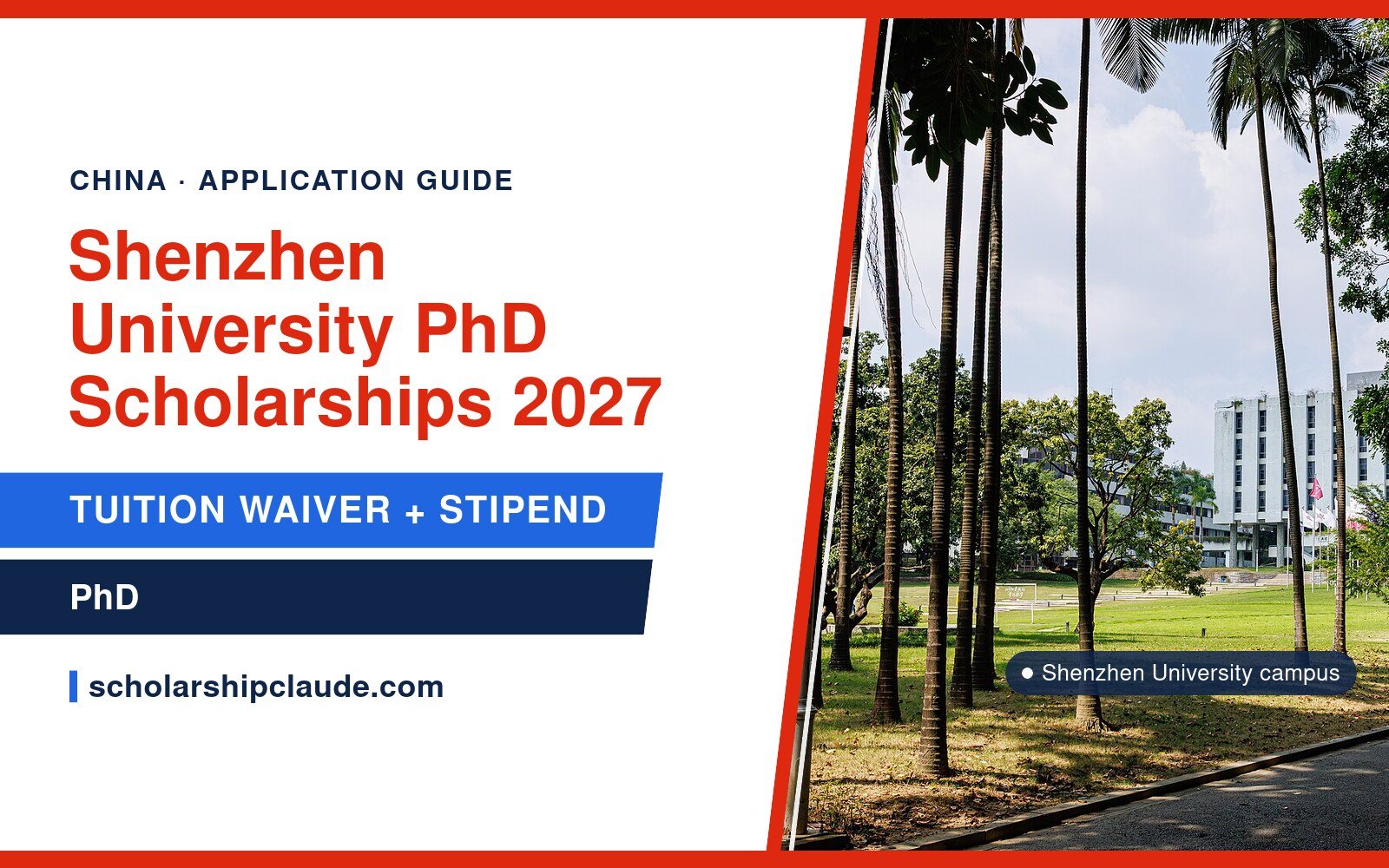
Shenzhen University (SZU) in southern China is admitting international PhD students for March 2027. Its strongest award, the Liyuan International Scholarship, waives tuition and pays CNY 4,000 to 6,000 a month. Two other scholarships pay CNY 30,000 or CNY 40,000 a year. You must find a supervisor before you apply, most programmes are taught in English, and the closing date is 30 November 2026.
This guide was checked on 16 October 2026 against SZU’s official doctoral admission brochure for the March 2027 intake and its official PhD programme list for that intake.
SZU PhD admission at a glance
| University | Shenzhen University (SZU), Shenzhen, Guangdong, China |
|---|---|
| Intake | March 2027 |
| Level | Full-time PhD |
| Programmes | 21 programme options; 19 taught in English and 2 in Chinese |
| Length | 3 to 4 years (5 years at most) |
| Age limit | Under 40 |
| Main scholarship | Liyuan International Scholarship: tuition waiver plus CNY 4,000 to 6,000 a month |
| Other scholarships | Guangdong Government (CNY 30,000 a year), Shenzhen Universiade (CNY 40,000 a year) |
| Supervisor support | At least CNY 12,000 a year for research or academic exchange |
| Applications | 10 October to 30 November 2026 |
| Closing date | 30 November 2026 |
| Application fee | CNY 400 (USD 60), not refundable |
| Results | Pre-admission in December 2026; admission documents in January 2027 |
About Shenzhen University and the March 2027 intake
Shenzhen University is a public university in Shenzhen, in Guangdong province. The admission brochure mentions two campuses, Yuehai and Lihu, and the housing on each is different, as the cost table below shows.
SZU runs two PhD intakes a year for international students, in March and September. This guide covers the March 2027 intake, which opened on 10 October 2026. All PhD study is full-time. Most programmes take four years, one takes three, and no student can stay longer than five years.
Each international PhD student studies under a named supervisor. That is why SZU asks for a recommendation letter from your potential supervisor as part of the application: you need to agree on supervision before you apply, not after.
PhD programmes for March 2027
SZU’s official list for this intake has 21 programme options in 17 academic and 4 professional doctoral degrees. Education and Psychology are taught in Chinese. All other programmes are taught in English.
| Programme | College or school | Language | Years |
|---|---|---|---|
| Education | Faculty of Education | Chinese | 4 |
| Psychology | School of Psychology | Chinese | 4 |
| Information and Communications Engineering | College of Electronics and Information Engineering | English | 4 |
| Optomechatronics Engineering and Application | College of Mechatronics and Control Engineering | English | 4 |
| Intelligent System and Manufacturing | College of Mechatronics and Control Engineering | English | 4 |
| Electronic Science and Technology | School of Integrated Circuits | English | 4 |
| Computer Science and Technology | College of Computer Science and Software Engineering | English | 4 |
| Computer Science and Technology | School of Artificial Intelligence | English | 4 |
| Architecture | School of Architecture and Urban Planning | English | 4 |
| Mathematics | School of Mathematical Science | English | 4 |
| Civil Engineering | College of Civil and Transportation Engineering | English | 4 |
| Optical Engineering | Institute of Microscale Optoelectronics | English | 4 |
| Optical Engineering | College of Physics and Optoelectronic Engineering | English | 4 |
| Physics | College of Physics and Optoelectronic Engineering | English | 4 |
| Chemistry | College of Chemistry and Environmental Engineering | English | 4 |
| Management Science and Engineering | College of Management | English | 3 |
| Biology | College of Life Sciences and Oceanography | English | 4 |
| Integrated Circuit Engineering (professional) | College of Electronics and Information Engineering | English | 4 |
| Integrated Circuit Engineering (professional) | School of Integrated Circuits | English | 4 |
| Artificial Intelligence (professional) | School of Artificial Intelligence | English | 4 |
| Optoelectronic Information Engineering (professional) | College of Physics and Optoelectronic Engineering | English | 4 |
Most options are in engineering, computing and the physical sciences. If your field is not on the list, SZU is not taking international PhD students in it for March 2027.
Scholarships you can get
| Scholarship | What it pays |
|---|---|
| Liyuan International Scholarship, first class | Tuition waiver plus CNY 6,000 a month |
| Liyuan International Scholarship, second class | Tuition waiver plus CNY 5,000 a month |
| Liyuan International Scholarship, third class | Tuition waiver plus CNY 4,000 a month |
| Guangdong Government Outstanding International Student Scholarship | CNY 30,000 a year |
| Shenzhen Universiade Scholarship | CNY 40,000 a year |
Liyuan International Scholarship
This is the most valuable award. It removes the tuition fee and adds a monthly living allowance. Over a year, the allowance comes to CNY 72,000 (first class), CNY 60,000 (second class) or CNY 48,000 (third class). The brochure does not say how SZU decides which class a student receives.
Guangdong Government Outstanding International Student Scholarship
This award pays CNY 30,000 a year. To be considered, download the scholarship form from the brochure, complete it and upload it with your application.
Shenzhen Universiade Scholarship
This award pays CNY 40,000 a year. The brochure gives no extra application step for it.
Supervisor support
On top of any scholarship, each supervisor provides at least CNY 12,000 a year for every international doctoral student they recruit. The money is for research costs or academic exchange, not for living costs.
What the brochure does not say
- How SZU chooses scholarship holders or decides the Liyuan class.
- Whether two scholarships can be combined.
- Whether scholarships are reviewed each year.
It does say that if your studies run past the normal length, scholarships, grants and fee discounts apply only to the first extra year, not to any later years.
What you pay
| Cost | Amount |
|---|---|
| Tuition, liberal arts | CNY 34,000 a year |
| Tuition, science and engineering | CNY 40,000 a year |
| Tuition, medicine, arts and physical education | CNY 52,000 a year |
| Housing, Lihu Campus (double room) | CNY 750 a semester |
| Housing, Yuehai Campus (single or double room) | CNY 2,400 to 8,000 a semester |
| Insurance (compulsory) | CNY 800 a year |
| Application fee | CNY 400 (USD 60) |
Housing prices do not include water and electricity. You pay for housing yourself, and you must buy SZU’s group insurance through the College of International Exchange on registration day. Students without it cannot register.
What the numbers mean for your budget
These examples use only the figures in the brochure:
- Liyuan third class, Lihu Campus: CNY 48,000 a year in allowance. Housing costs CNY 1,500 a year (two semesters) and insurance CNY 800, leaving CNY 45,700 a year for food, utilities and other costs.
- Liyuan third class, Yuehai Campus at the top housing price: housing costs CNY 16,000 a year, leaving CNY 31,200 after housing and insurance.
- Guangdong Government scholarship only, science or engineering programme: CNY 30,000 a year against tuition of CNY 40,000, so this award alone would not cover tuition.
Your real costs depend on your lifestyle and on where you live, so treat these as starting points.
Who can apply
- A non-Chinese citizen with a valid foreign passport.
- A master’s degree or higher. Final-year master’s students can apply with an expected graduation certificate, but must have the diploma before enrolment.
- Under 40 years old.
- In good physical and mental health.
- Willing to follow Chinese law and SZU’s rules.
The brochure does not set a minimum grade or limit nationalities beyond the passport rule.
Language requirements
- English-taught programmes: an English proficiency certificate. The brochure does not name a test or set a minimum score.
- Chinese-taught programmes (Education, Psychology): HSK 5 with at least 180 points.
- Native speakers of Chinese or English may be exempt once SZU confirms it.
- Certificates must still be valid when you apply.
Because no score is set for English-taught programmes, ask your potential supervisor which certificate they expect.
Step one: find a supervisor
SZU publishes a list of potential supervisors for international PhD students, linked from the brochure. Your application must include a recommendation letter from one of them, written on SZU’s template.
To approach a supervisor:
- Read the supervisor list and pick two or three people whose research matches yours.
- Read a few of their recent papers so you can mention specific work.
- Send a short email with a clear subject line, such as “Prospective PhD student, March 2027, [your field]”.
- In three or four short paragraphs, introduce yourself, explain your research interest, show how it fits their work, and ask if they would supervise you.
- Attach your CV and, if you have one, a short research proposal.
- If they agree, send them SZU’s recommendation template and the closing date.
Contact one supervisor at a time, or tell them if you are writing to others. Give them enough time: the letter must be uploaded before 30 November 2026. Our guide to emailing professors for China scholarships has templates.
Documents you need
Required
- Master’s degree certificate and diploma, or an expected graduation certificate
- Transcripts for all postgraduate courses
- Two recommendation letters from professors or associate professors, in Chinese or English, with their names and contact details
- Personal statement of about 1,500 words in English or Chinese
- Passport information page (valid beyond 30 June 2027) and a passport-style photo
- Recommendation letter from your potential SZU supervisor, on SZU’s template
- Language certificate
- CV covering everything from primary school to now
- Foreigner physical examination form
- Non-criminal record report, original and Chinese translation
- Bank statement showing at least CNY 30,000 or the equivalent, in your name or your guardian’s
- Receipt for the application fee
Conditional
- Guangdong Government Scholarship form, if you want to be considered for it
- Notarised translations of any document that is not in Chinese or English
- Any extra material SZU asks for during review
Tips for each document
- Personal statement: SZU asks you to cover your intended major and supervisor, your study and work experience, and your research results. Use those as your headings and keep close to 1,500 words.
- Recommendation letters: you need three in total: two from professors or associate professors, plus your SZU supervisor’s letter. Ask early.
- CV: SZU wants your education history from primary school onward, so list every stage with dates.
- Passport: it must be valid beyond 30 June 2027, and your passport details cannot change before you register. Renew it before applying if needed.
- Non-criminal record: you need the original and a Chinese translation. Getting this can take weeks in some countries.
- Bank statement: at least CNY 30,000 or the equivalent, in your name or a legal guardian’s.
Incomplete applications are not accepted, and SZU does not return documents. Our research proposal template and research CV guide can help.
How to structure your personal statement
SZU asks for about 1,500 words covering three things: your intended major and supervisor, your study and work experience, and your research results. A simple structure keeps the statement focused and easy for the review panel to read.
- Opening (about 150 words): name the programme you are applying to, the supervisor you have contacted, and the research question you want to work on.
- Academic background (about 350 words): your bachelor’s and master’s degrees, the subjects most relevant to your PhD, and your final project or thesis.
- Research experience and results (about 450 words): what you have done, the methods you used, what you found, and any papers, conference talks or patents. Be specific about your own role.
- Work experience (about 200 words): jobs, teaching or industry work that built skills you will use in the PhD.
- Fit with SZU and your supervisor (about 250 words): why this supervisor’s group, which of their work connects to yours, and what you plan to do in the first year.
- Closing (about 100 words): your goal after the PhD and how the degree helps you reach it.
Write in plain language, avoid general praise of the university, and check that names, programme titles and dates match your other documents. Our guide to the statement of purpose has more examples.
Application fee
The fee is CNY 400 or USD 60. Pay it by wire transfer to SZU’s designated account before you submit, then upload the payment voucher. Applications without payment are not reviewed, and the fee is not refunded.
How to apply, step by step
- Choose a programme from SZU’s March 2027 PhD list.
- Contact a potential supervisor and get their recommendation letter.
- Prepare all documents and translations.
- Pay the CNY 400 (USD 60) application fee by wire transfer.
- Register on the SZU College of International Exchange website.
- Log in, fill in your personal and visa information and upload your documents and the fee voucher.
- Submit by 30 November 2026.
- Prepare for a possible interview, online or in person.
Timeline
| Step | Date |
|---|---|
| Applications open | 10 October 2026 |
| Closing date | 30 November 2026 |
| Expert review and possible interviews | After the closing date |
| Pre-admission results by email | December 2026 |
| Digital admission documents by email | January 2027 |
| Registration in Shenzhen | On the date in your admission notice (March 2027 intake) |
How SZU selects students
After the closing date, a panel of experts reviews the applications. SZU may interview applicants online or in person. Pre-admission results are emailed in December 2026, and final results appear in the online system. When the admitted list is confirmed, SZU emails the digital admission documents in January 2027.
After you are admitted
- Apply for an X1 student visa at a Chinese embassy or consulate with the Shenzhen University Admission Notice and the JW202 form.
- Within 30 days of entering China, change the X1 visa into a residence permit. If you do not, SZU treats you as having withdrawn.
- SZU does not enrol students who arrive on other types of visa.
- Register in person on the date in your admission notice. Early registration is not accepted.
- Bring your original documents. SZU checks them at registration, and admission is cancelled if they cannot be verified.
- Buy the compulsory group insurance on registration day.
Checklist before you submit
- Your programme is on the March 2027 list, and the teaching language suits you.
- Your supervisor’s letter is on SZU’s template and is signed.
- You have two more recommendation letters from professors or associate professors.
- Your passport is valid beyond 30 June 2027.
- Your non-criminal record has a Chinese translation.
- Your bank statement shows at least CNY 30,000.
- The physical examination form is complete.
- You have paid the fee and saved the voucher.
- If you want the Guangdong Government scholarship, its form is filled in.
- Every document not in Chinese or English has a notarised translation.
Other PhD funding routes in China
SZU’s own scholarships are not the only way to fund a PhD in China. The Chinese Government Scholarship (CSC) covers tuition, housing, a stipend and insurance at many universities, and programmes such as CAS-ANSO and JUSTCOOL fund PhDs at specific institutions. If SZU’s fields or dates do not suit you, compare these routes before you decide. See our CSC scholarship guide, our CAS-ANSO guide and our JUSTCOOL guide.
Common mistakes to avoid
- Applying without a supervisor’s recommendation letter.
- Forgetting to pay the fee before submitting.
- Sending documents in a language other than Chinese or English without a notarised translation.
- Using a passport that expires before 30 June 2027, or changing passport details before registration.
- Choosing a field that is not on the March 2027 list.
- Arriving in China on the wrong type of visa.
Frequently asked questions
Is the Shenzhen University PhD scholarship fully funded?
The Liyuan International Scholarship waives tuition and pays CNY 4,000 to 6,000 a month. You still pay for housing and insurance. The Guangdong and Universiade scholarships pay a fixed amount each year instead.
Do I need a supervisor before applying?
Yes. A recommendation letter from your potential SZU supervisor is a required document.
Are the programmes taught in English?
19 of the 21 options are taught in English. Education and Psychology are taught in Chinese.
What is the age limit?
You must be under 40.
Do I need IELTS?
English-taught programmes ask for an English proficiency certificate, but the brochure does not name a test or a minimum score.
How much is the application fee?
CNY 400 or USD 60, paid by wire transfer and not refunded.
Can I apply with an expected master’s degree?
Yes, with an expected graduation certificate, but you need the official diploma before enrolment.
What is the closing date?
30 November 2026 for the March 2027 intake.
Where to apply
Read the official SZU doctoral admission brochure (March 2027 intake) and the official PhD programme list. The brochure links to the supervisor list and the online application system. Our Shenzhen University scholarship page keeps the key facts in one place, and our guide to scholarships in China lists other options.
Scholarships with the nearest deadlines
| Scholarship | Funding | Stipend | Deadline |
|---|---|---|---|
| US–Pakistan Knowledge Corridor PhD Scholarships 2027 | Fully funded | Not stated on HEC's programme page (see the HEC advertisement) | 30 Oct 2026 |
| Honjo International Scholarship 2027 in Japan | Partial | 230,000 yen a month (degree of 1 to 2 years), 210,000 yen a month (3-year degree) or 180,000 yen a month (degree longer than 3 years) | 31 Oct 2026 |
| European Parliament Schuman Traineeships 2027 | Partial | Monthly grant paid; amount not stated on the official source | 31 Oct 2026 |
| University of Melbourne Graduate Research Scholarships 2027 in Australia | Fully funded | 41,100 Australian dollars a year (2027 rate), plus a full fee offset | 31 Oct 2026 (expected) |
| Australian Government RTP Scholarships 2027 in Australia | Fully funded | 2027 full-time RTP stipend: base rate 35,550 Australian dollars a year, maximum 55,537 Australian dollars a year | 31 Oct 2026 (expected) |
| DAAD EPOS Scholarship 2027/28 in Germany | Fully funded | 992 euros a month for graduates; 1,400 euros a month for doctoral candidates | 31 Oct 2026 (expected) |
| One Young World Leading Scholarship 2026 in South Africa | Partial | See the scholarship page | 31 Oct 2026 |
| UNU Junior Fellows Internship 2027 in Tokyo, Japan | Partial | Monthly stipend; amount not stated on the official source | 1 Nov 2026 |
| Open Doors Russian Scholarship Project 2026–27 in Russia | Partial | Tuition-free study; a monthly allowance is possible only with grant support for Russian-taught programmes | 1 Nov 2026 |
| Max Planck Computer Science Summer Internships 2027 in Germany | Fully funded | Monthly stipend (amount not stated on the official source) | 1 Nov 2026 |
This list updates itself from our scholarships page. Stipend figures are shown where the provider publishes them. See all scholarships.