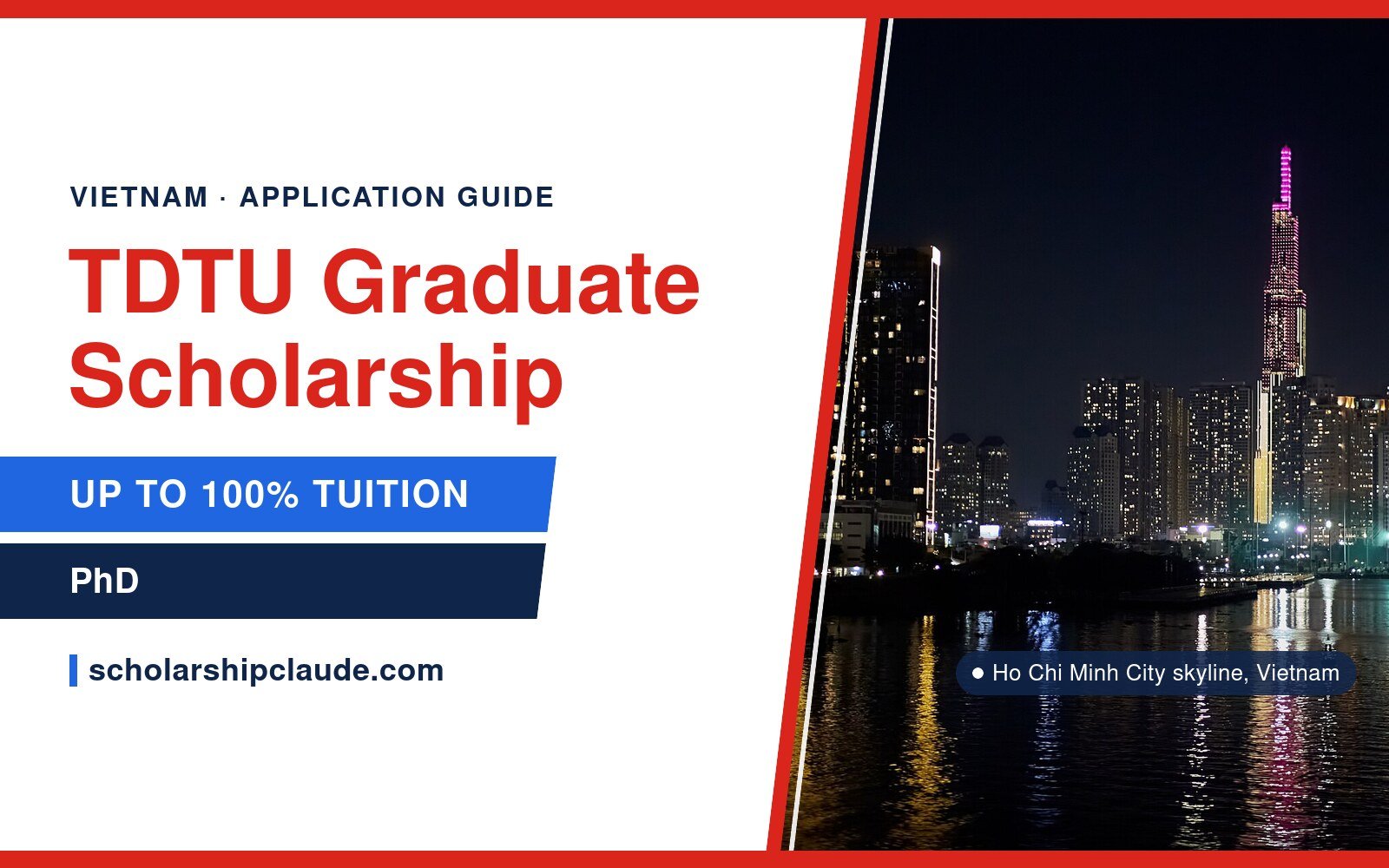
Ton Duc Thang University (TDTU) in Ho Chi Minh City gives a graduate scholarship to international master’s and doctoral students. Depending on your GPA, it can cover all of your first-year tuition, your dormitory fees and the admission fee. TDTU’s current doctoral intake, Phase 3 2026, closes on 6 November 2026.
This guide was checked on 15 October 2026 against TDTU’s official doctoral admissions announcement (Phase 3, 2026) and its graduate scholarship page.
TDTU graduate scholarship at a glance
| University | Ton Duc Thang University (TDTU), Ho Chi Minh City, Vietnam |
|---|---|
| Levels | Master’s and doctoral programmes (the intake open now is doctoral Phase 3, 2026) |
| 100% award | Full first-year tuition, first-year dormitory fees and the full admission fee |
| 50% award | Half of first-year tuition, full first-year dormitory fees and half of the admission fee |
| Living allowance | VND 3,500,000 a month, for only five students in 2026 |
| PhD length | 36 to 48 months |
| Closing date | 6 November 2026 |
| Results | 8 December 2026 |
| Enrolment | 18 and 19 December 2026 |
| Where to apply | Online at gradadmissions.tdtu.edu.vn |
What the scholarship covers
First year
| Award | GPA needed (out of 4.00) | What it covers |
|---|---|---|
| 100% | 3.50 or higher | Full first-year tuition, first-year dormitory fees and the full admission fee |
| 50% | 3.00 or higher | Half of first-year tuition, full first-year dormitory fees and half of the admission fee |
First-year awards are paid every six months, based on your academic results. Scholarship holders live in TDTU’s international student dormitory.
Second and third year
| Award | Cumulative GPA needed (out of 10.00) | What it covers |
|---|---|---|
| 100% | 8.00 or higher | Full tuition and dormitory fees for that year |
| 50% | 7.00 or higher | Half of tuition and full dormitory fees for that year |
To keep your award you must follow your academic and research plan, have no academic warning and no disciplinary action at warning level or above. Doctoral students are also judged on research progress and on papers in WoS or Scopus journals. A doctoral student whose award ends in the second year can apply again in the third year.
What it does not cover
- Courses you fail, or retake for a better grade
- Credits transferred from another programme
- Courses beyond the minimum credits of your programme
Living allowance
TDTU also pays a living allowance of VND 3,500,000 a month, but only five students received it in 2026. Holders must work at least 20 hours a week on tasks for a faculty or institute, and must apply with TDTU’s living allowance form each academic year. Plan your budget without counting on it.
Doctoral programmes in Phase 3, 2026
| Major | Language |
|---|---|
| Sociology | English or Vietnamese |
| Business Administration | English |
| Finance and Banking | Vietnamese |
| Accounting | English |
| Computational Science | English |
| Applied Mathematics | English |
| Computer Science | English |
| Electrical Engineering | English |
| Automation and Control Engineering | English |
| Civil Engineering | English |
Who can apply
- A bachelor’s degree in a relevant field.
- A master’s degree in a relevant field. TDTU waives this if you have a very good bachelor’s degree.
- For the scholarship: a GPA of at least 3.00 out of 4.00 (50% award) or 3.50 (100% award).
- English: IELTS 5.5 or higher, TOEFL iBT 46 or higher, or VSTEP Level 4 or higher, valid for two years. A degree taught in English is also accepted.
- For Vietnamese-taught programmes: a Vietnamese certificate at Level 4/6 or higher.
- A bank statement in your name showing at least USD 2,500.
The official pages do not set any nationality limit.
Documents you need
Required
- Online application form
- CV in TDTU’s format
- Bachelor’s transcript and degree certificate
- Master’s transcript and degree certificate (unless waived)
- Doctoral statement of purpose in TDTU’s format
- English proof
- One recommendation letter from a professor, associate professor or PhD holder (original)
- Passport copy and a 3×4 cm photo
- Criminal record certificate issued in the last 6 months
- Health check report from the last 12 months
- Bank statement showing at least USD 2,500
- TDTU scholarship application form
Conditional
- Copies of your research publications, if you have any
- Vietnamese certificate, for Vietnamese-taught programmes
- Work certificate, if you are a lecturer or researcher
How to apply, step by step
- Choose one doctoral major from the Phase 3 list.
- Write your CV and doctoral statement of purpose in TDTU’s own formats, as the official announcement requires.
- Ask your referee for the recommendation letter early, because TDTU needs the original.
- Request your criminal record certificate and health check in time, since both must be recent.
- Apply online at gradadmissions.tdtu.edu.vn and submit the scholarship application form.
- Submit everything by 6 November 2026.
- Check your results on 8 December 2026 and enrol on 18 or 19 December 2026.
Our guides to the statement of purpose and the PhD research proposal can help with the written parts.
Which award level can you expect?
TDTU sets the first-year award by your GPA on a 4.00 scale. Use this simple check before you apply:
| Your GPA (out of 4.00) | Likely first-year award | What you still pay in year one |
|---|---|---|
| 3.50 or higher | 100% award | Living costs, insurance and other personal costs |
| 3.00 to 3.49 | 50% award | Half of tuition, half of the admission fee, and living costs |
| Below 3.00 | No first-year award under these rules | Full tuition, admission fee and living costs |
If your university uses a different scale, such as a 10-point scale or percentages, ask TDTU how it converts your grades before you apply. The scholarship page states the thresholds only on the 4.00 scale for year one and on the 10.00 scale for later years.
Choosing your programme and language
Eight of the ten Phase 3 majors are taught only in English, Sociology is offered in English or Vietnamese, and Finance and Banking is taught in Vietnamese. If you do not speak Vietnamese, choose an English-taught major, because Vietnamese-taught programmes need a Vietnamese certificate at Level 4 out of 6 for foreigners.
Before you choose, read the research areas of the faculty you would join and check that someone there works on your topic. TDTU asks for one recommendation letter from a professor, associate professor or PhD holder, and a statement of purpose in its own format, so a clear match between your plans and the faculty makes both documents stronger.
How to write the doctoral statement of purpose
TDTU asks you to use its own statement of purpose format, so follow the headings in that template first. Within those headings, these points help the reviewers:
- Your research question. State in two or three sentences what you want to study and why it matters.
- Your background. Summarise your master’s thesis or main project, the methods you used and what you found.
- Your plan. Outline the methods and data you expect to use, and what you hope to finish in each year.
- Your fit with TDTU. Name the faculty and explain how your topic connects to its work.
- Your publications. List any papers, especially in journals indexed in Web of Science or Scopus, since TDTU uses these to review doctoral progress.
- Your goal. Explain what you want to do after the PhD.
Keep sentences short and specific. Our statement of purpose guide has more examples.
Preparing the harder documents
- Criminal record certificate: it must be issued in the last six months. In many countries this takes several weeks, so request it as soon as you decide to apply.
- Health check report: it must be from the last twelve months. Ask the clinic for a report you can upload as a clear scan.
- Bank statement: it must show at least USD 2,500 in your own name and be valid through the closing date. A statement in a parent’s name does not meet this rule.
- Recommendation letter: TDTU asks for the original, so plan how your referee will send or hand it over.
- English proof: IELTS 5.5, TOEFL iBT 46 or VSTEP Level 4 must be valid for two years. If your degree was taught in English, get a letter from your university that says so.
Keeping your scholarship after the first year
The first-year award does not automatically continue. From the second year, TDTU looks at:
- Your cumulative GPA on a 10.00 scale: 8.00 or higher for a 100% award, or 7.00 or higher for a 50% award.
- Whether you follow your academic and research plan.
- Whether you have any academic warning or disciplinary action.
- For doctoral students, your research progress and papers in journals indexed in Web of Science or Scopus.
Publishing during the PhD therefore matters for your funding, not only for your degree. Agree a publication plan with your supervisor early. If your award stops in the second year, you can apply again in the third year.
Also remember what is never covered: failed or retaken courses, transferred credits, and courses beyond your programme’s minimum credits. Plan your course load so you do not take extra paid credits by mistake.
Finding a supervisor and research fit
TDTU’s announcement does not require a supervisor’s acceptance letter before you apply, but a good research fit still matters. Your statement of purpose must show that your topic belongs in the faculty you choose, and your progress after the first year depends on research output that you will produce with a supervisor.
- Open the website of the faculty that runs your chosen major and read its research groups.
- Note two or three academics whose recent papers are close to your topic.
- Write a short email that introduces you, summarises your master’s research in three sentences, and asks whether they accept international doctoral students.
- Attach your CV and a one-page outline of your proposed research.
- If someone replies with interest, mention them in your statement of purpose.
Even a brief reply helps you write a more specific application. Our guide to writing a PhD research proposal shows how to build a one-page outline.
Planning your publications
TDTU reviews doctoral students partly on papers in journals indexed in Web of Science (WoS) or Scopus. These are two large databases that list journals meeting certain quality checks. Before you submit a paper, check the journal:
- Search the journal’s name in the Web of Science Master Journal List or in Scopus Sources to confirm it is indexed.
- Check the journal’s website for its publisher, editorial board and review process.
- Be careful with journals that promise very fast acceptance for a fee. Ask your supervisor if you are unsure.
A realistic plan is to turn your first-year literature review or first set of results into a paper with your supervisor, so you have something under review before your second-year scholarship is assessed.
How TDTU compares with other PhD funding in Asia
The TDTU award is strong on tuition and housing, but most holders do not receive a monthly stipend. If you need a stipend to live on, compare it with fully funded options that pay one, such as the SINGA award in Singapore, the GIST scholarship in South Korea or the CAS-ANSO scholarship in China. Each has its own deadlines, fields and eligibility rules, so read the official pages before you choose.
If you already have savings or support from your employer, TDTU’s tuition and dormitory cover can make a PhD affordable, and its December enrolment lets you start sooner than many autumn-start programmes.
A suggested timeline
| When | What to do |
|---|---|
| Now | Choose your major, contact your referee, request your criminal record certificate |
| Late October 2026 | Book the health check, get your bank statement, finish your CV and statement of purpose in TDTU’s formats |
| By early November 2026 | Upload everything on the TDTU portal and submit the scholarship form |
| 6 November 2026 | Closing date |
| 8 December 2026 | Admission results |
| 18 to 19 December 2026 | Enrolment |
This timeline is our suggestion based on TDTU’s official dates. Leave a few days before the closing date in case an upload fails.
Questions to ask TDTU before you apply
The official pages leave a few practical points open. Send a short email to TDTU’s graduate admissions office and ask:
- What the tuition fee is for your chosen doctoral major, so you know what a 50% award would leave you to pay.
- How TDTU converts grades from your country’s scale to its 4.00 scale.
- Which type of dormitory room scholarship holders receive, and whether utilities are included.
- When and how to apply for the living allowance, and how the five holders are chosen.
- What support TDTU gives for your Vietnamese student visa after admission.
Keep the replies with your application records. Clear answers now help you plan your budget and avoid surprises at enrolment.
Checklist before you submit
- Your major is on the Phase 3 list and you meet its language rule.
- Your CV and statement of purpose use TDTU’s formats.
- Your recommendation letter is from a professor, associate professor or PhD holder.
- Your criminal record certificate is less than six months old.
- Your health check is less than twelve months old.
- Your bank statement shows at least USD 2,500 in your name.
- Your English proof is valid for two years, or you have proof of an English-taught degree.
- You have submitted the scholarship application form on the portal.
Common mistakes to avoid
- Applying for a Vietnamese-taught major without a Vietnamese certificate.
- Using your own CV layout instead of TDTU’s format.
- Uploading an old criminal record certificate or health report.
- Forgetting the scholarship form and applying for admission only.
- Counting on the monthly living allowance, which only five students received in 2026.
Frequently asked questions
Is the TDTU scholarship fully funded?
No. The 100% award covers tuition, dormitory fees and the admission fee, but there is no general monthly stipend. The living allowance went to only five students in 2026.
Can master’s students get the scholarship?
Yes, the scholarship covers master’s and doctoral programmes. The intake open now on TDTU’s site is for doctoral programmes. Check TDTU’s graduate site for the next master’s intake.
What GPA do I need?
At least 3.00 out of 4.00 for the 50% award, and 3.50 for the 100% award.
Do I need IELTS?
You need IELTS 5.5, TOEFL iBT 46 or VSTEP Level 4, or a degree taught in English.
What is the closing date?
6 November 2026 for doctoral admissions Phase 3, 2026.
Does the scholarship cover the dormitory?
Yes. Both the 100% and 50% first-year awards cover the full first-year dormitory fee, and scholarship holders live in TDTU’s international student dormitory.
Can I apply if I do not have a master’s degree?
TDTU waives the master’s degree requirement for applicants with a very good bachelor’s degree. Check the admission announcement for the exact rule.
What happens if my grades drop?
Your award may drop to 50% or stop. From the second year, a cumulative GPA of 8.00 out of 10 keeps the 100% award, and 7.00 keeps the 50% award.
When are the results?
Admission results are announced on 8 December 2026, and enrolment takes place on 18 and 19 December 2026.
Is there an application fee?
The scholarship rules mention an admission fee, which the 100% award covers in full and the 50% award covers by half. The amount is not stated on the scholarship page, so check the admissions portal when you register.
Can I apply for the living allowance in my first year?
The scholarship page says holders submit TDTU’s living allowance application form each academic year. Only five students received it in 2026, and holders must work at least 20 hours a week for a faculty or institute, so treat it as a possible extra rather than part of your budget.
Where to apply
Read the official TDTU doctoral admissions announcement and the official TDTU scholarship page. Our TDTU scholarship page keeps the key facts in one place.
Scholarships with the nearest deadlines
| Scholarship | Funding | Stipend | Deadline |
|---|---|---|---|
| US–Pakistan Knowledge Corridor PhD Scholarships 2027 | Fully funded | Not stated on HEC's programme page (see the HEC advertisement) | 30 Oct 2026 |
| Honjo International Scholarship 2027 in Japan | Partial | 230,000 yen a month (degree of 1 to 2 years), 210,000 yen a month (3-year degree) or 180,000 yen a month (degree longer than 3 years) | 31 Oct 2026 |
| European Parliament Schuman Traineeships 2027 | Partial | Monthly grant paid; amount not stated on the official source | 31 Oct 2026 |
| University of Melbourne Graduate Research Scholarships 2027 in Australia | Fully funded | 41,100 Australian dollars a year (2027 rate), plus a full fee offset | 31 Oct 2026 (expected) |
| Australian Government RTP Scholarships 2027 in Australia | Fully funded | 2027 full-time RTP stipend: base rate 35,550 Australian dollars a year, maximum 55,537 Australian dollars a year | 31 Oct 2026 (expected) |
| DAAD EPOS Scholarship 2027/28 in Germany | Fully funded | 992 euros a month for graduates; 1,400 euros a month for doctoral candidates | 31 Oct 2026 (expected) |
| One Young World Leading Scholarship 2026 in South Africa | Partial | See the scholarship page | 31 Oct 2026 |
| UNU Junior Fellows Internship 2027 in Tokyo, Japan | Partial | Monthly stipend; amount not stated on the official source | 1 Nov 2026 |
| Open Doors Russian Scholarship Project 2026–27 in Russia | Partial | Tuition-free study; a monthly allowance is possible only with grant support for Russian-taught programmes | 1 Nov 2026 |
| Max Planck Computer Science Summer Internships 2027 in Germany | Fully funded | Monthly stipend (amount not stated on the official source) | 1 Nov 2026 |
This list updates itself from our scholarships page. Stipend figures are shown where the provider publishes them. See all scholarships.