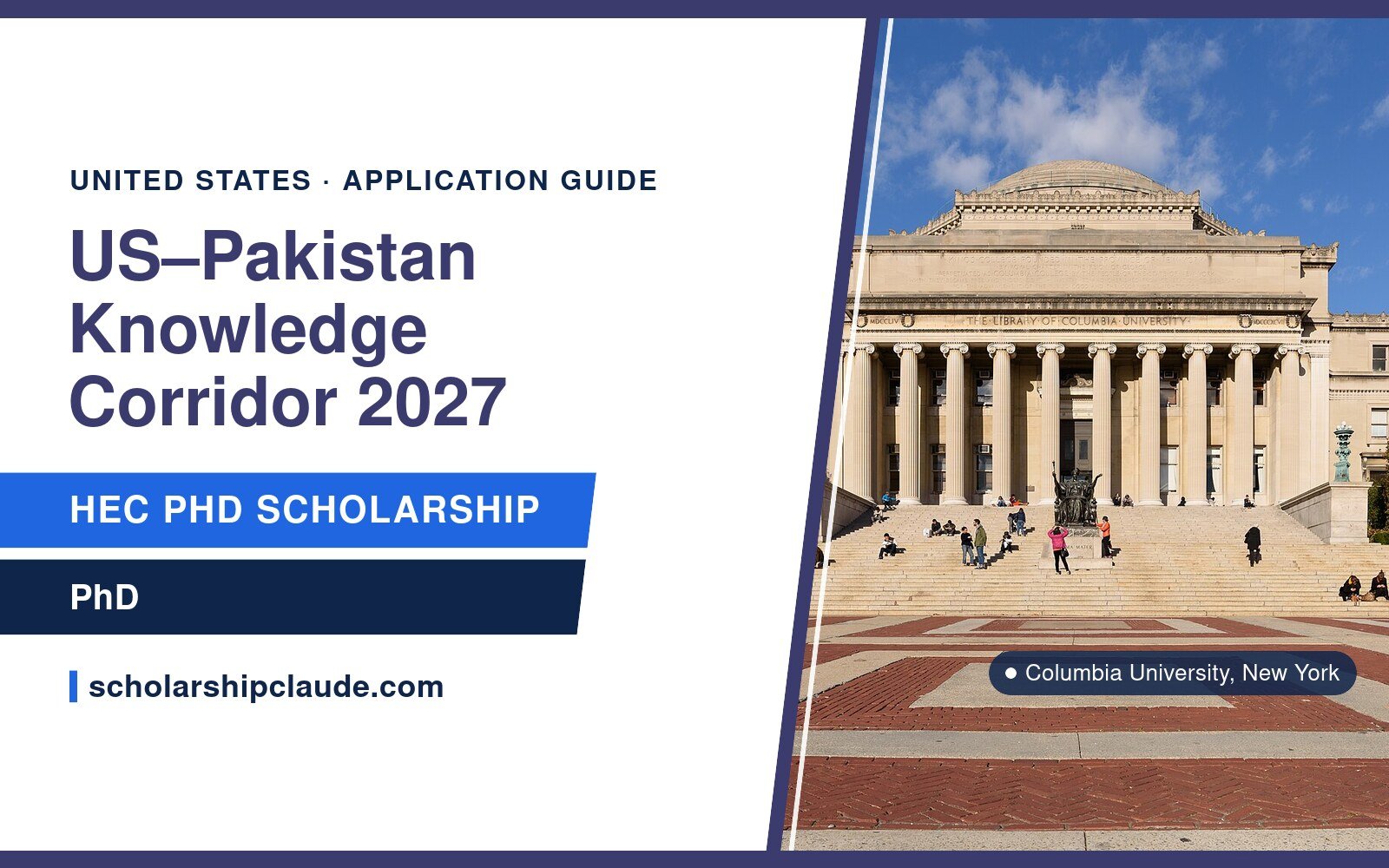
The US–Pakistan Knowledge Corridor is the Higher Education Commission (HEC) of Pakistan’s scholarship for Pakistani students who win a place on a PhD programme at a top US university. For 2027, HEC funds PhD study at universities ranked in the top 100 of the QS World University Rankings. There are two closing dates: 30 October 2026 for the Spring/Summer 2027 intake and 30 March 2027 for the Fall 2027 intake. It is only open to Pakistani and Azad Jammu and Kashmir (AJK) nationals.
This guide was checked on 16 October 2026 against HEC’s official US–Pakistan Knowledge Corridor page and the 2027 notice published by UET Lahore. Where those sources are silent, we say so, and we point you to HEC’s advertisement on the HEC Scholarship Portal.
Knowledge Corridor scholarship at a glance
| Run by | Higher Education Commission (HEC) of Pakistan |
|---|---|
| Who can apply | Pakistani and AJK nationals only |
| Level | PhD in the United States |
| Universities | US universities in the QS World University Rankings top 100 |
| Category I | Admission to a US university ranked in the top 50 |
| Category II | Admission to a US university ranked 51 to 100 |
| Test rule | GRE General total of at least 300, or HAT score of at least 60% |
| Spring/Summer 2027 closing date | 30 October 2026 |
| Fall 2027 closing date | 30 March 2027 |
| How to apply | Online on the HEC Scholarship Portal |
| Benefits | Set out in HEC’s advertisement (not listed on HEC’s programme page) |
What is the US–Pakistan Knowledge Corridor?
In June 2015, the United States and Pakistan set up an Education, Science and Technology Working Group. One of its aims, linked to Pakistan’s Vision 2025 plan, was to send 10,000 Pakistani scholars to US universities over ten years and build high-level skills for Pakistan.
HEC turned part of that plan into a project called PhD Scholarships under US–Pak Knowledge Corridor, Phase 1. Pakistan’s Executive Committee of the National Economic Council (ECNEC) approved it in January 2017, and it was revised in August 2020. Phase 1 aims to award 1,000 PhD scholarships for study in the United States.
HEC lists three main objectives:
- To improve the quality of teaching staff and the research capacity of Pakistan’s higher education institutions.
- To prepare about 1,000 potential applicants a year for the GRE and for TOEFL or IELTS, through a Talent Farming component.
- To build collaboration between Pakistani and US institutions.
In short, HEC wants to train future university teachers and researchers for Pakistan at strong US universities. Keep this aim in mind when you write your application: show how your PhD will help Pakistan’s universities or research after you finish.
The two scholarship categories
| Category | Where you need admission | Test rule |
|---|---|---|
| Category I | A US university ranked in the top 50 of the QS World University Rankings (overall) | GRE General 300+ or HAT 60%+ |
| Category II | A US university ranked 51 to 100 of the QS World University Rankings (overall) | GRE General 300+ or HAT 60%+ |
Your category depends on the overall QS ranking of the US university that admits you, not on the subject ranking of your department. The QS ranking changes every year, so a university can move between categories. HEC’s advertisement explains which ranking edition it uses and what each category pays. Check both before you build your list of universities.
Key dates for 2027
| Intake | HEC closing date |
|---|---|
| Spring/Summer 2027 | 30 October 2026 |
| Fall 2027 | 30 March 2027 |
What the two dates mean in practice
Because the categories depend on where you are admitted, you need your US PhD admission in hand to apply. If you do not already have an offer for Spring or Summer 2027, the 30 October 2026 date will be too soon for you, and the Fall 2027 round is the realistic target.
For Fall 2027, many US PhD programmes close their applications between December 2026 and January 2027, and send offers between February and April 2027. Some offers may arrive after 30 March 2027. Check your programmes’ dates early, apply to the earliest ones first, and ask HEC through its portal how it treats offers that arrive after the closing date.
Who can apply
The official sources we checked confirm these rules:
- You must be a Pakistani or AJK national.
- You must apply for a PhD at a US university ranked in the QS World University Rankings top 100.
- You must have a valid GRE General score with a total of at least 300, or a HAT score of at least 60%.
What the official pages do not tell you
HEC’s programme page and the UET notice do not give these details. They are in HEC’s advertisement on the HEC Scholarship Portal, so read it carefully:
- The tuition, stipend and health insurance amounts for each category
- Minimum grades or divisions in your previous degrees
- Any age limit
- Rules for people already working, including university teachers
- Any bond or obligation to return to Pakistan after the PhD
- The list of documents to upload
- Whether you can accept funding from your US university as well
Some websites publish figures for these points. We have not included them because we could not find them on an official HEC page. Rely on the advertisement itself.
How HEC’s aims can shape your application
HEC created this scholarship to raise the quality of teaching and research in Pakistan’s universities. Wherever HEC’s form or interview gives you space to explain your plans, link your PhD to that goal:
- Name the research problem you want to work on and why it matters for Pakistan, for example in energy, water, health, agriculture or computing.
- Explain how a PhD from a top US university will help you teach, supervise or lead research when you return.
- Mention any links you already have with a Pakistani university or research centre.
- Show collaboration ideas between your US department and institutions in Pakistan, since building such links is one of HEC’s stated objectives.
Keep these points short and concrete. Specific plans are more convincing than general statements about serving the country.
Meeting the GRE or HAT rule
GRE General Test
The GRE General Test is run by ETS. Its Verbal Reasoning and Quantitative Reasoning sections are each scored from 130 to 170, so the combined total runs from 260 to 340. HEC asks for a total of at least 300, which is the same as an average of 150 in each section. GRE scores can be reported for five years after the test date.
The GRE also helps your US applications. Even where a US programme does not require it, a strong quantitative score can support an application in engineering, economics or the sciences. For this scholarship, though, you need either the GRE or HAT whatever your US university asks for.
HAT
HAT is HEC’s own aptitude test, run by its Education Testing Council. HEC accepts a HAT score of at least 60% as an alternative to the GRE for this scholarship. HAT is not used by US universities, so if your US programmes ask for the GRE, you will need to take the GRE anyway.
Which test should you take?
- If your US programmes require or recommend the GRE, take the GRE and aim above 300.
- If your US programmes do not ask for the GRE, HAT may be the simpler way to meet HEC’s rule.
- Check that your score will still be valid on the HEC closing date.
HEC’s Talent Farming component trains potential applicants for the GRE and for TOEFL or IELTS. Watch HEC’s announcements for training calls.
How to get PhD admission at a top-100 US university
The scholarship depends on your admission, so most of your effort goes into the US applications. Here is how the process usually works.
- Choose your field and research area. US PhD programmes admit students to a department, and many expect you to name the research area you want to work in.
- Build a list of universities. Check each university’s place in the current QS World University Rankings to see whether it falls in Category I or II. Then look at the department’s strength in your area.
- Read each programme’s requirements. Note the application deadline, fee, English test, GRE policy, number of recommendation letters and any writing sample.
- Contact faculty where it helps. In many science and engineering fields, a short email to a professor whose work matches yours can help. Keep it brief, specific and polite.
- Take an English test. Most US universities ask international applicants for TOEFL iBT or IELTS, unless they qualify for a waiver.
- Write your statement of purpose. Explain your research interests, your preparation and why this department suits you.
- Ask for recommendation letters early. Most programmes ask for three, usually from professors who know your academic work.
- Submit and track your applications. Some departments interview shortlisted applicants before making offers.
Our guides to the statement of purpose, recommendation letters and IELTS or TOEFL can help with each step.
Choosing universities with the categories in mind
Because the scholarship covers both the top 50 and places 51 to 100, you can apply to a mix of universities across both categories. A balanced list lowers the risk of ending up with no eligible offer. Before you decide, read HEC’s advertisement to see exactly what each category pays, since the benefits are set by HEC and may not be the same for both categories.
Do not apply to universities outside the QS top 100 if you are counting on this scholarship. An offer from such a university would not fall in either category.
Documents to prepare
For your US applications
Most US PhD programmes ask for:
- Transcripts and degree certificates
- A statement of purpose
- An academic CV
- Recommendation letters, usually three
- English test scores (TOEFL iBT or IELTS) for international applicants
- GRE scores, where the programme requires them
- A writing sample or research summary in some fields
Each programme sets its own list, so follow its instructions.
For HEC
HEC’s programme page does not list the documents for the scholarship. Expect to need proof of your US admission and your GRE or HAT score, as these decide your eligibility and category, and follow the full list in HEC’s advertisement.
Our academic CV template and scholarship application checklist can help you organise everything.
Planning your English test
Most US universities ask international applicants for an English test, and HEC’s Talent Farming component also covers TOEFL and IELTS preparation. Before you book a test:
- Check which tests each of your programmes accepts. Many accept both TOEFL iBT and IELTS, but some prefer one.
- Note the minimum overall score and any minimum for each section, such as speaking or writing.
- Check whether your previous degree, taught in English, can earn a waiver. Policies differ by university.
- Leave time for a second attempt if your first score falls short.
Our comparison of IELTS and TOEFL explains the differences between the two tests.
Costs to plan for before the scholarship starts
The scholarship only starts once you are selected, so you pay the costs of getting there yourself. Plan a budget for:
- Tests: the GRE or HAT, and TOEFL or IELTS. Retakes cost extra.
- Score reports: sending official scores to several universities can carry a fee per university.
- Application fees: most US universities charge a fee for each programme you apply to. Some offer fee waivers, so check each department’s website.
- Documents: attested transcripts, degree certificates and any translations.
- Visa and travel: once admitted, the US visa process has its own fees. HEC’s advertisement explains what the scholarship covers after selection.
Applying to a focused list of well-matched programmes is usually better than applying to many at random, both for your budget and for the quality of each application.
How to apply to HEC
- Read the full HEC advertisement for the 2027 Knowledge Corridor call on HEC’s website.
- Create or log in to your account on the HEC Scholarship Portal.
- Fill in the application form for the correct intake: Spring/Summer 2027 or Fall 2027.
- Upload the documents the advertisement asks for, including your US admission and test score.
- Submit by 30 October 2026 (Spring/Summer 2027) or 30 March 2027 (Fall 2027).
- Keep checking the portal and your email for updates from HEC.
A suggested timeline for Fall 2027
| When | What to do |
|---|---|
| October 2026 | Finalise your list of US universities in the QS top 100; book the GRE or HAT and TOEFL or IELTS |
| November 2026 | Take your tests, write your statement of purpose and ask for recommendation letters |
| December 2026 to January 2027 | Submit your US applications before each programme’s deadline |
| February to March 2027 | Attend interviews and track offers |
| By 30 March 2027 | Apply to HEC on the Scholarship Portal with your offer and test score |
This timeline is our suggestion. Your programmes’ own deadlines come first.
If you do not get a top-100 offer
The Knowledge Corridor only funds PhDs at US universities in the QS top 100. If your offers come from other universities, or you prefer a master’s first, look at other routes. Pakistani students can apply for the Fulbright Foreign Student Program, which funds master’s and PhD study in the United States, and HEC runs other overseas scholarship schemes during the year. Many US PhD programmes also fund their students through teaching or research assistantships. Our guide to scholarships in the USA compares these options, and our page on finding fully funded scholarships explains how to search.
You can also apply again in a later round. Use the time to strengthen your research profile, publish if you can, and improve your test scores.
Common mistakes to avoid
- Applying to HEC before you have a PhD offer from an eligible US university.
- Applying to US universities outside the QS top 100 and counting on this scholarship.
- Checking a department ranking instead of the university’s overall QS rank.
- Taking the GRE too late for scores to arrive before the HEC closing date.
- Relying on figures from unofficial websites instead of the HEC advertisement.
- Applying for an MS or a master’s leading to a PhD when the scholarship is for PhD study.
Frequently asked questions
Who can apply for the US–Pakistan Knowledge Corridor scholarship?
Pakistani and AJK nationals who have, or are seeking, PhD admission at a US university ranked in the QS World University Rankings top 100.
Is the scholarship fully funded?
HEC’s programme page does not list the benefits. HEC’s advertisement sets the tuition, stipend and insurance support for each category, so read it before you apply.
What GRE score do I need?
A GRE General total of at least 300. A HAT score of at least 60% is accepted instead.
What is the difference between Category I and Category II?
Category I is for admission to a US university ranked in the QS top 50. Category II is for a university ranked 51 to 100.
What are the closing dates?
30 October 2026 for the Spring/Summer 2027 intake and 30 March 2027 for the Fall 2027 intake.
Can I apply without a US admission?
The categories are based on your admission at a ranked US university, so you need that admission to qualify. Check HEC’s advertisement for how it handles offers that are still pending.
Can students from other countries apply?
No. The scholarship is only for Pakistani and AJK nationals. Students from other countries can look at options such as the Fulbright programme in our guide to scholarships in the USA.
Where do I apply?
Online on the HEC Scholarship Portal, on HEC’s website.
Official links
Read HEC’s official US–Pakistan Knowledge Corridor page and the 2027 notice published by UET Lahore, then the full advertisement on the HEC Scholarship Portal. Our Knowledge Corridor scholarship page keeps the key facts in one place, and our guide to scholarships in the USA lists other US options.
Scholarships with the nearest deadlines
| Scholarship | Funding | Stipend | Deadline |
|---|---|---|---|
| US–Pakistan Knowledge Corridor PhD Scholarships 2027 | Fully funded | Not stated on HEC's programme page (see the HEC advertisement) | 30 Oct 2026 |
| Honjo International Scholarship 2027 in Japan | Partial | 230,000 yen a month (degree of 1 to 2 years), 210,000 yen a month (3-year degree) or 180,000 yen a month (degree longer than 3 years) | 31 Oct 2026 |
| European Parliament Schuman Traineeships 2027 | Partial | Monthly grant paid; amount not stated on the official source | 31 Oct 2026 |
| University of Melbourne Graduate Research Scholarships 2027 in Australia | Fully funded | 41,100 Australian dollars a year (2027 rate), plus a full fee offset | 31 Oct 2026 (expected) |
| Australian Government RTP Scholarships 2027 in Australia | Fully funded | 2027 full-time RTP stipend: base rate 35,550 Australian dollars a year, maximum 55,537 Australian dollars a year | 31 Oct 2026 (expected) |
| DAAD EPOS Scholarship 2027/28 in Germany | Fully funded | 992 euros a month for graduates; 1,400 euros a month for doctoral candidates | 31 Oct 2026 (expected) |
| One Young World Leading Scholarship 2026 in South Africa | Partial | See the scholarship page | 31 Oct 2026 |
| UNU Junior Fellows Internship 2027 in Tokyo, Japan | Partial | Monthly stipend; amount not stated on the official source | 1 Nov 2026 |
| Open Doors Russian Scholarship Project 2026–27 in Russia | Partial | Tuition-free study; a monthly allowance is possible only with grant support for Russian-taught programmes | 1 Nov 2026 |
| Max Planck Computer Science Summer Internships 2027 in Germany | Fully funded | Monthly stipend (amount not stated on the official source) | 1 Nov 2026 |
This list updates itself from our scholarships page. Stipend figures are shown where the provider publishes them. See all scholarships.