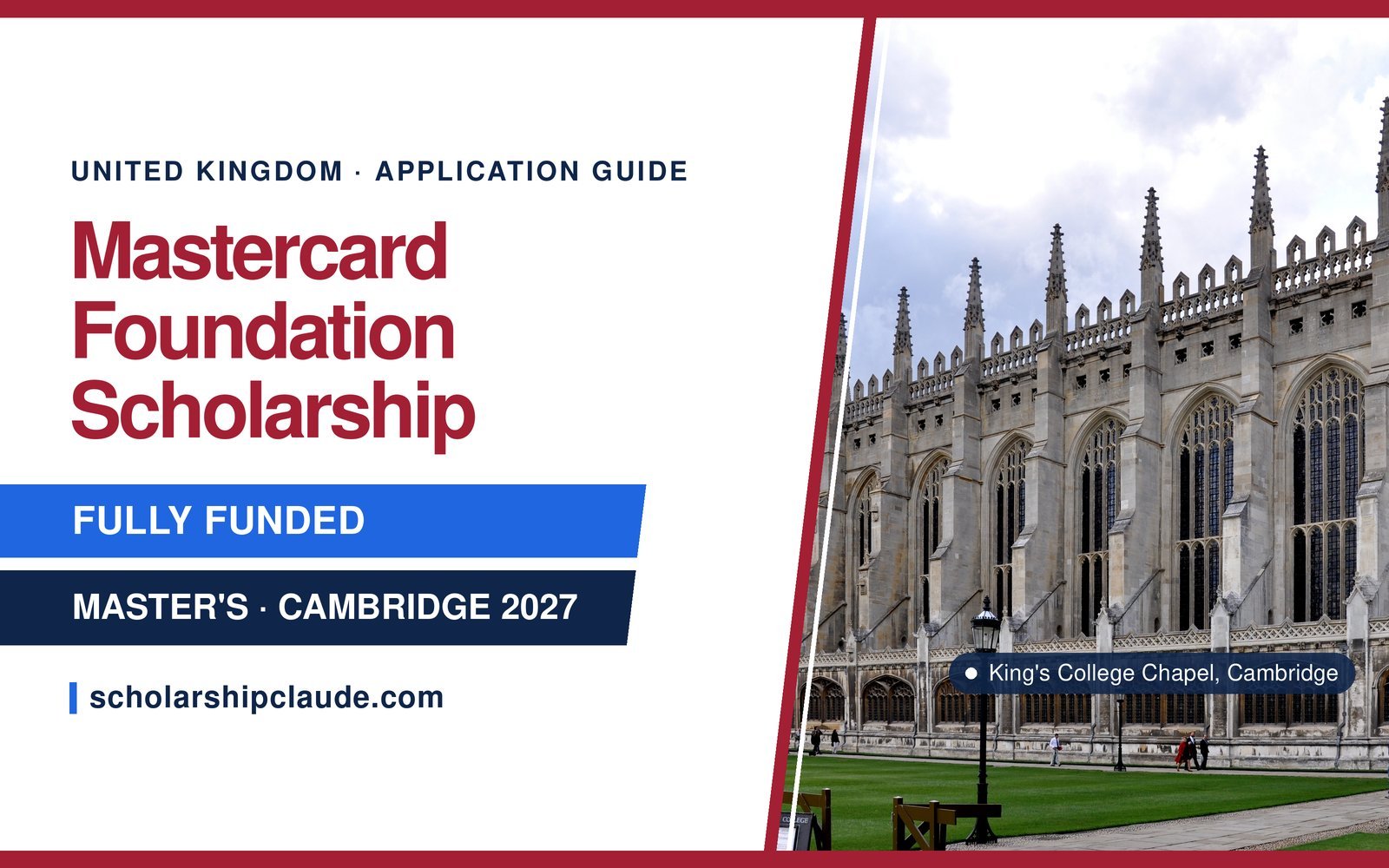
A Mastercard Scholarship application to the University of Cambridge can give a talented young African a fully funded one-year Master’s in the United Kingdom. The Mastercard Foundation Scholars Program pays the course fee, a monthly living allowance, a return flight, the student visa and health surcharge, and a laptop. This guide explains who can apply, how the scholarship statement works, and the December 2026 and January 2027 deadlines. The key facts are also on our Mastercard Foundation Scholarship 2027 listing.
We checked every detail on 29 October 2026 against the official Mastercard Foundation Scholars Program website at Cambridge and the University’s postgraduate funding page. Where Cambridge does not give a detail, we say so.
Mastercard Foundation Scholarship at a glance
| University | University of Cambridge, United Kingdom |
| Level | Full-time Master’s courses (9 to 12 months) starting in 2027/2028 |
| Who can apply | Citizens of African countries who live in Africa |
| Funding | Fully funded: course fee, monthly living allowance, flights, visa and IHS, laptop |
| Themes | Climate resilience and sustainability |
| Applications open | 11 September 2026 |
| Fee waiver form | By 20 November 2026 (if not automatic) |
| Deadline | 8 December 2026 or 6 January 2027, 23:59 GMT, depending on the course |
| Offers | March and April 2027 |
What the scholarship covers
Cambridge says the programme aims to cover everything you need to study and get the most out of your time in Cambridge. The package includes:
- Course fee for your Master’s.
- Monthly living allowance (maintenance). The website does not publish the exact amount.
- Travel: a return flight, with transport from the airport to Cambridge arranged by the programme.
- Student visa and Immigration Health Surcharge (IHS).
- A laptop.
Scholars also get a week-long orientation, a mentoring scheme, a leadership development programme for African students run with the Cambridge Institute for Sustainability Leadership, a three-day social ventures course at the King’s College Entrepreneurship Lab, and guidance on life after the Master’s. The programme can also support a three- to six-month placement with a leading Africa-based organisation. It cannot cover travel for a spouse or children, because the UK no longer lets students on one-year Master’s courses bring dependants.
Who can apply
You must meet all of these conditions:
- you hold a Bachelor’s degree;
- you meet the academic entry requirements of your course. Some courses ask for the equivalent of a UK first-class degree, others an upper second;
- you are a citizen of an African country and live in Africa. Temporary stays abroad for study or work are fine, and refugees and internally displaced people are exempt from the residence rule;
- you apply for an eligible full-time Master’s, which means any course except the MBA, Master of Accountancy, Master of Corporate Law and Master of Finance; and
- you show a commitment to giving back to your community, country or Africa, and to sustainability and climate resilience.
There is no upper age limit, and your Bachelor’s degree can be from a university outside Africa as long as you live in Africa or are only away to study. Dual African and UK passport holders are not eligible, and the programme does not fund PhDs. Women, refugees, internally displaced people and people with disabilities are particularly encouraged to apply.
Mastercard Scholarship application deadlines for 2027
Cambridge has two main funding deadlines for 2027/2028 entry: Tuesday 8 December 2026 and Wednesday 6 January 2027. Your course page in the Postgraduate Course Directory shows which one applies. Your full application, including references, must be in by 23:59 GMT on that date. This funding deadline is earlier than the normal course deadline, so do not work towards the later date.
| When | What happens |
|---|---|
| 11 September 2026 | Applications opened |
| 20 November 2026 | Last day to send the application fee waiver form (if needed) |
| 8 December 2026 or 6 January 2027 | Course funding deadline, 23:59 GMT |
| December 2026 to February 2027 | Departments select applicants |
| Late February / early March 2027 | Mastercard Foundation Scholars Program selection |
| March / April 2027 | Scholarships offered |
| 31 July 2027 | Outstanding documents (usually IELTS) due |
Documents you need
- your Cambridge course application with the supporting documents your course asks for (check its page in the Course Directory);
- references, which must arrive by the funding deadline;
- a scholarship statement covering your career and education history, leadership potential, how the scholarship will help you reach your goals, and how you hope to contribute to sustainable futures in Africa;
- if your country is not on the automatic list, the application fee waiver form with copies of your transcript and passport; and
- later, your English test results. Most courses ask for IELTS 7.0 or 7.5 overall, but you can apply without them.
For help, see our guides to writing a winning statement of purpose and getting strong recommendation letters.
How to apply step by step
- Pick your course in the Postgraduate Course Directory. Check its entry requirements, funding deadline and documents, and use the international qualifications checker.
- Start your application by clicking ‘Apply Now’ on the course page and creating an account.
- Sort out the fee. Applicants from Angola, Benin, Burkina Faso, Burundi, Central African Republic, Chad, Comoros, DR Congo, Djibouti, Eritrea, Ethiopia, Gambia, Guinea, Guinea-Bissau, Lesotho, Liberia, Madagascar, Malawi, Mali, Mauritania, Mozambique, Niger, Rwanda, Senegal, Sierra Leone, Somalia, South Sudan, Sudan, Tanzania, Togo, Uganda and Zambia get the fee waived automatically. Everyone else sends the waiver form by 20 November 2026.
- Opt in for funding and select the Mastercard Foundation Scholars Program, which appears if you meet the course entry requirements.
- Write your scholarship statement and choose one of the 31 Colleges.
- Submit everything, including references, by your course funding deadline.
How selection works
Selection happens in two stages. First, your department decides on your course application on a rolling basis between December and February; your scholarship statement is not used at this stage, and some departments interview shortlisted candidates. Then the programme team reviews applicants who hold a course offer and chooses scholars using both the course application and the scholarship statement. Offer letters go out in late March or early April, and you normally have 10 working days to accept.
Tips for a strong application
- Apply early. Ask for the fee waiver well before 20 November so it does not hold up your application.
- Get the course application right first. You need a course offer before the scholarship team even reads your statement.
- Link your plans to Africa. Show concretely how you will give back and how your course connects to sustainability or climate resilience.
- Prove leadership with examples. Name projects, roles and results rather than listing qualities.
- Brief your referees early. References count towards a complete application, and late references can cost you the deadline.
Common mistakes to avoid
- Working to the wrong deadline. The funding deadline comes before the general course deadline.
- Choosing an excluded course. MBA, MAcc, MCL and MFin applicants cannot be funded.
- Applying to several courses for free. The fee waiver covers only one course.
- Paying an agent. Cambridge warns of scams offering paid help with applications; you never need to pay anyone.
Comparing options? See the Gates Cambridge Scholarship, the Cambridge Trust Scholarships, and our round-up of scholarships in the UK.
Frequently asked questions
Is the Mastercard Foundation Scholarship at Cambridge fully funded?
Yes. It covers the course fee, a monthly living allowance, a return flight, the visa and Immigration Health Surcharge, and a laptop.
What is the deadline?
Your course funding deadline: 8 December 2026 or 6 January 2027, at 23:59 GMT. Check your course page.
Can I apply if I studied outside Africa?
Yes, as long as you are an African citizen living in Africa or only temporarily away for study or work.
Is there an age limit?
No. Cambridge says there is no upper age limit.
Can I use it for a PhD?
No. It funds full-time Master’s courses only.
Do I need IELTS to apply?
No. You can apply without it and, if successful, submit your results by 31 July 2027. Most courses ask for 7.0 or 7.5.
Can I bring my family?
The programme cannot pay for a spouse or children, because one-year Master’s students can no longer bring dependants on their visa.
When will I hear back?
Scholarship offers are sent in March and April 2027.
Where to apply
Read the official How to apply page, the eligibility criteria and the Cambridge postgraduate funding deadlines before you start. Our Mastercard Foundation Scholarship listing keeps the key facts in one place.
Scholarships with the nearest deadlines
| Scholarship | Funding | Stipend | Deadline |
|---|---|---|---|
| US–Pakistan Knowledge Corridor PhD Scholarships 2027 | Fully funded | Not stated on HEC's programme page (see the HEC advertisement) | 30 Oct 2026 |
| Honjo International Scholarship 2027 in Japan | Partial | 230,000 yen a month (degree of 1 to 2 years), 210,000 yen a month (3-year degree) or 180,000 yen a month (degree longer than 3 years) | 31 Oct 2026 |
| European Parliament Schuman Traineeships 2027 | Partial | Monthly grant paid; amount not stated on the official source | 31 Oct 2026 |
| University of Melbourne Graduate Research Scholarships 2027 in Australia | Fully funded | 41,100 Australian dollars a year (2027 rate), plus a full fee offset | 31 Oct 2026 (expected) |
| Australian Government RTP Scholarships 2027 in Australia | Fully funded | 2027 full-time RTP stipend: base rate 35,550 Australian dollars a year, maximum 55,537 Australian dollars a year | 31 Oct 2026 (expected) |
| DAAD EPOS Scholarship 2027/28 in Germany | Fully funded | 992 euros a month for graduates; 1,400 euros a month for doctoral candidates | 31 Oct 2026 (expected) |
| One Young World Leading Scholarship 2026 in South Africa | Partial | See the scholarship page | 31 Oct 2026 |
| UNU Junior Fellows Internship 2027 in Tokyo, Japan | Partial | Monthly stipend; amount not stated on the official source | 1 Nov 2026 |
| Open Doors Russian Scholarship Project 2026–27 in Russia | Partial | Tuition-free study; a monthly allowance is possible only with grant support for Russian-taught programmes | 1 Nov 2026 |
| Max Planck Computer Science Summer Internships 2027 in Germany | Fully funded | Monthly stipend (amount not stated on the official source) | 1 Nov 2026 |
This list updates itself from our scholarships page. Stipend figures are shown where the provider publishes them. See all scholarships.