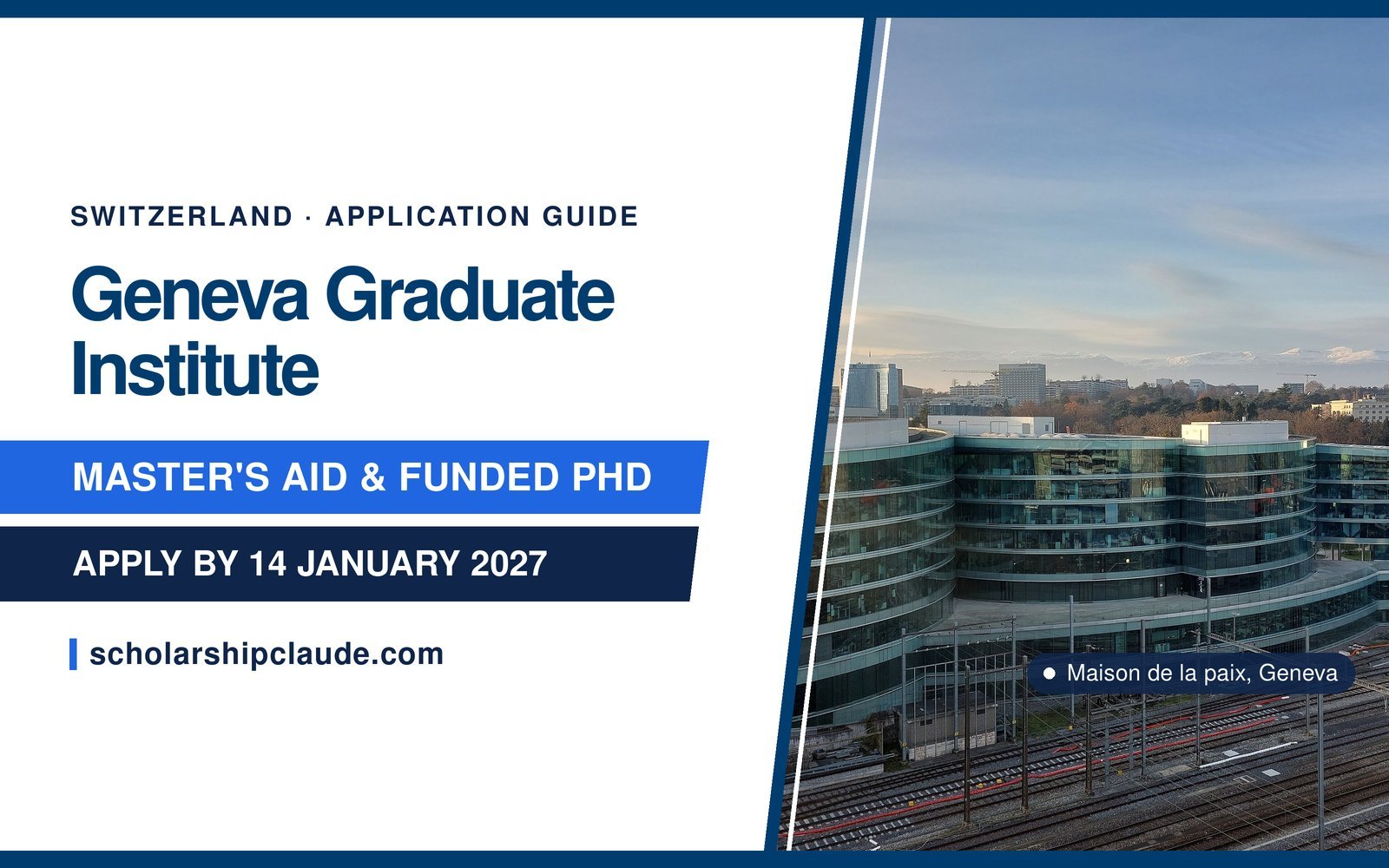
Your Geneva Graduate Institute application is also your scholarship application: Master’s applicants request financial aid in the same online form, and every PhD offer already comes with a four-year funding package. The deadline for September 2027 entry is Thursday 14 January 2027, so you have about ten weeks. This guide covers the funding, the documents and how to make your file stronger. The key facts are also on our Geneva Graduate Institute Scholarship 2027 listing.
We checked every detail on 30 October 2026 against the Institute’s admissions page, its fees and financial aid page, its programmes page, and the application and financial aid checklists published in September 2026.
Geneva Graduate Institute scholarships at a glance
| Institution | Geneva Graduate Institute, Geneva, Switzerland |
| Levels | Master’s and PhD, starting September 2027 |
| Who can apply | Any nationality (about 85% of students are international) |
| Master’s aid | Full or partial scholarship up to CHF 20,000 for two years and/or tuition reduction |
| PhD funding | Four-year package with every offer; Institute package CHF 20,000 a year |
| Deadline | 14 January 2027, midnight Geneva time |
| References | Uploaded by 22 January 2027 |
| Application fee | CHF 100 (no waivers) |
What the funding covers
Master’s financial aid
The Financial Aid Committee awards a full or partial scholarship (maximum CHF 20,000) for two years, a tuition reduction, or both. It decides based on your documented financial need and the excellence of your application, within the funds available. About 10 to 15 per cent of new Master’s students receive aid each year, and aid is renewable for the second year if your need remains. Some awards are sponsored by donors, but there is no separate application: the committee matches recipients with sponsors, and the Institute asks applicants not to contact donors directly.
PhD support package
All PhD admission offers come with four years of support, either from the Institute or from an approved external funder. The Institute’s package pays CHF 20,000 a year, as CHF 2,000 a month from September to June. The admissions FAQ says it supports six students per department, 30 in total each year. PhD applicants should not disclose financial information on their application.
| Cost | Amount (official figures) |
|---|---|
| Master’s tuition (applying from abroad) | CHF 8,000 a year |
| Master’s tuition (Swiss residents) | CHF 5,000 a year |
| PhD tuition | CHF 3,000 in year 1, then CHF 1,000 a year |
| Living costs | At least CHF 2,000 a month |
| Pre-registration fee if admitted | CHF 1,000, deducted from the first tuition invoice |
Because the Master’s scholarship is capped at CHF 20,000 and living costs alone are at least CHF 2,000 a month, many students will need other funds as well. Plan your budget carefully.
Programmes you can choose
The interdisciplinary Master in International and Development Studies (MINT) combines a common core with a specialisation in one of seven broader themes. The five disciplinary programmes, offered at Master’s and PhD level, are Anthropology and Sociology, International Economics, International History and Politics, International Law, and International Relations/Political Science. PhD programmes require a four-year commitment, with the first three semesters in residence, a preliminary thesis presentation at the end of the third semester and the defence at the end of the eighth.
Who can apply
- Any nationality. The same process applies to everyone.
- English at C1. TOEFL iBT 100, IELTS 7.0 or Cambridge C1 Advanced/C2 Proficiency with 185+. Duolingo and Linguaskill are not accepted. Native speakers and those with at least one year of full-time English-medium university study are exempt.
- No French needed. Students below B1 take a three-week intensive French course before the first semester.
- One application only. You can submit one MA or PhD application per cycle.
- Master’s aid only in January. If you do not ask for aid in this round, you cannot ask later.
Geneva Graduate Institute application deadlines for 2027
| Date | What happens |
|---|---|
| 1 October 2026 | Applications opened for September 2027 |
| 14 January 2027, midnight Geneva time | Deadline for all MA and PhD programmes and for Master’s financial aid |
| 22 January 2027 | Recommendation letters due |
| To be announced | Possible late round for Master’s programmes (CHF 200, no aid) |
| March 2027 | Housing applications open for newly admitted students |
| September 2027 | Programmes start |
Note that some financial aid paragraphs on the official page still say ’15 January’, while the dated deadline table says 14 January 2027. Submit by 14 January to be safe. Midnight Geneva time is 04:00 PKT on 15 January.
Documents you need
- a motivation letter in English or French (800 words maximum) on why you want to study at the Institute;
- a CV (no set format; two pages recommended);
- official transcripts with an explanation of the grading scale, and copies of all degree diplomas (certified English translation if not in English, French, German, Italian or Spanish);
- an English certificate if needed, and a passport or ID copy;
- names and professional emails of two or three referees;
- for PhD: your Master’s dissertation and a thesis proposal; PhD Economics also needs the GRE.
Master’s applicants requesting aid also upload a cover letter explaining financial need (about one page is fine), proof of their own income and their parents’ income. Parents’ income is mandatory if you are under 26. Our recommendation letters guide and motivation letter template will help.
How to apply step by step
- Pick one programme from the MINT or the disciplinary Master’s and PhD programmes.
- Book your English test if you do not have a result yet; you can apply with a confirmed test date.
- Draft your motivation letter and CV, and contact your referees early.
- Gather financial documents if you want Master’s aid.
- Submit online and pay CHF 100 before midnight Geneva time on 14 January 2027.
- Check your referees have uploaded their letters by 22 January 2027.
How applications are judged
Committees look for academic excellence (transcripts and references), motivation as shown in your letter, and evidence of curiosity, criticality, the ability to take multiple perspectives, accountability and excellent writing. There is no GPA cut-off. Admission is need-blind, and financial aid is decided separately by the Financial Aid Committee. For PhD funding, acceptance rates in 2026–27 ranged from 4% to 19% across programmes.
Tips for a stronger application
- Write a specific cover letter on need. The checklist says it is very important: explain your background, your family’s finances and how you will cover your studies.
- Show fit. Link your motivation letter to the programme’s themes and faculty.
- Do not wait. The Institute advises applying early to avoid technical problems.
Comparing Swiss options? See the Swiss Government Excellence Scholarships, our Swiss Government Excellence guide, the ETH Zurich Excellence Scholarship and our list of scholarships in Switzerland.
Frequently asked questions
What is the Geneva Graduate Institute scholarship deadline for 2027?
14 January 2027 at midnight Geneva time, for all MA and PhD programmes. References are due by 22 January 2027.
How much is the Master’s scholarship?
A full or partial scholarship of up to CHF 20,000 for two years, a tuition reduction, or both.
Do all PhD students get funding?
Yes. Every PhD offer comes with a four-year package from the Institute or an approved external funder.
Can I apply for financial aid after admission?
No. Master’s applicants must request aid in the January round.
Is there an application fee waiver?
No. The CHF 100 fee cannot be waived.
Do I need French?
No. French is not an admission requirement.
Is Duolingo accepted?
No. Use TOEFL, IELTS or Cambridge C1/C2, unless you are exempt.
Does asking for aid affect admission?
No. Admission is need-blind.
Where to apply
Start on the official admissions page, read the fees and financial aid page and browse the Master and PhD programmes. Our Geneva Graduate Institute Scholarship listing keeps the key facts in one place.
Scholarships with the nearest deadlines
| Scholarship | Funding | Stipend | Deadline |
|---|---|---|---|
| US–Pakistan Knowledge Corridor PhD Scholarships 2027 | Fully funded | Not stated on HEC's programme page (see the HEC advertisement) | 30 Oct 2026 |
| Honjo International Scholarship 2027 in Japan | Partial | 230,000 yen a month (degree of 1 to 2 years), 210,000 yen a month (3-year degree) or 180,000 yen a month (degree longer than 3 years) | 31 Oct 2026 |
| European Parliament Schuman Traineeships 2027 | Partial | Monthly grant paid; amount not stated on the official source | 31 Oct 2026 |
| University of Melbourne Graduate Research Scholarships 2027 in Australia | Fully funded | 41,100 Australian dollars a year (2027 rate), plus a full fee offset | 31 Oct 2026 (expected) |
| Australian Government RTP Scholarships 2027 in Australia | Fully funded | 2027 full-time RTP stipend: base rate 35,550 Australian dollars a year, maximum 55,537 Australian dollars a year | 31 Oct 2026 (expected) |
| DAAD EPOS Scholarship 2027/28 in Germany | Fully funded | 992 euros a month for graduates; 1,400 euros a month for doctoral candidates | 31 Oct 2026 (expected) |
| One Young World Leading Scholarship 2026 in South Africa | Partial | See the scholarship page | 31 Oct 2026 |
| UNU Junior Fellows Internship 2027 in Tokyo, Japan | Partial | Monthly stipend; amount not stated on the official source | 1 Nov 2026 |
| Open Doors Russian Scholarship Project 2026–27 in Russia | Partial | Tuition-free study; a monthly allowance is possible only with grant support for Russian-taught programmes | 1 Nov 2026 |
| Max Planck Computer Science Summer Internships 2027 in Germany | Fully funded | Monthly stipend (amount not stated on the official source) | 1 Nov 2026 |
This list updates itself from our scholarships page. Stipend figures are shown where the provider publishes them. See all scholarships.