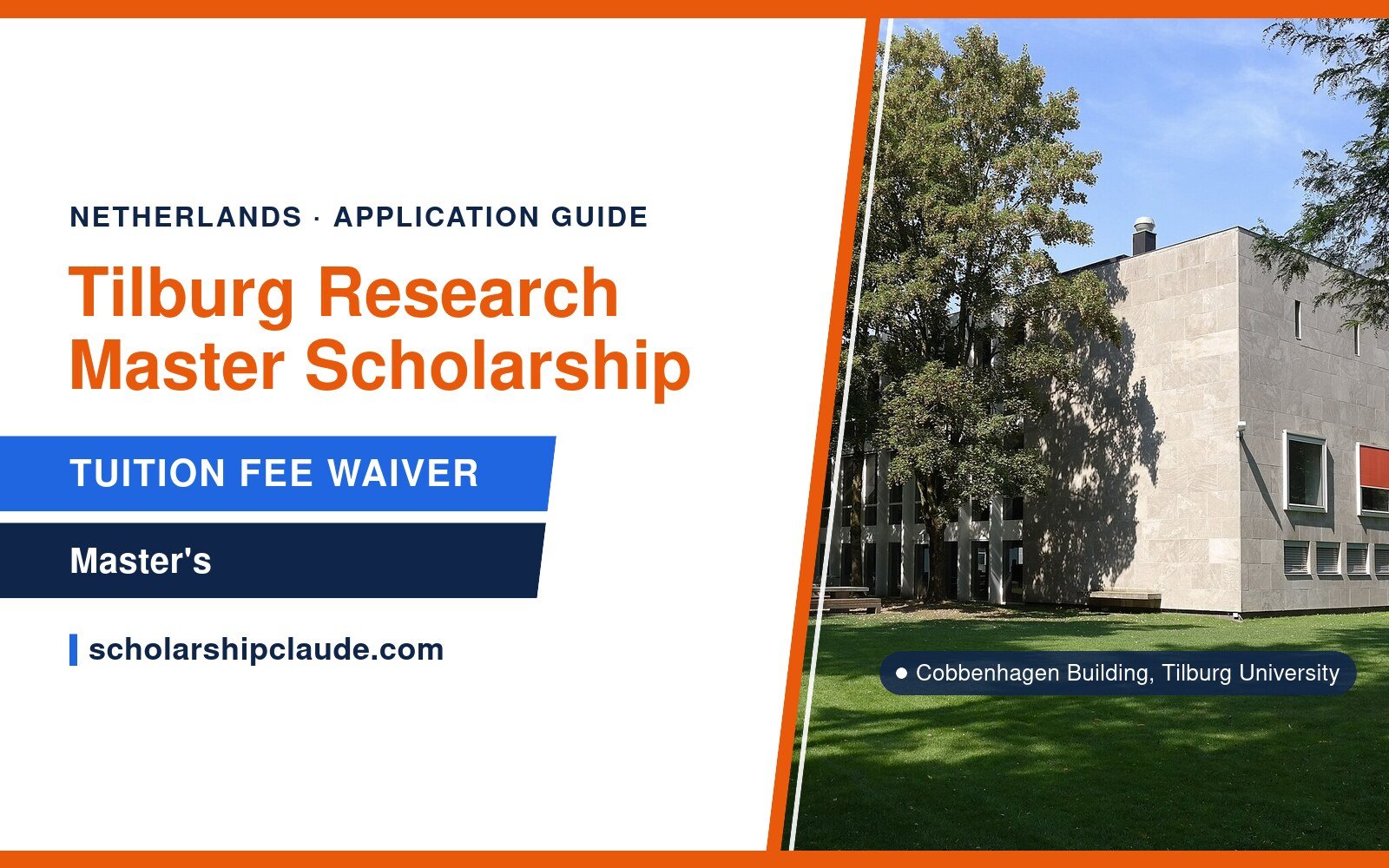
Tilburg University’s Research Master Scholarship is a tuition fee waiver for outstanding non-EEA students on its two-year Research Master’s programmes. Winners pay the statutory fee of €2,771 a year instead of €20,500. The closing date is 1 March 2027 or 1 April 2027, depending on the programme.
This guide was checked on 15 October 2026 against the official Tilburg University Research Master Scholarship page.
Tilburg Research Master Scholarship at a glance
| University | Tilburg University, Netherlands |
|---|---|
| Type | Tuition fee waiver |
| What you pay | €2,771 a year (2027–28 statutory fee, preliminary) instead of €20,500 |
| Length | The full two-year programme |
| Living costs | Not stated on the official source |
| Number | Up to three per programme or cohort |
| Closing date | 1 March 2027 (Social and Behavioral Sciences; Psychology) or 1 April 2027 (Communication, Cognition and Digital Culture) |
| Start | September 2027 |
What the waiver covers
Non-EEA students normally pay the institutional fee of €20,500 a year. With the waiver you pay the statutory fee instead, which is €2,771 for 2027–28. Tilburg says this figure is preliminary and may change. The waiver covers the full two-year programme. It does not include a living allowance.
Which programmes take part
| Programme | Waivers | Closing date |
|---|---|---|
| Social and Behavioral Sciences | Up to three per programme | 1 March 2027 |
| Psychology: Individual Differences and Assessment | Up to three per programme | 1 March 2027 |
| Communication, Cognition and Digital Culture | Up to three per cohort | 1 April 2027 |
The Research Master in Economics does not use this waiver. Tilburg refers those students to its CentER and Koopmans scholarships.
Who can apply
Social and Behavioral Sciences, and Psychology
- Non-EEA students who pay the institutional fee, including students with a Dutch bachelor’s degree.
- Conditionally or fully admitted by the Admissions Board.
Communication, Cognition and Digital Culture
- Outstanding non-EEA students doing their first master’s in the Netherlands.
- Exceptional students who already hold a Dutch master’s, of any nationality.
- September start only.
How to apply
Social and Behavioral Sciences, and Psychology
- Apply for the programme in Studielink by 1 March 2027.
- You are registered for the waiver selection automatically.
- Selection and notification follow in May or June.
- If selected, confirm within two weeks.
Communication, Cognition and Digital Culture
- Send a complete programme application, with your motivation letter, by 1 April 2027.
- Allow at least six weeks to receive a conditional admission letter.
- Shortlisted students are invited in the first half of May and interviewed in the first half of June.
- Results are sent by email in the third week of June.
- Return the signed award letter by 1 July.
Documents you need
Required
- A complete programme application
- Proof of your prior education and English, as set by the programme’s admission rules
Conditional
- A motivation letter, for Communication, Cognition and Digital Culture
- A signed award letter, if you are selected for Communication, Cognition and Digital Culture
Our motivation letter template can help you explain your academic motivation clearly.
How winners are chosen
- Social and Behavioral Sciences and Psychology: prior education, research experience and study progress. If more than three students are eligible, a draw decides. If a winner declines, the waiver goes to the next candidate.
- Communication, Cognition and Digital Culture: eligibility, academic quality and potential, fit with the programme, and the motivation in your letter.
Keeping the waiver
In Social and Behavioral Sciences, a second-year waiver is given to students who held one in year one and met the study progress rules. In Communication, Cognition and Digital Culture, students who take longer than two years lose the waiver for the extra time.
What a Research Master is
A Research Master is a two-year master’s degree that trains students to do academic research. Compared with a one-year taught master’s, it includes more research methods, more independent work and a larger thesis, and it is often the first step towards a PhD. Tilburg’s Research Master’s programmes in Social and Behavioral Sciences, Psychology: Individual Differences and Assessment, and Communication, Cognition and Digital Culture follow this model.
Because these programmes are selective and research-focused, the waiver goes to students who show strong academic results and clear research potential, not only good grades.
How much the waiver saves you
For a non-EEA student, the institutional fee is €20,500 a year. With the waiver you pay the statutory fee of €2,771 instead, a saving of €17,729 a year, or €35,458 over the two years. The €2,771 figure for 2027–28 is preliminary, so the final saving may differ slightly.
The waiver does not include a living allowance. Plan how you will pay rent, food, insurance and travel for two years, and remember that non-EEA students also need to show enough money for a Dutch residence permit.
The Social and Behavioral Sciences and Psychology route in detail
For these programmes, the process is mostly automatic:
- Apply for the programme in Studielink, the Dutch national application system, by 1 March 2027. This registers you for the waiver selection.
- Your application must lead to conditional or full admission by the Admissions Board, since only admitted students are eligible.
- The school selects up to three first-year waiver holders per programme, based on prior education, research experience and study progress.
- If more than three students are equally eligible, a draw decides.
- Selection and notification happen in May or June. If you are selected, confirm within two weeks.
- If a winner declines, the waiver is offered to the next candidate in a ranking recap by June.
A second-year waiver is available to students who held one in the first year and met the study progress criteria. In exceptional cases, an extension may be granted in Social and Behavioral Sciences.
The Communication, Cognition and Digital Culture route in detail
This programme runs its own selection with interviews:
- Check that you are eligible: an outstanding non-EEA student doing a first master’s in the Netherlands, or an exceptional student of any nationality with an earlier Dutch master’s.
- Submit a complete programme application, including your motivation letter, by 1 April 2027. Only September starts qualify.
- Allow at least six weeks to receive a conditional admission letter.
- Invitations to interview are sent in the first half of May, and interviews take place in the first half of June.
- Results are emailed in the third week of June.
- If selected, return the signed award letter by 1 July.
The selection looks at general eligibility, academic quality and potential, fit with the programme, and the academic and personal motivation in your letter. If your studies take longer than two years, you cannot claim the waiver for the extra time.
Is a Research Master right for you?
A Research Master is a strong choice if you enjoy research and want to keep the door open to a PhD. It may not suit you if you want a short degree to move straight into a non-research job. Ask yourself:
- Did you enjoy your bachelor’s thesis or research projects, including the slow parts such as data cleaning and reading papers?
- Are you comfortable with statistics and research methods, or ready to learn them in depth?
- Can you commit to two years of study, rather than the one year of many taught master’s?
- Do you have a research question you would like to explore?
If most answers are yes, the Research Master and the waiver are worth applying for. If not, a one-year master’s with its own scholarships may suit you better.
Building research experience before you apply
Selection in Social and Behavioral Sciences and Psychology looks at research experience, and Communication, Cognition and Digital Culture looks at academic potential and motivation. You can strengthen both in the months before the closing date:
- Work as a research assistant for a professor at your current university, even for a few hours a week.
- Turn your thesis into a short paper or poster and present it at a student conference or departmental seminar.
- Take a methods course, such as statistics, survey design or a programming language used for data analysis.
- Read recent work by Tilburg researchers in your area, so you can name it in your letter and interview.
Even small, concrete steps give you specific evidence to describe, which is more convincing than general claims of interest.
Preparing your documents
The waiver itself needs few separate documents, because it is decided through your programme application. Prepare what your programme’s admission page asks for, which usually means transcripts, your diploma or proof that you will graduate, English test results, a CV and references. Order official transcripts early and ask referees at least a month before you submit. For Communication, Cognition and Digital Culture, the motivation letter is part of the application and carries real weight in the selection.
Planning your budget for two years
Even with the waiver, you pay the statutory fee and all living costs for two years. Build a simple plan: list your expected monthly costs for rent, food, insurance, transport and study materials, multiply by 24 months, and add the statutory fee for both years. Then list your savings, family support and any other awards. If there is a gap, look for additional funding before you accept your place, and check the residence permit funds requirement for non-EEA students.
Writing a research-focused motivation letter
For a Research Master, your letter should read like the start of a research career, not like a general application. In about one to one and a half pages:
- Your research interest: name a question or topic you want to explore, and why it matters.
- Your research experience: describe your thesis, research assistant work or projects. Mention methods you used, such as surveys, experiments, interviews or statistical analysis.
- Your methods training: list relevant courses in statistics, research design or programming.
- Your fit with Tilburg: name faculty members or research groups whose work connects to yours, and the parts of the curriculum that interest you.
- Your plans: explain whether you aim for a PhD or a research-based career, and how the programme prepares you.
Specific details persuade more than enthusiasm. Our motivation letter template and our guide on the difference between a personal statement, SOP and motivation letter can help.
Preparing for the interview
Communication, Cognition and Digital Culture applicants who reach the shortlist are interviewed in the first half of June. Prepare to:
- Explain your research interest in two minutes, in plain language.
- Discuss your thesis or main project: the question, method, results and what you would do differently.
- Say why this programme, and not a one-year master’s, is right for you.
- Mention which researchers at Tilburg you would like to learn from.
- Ask one or two thoughtful questions about the programme.
Our scholarship interview tips cover common questions and online interview set-up.
A suggested timeline
| When | What to do |
|---|---|
| November to December 2026 | Choose your programme; check admission rules; book an English test if needed |
| January 2027 | Write your motivation letter; collect transcripts and references |
| By mid-February 2027 | Submit your application, leaving six weeks for a conditional admission letter |
| 1 March 2027 | Closing date: Social and Behavioral Sciences and Psychology |
| 1 April 2027 | Closing date: Communication, Cognition and Digital Culture |
| May to June 2027 | Selection, interviews and results |
| 1 July 2027 | Return the signed award letter (Communication, Cognition and Digital Culture) |
Checklist before you submit
- You are non-EEA and pay the institutional fee, or you meet the Communication, Cognition and Digital Culture rule for earlier Dutch master’s holders.
- You have chosen one of the three participating programmes.
- Your application is complete, with transcripts and English proof.
- Your motivation letter focuses on research.
- You have applied early enough to receive a conditional admission letter.
- You have a plan for living costs and residence permit funds.
Common mistakes to avoid
- Applying for the Research Master in Economics and expecting this waiver; it uses separate scholarships.
- Applying for a February start in Communication, Cognition and Digital Culture; only September starts qualify.
- Submitting close to the deadline and missing the six weeks needed for a conditional admission letter.
- Forgetting that the waiver covers tuition only.
- Missing the two-week confirmation window or the 1 July award letter date.
After you are selected
- Confirm your acceptance on time: within two weeks in Social and Behavioral Sciences and Psychology, or by returning the signed award letter by 1 July in Communication, Cognition and Digital Culture.
- Complete your admission conditions, such as sending your final diploma.
- As a non-EEA student, start your residence permit process and show the required funds.
- Arrange housing in Tilburg early, since the waiver does not cover accommodation.
- Plan your study progress from the first semester. In Social and Behavioral Sciences, the second-year waiver depends on meeting the progress criteria.
Questions to ask Tilburg before you apply
- Is the statutory fee for 2027–28 confirmed yet, or still preliminary?
- Which documents does your programme need for conditional admission, and how long does the review take?
- For Social and Behavioral Sciences and Psychology, how is research experience weighed against grades?
- For Communication, Cognition and Digital Culture, will the interview be online or on campus?
Contact the admissions office of your programme. Clear answers help you plan the months between applying and the start of the programme.
Other options in the Netherlands
If you are not selected, or need help with living costs, look at the NL Scholarship, the Leiden University Excellence Scholarship, the Amsterdam Merit Scholarship and the Maastricht NL-High Potential Scholarship. Our guide to scholarships in the Netherlands compares them.
Frequently asked questions
Is the Tilburg Research Master Scholarship fully funded?
No. It lowers your tuition from €20,500 to €2,771 a year. You pay your own living costs.
Do I need to apply separately for the scholarship?
Not for Social and Behavioral Sciences or Psychology: Studielink applicants are considered automatically. For Communication, Cognition and Digital Culture, your complete programme application and motivation letter are used.
Can EU students apply?
The waiver is mainly for non-EEA students who pay the institutional fee. In Communication, Cognition and Digital Culture, exceptional students with an earlier Dutch master’s can apply whatever their nationality.
What are the closing dates?
1 March 2027 for Social and Behavioral Sciences and Psychology, and 1 April 2027 for Communication, Cognition and Digital Culture.
How many waivers are there?
Up to three per programme for first-year students in Social and Behavioral Sciences and Psychology, and up to three per cohort in Communication, Cognition and Digital Culture.
What happens if more students qualify than there are waivers?
In Social and Behavioral Sciences and Psychology, a draw decides among equally eligible students, and a ranking recap offers declined waivers to the next candidates.
Does the waiver cover a third year if I need more time?
In Communication, Cognition and Digital Culture, students who take longer than two years can no longer claim the waiver for the extra time. In Social and Behavioral Sciences, an extension may be granted in exceptional cases.
Do I need to apply separately for the waiver?
Not in Social and Behavioral Sciences or Psychology: applying in Studielink registers you automatically. In Communication, Cognition and Digital Culture, your complete programme application and motivation letter are used for the waiver selection.
Where to apply
Read the full rules on the official Tilburg University Research Master Scholarship page. Our Tilburg scholarship page keeps the key facts in one place, and our guide to scholarships in the Netherlands lists other options.
Scholarships with the nearest deadlines
| Scholarship | Funding | Stipend | Deadline |
|---|---|---|---|
| US–Pakistan Knowledge Corridor PhD Scholarships 2027 | Fully funded | Not stated on HEC's programme page (see the HEC advertisement) | 30 Oct 2026 |
| Honjo International Scholarship 2027 in Japan | Partial | 230,000 yen a month (degree of 1 to 2 years), 210,000 yen a month (3-year degree) or 180,000 yen a month (degree longer than 3 years) | 31 Oct 2026 |
| European Parliament Schuman Traineeships 2027 | Partial | Monthly grant paid; amount not stated on the official source | 31 Oct 2026 |
| University of Melbourne Graduate Research Scholarships 2027 in Australia | Fully funded | 41,100 Australian dollars a year (2027 rate), plus a full fee offset | 31 Oct 2026 (expected) |
| Australian Government RTP Scholarships 2027 in Australia | Fully funded | 2027 full-time RTP stipend: base rate 35,550 Australian dollars a year, maximum 55,537 Australian dollars a year | 31 Oct 2026 (expected) |
| DAAD EPOS Scholarship 2027/28 in Germany | Fully funded | 992 euros a month for graduates; 1,400 euros a month for doctoral candidates | 31 Oct 2026 (expected) |
| One Young World Leading Scholarship 2026 in South Africa | Partial | See the scholarship page | 31 Oct 2026 |
| UNU Junior Fellows Internship 2027 in Tokyo, Japan | Partial | Monthly stipend; amount not stated on the official source | 1 Nov 2026 |
| Open Doors Russian Scholarship Project 2026–27 in Russia | Partial | Tuition-free study; a monthly allowance is possible only with grant support for Russian-taught programmes | 1 Nov 2026 |
| Max Planck Computer Science Summer Internships 2027 in Germany | Fully funded | Monthly stipend (amount not stated on the official source) | 1 Nov 2026 |
This list updates itself from our scholarships page. Stipend figures are shown where the provider publishes them. See all scholarships.