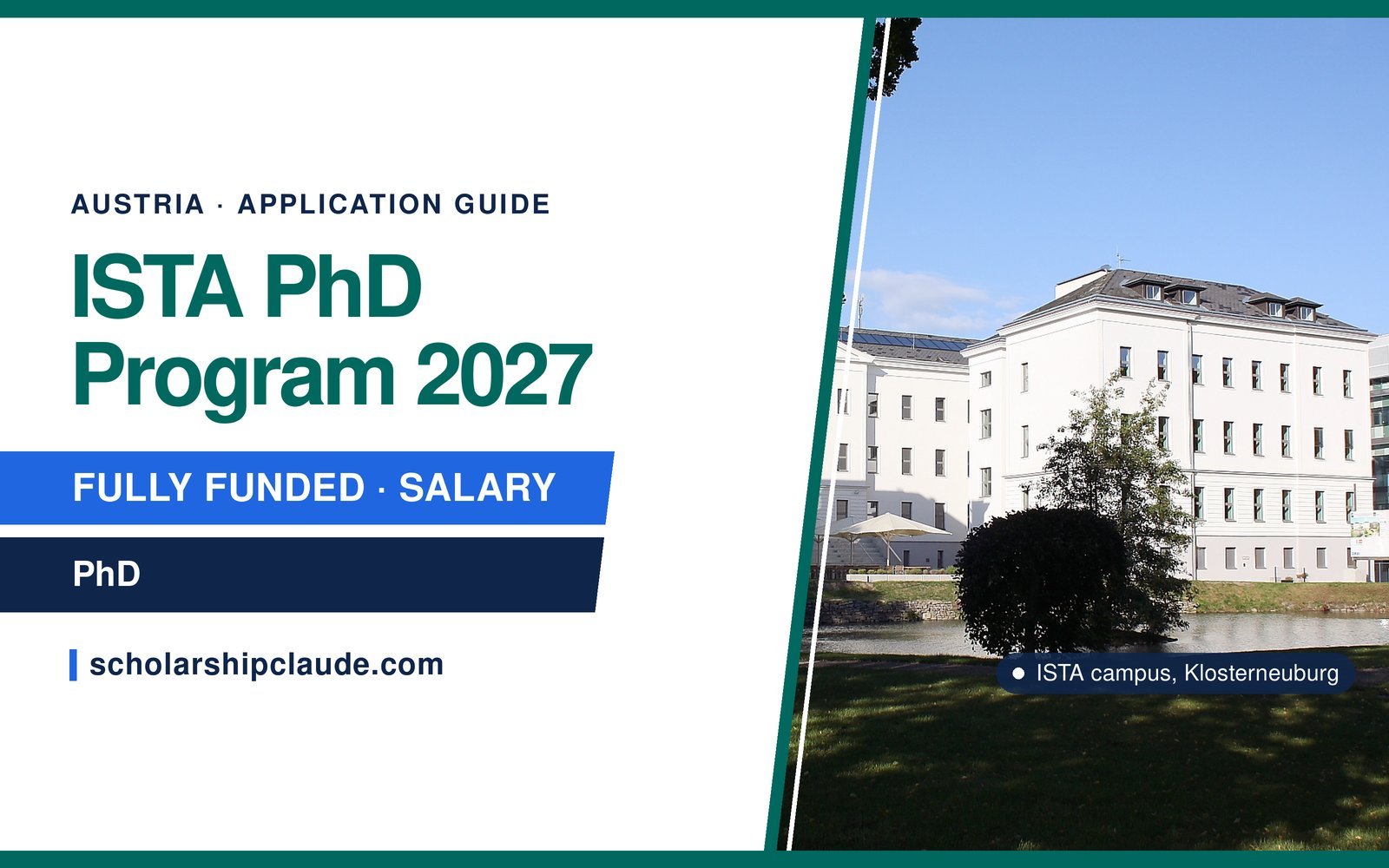
An ISTA PhD application is one online file that puts you in the running for a fully funded, salaried doctorate at the Institute of Science and Technology Austria, just outside Vienna. This guide explains who can apply for the 2027 intake, what ISTA pays, which documents you need, how selection works and the January deadlines. The key facts are also on our ISTA PhD Program 2027 listing.
We checked every detail on 26 October 2026 against ISTA’s official Graduate School pages. Where ISTA does not give a detail, we say so.
ISTA PhD Program at a glance
| Institution | Institute of Science and Technology Austria (ISTA), Klosterneuburg, near Vienna |
| Level | PhD (optional Master of Science en route) |
| Who can apply | All nationalities, with a Bachelor’s or Master’s degree in the natural sciences, mathematics, computer science or a related area |
| Funding | Employment with a salary of 3,053 to 3,673 euros gross a month (2026 rates, paid 14 times a year), social security, no tuition fees |
| Places | Around 80 students per intake |
| Language | English; no IELTS, TOEFL or GRE required |
| Deadline | 8 January 2027, 3:00 pm CET (referees: 12 January 2027, 11:59 pm CET) |
| Start | 15 September 2027 |
What ISTA PhD students receive
- A salary, not a stipend. PhD students are employed by ISTA. Gross salaries in 2026 range from 3,053 to 3,673 euros a month, depending on whether you join with a Bachelor’s or a Master’s degree. Salaries are paid 14 times a year: monthly, with double payments in June and November.
- A raise after the qualifying exam. Students who pass the qualifying exam, about 1.5 years into the PhD, move up to a higher salary.
- Social security and health insurance. Austria’s statutory system covers you from the day you start, and ISTA registers you with the Austrian health insurer (ÖGK).
- No fees. ISTA charges no tuition fees and no application fee.
- Conference support. Extra money is available to attend scientific conferences and workshops.
ISTA does not pay for visas or relocation. If you are invited to an on-site interview, ISTA reimburses travel and accommodation up to a limit.
Who can apply
ISTA has no quota on international students and does not treat local and international applicants differently. You can apply if you:
- hold, or will hold before enrolment, a Bachelor’s or Master’s degree in biology, chemistry, neuroscience, mathematics, computer science, physics, data science and scientific computing, astronomy, earth science or a related area;
- are a final-year student who can show the degree is complete by August 2027 at the latest;
- have research interests that match ISTA groups that are recruiting this cycle (only groups listed in the portal are taking students); and
- can work in English, the programme’s working language.
There is no age limit, but if there is a long gap since your last degree, explain it in your statement of purpose. Previous applicants can reapply if they can show significant new experience, such as a new degree or a research job.
How the PhD is structured
You apply to the programme, not to one professor. In the first year you take courses and complete rotations in at least three research groups to find your academic home, then choose a supervisor. After the qualifying exam you focus on thesis research and help teach at least one half-semester course. The PhD usually takes about five years. There are seven tracks: Biology, Chemistry & Materials, Computer Science, Data Science & Scientific Computing, Mathematics, Neuroscience and Physics.
ISTA PhD application deadlines for 2027
| Step | Date (as stated by ISTA) |
|---|---|
| Application portal opens | Late October 2026 |
| Application deadline (also the last day to change referee details) | 8 January 2027, 3:00 pm CET |
| Referee letters due | 12 January 2027, 11:59 pm CET |
| Interviews for shortlisted candidates | Late February to early March 2027, mostly online |
| Status notifications | By the beginning of March 2027 |
| Accept or decline offers | By 15 April 2027 |
| Programme start | 15 September 2027 |
In Pakistan (PKT), 3:00 pm CET on 8 January is 7:00 pm the same day. ISTA does not grant extensions and warns that the site gets busy near the deadline, so submit a few days early. ISTA encourages early applications, and professors may contact strong candidates before the main interview period.
Documents checklist
- CV.
- Statement of purpose of one to two pages: your research experience, motivation, technical skills and why ISTA and its groups fit you.
- Three short answers (5-8 lines each): which ISTA groups suit you and why (up to three); a paper by an ISTA professor you would have liked to work on, with its DOI; and your most meaningful research experience.
- Transcripts and diplomas for all degree programmes and years, in English and in the original language. Translations do not need to be notarised, and you may translate them yourself if your university does not issue English versions.
- Three referees who can judge your academic and research work. Letters come directly from referees through the portal; uploading a letter yourself leads to disqualification.
- Optional test scores. IELTS, TOEFL or GRE results are not required, but you can list valid scores under ‘additional information’.
All files must be PDFs (maximum 39 MB each). ISTA does not accept documents sent outside the portal.
How to apply for the ISTA PhD, step by step
- Study the research groups. Read recent papers and check which groups appear in the portal this year.
- Contact your referees personally and ask whether they can write by 12 January 2027.
- Register on the portal with an email address you check often, using a desktop browser (mobile browsers are not supported).
- Send reference requests early. You can do this before you submit, which gives referees more time.
- Upload your documents and write the three short answers in your own words.
- Pick three to five research groups in your chosen fields.
- Submit by 8 January 2027, 3:00 pm CET. If you ‘undo submit’ to edit, remember to submit again.
- Prepare for interviews with at least two professors; some include coding or group interviews.
How ISTA selects PhD students
The selection committee looks at undergraduate performance (especially relevant courses), reference letters, the statement of purpose, extra field-specific skills such as research projects, Olympiads, programming or lab techniques, transferable skills such as teamwork and leadership, and diversity, for example a woman in computer science, mathematics or physics, or someone who switched fields. Interviews usually last 20 to 40 minutes. All decisions are final.
Tips for a strong application
- Be specific. ISTA asks you to stress the technical skills you have mastered. Our guide to a winning statement of purpose shows how.
- Choose the paper carefully. Pick a recent ISTA paper you understand and explain what you could have added.
- Help your referees. Send requests early and share your CV; see how to get strong recommendation letters.
- Show your research, not just grades. A clear research CV helps reviewers see your projects.
Other funded PhD programmes to consider
Similar salaried, rotation-based PhDs include the OIST PhD Program in Japan and the KAUST Fellowship in Saudi Arabia. In Europe you could also look at the EPFL Excellence Fellowships for a Master’s first, or our overview of scholarships in Germany.
Frequently asked questions
Is the ISTA PhD Program fully funded?
Yes. You are employed with a salary of 3,053 to 3,673 euros gross a month (2026), paid 14 times a year, plus full social security, and ISTA charges no tuition or application fee.
What is the ISTA PhD deadline for 2027?
8 January 2027 at 3:00 pm CET. Referees must submit their letters by 12 January 2027 at 11:59 pm CET.
Can I apply with a Bachelor’s degree?
Yes. Bachelor’s and Master’s graduates can apply, and final-year students can apply if they finish by August 2027.
Do I need IELTS, TOEFL or the GRE?
No. A formal English test is not required, and English is assessed in the interviews. You may list valid scores if you have them.
Can international students apply?
Yes. ISTA has no quota on international students and treats all applicants the same way.
Do I need to contact a professor first?
No. You list three to five research groups in the form, and those professors review your application.
How many students does ISTA admit?
Around 80 students per intake. The number per field depends on the quality of applications.
When does the PhD start?
On 15 September 2027. The start date cannot be changed.
Where to apply
Apply through the portal linked on ISTA’s PhD Application & Admissions page, check salaries on the Funding & Awards page and read the PhD Program FAQ before you submit by 8 January 2027. Our ISTA PhD Program listing keeps the key facts in one place.
Scholarships with the nearest deadlines
| Scholarship | Funding | Stipend | Deadline |
|---|---|---|---|
| US–Pakistan Knowledge Corridor PhD Scholarships 2027 | Fully funded | Not stated on HEC's programme page (see the HEC advertisement) | 30 Oct 2026 |
| Honjo International Scholarship 2027 in Japan | Partial | 230,000 yen a month (degree of 1 to 2 years), 210,000 yen a month (3-year degree) or 180,000 yen a month (degree longer than 3 years) | 31 Oct 2026 |
| European Parliament Schuman Traineeships 2027 | Partial | Monthly grant paid; amount not stated on the official source | 31 Oct 2026 |
| University of Melbourne Graduate Research Scholarships 2027 in Australia | Fully funded | 41,100 Australian dollars a year (2027 rate), plus a full fee offset | 31 Oct 2026 (expected) |
| Australian Government RTP Scholarships 2027 in Australia | Fully funded | 2027 full-time RTP stipend: base rate 35,550 Australian dollars a year, maximum 55,537 Australian dollars a year | 31 Oct 2026 (expected) |
| DAAD EPOS Scholarship 2027/28 in Germany | Fully funded | 992 euros a month for graduates; 1,400 euros a month for doctoral candidates | 31 Oct 2026 (expected) |
| One Young World Leading Scholarship 2026 in South Africa | Partial | See the scholarship page | 31 Oct 2026 |
| UNU Junior Fellows Internship 2027 in Tokyo, Japan | Partial | Monthly stipend; amount not stated on the official source | 1 Nov 2026 |
| Open Doors Russian Scholarship Project 2026–27 in Russia | Partial | Tuition-free study; a monthly allowance is possible only with grant support for Russian-taught programmes | 1 Nov 2026 |
| Max Planck Computer Science Summer Internships 2027 in Germany | Fully funded | Monthly stipend (amount not stated on the official source) | 1 Nov 2026 |
This list updates itself from our scholarships page. Stipend figures are shown where the provider publishes them. See all scholarships.