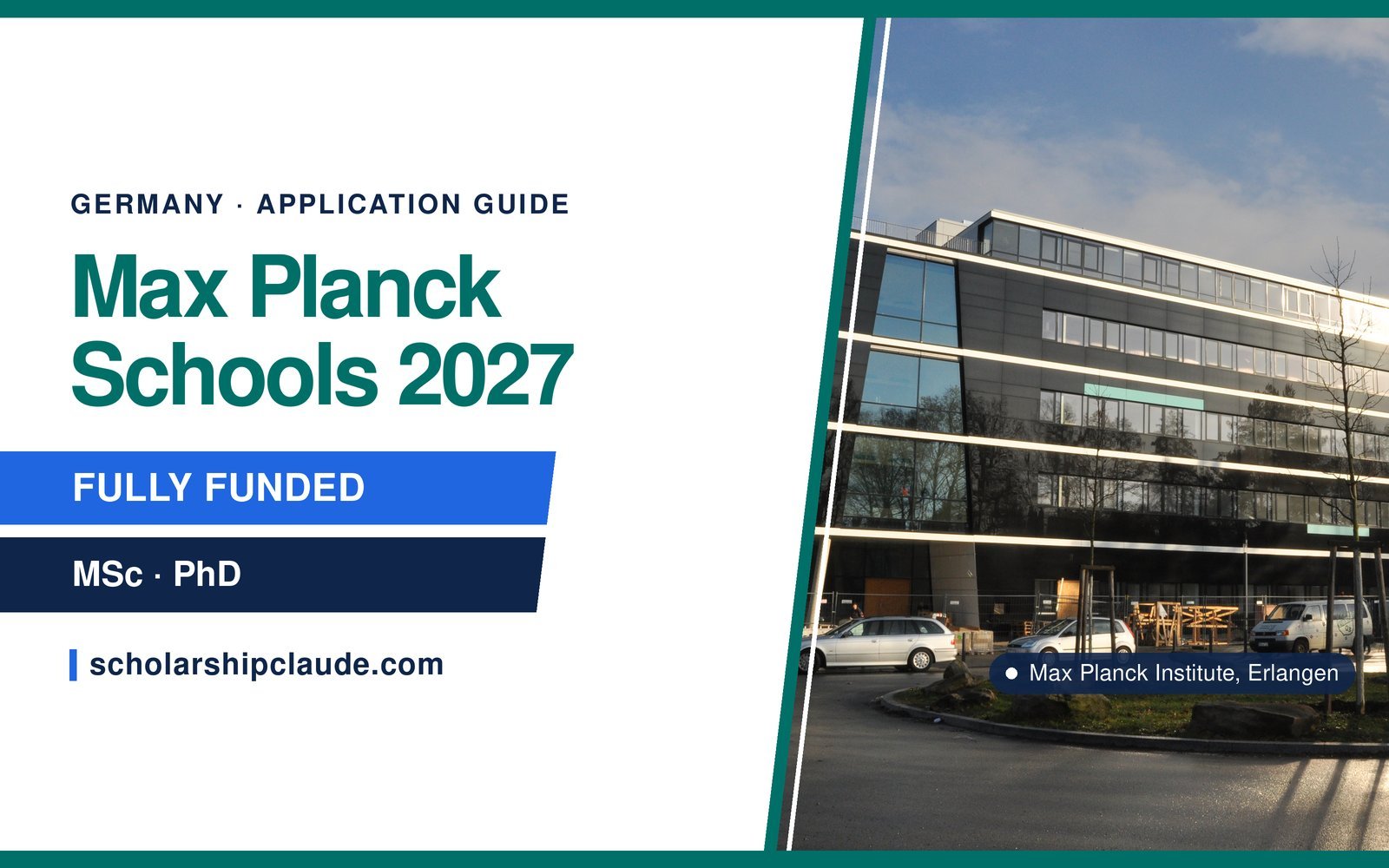
A Max Planck Schools application gives you a shot at a fully funded PhD, or an integrated MSc and PhD, inside one of Germany’s strongest research networks. This guide explains the four Schools open for the autumn 2027 intake, who can apply to each, what the funding pays, which documents you need and how selection works before the 1 December 2026 deadline. The key facts are also on our Max Planck Schools PhD 2027 listing.
We checked every detail on 26 October 2026 against the official Max Planck Schools website and the application pages and FAQs of each School. Where a School does not give a detail, we say so.
Max Planck Schools at a glance
| What it is | Joint graduate programme of 30 universities and 33 non-university research institutes in Germany |
| Schools | Biomedical AI (first cohort), Cognition, Matter to Life, Photonics |
| Level | Integrated MSc/PhD or PhD, depending on the School and your degree |
| Funding | Up to five years: 1,565 euros net a month in the first phase, then an E 13 employment contract; no tuition fees |
| Who can apply | Candidates from around the world with a Bachelor’s or Master’s degree (Biomedical AI: Master’s) |
| Language | English |
| Deadline | 1 December 2026 |
| Start | Autumn 2027 (Cognition and Biomedical AI: September 2027) |
What the funding covers
- Up to five years of funding. The Max Planck Schools say admission includes full funding for up to five years, so you can focus on research.
- A stipend in the first phase. Students who start with a Bachelor’s degree (and Cognition students in their orientation year) receive 1,565 euros net a month, plus up to 100 euros towards health insurance where applicable.
- A salary in the doctoral phase. After the first phase you get an employment contract under the public-sector wage agreement (TVöD/TV-L, E 13), which the Photonics School says is considerably higher than the stipend.
- No tuition fees at the Schools. One exception to note: the Photonics FAQ says its Master’s-phase universities charge semester fees (about 82 to 350 euros), and FAU Erlangen and KIT also charge non-EU students tuition (about 2,000 and 1,500 euros).
Cognition reimburses travel costs for invited interview candidates. Students arrange their own housing, and the Photonics School says the stipend or salary is enough for living costs in Germany.
The four Schools and who can apply
| School | Structure | You need |
|---|---|---|
| Biomedical AI | 3-year funded PhD; site depends on your supervisor | Master’s in computer science, mathematics, statistics, engineering, physics or computational life sciences |
| Cognition | Orientation year + 3 research years | Bachelor’s (fast-track) and/or Master’s in a cognition-related field, such as psychology, neuroscience, AI, linguistics, philosophy or physics |
| Matter to Life | 2-year joint Master’s (Göttingen and Heidelberg) + 3-year PhD | Bachelor’s (180 ECTS) in natural sciences or engineering, GPA 1.7 or top 5% |
| Photonics | Master’s study phase and/or 3-year PhD research phase | Bachelor’s and/or Master’s with strong physics or engineering coursework |
All Schools welcome applicants from every country. Final-year students can apply with a current transcript and send the final certificate before starting. Cognition says successful applicants usually have a German GPA of about 1.3 or better, though strong research or references can make up for a lower grade. Photonics says applicants from embargoed countries may face extra visa checks.
Max Planck Schools application deadlines for 2026-27
| Step | Date |
|---|---|
| Portals open | 1 September 2026 |
| Application deadline (all four Schools) | 1 December 2026 (Matter to Life: 11:59 pm) |
| Referee deadline | 1 December 2026 at Cognition and Biomedical AI; responses by 15 December 2026 at Photonics |
| Biomedical AI selection symposium | 1-5 February 2027, online |
| Cognition interviews | 23-24 February 2027, online |
| English test (if not yet sent) | By 15 July 2027 at Matter to Life and Biomedical AI |
| Start | Autumn 2027 |
The deadline is set in German time, which is four hours behind Pakistan (PKT) in December. Submit at least a day early, because late or incomplete applications are not considered.
Documents checklist
- Certificates and transcripts for your Bachelor’s and, if you have one, your Master’s (or proof of current enrolment). Documents must be in English or German, or translated.
- Academic CV, listing all stages of your education in order.
- Motivation letter or personal statement. Matter to Life requires its template in the portal; Photonics asks for no more than 500 words.
- Passport or ID copy.
- Two referees, invited through the portal.
- Potential supervisors. Cognition and Biomedical AI ask for the names of up to three Fellows; Photonics research-phase applicants list topics.
- Proof of English for non-native speakers. Minimum scores vary: Cognition IELTS 5.5 or TOEFL iBT 72; Matter to Life and Biomedical AI IELTS 6.5 or TOEFL iBT 90; Photonics IELTS above 6.0 or TOEFL above 70. Nationals of the USA, UK, Ireland, Australia, New Zealand and Canada are exempt at several Schools.
- GRE scores are optional at Cognition.
How to apply to the Max Planck Schools, step by step
- Pick one School that matches your degree and interests, and for Photonics choose the study or research phase carefully.
- Read that School’s FAQ for its grade, credit and English rules.
- Register on the application portal.
- Invite your referees first. Photonics will not let you continue until two referees are invited.
- Upload your documents and write your motivation letter or personal statement.
- Name supervisors or topics if your School asks for them, but do not contact Cognition Fellows before admission.
- Submit by 1 December 2026.
- Prepare for selection. Expect online interviews, a test on a research article (Photonics) or a selection symposium (Biomedical AI).
How candidates are selected
Each School runs a competitive multi-stage process. At Matter to Life, the committee reviews grades and motivation, then holds a 15-minute video interview and a 30-minute second interview on one or two Fellows’ papers. Photonics shortlists applicants for an online test on a research article, followed by a Zoom interview. Biomedical AI Fellows shortlist candidates, who present their research at an online symposium, interview with interested Fellows and are matched to a project in March and April.
Tips for a strong application
- Explain the fit. Show why this School’s interdisciplinary focus suits you; our motivation letter template can help you structure it.
- Brief your referees early. Deadlines for references are tight; see how to get strong recommendation letters.
- Name realistic supervisors. Read the Fellows’ recent papers before you list them.
- Book your English test now if your School needs it with the application.
Other funding in Germany
If you want a shorter research stay first, look at the Max Planck computer science summer internships. For other routes, see the DAAD Scholarships, the University of Erfurt Doctoral Scholarships and our overview of scholarships in Germany.
Frequently asked questions
Is the Max Planck Schools programme fully funded?
Yes. Funding lasts up to five years: a stipend of 1,565 euros net a month in the first phase, then an E 13 employment contract, with no tuition fees at the Schools.
What is the Max Planck Schools deadline?
1 December 2026 for the autumn 2027 intake, at all four Schools.
Can I apply with only a Bachelor’s degree?
Yes, for Matter to Life, the Photonics study phase and the Cognition fast-track. Biomedical AI requires a Master’s degree.
Can international students apply?
Yes. The Schools invite candidates from around the world, and all programmes are taught in English.
Can I apply to more than one School?
The official pages say applications go to the respective School and its own requirements; check each School’s FAQ before applying to more than one.
What English score do I need?
It depends on the School, from IELTS 5.5 (Cognition) to IELTS 6.5 (Matter to Life and Biomedical AI). Some Schools accept the test after selection, by 15 July 2027.
Is the GRE required?
No. Cognition says the GRE is welcome but optional, and the other Schools do not list it.
Where will I study?
It depends on the School and your supervisor. Matter to Life’s Master’s phase is at Göttingen and Heidelberg, and Photonics teaches at Erlangen, Jena and Karlsruhe.
Where to apply
Start on the official Max Planck Schools application page, which links to the portal and each School’s rules. For funding details see the Cognition costs and financial support FAQ and the Matter to Life FAQ. Our Max Planck Schools PhD listing keeps the key facts in one place.
Scholarships with the nearest deadlines
| Scholarship | Funding | Stipend | Deadline |
|---|---|---|---|
| US–Pakistan Knowledge Corridor PhD Scholarships 2027 | Fully funded | Not stated on HEC's programme page (see the HEC advertisement) | 30 Oct 2026 |
| Honjo International Scholarship 2027 in Japan | Partial | 230,000 yen a month (degree of 1 to 2 years), 210,000 yen a month (3-year degree) or 180,000 yen a month (degree longer than 3 years) | 31 Oct 2026 |
| European Parliament Schuman Traineeships 2027 | Partial | Monthly grant paid; amount not stated on the official source | 31 Oct 2026 |
| University of Melbourne Graduate Research Scholarships 2027 in Australia | Fully funded | 41,100 Australian dollars a year (2027 rate), plus a full fee offset | 31 Oct 2026 (expected) |
| Australian Government RTP Scholarships 2027 in Australia | Fully funded | 2027 full-time RTP stipend: base rate 35,550 Australian dollars a year, maximum 55,537 Australian dollars a year | 31 Oct 2026 (expected) |
| DAAD EPOS Scholarship 2027/28 in Germany | Fully funded | 992 euros a month for graduates; 1,400 euros a month for doctoral candidates | 31 Oct 2026 (expected) |
| One Young World Leading Scholarship 2026 in South Africa | Partial | See the scholarship page | 31 Oct 2026 |
| UNU Junior Fellows Internship 2027 in Tokyo, Japan | Partial | Monthly stipend; amount not stated on the official source | 1 Nov 2026 |
| Open Doors Russian Scholarship Project 2026–27 in Russia | Partial | Tuition-free study; a monthly allowance is possible only with grant support for Russian-taught programmes | 1 Nov 2026 |
| Max Planck Computer Science Summer Internships 2027 in Germany | Fully funded | Monthly stipend (amount not stated on the official source) | 1 Nov 2026 |
This list updates itself from our scholarships page. Stipend figures are shown where the provider publishes them. See all scholarships.