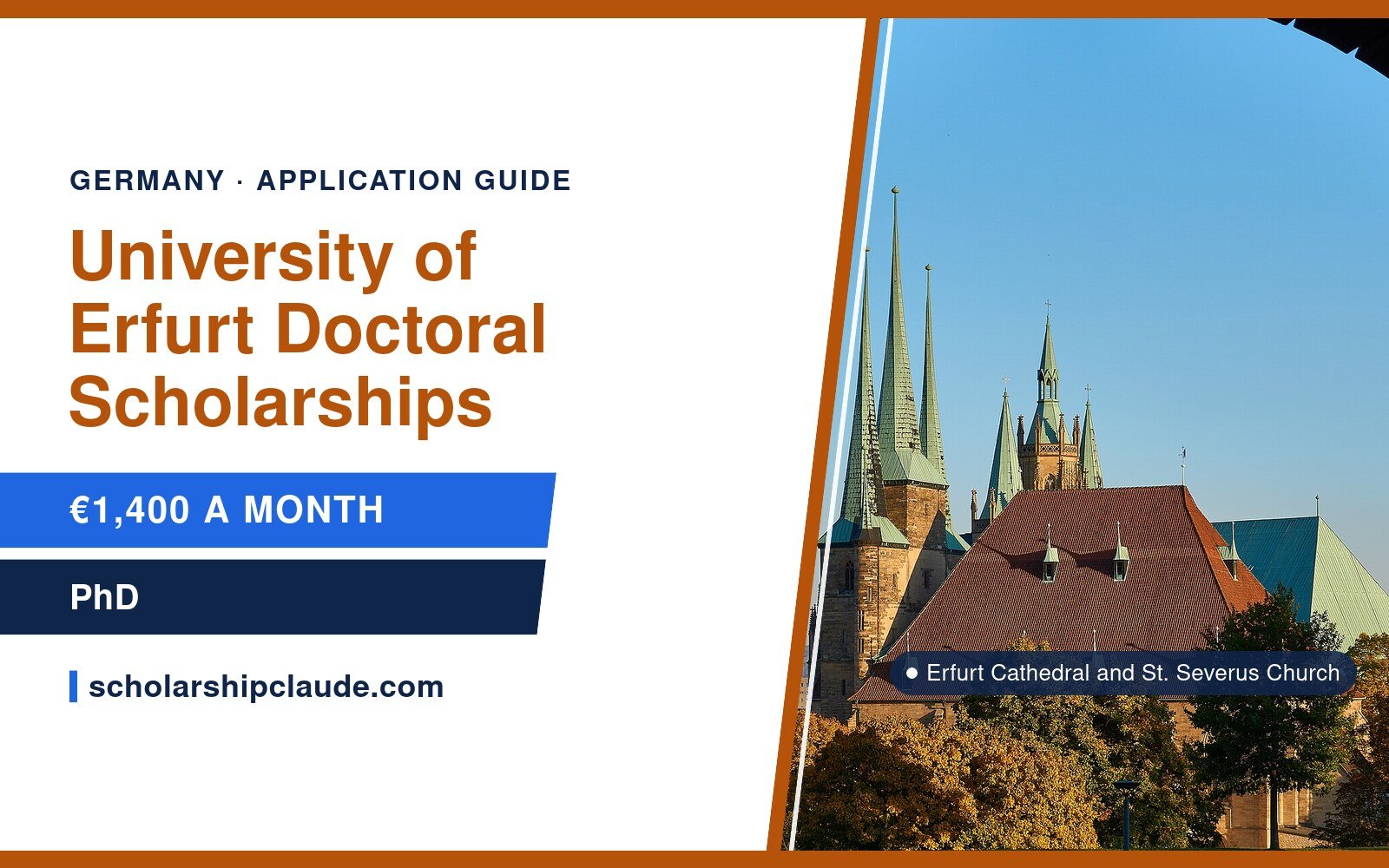
The University of Erfurt in Germany is offering up to four doctoral scholarships worth €1,400 a month for three years, starting 1 April 2027. They are funded by the Thuringian State Graduate Support scheme. You apply by email with one PDF, and the closing date is 24 November 2026.
This guide was checked on 15 October 2026 against the University of Erfurt’s official call for applications and its announcements page.
Erfurt doctoral scholarships at a glance
| University | University of Erfurt, Germany |
|---|---|
| Scheme | Thuringian State Graduate Support (Landesgraduiertenförderung) |
| Number | Up to four scholarships |
| Stipend | €1,400 a month |
| Length | Three years, plus one more year on request |
| Family allowance | €300 a month for the first child, €150 for each extra child |
| Research costs | Up to €600 a year, on request |
| Start | 1 April 2027 (1 July 2027 at the latest) |
| Closing date | 24 November 2026 |
| Decisions | Expected by the end of February 2027 |
What the scholarship pays
- €1,400 a month for three years. You can ask for a fourth year.
- Family allowance of €300 a month for your first dependent child and €150 for each additional child.
- Up to €600 a year for research materials and travel, on request and if funds allow.
The call does not mention tuition or health insurance costs. You must show proof of health insurance by the start of funding.
Who can apply
- A master’s degree, or a Diploma or Magister, with above-average results that show research ability.
- A doctoral project in the Erfurt Doctoral and Postdoctoral Programme (EPPP), at a certified Graduate Centre or the Max-Weber-Kolleg.
- By the start of funding: accepted as a doctoral candidate by an Erfurt faculty or the Max-Weber-Kolleg, enrolled at the University, and a full member of your Graduate Centre or the Max-Weber-Kolleg.
- No other public funding for the same purpose and period.
The call does not state any nationality restriction. You may apply to only one Graduate Centre or the Max-Weber-Kolleg.
Rules while you hold the scholarship
- Paid research or teaching work of up to 12 hours a week, or other paid work of up to 5 hours a week.
- Regular participation in your Graduate Centre or the Max-Weber-Kolleg programme.
- At least six Academic Skills Training courses.
- A progress report after 18 months.
Documents you need
Put these into one PDF, no larger than 5 MB, with a table of contents, in this order:
Required
- Cover letter of up to two pages: your chosen Graduate Centre or the Max-Weber-Kolleg, why you chose it, and the preparation you have done
- CV in table format, plus the completed CV supplement form
- Project outline of 6 to 8 pages (not counting the cover page and bibliography) with your research question, state of research, method, bibliography and a three-year work schedule
- Form confirming your contact with a Graduate Centre or the Max-Weber-Kolleg (German only), or the admission form if you are already a full member
- Degree certificates, with certified German or English translations if needed
- Full copy of your final thesis, with a summary of up to two pages in German or English if the thesis is in another language
- Signed consent to data processing (German only, with an English information sheet)
Conditional
- Confirmation of your acceptance as a doctoral candidate, if you already have it
- List of publications and presentations, if you have any
Sent separately
- A signed recommendation letter from a professor or university teacher, on the official form (English or German). The professor emails it directly. Do not put it in your PDF.
How to apply, step by step
- Read the full call for applications on the University of Erfurt announcements page.
- Choose one Graduate Centre or the Max-Weber-Kolleg and contact it about your project.
- Write your cover letter and 6 to 8 page project outline.
- Fill in the CV supplement, contact confirmation and data consent forms.
- Ask a professor to complete the recommendation form and email it separately.
- Combine your documents into one PDF in the order of the call.
- Email it to graduiertenfoerderung@uni-erfurt.de with the subject “Application for the State Graduate Scholarship 2026 – surname, first name”.
- Submit by 24 November 2026. Late, incomplete or wrongly formatted applications are not considered.
Our research proposal template and research CV guide can help with the outline and CV.
How applicants are selected
- Academic results and previous academic work
- Research potential
- Quality, method and importance of the project, and whether the timeline is realistic
If candidates are equally strong, the scholarships should be shared equally between women and men, if there are enough suitable applications. The review takes about ten weeks.
What the Erfurt Doctoral and Postdoctoral Programme is
The scholarships are tied to the Erfurt Doctoral and Postdoctoral Programme (EPPP), the University of Erfurt’s structured framework for doctoral training. Doctoral projects run inside certified Graduate Centres or at the Max-Weber-Kolleg, the University’s institute for advanced study. As a scholar you are expected to take part in your centre’s programme, complete at least six Academic Skills Training courses, build your academic network and submit a progress report after 18 months.
This structure is useful for international students. You are not working alone with one professor: you join a group with regular seminars, training and peers at the same stage.
Choosing a Graduate Centre or the Max-Weber-Kolleg
You can apply to only one Graduate Centre or the Max-Weber-Kolleg, so choose carefully. One of the required documents is a form confirming that you have contacted that centre, which means you must reach out before you apply.
- Read the University of Erfurt’s pages on its Graduate Centres and the Max-Weber-Kolleg.
- Shortlist the centre whose research themes are closest to your project.
- Find the centre’s coordinator or spokesperson and the professors who could supervise you.
- Email them with a one-paragraph summary of your project, your CV and a question about whether the project fits.
- Ask how they complete the contact confirmation form, which is in German only.
Start this step at least a month before 24 November 2026. Centres need time to reply, and you need their confirmation for your file.
Writing the 6 to 8 page project outline
The project outline is the heart of your application. Reviewers judge your research potential, the quality of your method and whether your plan is realistic. The call asks for 6 to 8 pages, not counting the cover page and bibliography. A clear structure:
- Research question (half a page): the problem you will study and why it matters to your field.
- State of research (one and a half to two pages): the main debates and studies, and the gap your project fills.
- Theory and method (two pages): your approach, sources or data, and how you will analyse them.
- Preliminary work (half a page): what you have already done, such as your master’s thesis or archive visits.
- Fit with the Graduate Centre (half a page): how your project connects to the centre’s themes.
- Three-year work and time schedule (one page): a semester-by-semester plan with milestones.
- Bibliography: the key works you cite, on separate pages.
Make the schedule concrete. Reviewers look for a plan that can really be finished in three years. Our PhD research proposal template has examples of each section.
Writing the cover letter
The cover letter is limited to two pages. The call asks it to cover your chosen Graduate Centre or the Max-Weber-Kolleg, why you chose it, the preparation you have already done, and, if you wish, your personal circumstances. Keep each part short:
- One paragraph on who you are and what you propose to study.
- One or two paragraphs on why this centre is the right home for the project.
- One paragraph on your preparation: thesis, publications, language skills, archive or field work.
- Optional: a short note on circumstances such as caring duties or disability, which the call says may be considered.
The CV, the recommendation and the other forms
- CV: use a table format with dates, and complete the University’s CV supplement form as well.
- Recommendation: one signed letter from a professor or university teacher at Erfurt or another university, on the official form, in English or German. The referee emails it directly to graduiertenfoerderung@uni-erfurt.de. It must not be inside your PDF.
- Data consent form: German only, with an English information sheet. Sign and include it.
- Final thesis: include a full copy. If it is not in German or English, add a summary of up to two pages in one of those languages.
Putting together your PDF
Erfurt is strict about format. Incomplete, non-compliant or late applications are not considered.
- Collect all documents except the recommendation letter.
- Put them in the order given in the call, from the cover letter to the data consent form.
- Add a table of contents at the front.
- Merge everything into one PDF no larger than 5 MB. If your thesis makes the file too large, reduce image quality rather than leaving pages out.
- Email it with the subject line “Application for the State Graduate Scholarship 2026 – surname, first name”.
What €1,400 a month means for your budget
Over a year, the basic stipend comes to €16,800. With one child, the family allowance raises the monthly amount to €1,700, and with two children to €1,850. You can also ask for up to €600 a year for research materials and travel.
The stipend is a scholarship, not a salary, and the call requires proof of health insurance by the start of funding. Plan your health insurance costs before you accept. If you want to earn extra, the call allows paid research or teaching work of up to 12 hours a week, or other work of up to 5 hours a week.
German or English?
The call does not set a language level, and you can write your project outline in German or English. Some practical points still matter:
- The contact confirmation form and the data consent form are only in German. Ask the Graduate Centre for help if you do not read German.
- Degree certificates and thesis summaries must be in German or English, or translated into one of them.
- The recommendation form is available in English or German.
- Ask your Graduate Centre which language its seminars and training use, so you know what you need to take part fully.
If your German is basic, it is worth starting a course now. Daily life in Erfurt, and many administrative steps, will be easier with some German.
After you are selected
Selection is not the last step. By the start of funding on 1 April 2027 (1 July 2027 at the latest), you must have:
- Acceptance as a doctoral candidate by an Erfurt faculty or the Max-Weber-Kolleg.
- Enrolment at the University of Erfurt.
- Full membership of your Graduate Centre or the Max-Weber-Kolleg.
- Proof of health insurance.
If you are coming from outside the European Union, check the visa rules for your country as soon as you receive the decision, because visa appointments can take weeks. Keep your award letter and admission documents ready for the visa application.
Is this scholarship right for you?
The Erfurt scholarship suits applicants who already have a well-developed doctoral project, a master’s degree with strong results, and a clear link to one of Erfurt’s Graduate Centres or the Max-Weber-Kolleg. With only up to four awards, competition is strong, so it makes sense to apply to other funding at the same time.
For other routes to a funded doctorate in Germany, see our DAAD scholarship guide, the DAAD research grants for doctoral programmes and our guide to scholarships in Germany. Remember that the Erfurt rules do not allow other public funding for the same period, so you would need to choose one award if you win more than one.
A suggested timeline
| When | What to do |
|---|---|
| Now to late October 2026 | Choose a Graduate Centre, contact it and your potential supervisor, ask a professor for the recommendation |
| Early November 2026 | Finish the project outline and cover letter; complete the forms |
| Mid-November 2026 | Build and check the PDF; confirm your referee has sent the letter |
| 24 November 2026 | Closing date |
| By end of February 2027 | Decisions expected |
| 1 April 2027 | Funding starts (1 July 2027 at the latest) |
Checklist before you submit
- You have contacted one Graduate Centre or the Max-Weber-Kolleg and have the confirmation form.
- Your project outline is 6 to 8 pages with a three-year schedule.
- Your cover letter is no longer than two pages.
- Your degree certificates have German or English translations if needed.
- Your thesis is included in full, with a summary if needed.
- Your PDF is one file, under 5 MB, in the right order, with a table of contents.
- Your referee has emailed the recommendation separately.
- Your subject line follows the required wording.
Common mistakes to avoid
- Applying to two Graduate Centres at once.
- Putting the recommendation letter inside your own PDF.
- Sending several files instead of one PDF.
- Writing a project outline without a realistic schedule.
- Forgetting that you must be accepted as a doctoral candidate and enrolled at Erfurt by the start of funding.
Frequently asked questions
How much is the University of Erfurt doctoral scholarship?
€1,400 a month for three years, with a possible fourth year. There are extra allowances for children and research costs.
Can international students apply?
The call does not state a nationality restriction. You must be accepted as a doctoral candidate and enrolled at Erfurt by the start of funding.
Do I need to speak German?
The call does not set a language level. Some forms are in German only, and certificates and thesis summaries must be in German or English.
How many scholarships are there?
Up to four, starting 1 April 2027.
What is the closing date?
24 November 2026.
Can I hold another scholarship at the same time?
No public funding from other sources is allowed for the same period and purpose. Funding for research stays abroad that serve your project may still be possible.
Can I work while holding the scholarship?
Yes, within limits: paid research or teaching of up to 12 hours a week, or other paid work of up to 5 hours a week.
What do I have to do during the scholarship?
Take part in your centre’s programme, complete at least six Academic Skills Training courses, network actively and submit a progress report after 18 months.
How are the scholarships shared between applicants?
Selection is based on research aptitude and the quality and importance of the project. If candidates are equally qualified and their projects are of equal quality, the call says the scholarships should be shared equally between women and men, as long as there are enough suitable applications. Disability, chronic illness, voluntary work and social criteria may also be considered if you choose to mention them.
Is there a legal right to the scholarship?
No. The call says there is no legal entitlement, and the number of awards depends on the state funds available.
How long does the review take?
About ten weeks. Decisions are expected by the end of February 2027.
Where to apply
Read the official University of Erfurt announcements page, which links to the full call and the forms. Our Erfurt scholarship page keeps the key facts in one place, and our guide to scholarships in Germany lists other options.
Scholarships with the nearest deadlines
| Scholarship | Funding | Stipend | Deadline |
|---|---|---|---|
| US–Pakistan Knowledge Corridor PhD Scholarships 2027 | Fully funded | Not stated on HEC's programme page (see the HEC advertisement) | 30 Oct 2026 |
| Honjo International Scholarship 2027 in Japan | Partial | 230,000 yen a month (degree of 1 to 2 years), 210,000 yen a month (3-year degree) or 180,000 yen a month (degree longer than 3 years) | 31 Oct 2026 |
| European Parliament Schuman Traineeships 2027 | Partial | Monthly grant paid; amount not stated on the official source | 31 Oct 2026 |
| University of Melbourne Graduate Research Scholarships 2027 in Australia | Fully funded | 41,100 Australian dollars a year (2027 rate), plus a full fee offset | 31 Oct 2026 (expected) |
| Australian Government RTP Scholarships 2027 in Australia | Fully funded | 2027 full-time RTP stipend: base rate 35,550 Australian dollars a year, maximum 55,537 Australian dollars a year | 31 Oct 2026 (expected) |
| DAAD EPOS Scholarship 2027/28 in Germany | Fully funded | 992 euros a month for graduates; 1,400 euros a month for doctoral candidates | 31 Oct 2026 (expected) |
| One Young World Leading Scholarship 2026 in South Africa | Partial | See the scholarship page | 31 Oct 2026 |
| UNU Junior Fellows Internship 2027 in Tokyo, Japan | Partial | Monthly stipend; amount not stated on the official source | 1 Nov 2026 |
| Open Doors Russian Scholarship Project 2026–27 in Russia | Partial | Tuition-free study; a monthly allowance is possible only with grant support for Russian-taught programmes | 1 Nov 2026 |
| Max Planck Computer Science Summer Internships 2027 in Germany | Fully funded | Monthly stipend (amount not stated on the official source) | 1 Nov 2026 |
This list updates itself from our scholarships page. Stipend figures are shown where the provider publishes them. See all scholarships.