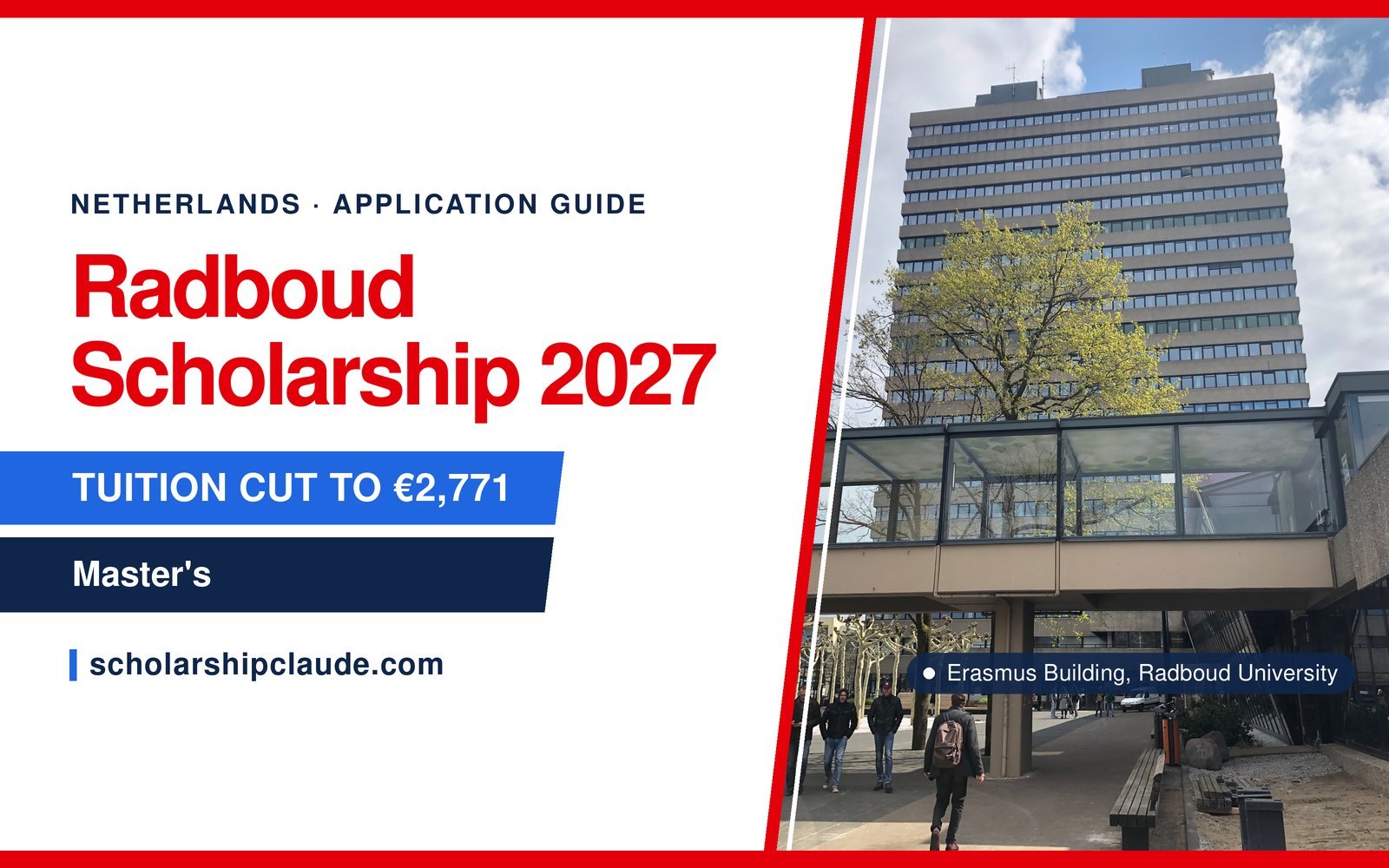
A Radboud Scholarship application is not a separate form: you make it inside your Master’s application to Radboud University in Nijmegen, the Netherlands. This guide explains who can apply for the Radboud Scholarship Programme 2027/2028, what it pays, which documents you need and the two deadlines that matter. The key facts are also on our Radboud Scholarship 2027 listing.
We checked every detail on 19 October 2026 against Radboud University’s official scholarship, deadline and application pages and its reference letter guidelines. Where the official pages do not give a detail, we say so.
Radboud Scholarship at a glance
| Full name | Radboud Scholarship Programme |
| University | Radboud University, Nijmegen, Netherlands |
| Level | English-taught Master’s programmes (not Erasmus Mundus or joint degrees) |
| Funding | Partial: tuition cut to €2,771 (amount to be confirmed), plus visa, residence permit and insurance |
| Not covered | Living and study costs |
| Places for 2027/2028 | Up to 26, split by faculty |
| Who can apply | Non-EU/EEA passport holders with a non-Dutch Bachelor’s degree |
| How to apply | Tick the scholarship in OSIRIS Application and upload two reference letters and a CV |
| Deadline | Submit by 31 January 2027, 23:59 CET; complete by 14 February 2027, 23:59 CET |
| Decision | Before mid-April 2027 (date subject to change) |
What the Radboud Scholarship covers
- Lower tuition. Your tuition fee drops to €2,771 for 2027/2028. Radboud says the amount is still to be confirmed. Without it, you could pay about €19,000, depending on your programme.
- Visa and residence permit costs.
- Health and liability insurance for your stay in the Netherlands, through Aon Student Insurance.
- The whole programme. It runs for the nominal length of your Master’s. On a two-year programme you qualify again for year two only if you pass all first-year courses.
It does not cover the costs of living and studying in the Netherlands. Plan how you will pay for housing, food, books and travel before you apply, because the official page gives no living allowance.
How many scholarships are there?
For 2027/2028 Radboud offers at most 26 scholarships. They are split by faculty:
| Faculty | Scholarships |
|---|---|
| Faculty of Science | 9 |
| Faculty of Social Sciences | 7 |
| Nijmegen School of Management | 5 |
| Faculty of Arts | 2 |
| Faculty of Law | 2 |
| Faculty of Philosophy, Theology and Religious Studies | 1 |
The numbers are small, so the scholarship is very selective. Science and Social Sciences have the most places.
Who can apply
All English-taught Master’s programmes at Radboud are eligible, except Erasmus Mundus Master’s programmes and joint-degree Master’s programmes. You can apply only if you:
- hold a non-EU/non-EEA passport;
- are not eligible for the lower EU/EEA tuition fee for any other reason;
- have, or will obtain, a Bachelor’s degree from outside the Netherlands, with no Dutch degree and no earlier education in the Netherlands (an exchange that was part of your foreign Bachelor’s is fine);
- meet the English requirement of your chosen Master’s programme;
- are fully admitted to an English-taught Master’s starting 1 September 2027, as stated in your formal letter of admission;
- can meet the conditions for a Dutch visa; and
- enrol full-time at Radboud for that year and programme.
Radboud does not publish one English test score for the scholarship. The requirement depends on your programme, so check the programme page.
Radboud Scholarship application deadlines for 2027
Radboud’s Master’s deadlines page says applications for the September intake open on 1 October, and that non-EU/EEA students who want a scholarship must apply by 31 January (September intake only). Without a scholarship, the deadline is 1 April, so scholarship applicants must be about two months earlier.
| Step | Date |
|---|---|
| Applications open (September 2027 intake) | 1 October 2026 |
| Submit your application in OSIRIS Application | 31 January 2027, 23:59 CET |
| Application complete (fee paid, documents fixed) | 14 February 2027, 23:59 CET |
| Proof of English (recommended) | By 14 February 2027 |
| Scholarship decision | Before mid-April 2027 (subject to change) |
| Enrolment deadline for non-EU/EEA students | 1 June 2027 |
After you submit, Student Admissions checks your file and sends it back for the handling fee and any wrong, unreadable or missing documents. Resubmit as soon as possible. Incomplete applications are not considered for the scholarship.
Documents checklist
- Two reference letters, preferably from academics.
- A CV (curriculum vitae). If you already uploaded the letters and CV for your Master’s application, upload them again in the scholarship section.
- Passport scan (personal details page).
- Bachelor’s diploma, if you have it, and an official transcript with the grading scale.
- Sworn translations if your diploma and transcript are not in Dutch, English or German.
- Course descriptions of finished and unfinished courses (content, hours and literature).
- Personal statement or motivation letter, depending on the programme.
- English certificate, if your programme requires one.
- Application fee of €100 (non-refundable) for applicants with international previous education.
Reference letter rules
Radboud’s reference letter guidelines say each letter must be in English, typed, and signed by hand or with a signature that can be verified in Adobe. A pasted image of a signature is not accepted. Ideally the letter is at most one A4 page, explains how the referee knows you, describes your achievements and says how you will use the Master’s. An employer can write one if they show how your work relates to the programme. Under the GDPR, you will be able to see the letters once they are in OSIRIS Application.
How to apply for the Radboud Scholarship, step by step
- Pick an eligible programme. It must be English-taught and not an Erasmus Mundus or joint degree. Check its admission and English requirements.
- Ask your referees early. Send them Radboud’s guidelines so the letters are signed correctly.
- Apply in Studielink. Create an account and an enrolment application for the September 2027 intake.
- Log in to OSIRIS Application. You get the login details by email after the Studielink step.
- Tick the Radboud Scholarship option. Upload your two reference letters and your CV.
- Upload your programme documents and submit by 31 January 2027, 23:59 CET.
- Pay the fee and fix any issues so the file is complete by 14 February 2027, 23:59 CET.
- Wait for the result. Student Life and International Mobility decides before mid-April 2027.
The step-by-step admission process is on Radboud’s Master’s application procedure page. Admission and the scholarship are separate: being admitted does not mean you are selected.
How Radboud selects scholars
A selection committee in the faculty you applied to considers each applicant individually. It looks at:
- Academic excellence: grades, test scores or publications, how relevant your previous degree is, and the ranking of your previous university.
- Ambition: the quality and relevance of your motivation letter, promise shown by past achievements, and life experience or activities such as internships or volunteering.
- References: the quality of your two reference letters.
Faculties may use other criteria as well, and some programmes hold interviews.
Tips for a strong application
- Apply well before 31 January. The OSIRIS login only arrives after the Studielink step, and you need time to fix documents before 14 February.
- Write the motivation letter for the committee. Link your degree to the programme and give clear goals. Our motivation letter template for a Master’s scholarship can help.
- Choose referees who know your academic work. See how to get strong recommendation letters.
- Send English proof early. Radboud recommends doing so before 14 February 2027.
- Budget for living costs. The scholarship does not pay them.
- Join a Q&A. Radboud runs scholarship Q&A sessions, and questions can go to scholarships[at]ru.nl (not for applications).
Other funding in the Netherlands
The Radboud Scholarship can be combined with the NL Scholarship. At Radboud the NL Scholarship is €5,000 for the first year, and it is always paired with the Radboud Scholarship Programme: you can win both, or just the Radboud Scholarship, but not the NL Scholarship alone. Also compare the Leiden University Excellence Scholarship, the Amsterdam Merit Scholarship, the TU Delft Excellence Scholarships and the Maastricht NL-High Potential Scholarship, or read our overview of scholarships in the Netherlands.
Frequently asked questions
Is the Radboud Scholarship fully funded?
No. It is a partial scholarship. It cuts tuition to €2,771 (amount to be confirmed) and covers visa, residence permit and insurance, but not living costs.
What is the deadline for 2027?
Submit your OSIRIS Application by 31 January 2027, 23:59 CET. It must be complete by 14 February 2027, 23:59 CET.
Is there a separate scholarship form?
No. You tick the Radboud Scholarship option in OSIRIS Application during your Master’s application and upload two reference letters and a CV.
How many Radboud Scholarships are available?
At most 26 for 2027/2028: Science 9, Social Sciences 7, Nijmegen School of Management 5, Arts 2, Law 2 and Philosophy, Theology and Religious Studies 1.
What IELTS or TOEFL score do I need?
It depends on the programme. You must meet the English requirement of your chosen Master’s; Radboud gives no separate scholarship score.
Can I apply if I studied in the Netherlands before?
No. You must have no Dutch degree and no earlier education in the Netherlands, except an exchange that was part of your foreign Bachelor’s.
Can I get the NL Scholarship as well?
Yes. At Radboud the €5,000 NL Scholarship is always combined with the Radboud Scholarship Programme, so you can receive both.
When will I hear back?
Radboud says it will inform you before mid-April 2027; the date may change.
Where to apply
Read the full rules on the official Radboud Scholarship Programme page, then apply through Studielink and OSIRIS Application before 31 January 2027. Our Radboud Scholarship listing keeps the key facts in one place.
Scholarships with the nearest deadlines
| Scholarship | Funding | Stipend | Deadline |
|---|---|---|---|
| US–Pakistan Knowledge Corridor PhD Scholarships 2027 | Fully funded | Not stated on HEC's programme page (see the HEC advertisement) | 30 Oct 2026 |
| Honjo International Scholarship 2027 in Japan | Partial | 230,000 yen a month (degree of 1 to 2 years), 210,000 yen a month (3-year degree) or 180,000 yen a month (degree longer than 3 years) | 31 Oct 2026 |
| European Parliament Schuman Traineeships 2027 | Partial | Monthly grant paid; amount not stated on the official source | 31 Oct 2026 |
| University of Melbourne Graduate Research Scholarships 2027 in Australia | Fully funded | 41,100 Australian dollars a year (2027 rate), plus a full fee offset | 31 Oct 2026 (expected) |
| Australian Government RTP Scholarships 2027 in Australia | Fully funded | 2027 full-time RTP stipend: base rate 35,550 Australian dollars a year, maximum 55,537 Australian dollars a year | 31 Oct 2026 (expected) |
| DAAD EPOS Scholarship 2027/28 in Germany | Fully funded | 992 euros a month for graduates; 1,400 euros a month for doctoral candidates | 31 Oct 2026 (expected) |
| One Young World Leading Scholarship 2026 in South Africa | Partial | See the scholarship page | 31 Oct 2026 |
| UNU Junior Fellows Internship 2027 in Tokyo, Japan | Partial | Monthly stipend; amount not stated on the official source | 1 Nov 2026 |
| Open Doors Russian Scholarship Project 2026–27 in Russia | Partial | Tuition-free study; a monthly allowance is possible only with grant support for Russian-taught programmes | 1 Nov 2026 |
| Max Planck Computer Science Summer Internships 2027 in Germany | Fully funded | Monthly stipend (amount not stated on the official source) | 1 Nov 2026 |
This list updates itself from our scholarships page. Stipend figures are shown where the provider publishes them. See all scholarships.