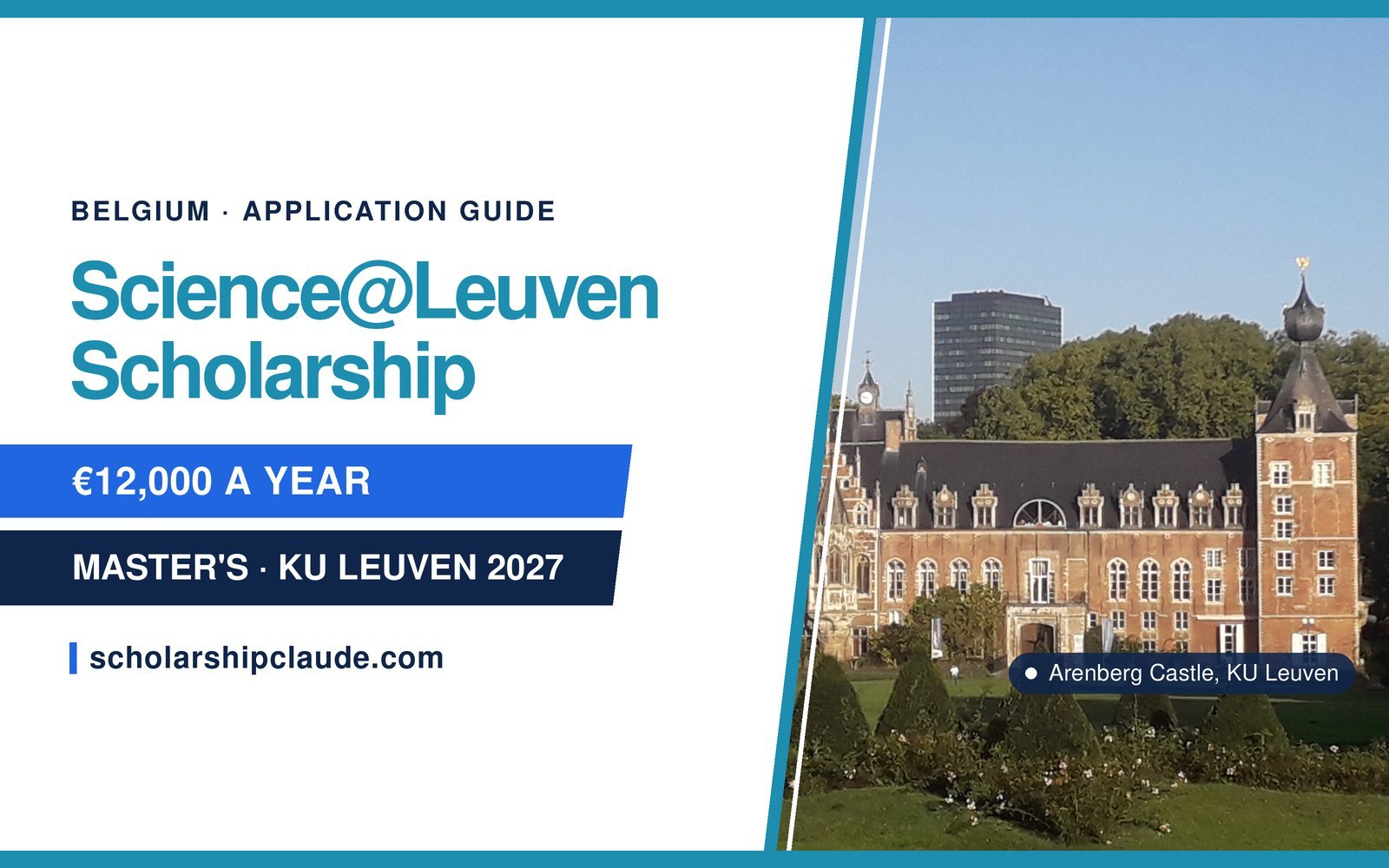
A Science@Leuven Scholarship application gives excellent international students a chance at 12,000 euros a year for a science Master’s at KU Leuven in Belgium. The award comes from the Science@Leuven Fund of the Faculty of Science, and students from outside the EEA also get a partial tuition fee waiver. This guide explains who can apply, what the award pays, the two-step application and the 15 February 2027 deadline. The key facts are also on our Science@Leuven Scholarship 2027 listing.
We checked every detail on 28 October 2026 against the official KU Leuven scholarship page for 2027-2028. Where KU Leuven does not give a detail, we say so.
Science@Leuven Scholarship at a glance
| University | KU Leuven, Faculty of Science, Leuven, Belgium |
| Level | Master’s programmes starting in 2027-2028 |
| Who can apply | All nationalities except Belgian |
| Award | 12,000 euros per academic year for up to two years |
| Fee waiver | Partial tuition fee waiver for non-EEA students |
| Applications open | 1 October 2026 |
| Deadline | 15 February 2027 (time not stated) |
| Results | Beginning of May 2027 |
What the scholarship pays
- Allowance. 12,000 euros per academic year.
- Second year. The award runs for a maximum of two consecutive years; you receive the second year if you perform well in the first year of your Master’s.
- Fee waiver for non-EEA students. With the waiver, non-EEA scholarship holders paid a fee of 3,252.72 euros in 2026-2027, whatever their programme. The 2027-2028 amount had not been decided when we checked.
- EEA students receive the allowance but no extra fee waiver.
The number of scholarships changes every year depending on the funds available, and KU Leuven calls them highly competitive. One named scholarship is reserved for the Master of Geography, but it is only awarded if an applicant meets the expected level. KU Leuven does not say whether the allowance is paid monthly or in one sum.
Eligible Master’s programmes
- Astronomy and Astrophysics
- Biology
- Biophysics, Biochemistry and Biotechnology
- Chemistry
- Geography (only with KU Leuven as home institution)
- Geology (only with KU Leuven as home institution)
- Mathematics
- Physics
- Statistics and Data Science
- Sustainable Development
Who can apply
- students of any nationality except Belgian;
- students with excellent results, comparable to at least Distinction at KU Leuven (preferably more);
- holders of a Bachelor’s degree from a non-Belgian university that gives access to the chosen Master’s;
- students who have not studied or worked at KU Leuven before and do not already hold a Master’s or PhD; and
- students willing to act as an ambassador for their programme.
English must be very good: TOEFL iBT 94 with at least 19 for reading, 18 for listening, 19 for speaking and 21 for writing (or 4.5 overall on the new TOEFL scale, with 4, 4, 3.5 and 4.5), or IELTS 7.0 with at least 6.5 for reading and 6 for listening, speaking and writing. If you are choosing a test, see IELTS vs TOEFL.
Documents you need
- the standard documents for admission to your Master’s programme;
- a transcript of records listing every course with its ECTS credits and result, plus an explanation of your grading scale if it is not ECTS;
- a description of half a page to one page of your most relevant courses, with content, textbooks and credits;
- two letters of reference from internationally renowned professors; and
- a letter of motivation for the programme.
All of these are uploaded in the KU Leuven application tool with your Master’s application. Our motivation letter template and our tips on getting strong recommendation letters will help.
Science@Leuven Scholarship application steps
- Apply for your Master’s in the KU Leuven application tool, following the application instructions. Each application costs a non-refundable 120 euros.
- Upload the required documents listed above.
- Wait for the confirmation email that your Master’s application was submitted.
- Register for the scholarship on the Science@Leuven form with your name, email, programme and guest account ID, and attach the confirmation email as a PDF.
- Check for a second email confirming that you are registered. Your registration is complete only when you receive it.
You do not need to wait for admission before registering. However, your application will not be considered if it is clear you will not be admitted to the Master’s.
Timeline and selection
| When | What happens |
|---|---|
| 1 October 2026 | Applications open |
| 15 February 2027 | Scholarship deadline |
| 15 February to end of March 2027 | Programme admissions committee evaluates your Master’s application |
| Beginning of April 2027 | Applicants admitted by then are checked against the scholarship rules |
| April 2027 | Selection Committee ranks students and holds online interviews |
| Beginning of May 2027 | The Fund’s Board awards the scholarships and notifies applicants |
The Programme Director first ranks applicants, mainly on academic results; motivation and knowledge of the programme can also count. The Selection Committee then ranks everyone on academic results, English and motivation. Its main criterion is how likely you are to graduate at least cum laude. About eight students are invited to an online interview, which may cover your motivation, future plans, extracurricular activities and why you chose KU Leuven and the programme.
Tips for a strong application
- Apply early. Your Master’s application must be complete and admitted by the beginning of April 2027.
- Make the course description count. Pick the courses that best prepare you for the Master’s and name the textbooks.
- Show you know the programme. Motivation and knowledge of the programme are part of the ranking and the interview.
- Think like an ambassador. The committee looks at how you would represent the Science@Leuven Fund.
Common mistakes to avoid
- Stopping after the Master’s application. The scholarship needs a separate registration on the Science@Leuven form, with your application confirmation email attached as a PDF.
- Choosing the wrong Geography or Geology route. These two programmes only qualify if KU Leuven is your home institution.
- Missing the eligibility rules. A Bachelor’s from a Belgian university, earlier study or work at KU Leuven, or an existing Master’s degree all rule you out.
- Weak English subscores. A good overall score is not enough if one section is below the minimum.
- Generic reference letters. KU Leuven asks for two letters from internationally renowned professors, so give your referees enough time and details about the programme.
Comparing options? See the Erasmus Mundus DEAI Scholarship, partly in Belgium, the ETH Zurich Excellence Scholarship and the EPFL Excellence Fellowships.
Frequently asked questions
How much is the Science@Leuven Scholarship?
12,000 euros per academic year for up to two years. Non-EEA students also receive a partial tuition fee waiver.
When is the deadline for 2027-2028?
15 February 2027. KU Leuven does not state a time, so submit a few days early.
Can students from Pakistan, India or Nigeria apply?
Yes. The scholarship is open to all nationalities except Belgian, if you meet the academic and English requirements.
Do I need admission before I apply?
No. You can register once you have applied for the Master’s, but only admitted students are considered.
What English score is required?
TOEFL iBT 94 or IELTS 7.0, with minimum subscores for each section.
Can I apply if I already have a Master’s degree?
No. Applicants must not have obtained a Master’s degree or a PhD.
Is there an interview?
Yes. Around eight shortlisted candidates are interviewed online in April 2027.
When are results announced?
At the beginning of May 2027.
Where to apply
Read the official Science@Leuven Scholarship 2027-2028 page, the scholarship timepath and the KU Leuven application instructions before you apply. Our Science@Leuven Scholarship listing keeps the key facts in one place.
Scholarships with the nearest deadlines
| Scholarship | Funding | Stipend | Deadline |
|---|---|---|---|
| US–Pakistan Knowledge Corridor PhD Scholarships 2027 | Fully funded | Not stated on HEC's programme page (see the HEC advertisement) | 30 Oct 2026 |
| Honjo International Scholarship 2027 in Japan | Partial | 230,000 yen a month (degree of 1 to 2 years), 210,000 yen a month (3-year degree) or 180,000 yen a month (degree longer than 3 years) | 31 Oct 2026 |
| European Parliament Schuman Traineeships 2027 | Partial | Monthly grant paid; amount not stated on the official source | 31 Oct 2026 |
| University of Melbourne Graduate Research Scholarships 2027 in Australia | Fully funded | 41,100 Australian dollars a year (2027 rate), plus a full fee offset | 31 Oct 2026 (expected) |
| Australian Government RTP Scholarships 2027 in Australia | Fully funded | 2027 full-time RTP stipend: base rate 35,550 Australian dollars a year, maximum 55,537 Australian dollars a year | 31 Oct 2026 (expected) |
| DAAD EPOS Scholarship 2027/28 in Germany | Fully funded | 992 euros a month for graduates; 1,400 euros a month for doctoral candidates | 31 Oct 2026 (expected) |
| One Young World Leading Scholarship 2026 in South Africa | Partial | See the scholarship page | 31 Oct 2026 |
| UNU Junior Fellows Internship 2027 in Tokyo, Japan | Partial | Monthly stipend; amount not stated on the official source | 1 Nov 2026 |
| Open Doors Russian Scholarship Project 2026–27 in Russia | Partial | Tuition-free study; a monthly allowance is possible only with grant support for Russian-taught programmes | 1 Nov 2026 |
| Max Planck Computer Science Summer Internships 2027 in Germany | Fully funded | Monthly stipend (amount not stated on the official source) | 1 Nov 2026 |
This list updates itself from our scholarships page. Stipend figures are shown where the provider publishes them. See all scholarships.