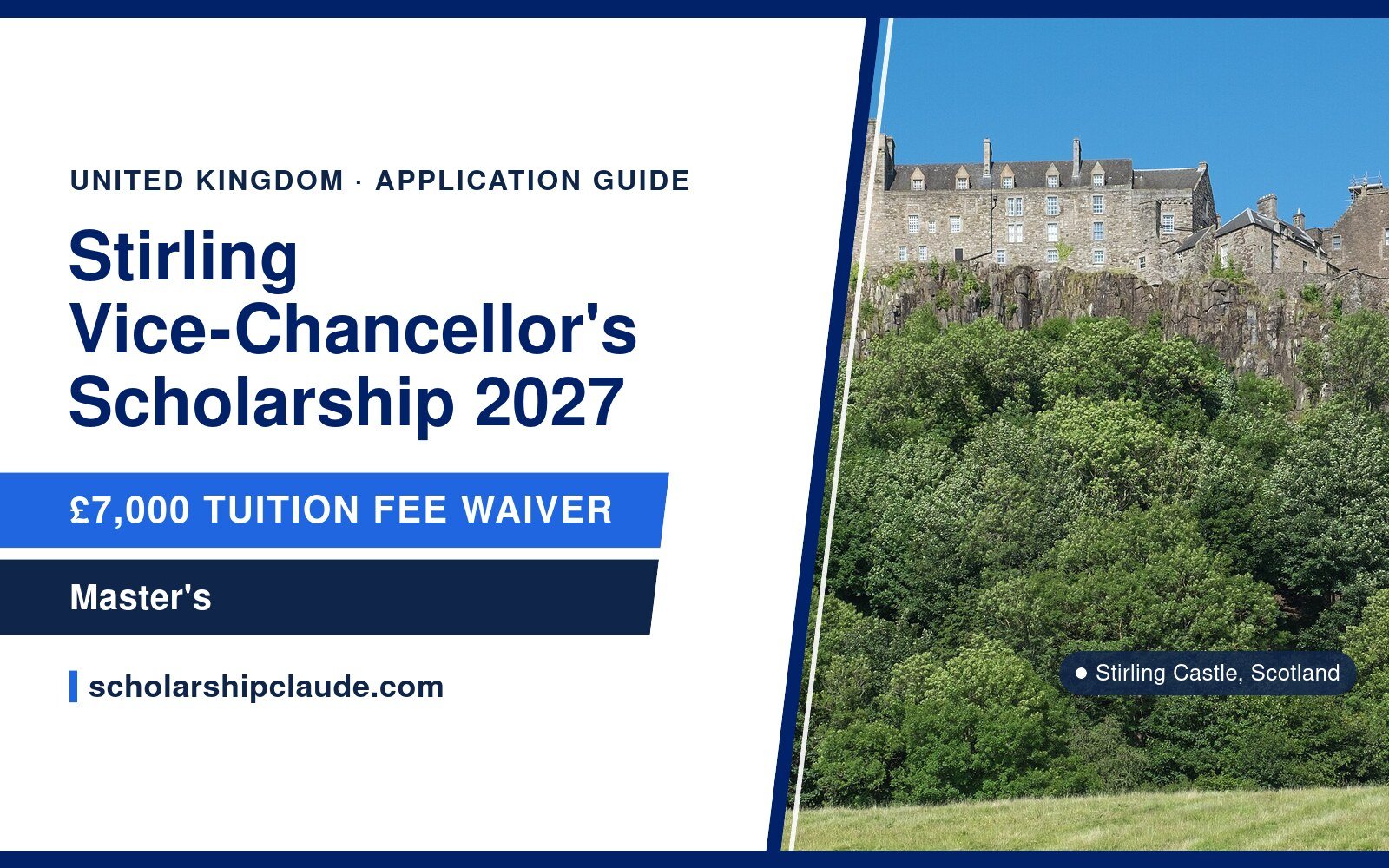
The Vice-Chancellor’s Postgraduate International Scholarship is a £7,000 tuition fee waiver from the University of Stirling in Scotland. It is for new international students who start a full-time taught master’s on the Stirling campus. Students of every nationality can apply. For September 2027 and January 2028 starts, the first funding round closes on 15 December 2026.
This guide was checked on 15 October 2026 against the official University of Stirling scholarship page.
The scholarship at a glance
| Provider | University of Stirling, Scotland, UK |
|---|---|
| Level | Full-time taught master’s on the Stirling campus |
| Value | £7,000 off the tuition fee |
| Who can apply | New students who pay international (including EU) tuition fees, any nationality |
| Intakes | January 2027, September 2027 and January 2028 |
| Offer needed first | Yes, a conditional or unconditional offer |
| Deposit to keep the award | £1,000 |
| Funding type | Partial (tuition only) |
What the scholarship covers
The award is a reduction of £7,000 on your first-year tuition fee. It is not paid to you as cash, and it does not cover living costs, accommodation, flights, visa fees or the Immigration Health Surcharge. You need to show that you can pay the rest of the fee and your living costs from your own money.
Who can apply
- You are a new student starting a full-time taught master’s degree on the Stirling campus.
- You pay tuition fees at the international rate. EU students who pay international fees are included.
- You hold a conditional or unconditional offer for an eligible course. Applications without an offer are not assessed.
- You pay for your own studies. Students with external sponsorship or another scholarship cannot receive it.
These students are not eligible:
- Students on online degrees
- Students moving on from an INTO Pre-Masters course
- Students who would combine it with another Stirling scholarship. If you are offered more than one, you keep the one with the highest value.
The official page does not set a minimum grade for the scholarship itself. Your course still has its own entry requirements, including English.
Funding rounds and closing dates
Stirling assesses applications in rounds. In each round you must apply for the scholarship, already hold your course offer, and later pay the deposit by the date shown.
| Course start | Scholarship application window | Offer held by | Deposit paid by |
|---|---|---|---|
| January 2027 | 1 September to 31 October 2026 | 2 November 2026 | 13 November 2026 |
| September 2027 or January 2028 | 1 September to 15 December 2026 | 21 December 2026 | 1 February 2027 |
| September 2027 or January 2028 | 15 December 2026 to 28 February 2027 | 2 March 2027 | 1 April 2027 |
| September 2027 or January 2028 | 1 March to 30 April 2027 | 3 May 2027 | 1 June 2027 |
| September 2027 or January 2028 | 1 May to 15 June 2027 | 18 June 2027 | 15 July 2027 |
| January 2028 | 16 June to 30 October 2027 | 2 November 2027 | 12 November 2027 |
Stirling says funding for the January 2027 intake is nearly fully allocated. Eligible applicants may be put on a reserve list. If you plan to start in September 2027, apply in the first round, which closes on 15 December 2026.
How to apply, step by step
- Choose a course. Pick a full-time taught master’s that runs on the Stirling campus.
- Apply for the course. Submit your course application to the University of Stirling and wait for your offer.
- Check the round. Use the table above to find the round your offer date fits into.
- Fill in the scholarship form. Use the Vice-Chancellor’s Scholarship application form linked on the official scholarship page.
- Pay the deposit. If you are awarded the scholarship, pay the £1,000 deposit by the date in your offer letter to secure it.
The official page does not mention an essay, a word limit or extra documents for the scholarship form. Read the terms and conditions linked on that page before you submit.
What happens after you apply
Applications are assessed and awards are made as funding becomes available. The university aims to tell every applicant the outcome by 15 July. It advises you to apply for other scholarships in the meantime, because there is no guarantee of an award.
Is it worth applying?
Yes, if Stirling is already one of your choices and you can fund the rest of your study. It is a simple application, there is no separate essay on the official page, and it can reduce your fee by a large amount. It will not, on its own, make a UK master’s affordable if you need full funding. For fully funded options, see our guide to fully funded scholarships in the UK and the Chevening Scholarship.
Tips before you apply
- Apply for your course early. You cannot enter a scholarship round until you hold an offer.
- Have your deposit ready. The award is only secured once the £1,000 deposit is paid by the date given.
- Check your funding status. If an employer, government or other body is paying your fees, you are not eligible.
- Plan your budget for the full year, including living costs, so that your visa application is not delayed.
How much the scholarship is really worth to you
The award is a fixed £7,000 off your first-year tuition fee. How much that helps depends on the fee for your course, which differs between programmes. To see your real cost:
- Find the international tuition fee for your course on its Stirling course page.
- Subtract £7,000. That is the tuition you still pay.
- Add your living costs for the length of the course: rent, food, transport, phone and study materials.
- Add one-off costs such as your visa fee, the Immigration Health Surcharge and your flights.
The total is what you need from savings, family or other funding. Because the award is a fee reduction, not cash, it does not help with living costs at all. If you need those covered, look at fully funded scholarships as well.
Understanding the funding rounds
Stirling assesses applications in rounds rather than all at once. For each round there are three dates: when the scholarship application window closes, the date by which you must already hold your course offer, and the date by which you must pay the deposit if you are awarded. This system rewards applicants who apply early. Funding is limited, and Stirling already says the January 2027 intake is nearly fully allocated, with eligible applicants possibly placed on a reserve list.
For a September 2027 start, the first round closes on 15 December 2026, and you must hold your offer by 21 December 2026. If you are not ready by then, later rounds close on 28 February, 30 April and 15 June 2027. Each later round may have less money left, so aim for the earliest round you can meet.
Getting your course offer in time
You cannot apply for the scholarship until you hold a conditional or unconditional offer. To get your offer before the round you want:
- Apply for your course early. For the 15 December round, aim to submit your course application by October or early November 2026.
- Prepare documents in advance: transcripts, degree certificate or expected graduation letter, references and proof of English as your course requires.
- Answer quickly if the admissions team asks for more information.
- A conditional offer is enough to apply for the scholarship. You can meet the conditions later, before you enrol.
Check your course page for its English requirement and documents. Our guide to conditional and unconditional offers explains what each type means.
The £1,000 deposit
If you are awarded the scholarship, you secure it by paying a £1,000 deposit by the date in your offer letter. If you do not pay by that date, you may lose the award. Plan this money in advance, especially if transferring funds from your country takes time. Read the scholarship terms and conditions linked on the official page for the full rules on the deposit.
Who the scholarship suits
- Self-funded international students who have already chosen Stirling and can pay the rest of the fee and living costs.
- Students on full-time taught master’s courses on the Stirling campus.
- Students who want a simple application: the official page does not mention an essay or extra documents.
It does not suit students who need full funding, students with a sponsor or another scholarship, online students, or students progressing from an INTO Pre-Masters course.
Choosing the right course
The scholarship only applies to full-time taught master’s courses on the Stirling campus, so the first decision is which course. A good choice also makes your application stronger, because a clear fit between your background and the course shows in your personal statement and references.
- Read the module list, not only the course title. Check that the core modules match the skills you want.
- Check the entry requirements for your degree subject, grades and English.
- Look at the start dates. Some courses start in September and January, others only in September.
- Confirm the mode of study. Online and part-time versions are not eligible for this scholarship.
- Think about your career. Look at what graduates of the course go on to do, and whether it supports the job or PhD you want.
Writing a strong course application
Your offer comes first, so your course application deserves care. If your course asks for a personal statement, use it to answer three questions clearly: why this subject, why this course at Stirling, and what you will do afterwards. Give evidence from your degree, projects or work, and avoid general statements about the UK or the university.
For references, choose people who know your academic work and can comment on your ability to succeed at master’s level. Give them your CV and the course details, and ask them early. Our guides to the statement of purpose and recommendation letters explain both in detail.
Money tips for self-funded students
- Allow for exchange-rate changes. If your savings are in another currency, keep a buffer in case the pound rises before you pay.
- Know the work rules. Student visa holders can usually work limited hours during term. Check the current rules before counting on part-time income; our guide to part-time work rules explains the basics.
- Plan for the first month. Rent deposits, a laptop or winter clothing can add up before your first wage or transfer arrives.
- Keep your funding simple. Students with external sponsorship or another scholarship are not eligible for this award, so if you are offered other funding, compare the two and choose the one that helps you most.
Planning your UK student visa
Most international students need a UK Student visa. The general steps are:
- Accept your offer and meet its conditions.
- Receive a Confirmation of Acceptance for Studies (CAS) from the university.
- Show that you can pay your remaining tuition and living costs. UK Visas and Immigration sets the amount of money you must show for living costs, so check the current figure on the official GOV.UK Student visa page.
- Apply online, pay the visa fee and the Immigration Health Surcharge, and attend a biometrics appointment.
The scholarship reduces the tuition you must show, but it does not reduce the living-cost amount. Our guide to student visas explains the process in more detail.
What happens between award and arrival
- Award decision: Stirling assesses each round and makes awards as funding allows, aiming to reply to everyone by 15 July.
- Deposit: pay £1,000 by the date in your offer letter to secure the award.
- Offer conditions: send your final transcripts, degree certificate and English results if your offer was conditional.
- CAS and visa: the university issues your Confirmation of Acceptance for Studies (CAS) once you meet its conditions. Check its CAS rules, then apply for your Student visa as soon as you have the CAS.
- Fees: the award is applied as a £7,000 reduction to your first-year tuition fee. Pay the remaining fee by the dates the university gives you, and keep the payment receipts for your visa application.
- Arrival: plan to arrive in time for orientation at the start of your intake.
A suggested timeline for a September 2027 start
| When | What to do |
|---|---|
| October 2026 | Choose your course; prepare transcripts, references and English test |
| By early November 2026 | Submit your course application |
| November to mid-December 2026 | Receive your offer; fill in the scholarship form |
| 15 December 2026 | First round closes |
| 21 December 2026 | Offer must be held for this round |
| 1 February 2027 | Deposit due if awarded in this round |
| Spring and summer 2027 | Meet offer conditions; get your CAS; apply for your visa |
Checklist before you submit the scholarship form
- Your course is a full-time taught master’s on the Stirling campus.
- You pay international (including EU) tuition fees.
- You hold a conditional or unconditional offer.
- You are self-funded, with no sponsor or other scholarship.
- You know which round your offer date fits and its deposit date.
- You have read the terms and conditions on the official page.
- You have the £1,000 deposit ready if awarded.
Common mistakes to avoid
- Applying for the scholarship before you have an offer.
- Waiting for a later round when the first round would have been possible.
- Missing the deposit date after being awarded.
- Applying while holding an external sponsorship or another scholarship.
- Treating the award as cash or as help with living costs.
Other UK funding to look at
If you need more than a fee reduction, compare fully funded options such as the Commonwealth Scholarships for eligible countries, the Gates Cambridge Scholarship and the Rhodes Scholarship. Our guide to scholarships in the UK lists more, with their closing dates. Many have early deadlines, so check them now.
Frequently asked questions
Is the Stirling Vice-Chancellor’s Scholarship fully funded?
No. It is a £7,000 reduction in tuition fees. It does not pay living costs or travel.
Which countries can apply?
All nationalities, as long as you pay international (including EU) tuition fees.
What is the closing date?
For September 2027 and January 2028 starts, the first round closes on 15 December 2026. Later rounds close on 28 February, 30 April and 15 June 2027.
Do I need an offer before I apply?
Yes. Applications without a valid conditional or unconditional offer are not assessed.
Can I combine it with another scholarship?
No. It cannot be combined with other Stirling scholarships, and students with external sponsorship or other scholarships are not eligible.
Can PhD or online students apply?
No. It is only for full-time taught master’s students on the Stirling campus.
Is there an essay for the scholarship?
The official page does not mention an essay, word limit or extra documents. Read the terms and conditions linked there before you submit.
When will I know if I have won?
Stirling aims to tell every applicant the outcome by 15 July. Awards are made as funding becomes available.
What if I get more than one Stirling scholarship?
You cannot combine them. If you are offered more than one, you keep the one with the highest value.
Does the scholarship apply to my second year?
The award is a reduction on your first-year tuition fee for a taught master’s. Most taught master’s courses in the UK last one year, but check your course length and the terms and conditions if your course is longer.
Where to apply
Apply through the official Vice-Chancellor’s Postgraduate International Scholarship page. Our Stirling scholarship page keeps the key facts and closing dates in one place.
Scholarships with the nearest deadlines
| Scholarship | Funding | Stipend | Deadline |
|---|---|---|---|
| US–Pakistan Knowledge Corridor PhD Scholarships 2027 | Fully funded | Not stated on HEC's programme page (see the HEC advertisement) | 30 Oct 2026 |
| Honjo International Scholarship 2027 in Japan | Partial | 230,000 yen a month (degree of 1 to 2 years), 210,000 yen a month (3-year degree) or 180,000 yen a month (degree longer than 3 years) | 31 Oct 2026 |
| European Parliament Schuman Traineeships 2027 | Partial | Monthly grant paid; amount not stated on the official source | 31 Oct 2026 |
| University of Melbourne Graduate Research Scholarships 2027 in Australia | Fully funded | 41,100 Australian dollars a year (2027 rate), plus a full fee offset | 31 Oct 2026 (expected) |
| Australian Government RTP Scholarships 2027 in Australia | Fully funded | 2027 full-time RTP stipend: base rate 35,550 Australian dollars a year, maximum 55,537 Australian dollars a year | 31 Oct 2026 (expected) |
| DAAD EPOS Scholarship 2027/28 in Germany | Fully funded | 992 euros a month for graduates; 1,400 euros a month for doctoral candidates | 31 Oct 2026 (expected) |
| One Young World Leading Scholarship 2026 in South Africa | Partial | See the scholarship page | 31 Oct 2026 |
| UNU Junior Fellows Internship 2027 in Tokyo, Japan | Partial | Monthly stipend; amount not stated on the official source | 1 Nov 2026 |
| Open Doors Russian Scholarship Project 2026–27 in Russia | Partial | Tuition-free study; a monthly allowance is possible only with grant support for Russian-taught programmes | 1 Nov 2026 |
| Max Planck Computer Science Summer Internships 2027 in Germany | Fully funded | Monthly stipend (amount not stated on the official source) | 1 Nov 2026 |
This list updates itself from our scholarships page. Stipend figures are shown where the provider publishes them. See all scholarships.