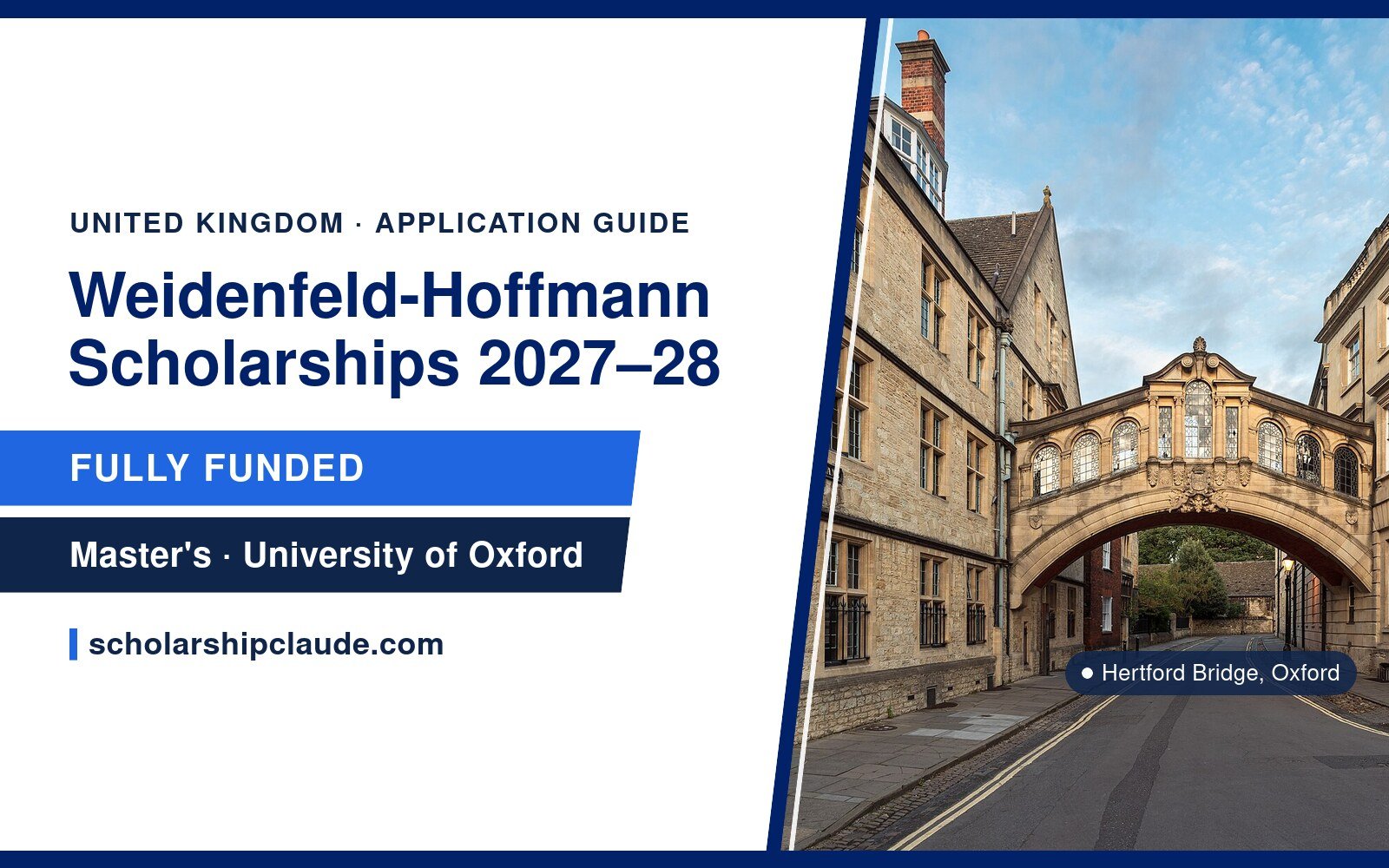
The Weidenfeld-Hoffmann Scholarships and Leadership Programme pays 100% of course fees and a living grant of at least £21,805 for selected master’s students at the University of Oxford. It is for graduates and professionals from eligible countries who could not otherwise afford Oxford and who plan to return home after their studies. There is no single closing date: you apply through Oxford’s graduate application by the December or January deadline of your course.
This guide was checked on 17 October 2026 against the University of Oxford’s Weidenfeld-Hoffmann Scholarships and Leadership Programme page for 2027–28 entry.
Weidenfeld-Hoffmann Scholarships at a glance
| University | University of Oxford, United Kingdom |
|---|---|
| Level | Full-time graduate courses on the eligible list (master’s level, including the MBA, BCL, MPP and selected MSc and MSt courses) |
| Covers | 100% of course fees and a living grant of at least £21,805 |
| Length | Full duration of fee liability for the agreed course |
| Who can apply | People ordinarily resident in an eligible country who plan to return there after the course |
| How to apply | Select the scholarship in the Oxford graduate application form and upload the Weidenfeld-Hoffmann Scholarships Statement |
| Closing date | Your course’s December 2026 or January 2027 deadline |
| Interviews | Likely online in April 2027, for shortlisted candidates |
| Decisions | Expected by the end of May 2027 |
What is the Weidenfeld-Hoffmann Scholarship?
The Weidenfeld-Hoffmann Scholarships and Leadership Programme supports outstanding university graduates and professionals who would not otherwise be able to fund their study at Oxford. It focuses on people who want to improve public life in their own countries or at a wider regional or international level. Applicants must intend to return to their country of ordinary residence after their course.
As its full name shows, the scholarship is linked to a leadership programme. The Oxford page we checked focuses on funding and eligibility, and it does not describe the leadership activities in detail.
What the scholarship covers
- Course fees: 100% of your course fees.
- Living costs: a grant of at least £21,805.
- Length: the full duration of your fee liability for the agreed course.
Because both fees and living costs are covered, this is a fully funded scholarship. Plan for costs outside the scholarship that the page does not mention, such as your visa application and travel to the UK, and check with Oxford if you are selected.
Who can apply
- You must be applying to start a new full-time graduate course at Oxford in 2027–28.
- Your course must be on the eligible course list.
- You must be ordinarily resident in an eligible country. Refugees and displaced applicants who declared this status in their application can be considered if their nationality meets the country criteria.
- You should intend to return to your country of ordinary residence when your course is completed.
- You must be able to show a connection between your subject and your longer-term career goals.
- You must be offered a place after the December or January deadline review.
Who cannot apply
- People who hold a deferred offer to start at Oxford in 2027–28.
- Current Oxford students, unless they are already Weidenfeld-Hoffmann scholars.
- Applicants whose course application is held over to the March deadline or put on a waiting list.
Eligible countries
The official page lists the eligible countries and territories, from Afghanistan to Zimbabwe, across every region of the world. Examples on the list include Bangladesh, Brazil, China, India, Kenya, Mexico, Nigeria, Pakistan and Ukraine. The rule is based on where you are ordinarily resident. Check the full list on the official page before you apply.
Eligible courses for 2027–28
Only the courses below are eligible. Check each course’s own page for entry requirements and deadlines.
| Area | Eligible courses |
|---|---|
| Law | BCL; MJur; MSc Law and Finance; MSc Criminology and Criminal Justice |
| Business and economics | MBA; MSc Financial Economics; MSc Economics for Development |
| Public policy and government | MPP; MSt Diplomatic Studies; MSc Global Governance and Diplomacy; MSc Comparative Social Policy; MSc Evidence-Based Social Intervention and Policy Evaluation |
| Area studies | MSc African Studies; MSt Asian and Middle Eastern Studies; MSc Contemporary Chinese Studies; MSc Latin American Studies; MSc Modern Middle Eastern Studies; MSc Modern South Asian Studies; MSc Russian and East European Studies; MSt Islamic Studies and History; MSt Jewish Studies |
| Migration and society | MSc Migration Studies; MSc Refugee and Forced Migration Studies |
| Health | MSc Clinical and Therapeutic Neuroscience; MSc Global Health Science and Epidemiology; MSc Health Service Improvement and Evaluation; MSc International Health and Tropical Medicine |
| Environment and energy | MSc Biodiversity, Conservation and Nature Recovery; MSc Energy Systems; MSc Environmental Change and Policy; MSc Nature, Society and Environmental Governance; MSc Sustainability, Enterprise and the Environment; MSc Water Science, Policy and Management |
| Education | MSc Education (Comparative and International Education); MSc Education (Digital and Social Change); MSc Education (Higher Education) |
| Data, computing and mathematics | MSc Advanced Computer Science; MSc Social Data Science; MSc Social Science of the Internet; MSc Mathematical Modelling and Scientific Computing |
The grouping into areas is ours, to make the list easier to read. The course names are as listed on the official page.
How to apply, step by step
- Check your country and course. Make sure you are ordinarily resident in an eligible country and that your chosen course is on the list.
- Find your course deadline. Each Oxford course page states whether its deadline is in December or January. Note the exact date.
- Prepare your course application. Gather everything your course asks for, such as transcripts, references, a CV and any written work or statement.
- Write the Weidenfeld-Hoffmann Scholarships Statement 2027/28. This is a separate document that you upload with your application.
- Select the scholarship in the form. In the University of Oxford Scholarships section of the graduate application form, select the Weidenfeld-Hoffmann Scholarships and Leadership Programme.
- Submit by your course’s December or January deadline.
- Prepare for an interview. Shortlisted candidates are likely to be interviewed online in April 2027.
Writing the Weidenfeld-Hoffmann Scholarships Statement
The statement is the part of the application that is written only for this scholarship. The official page says it should explain how your professional work could contribute to improving public life in your country of origin, or at a wider regional or international level. Download the 2027/28 statement form from the official page and follow its instructions and any word limit it sets.
A clear structure helps:
- The problem. Name one public issue in your country that your work addresses, such as access to clean water, financial inclusion, refugee protection or health services.
- Your record. Show what you have already done about it, with real results from your studies, work or volunteering.
- The course. Explain what your Oxford course will give you that you cannot get at home, such as specific methods, knowledge or networks.
- Your plan. Describe what you will do when you return, and how it improves public life. Be specific about the role and the first steps.
An invented example paragraph
The paragraph below is invented to show the level of detail. Do not copy it.
“For four years I have worked with a city water utility on billing for informal settlements, where many households pay several times more for water bought from vendors. Our pilot of shared metered taps reached about 3,000 homes, but I lack the policy and economics tools to design a city-wide tariff. The MSc Water Science, Policy and Management would let me study tariff design and regulation, and on my return I plan to lead a tariff reform proposal for our regulator.”
Notice that it links a real problem, a measured result, a gap in skills, a specific course and a concrete plan after Oxford.
Questions to answer before you write
Before you draft the statement, write short answers to these questions. They will give you the raw material for a focused statement.
- Which public problem in my country do I care about most, and why?
- What have I already done about it, and what changed as a result?
- What exactly is stopping me from doing more right now: knowledge, skills, networks or credentials?
- How does my chosen Oxford course fill that gap?
- What role will I take on when I return, and what will I do in my first two years?
- How will the benefit reach people beyond me and my employer?
If you cannot answer one of these clearly, spend more time on it before you start writing. Vague answers usually lead to a vague statement.
How the scholarship is decided
- Your graduate application form, your Weidenfeld-Hoffmann Scholarships Statement and, where relevant, an interview are used to assess you.
- You must first be offered a place on your course after the December or January deadline review.
- Shortlisted candidates are likely to be interviewed online in April 2027.
- Decisions are expected by the end of May 2027.
- Unsuccessful applicants are not contacted individually, and feedback is not provided. If you hear nothing by then, assume you were not selected.
Preparing for the interview
If you are shortlisted, expect questions about your career so far, why you chose your course and how you will use it when you return home. Interviewers may also ask about leadership and public service. Practise explaining your plan in two minutes, and prepare one or two examples of times you led a team or solved a hard problem. Our scholarship interview tips cover common questions and how to answer them.
Choosing the right eligible course
The scholarship can fund only the courses on the eligible list, so your course choice matters twice: for admission and for the scholarship. Choose the course that best connects your past work with the public problem you want to solve.
- Start from your goal. If you want to reform health services, look first at the health courses. If you work on public budgets or regulation, look at economics, policy and law.
- Read the course page closely. Check the entry requirements, the teaching, the length and what the course asks you to submit.
- Check the deadline. Some courses close in December and others in January. Missing your course’s deadline also means missing the scholarship.
- Be realistic. Oxford courses are competitive. Choose a course where your degree and experience clearly meet the entry requirements.
Making your Oxford course application strong
You must be offered a place before you can receive the scholarship, so the course application comes first. Each course sets its own requirements. In general, focus on:
- Academic record. Upload complete transcripts and meet the course’s minimum grade requirement.
- References. Choose referees who know your academic or professional work in depth. Our guide on strong recommendation letters explains how to brief them.
- Statement of purpose or written work. If your course asks for one, keep it focused on the course. Save your public-life plans for the Weidenfeld-Hoffmann statement, so the two documents do not repeat each other. Our statement of purpose guide can help.
- CV. Show your professional experience clearly, with dates and results. Our academic CV template shows a clear layout.
Is the Weidenfeld-Hoffmann Scholarship right for you?
It is a strong fit if you live in an eligible country, you have a clear plan to improve public life there, your chosen Oxford course is on the eligible list, and you could not afford Oxford without a full scholarship. It is less suitable if your plans focus on a career abroad, because the programme expects you to intend to return to your country of ordinary residence.
If you are not selected
Many strong candidates are not selected, because there are far more applicants than scholarships. If you receive an Oxford offer without this scholarship, check whether you are being considered for other Oxford funding, and look at UK government scholarships such as Chevening and Commonwealth Scholarships. If you plan to apply again in a later year, read the rules for that year carefully, including the rule on deferred offers. Our guide on finding fully funded scholarships lists other ways to search.
The Chevening-Weidenfeld-Hoffmann route
The official page says there are also Chevening-Weidenfeld-Hoffmann Scholarships. These need a separate application through the Chevening website, with Oxford as your first-preference university. The Chevening application has its own rules and dates, so read our Chevening page and Chevening guide if you are interested. Oxford also says that applying for the Weidenfeld-Hoffmann Scholarship means you agree to be considered for its partner schemes, which are managed separately.
Weidenfeld-Hoffmann and other Oxford funding
Oxford has many other scholarships, and for most of them there is no separate application: you are considered when you apply for your course by the December or January deadline. Our Oxford scholarships page explains how this works, including the Clarendon Fund. The Weidenfeld-Hoffmann Scholarship is different because you must select it in the form and upload its own statement.
A suggested timeline
| When | What to do |
|---|---|
| Now to November 2026 | Check your country and course, find your course deadline, ask your referees, and draft your statement. |
| December 2026 or January 2027 | Submit your Oxford course application with the scholarship selected and the statement uploaded, by your course’s deadline. |
| Early 2027 | Oxford reviews course applications. You must be offered a place after the December or January review. |
| April 2027 | Shortlisted candidates are likely to be interviewed online. |
| By the end of May 2027 | Decisions are expected. |
Common mistakes to avoid
- Applying for a course that is not on the eligible list.
- Forgetting to select the scholarship in the University of Oxford Scholarships section of the form.
- Not uploading the Weidenfeld-Hoffmann Scholarships Statement.
- Missing your course’s December or January deadline and applying at the March deadline instead.
- Writing a statement about personal ambition without a clear link to public life in your country.
- Applying with a deferred offer for 2027–28.
Checklist before you submit
- My country of ordinary residence is on the eligible list.
- My course is on the eligible list, and I know its December or January deadline.
- I intend to return to my country after the course.
- My statement links my work to improving public life.
- I have selected the scholarship in the application form.
- My references and course documents are complete.
Frequently asked questions
Is the Weidenfeld-Hoffmann Scholarship fully funded?
Yes. It covers 100% of course fees and gives a living grant of at least £21,805, for the full duration of fee liability for your course.
What is the deadline?
It depends on your course. Submit your Oxford course application by the December or January deadline shown on your course page.
Do I need a separate application?
You select the scholarship in the graduate application form and upload the Weidenfeld-Hoffmann Scholarships Statement. The Chevening-Weidenfeld-Hoffmann route needs a separate Chevening application.
Can I apply for any Oxford course?
No. Only the courses on the eligible list can be funded.
Do I have to return home?
You should intend to return to your country of ordinary residence after your course.
When will I hear back?
Interviews are likely in April 2027 and decisions are expected by the end of May 2027. Unsuccessful applicants are not contacted.
Can current Oxford students apply?
No, unless they are already Weidenfeld-Hoffmann scholars.
Is there an English test requirement?
The scholarship page does not set a separate requirement. Your Oxford course’s English language requirement applies.
Is the scholarship only for people from low-income countries?
The rule is about being ordinarily resident in a country on the official eligible list. Check the list rather than guessing.
Can I apply for Chevening and Weidenfeld-Hoffmann at the same time?
The Chevening-Weidenfeld-Hoffmann route needs a separate Chevening application with Oxford as your first preference. Read both sets of rules carefully before you apply to both.
Where to apply
Read the full rules, the eligible country list and the statement form on the official Oxford Weidenfeld-Hoffmann page. Our Weidenfeld-Hoffmann Scholarships page keeps the key facts in one place, and our guide to scholarships in the UK lists other options.
Scholarships with the nearest deadlines
| Scholarship | Funding | Stipend | Deadline |
|---|---|---|---|
| US–Pakistan Knowledge Corridor PhD Scholarships 2027 | Fully funded | Not stated on HEC's programme page (see the HEC advertisement) | 30 Oct 2026 |
| Honjo International Scholarship 2027 in Japan | Partial | 230,000 yen a month (degree of 1 to 2 years), 210,000 yen a month (3-year degree) or 180,000 yen a month (degree longer than 3 years) | 31 Oct 2026 |
| European Parliament Schuman Traineeships 2027 | Partial | Monthly grant paid; amount not stated on the official source | 31 Oct 2026 |
| University of Melbourne Graduate Research Scholarships 2027 in Australia | Fully funded | 41,100 Australian dollars a year (2027 rate), plus a full fee offset | 31 Oct 2026 (expected) |
| Australian Government RTP Scholarships 2027 in Australia | Fully funded | 2027 full-time RTP stipend: base rate 35,550 Australian dollars a year, maximum 55,537 Australian dollars a year | 31 Oct 2026 (expected) |
| DAAD EPOS Scholarship 2027/28 in Germany | Fully funded | 992 euros a month for graduates; 1,400 euros a month for doctoral candidates | 31 Oct 2026 (expected) |
| One Young World Leading Scholarship 2026 in South Africa | Partial | See the scholarship page | 31 Oct 2026 |
| UNU Junior Fellows Internship 2027 in Tokyo, Japan | Partial | Monthly stipend; amount not stated on the official source | 1 Nov 2026 |
| Open Doors Russian Scholarship Project 2026–27 in Russia | Partial | Tuition-free study; a monthly allowance is possible only with grant support for Russian-taught programmes | 1 Nov 2026 |
| Max Planck Computer Science Summer Internships 2027 in Germany | Fully funded | Monthly stipend (amount not stated on the official source) | 1 Nov 2026 |
This list updates itself from our scholarships page. Stipend figures are shown where the provider publishes them. See all scholarships.